Apprentice guides
The method behind a cable size, worked through step by step with the numbers shown.
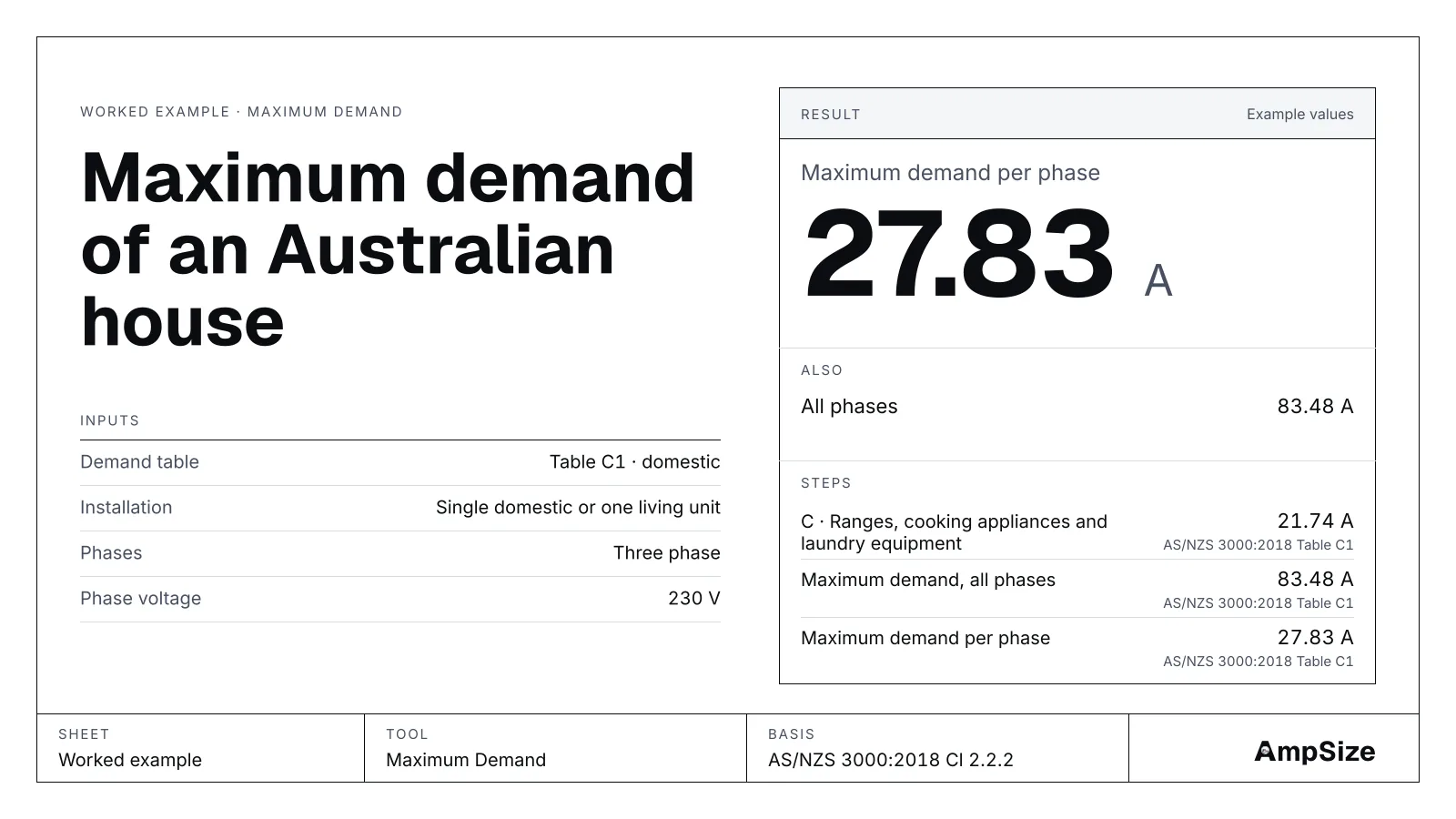
- 4 min readMaximum demand of an Australian house, Table C1A three-phase Australian house assessed with AS/NZS 3000 Table C1, group by group, giving 27.83 A per phase, then sized to the consumer mains on 3008.1.1:2025.
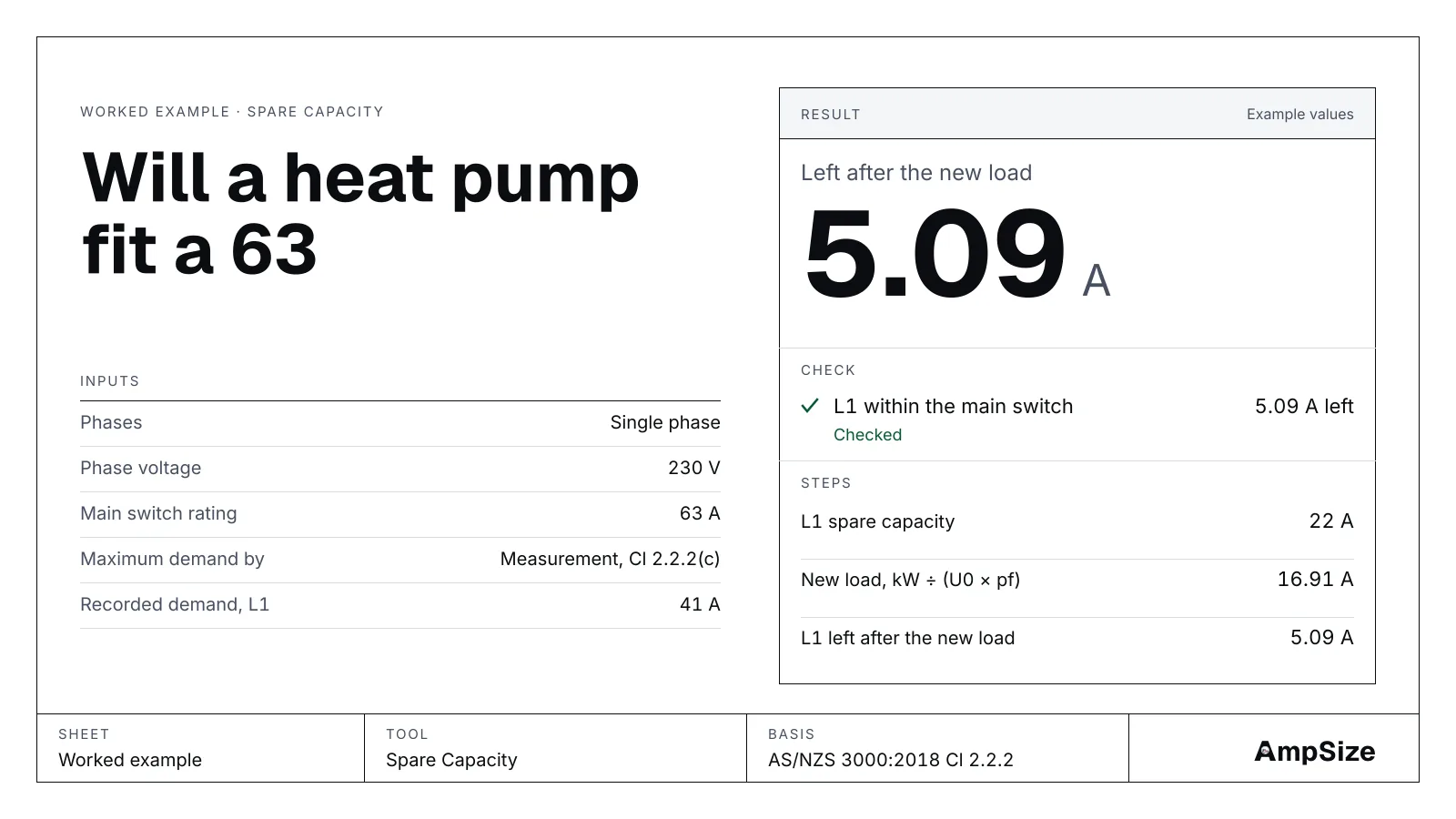
- 3 min readWill a heat pump fit a 63 A supply?Check if a 3.5 kW heat pump fits a house with a 63 A main switch. Find the maximum demand by measurement, then cross-check it by limitation, per AS/NZS 3000.
- 5 min readWorked examples index by tool and tradeEvery AmpSize worked example in one place, grouped by calculator and tagged with the trade it was written for, from house circuits to industrial boards.

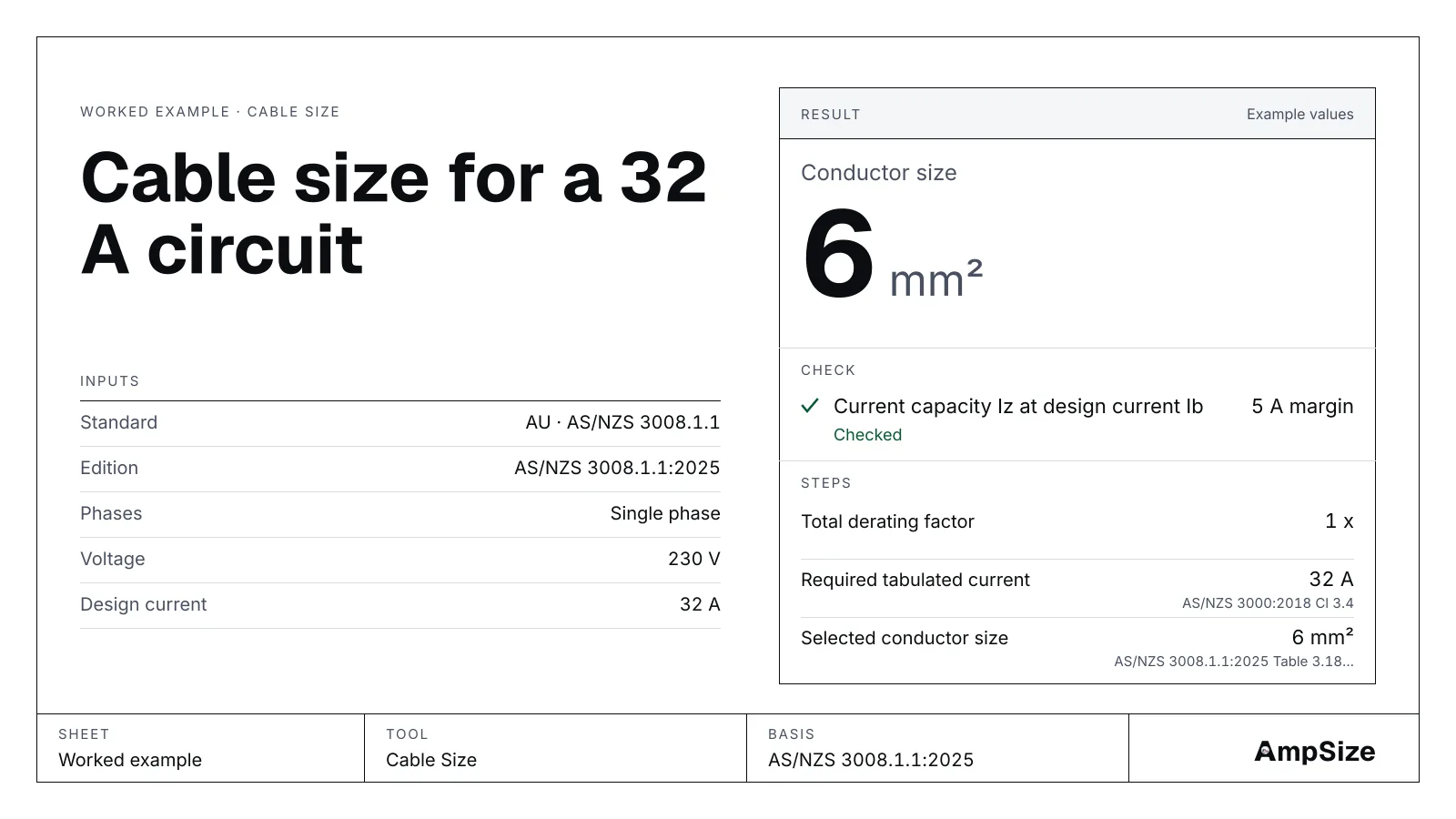
- 4 min readCable size for a 32 A circuit, Australia 2025A 32 A single-phase circuit run 25 m at 40 °C, sized on AS/NZS 3008.1.1:2025 and checked against the 2017 edition, with the voltage drop and the next size up.
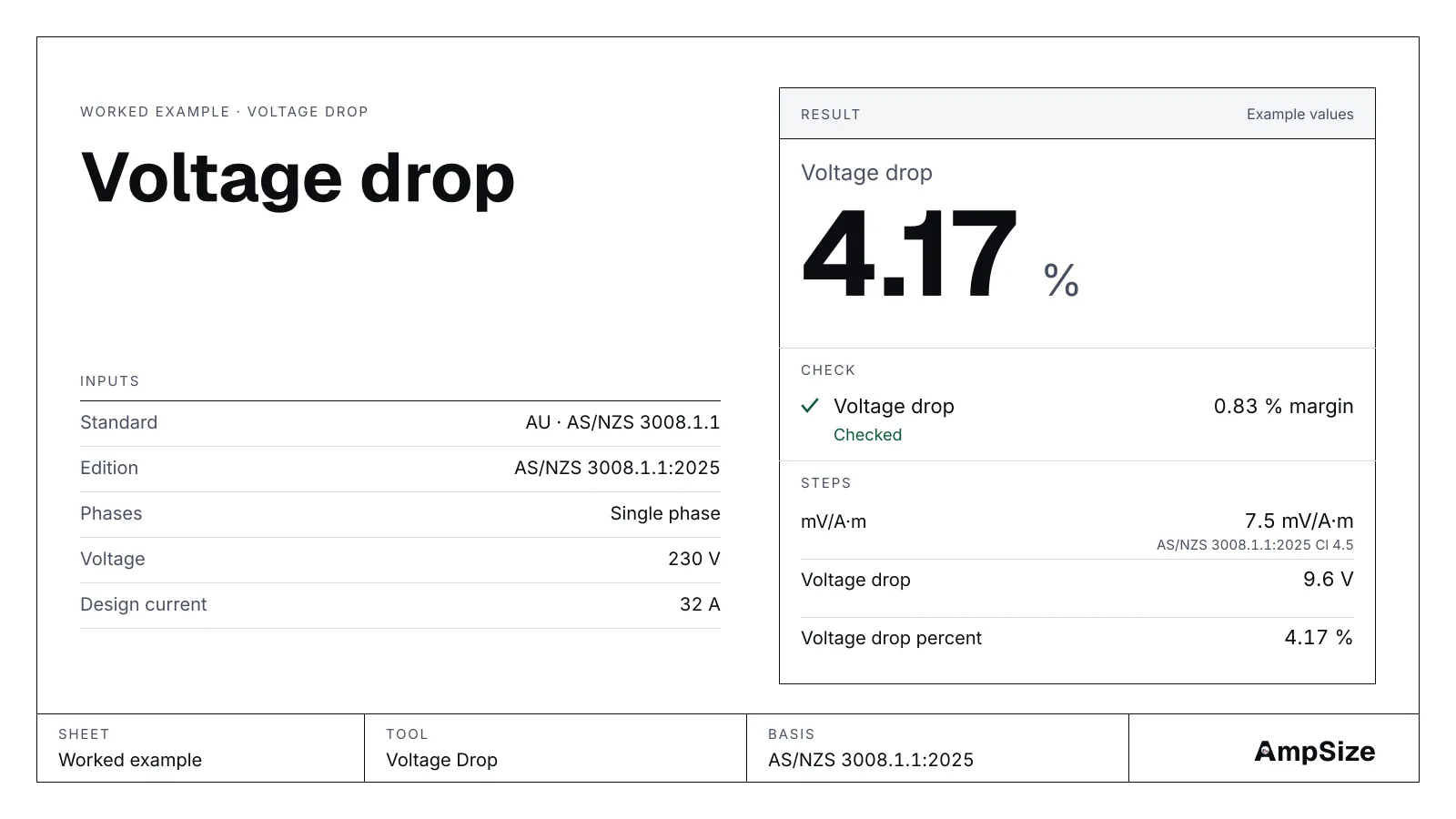
- 4 min readVoltage drop for AS3000 on a 2025 runA 32 A single-phase run of 40 m, checked for voltage drop with the mV/A·m values of AS/NZS 3008.1.1:2025 against the 5 % limit, in copper and aluminium.
- 3 min readElectricity Safety Regulations: reg 57 and 59What reg 57 and reg 59 of the Electricity (Safety) Regulations 2010 govern, and a house that reaches 100.26 A and crosses the reg 59(1) threshold of 80 A.
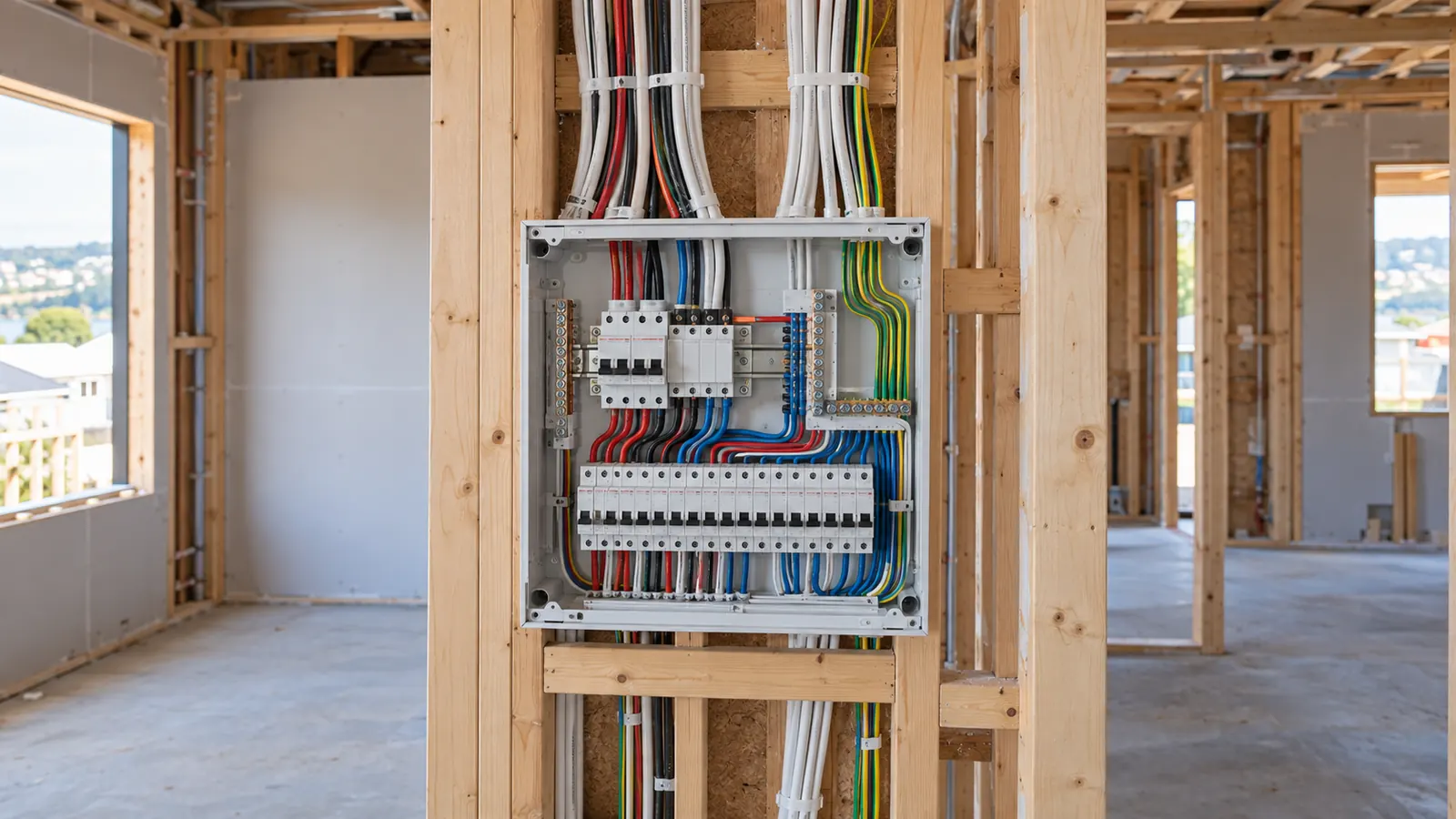
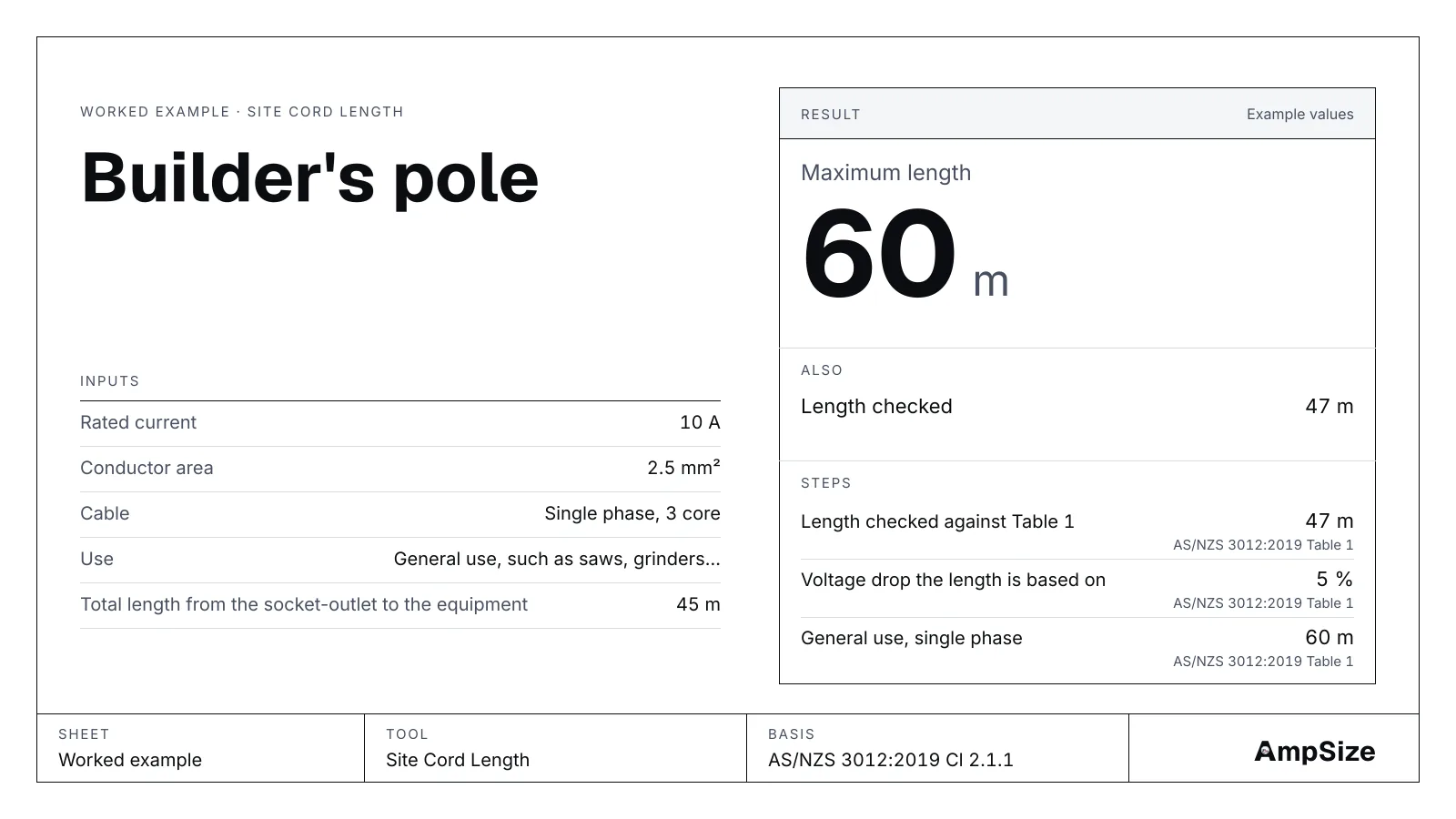
- 5 min readBuilder's pole: supply, RCDs and cord lengthsA builder's pole for a house build, worked to AS/NZS 3012:2019. The supply it may take, the 30 mA RCDs, the Table 1 cord lengths and the test intervals.
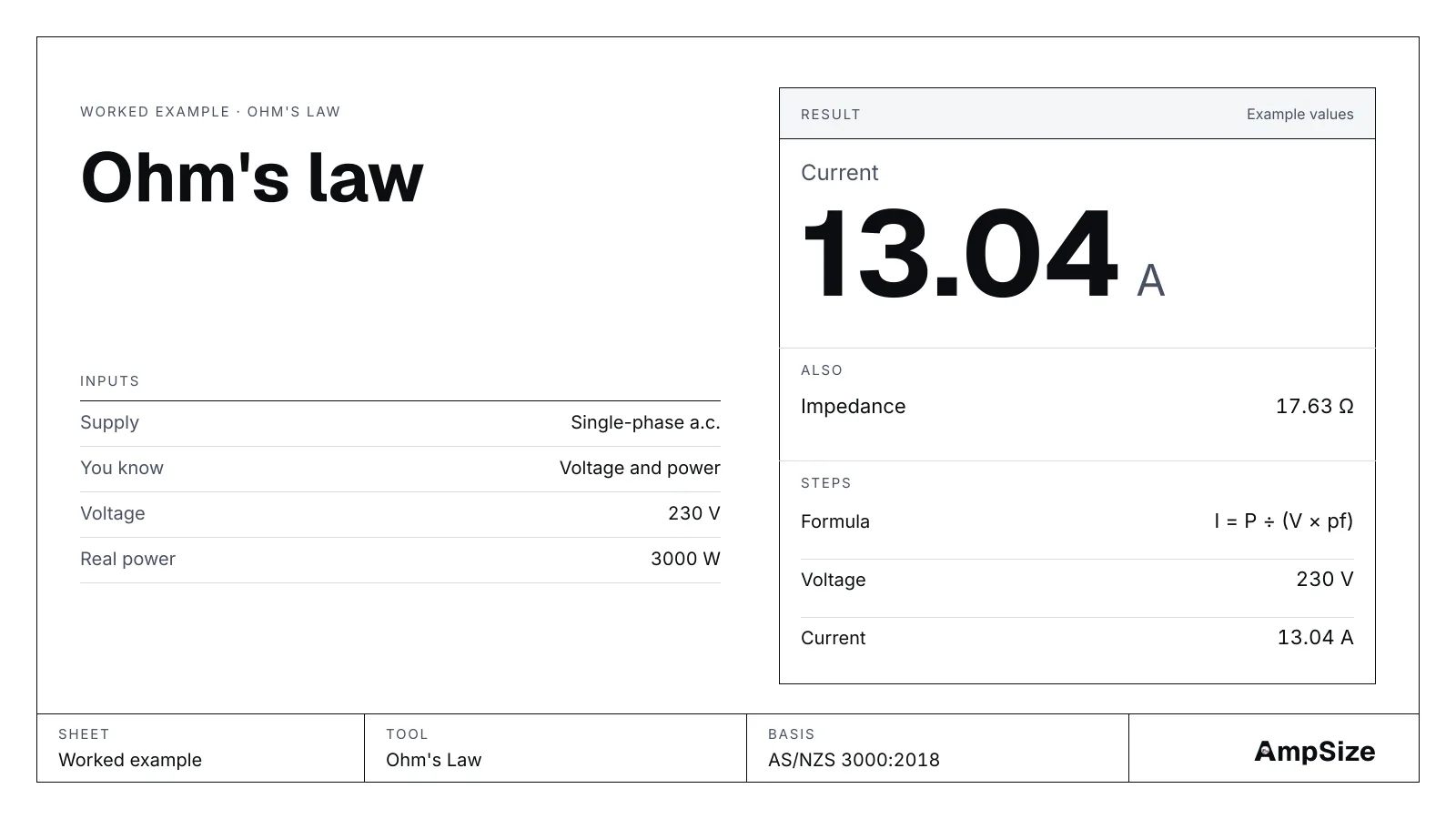
- 5 min readOhm's law on a 3 kW water heater elementWork the current and working resistance of a 3 kW, 230 V water heater element with Ohm's law, why a cold meter reading is lower, then a 9 kW three-phase bank.
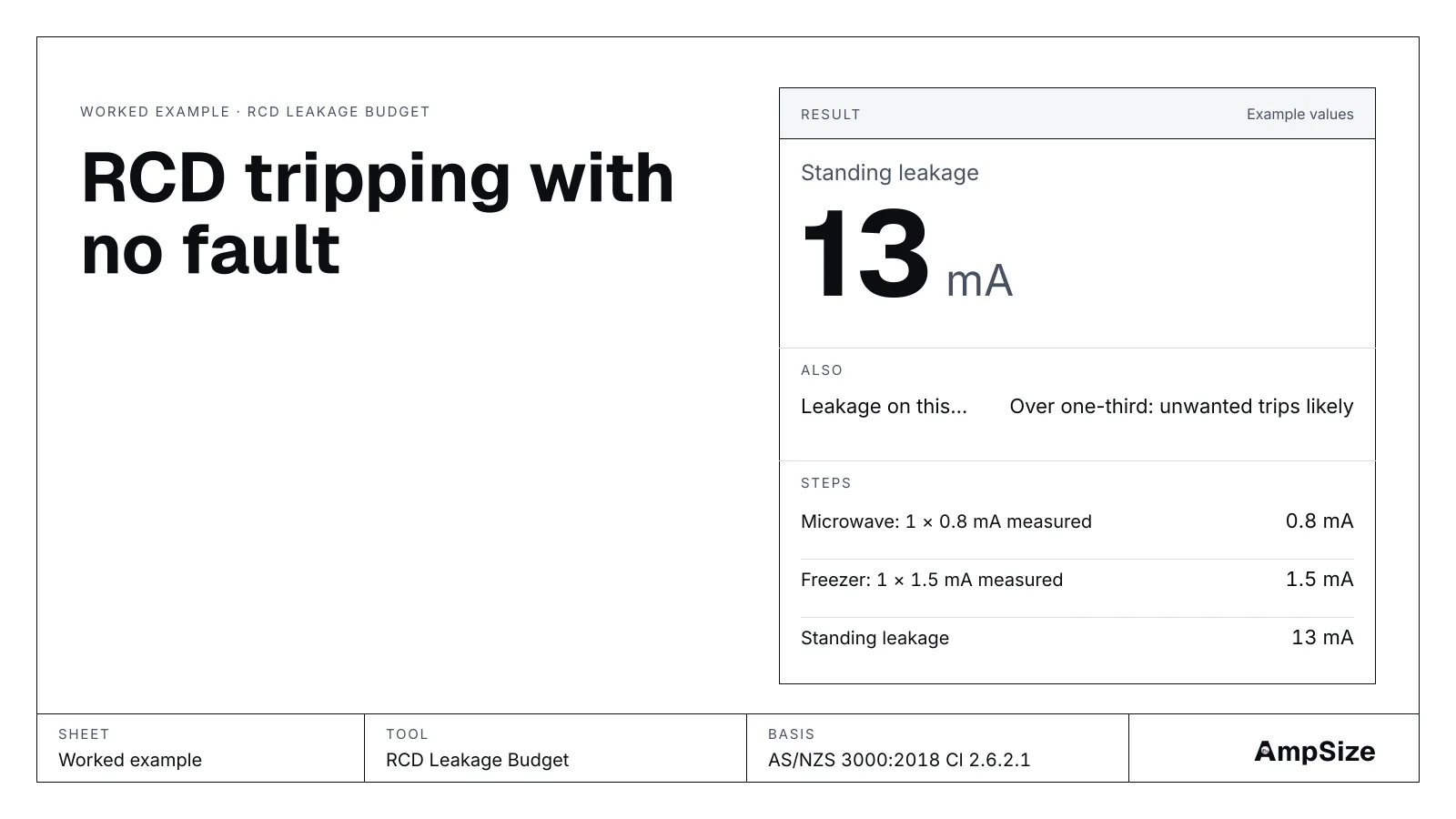
- 5 min readRCD tripping with no fault: add up the leakageAn RCD on a home office and kitchen trips with no fault found. Add up the standing leakage, check it against a third of 30 mA, and split it over two RCDs.
- 3 min readVoltage drop single phase vs three phaseThe same 6 mm² cable at 32 A over 50 m, worked on a three phase supply and on a single phase supply, with both drops, both percents and both run limits.
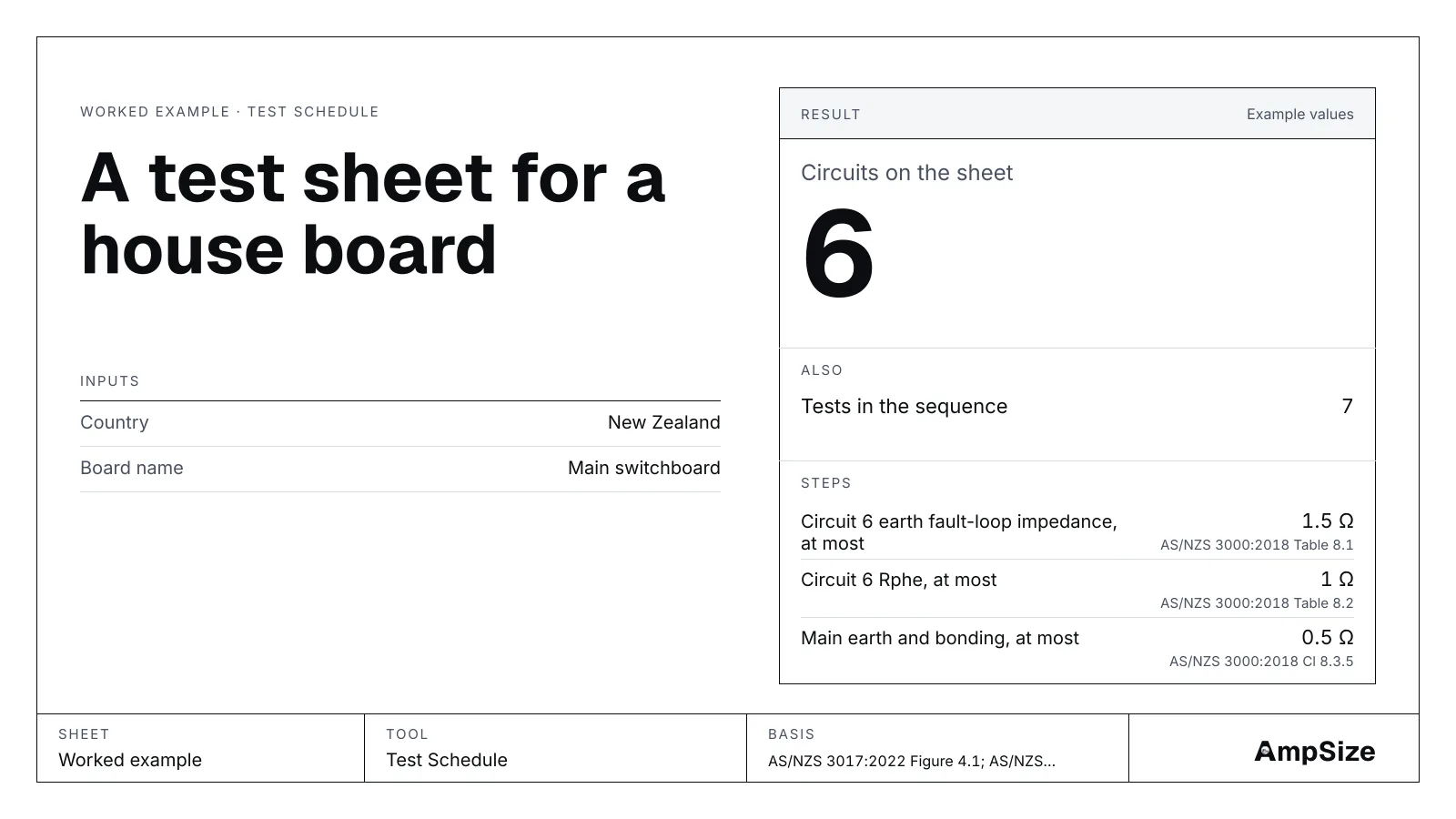
- 3 min readA test sheet for a house boardA test sheet for a six-circuit New Zealand house board, with the tests in the AS/NZS 3017 order and the limit for each reading, then the Australian sheet.
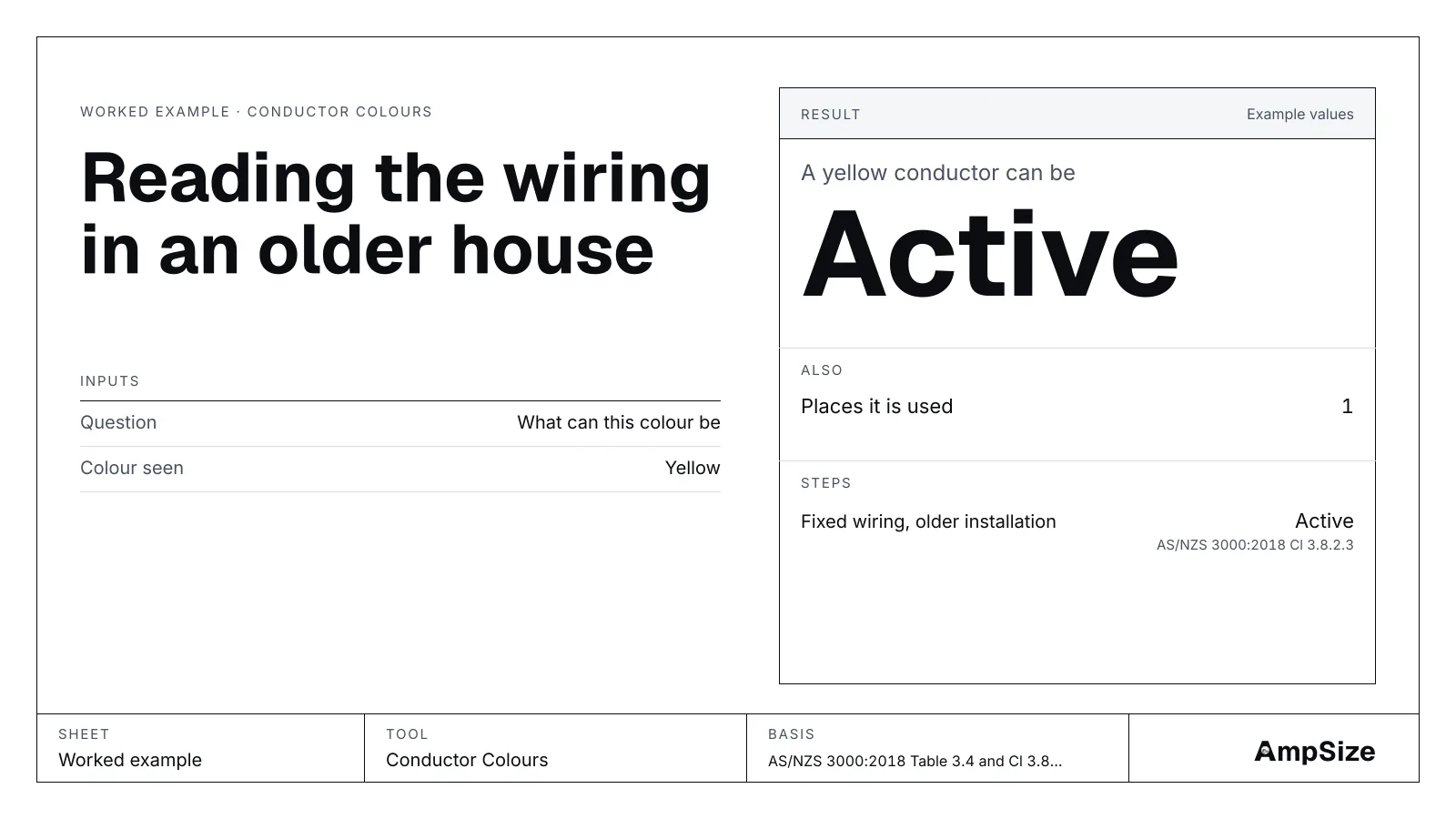
- 3 min readReading the wiring in an older houseA 1970s New Zealand house with yellow actives, a green earth and a black neutral. What each colour can be, what may stay, and how to sleeve new terminations.
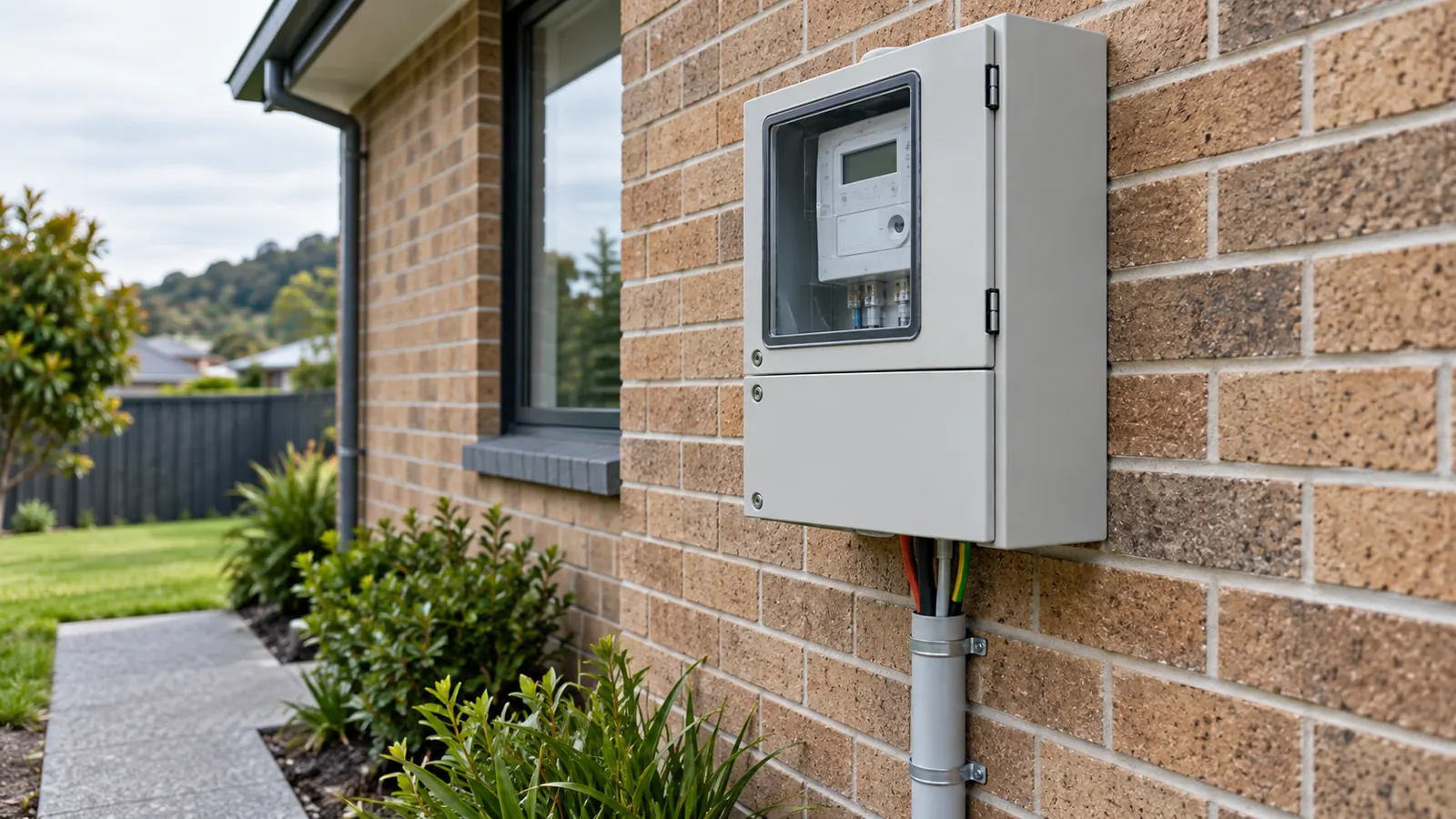
- 4 min readConsumer mains fault withstand for 16 mm² copperA domestic 6 kA fault cleared in 10 milliseconds against 16 mm² copper PVC mains, giving a 5.41 mm² minimum size and a 17.76 kA adiabatic withstand.
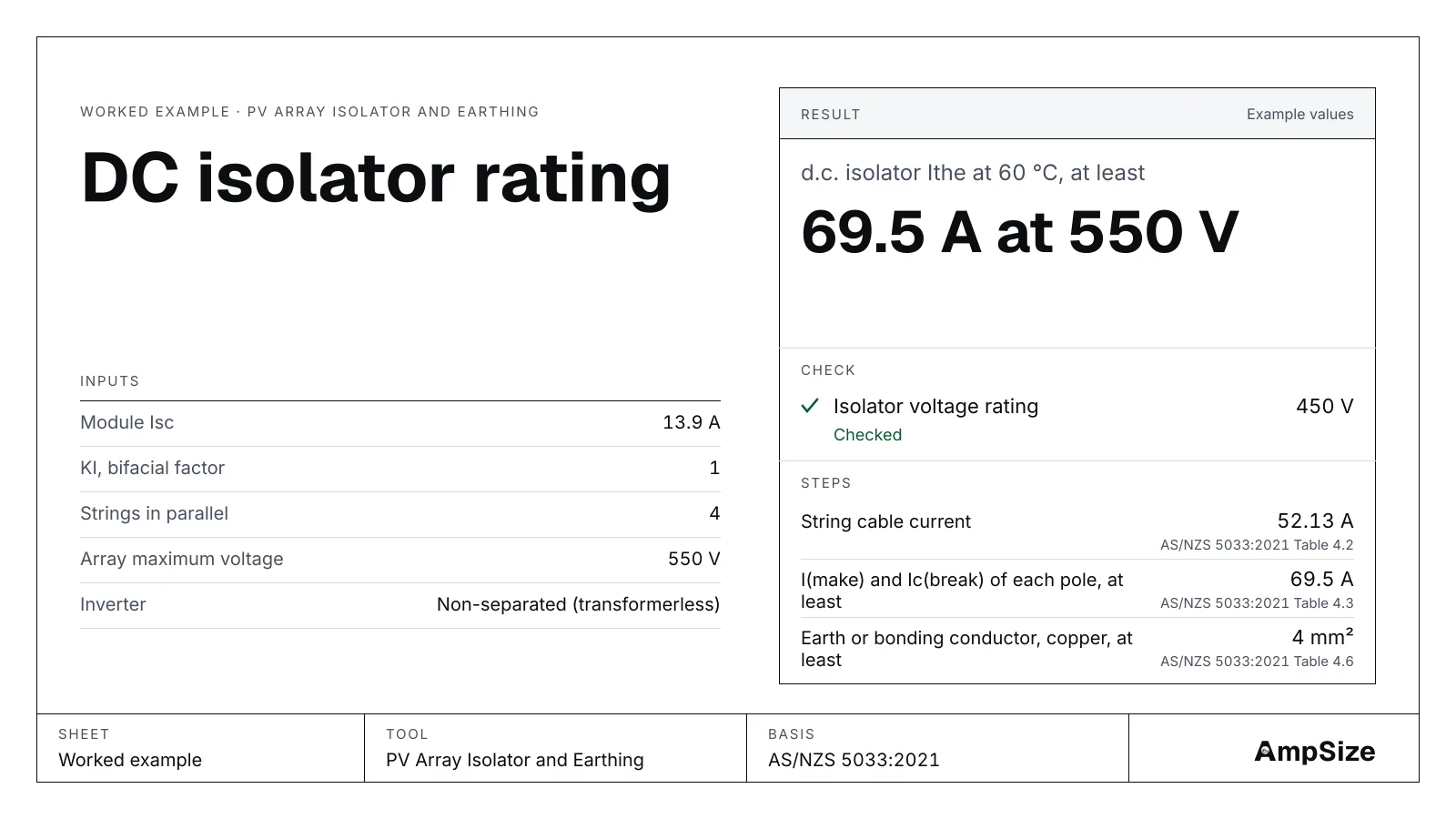
- 3 min readDC isolator rating for a 10 kW solar arrayRate the d.c. isolator and size the frame earth for a four-string domestic array. Check one data sheet that passes and one that fails per pole.
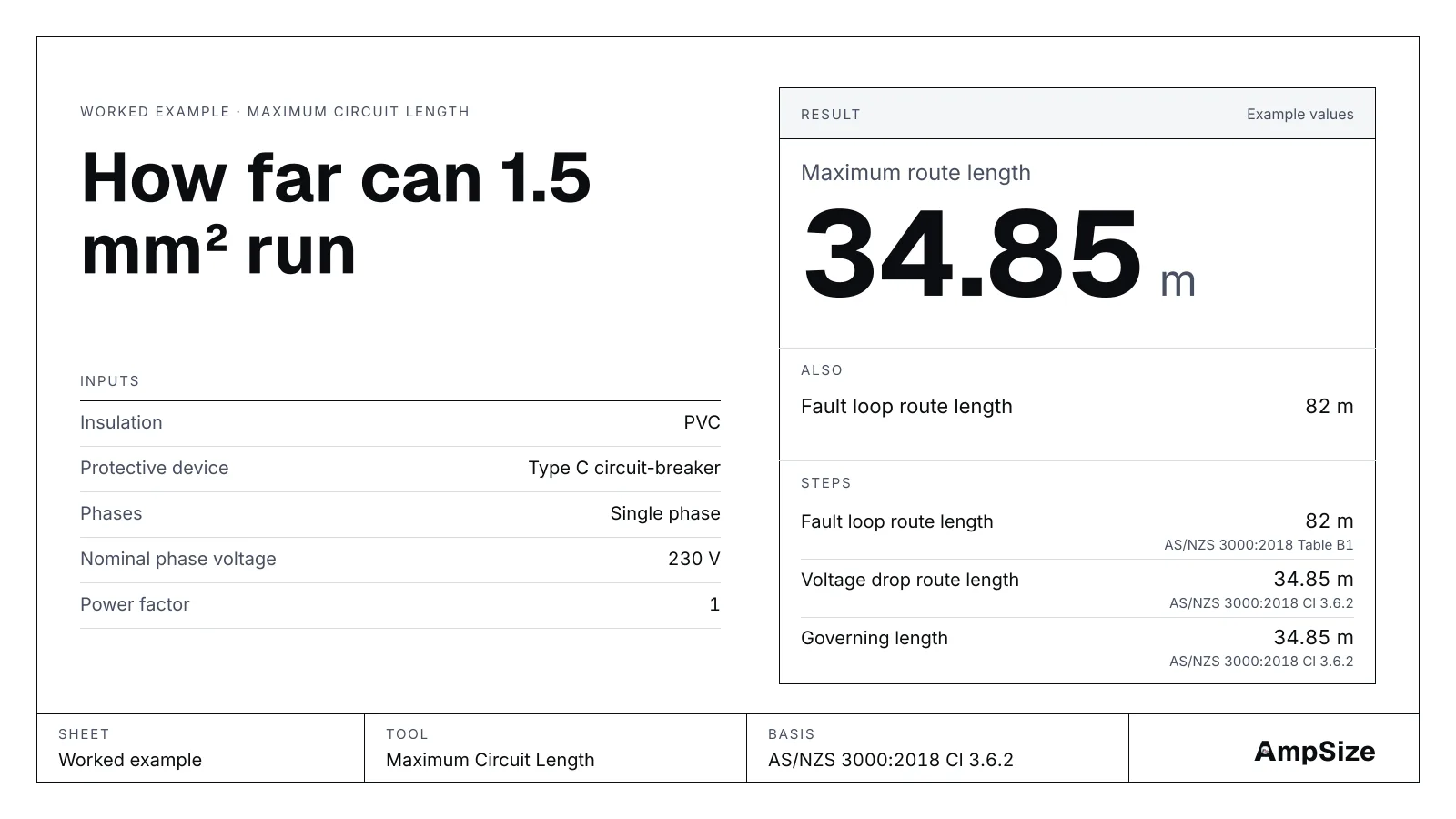
- 1 min readHow far can 1.5 mm² run on a 10 A circuit?1.5 mm² copper on a 10 A curve C circuit can run 34.85 m before it reaches the 5 % voltage drop limit. The fault loop alone would allow 82 m.
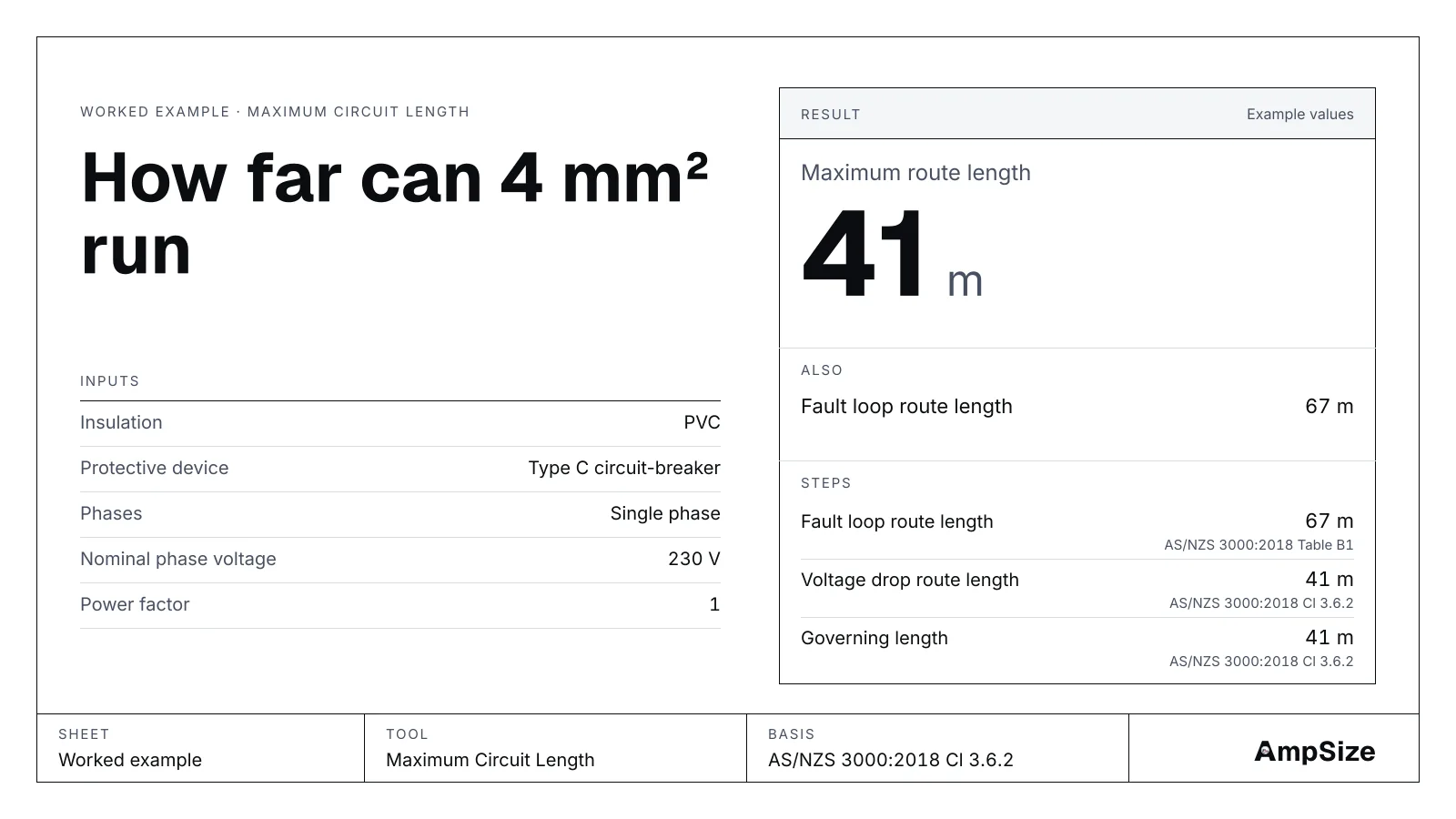
- 1 min readHow far can 4 mm² run on a 25 A circuit?4 mm² copper on a 25 A curve C circuit can run 41 m at full load before it reaches the 5 % voltage drop limit. At 20 A of load it can run 51.25 m.
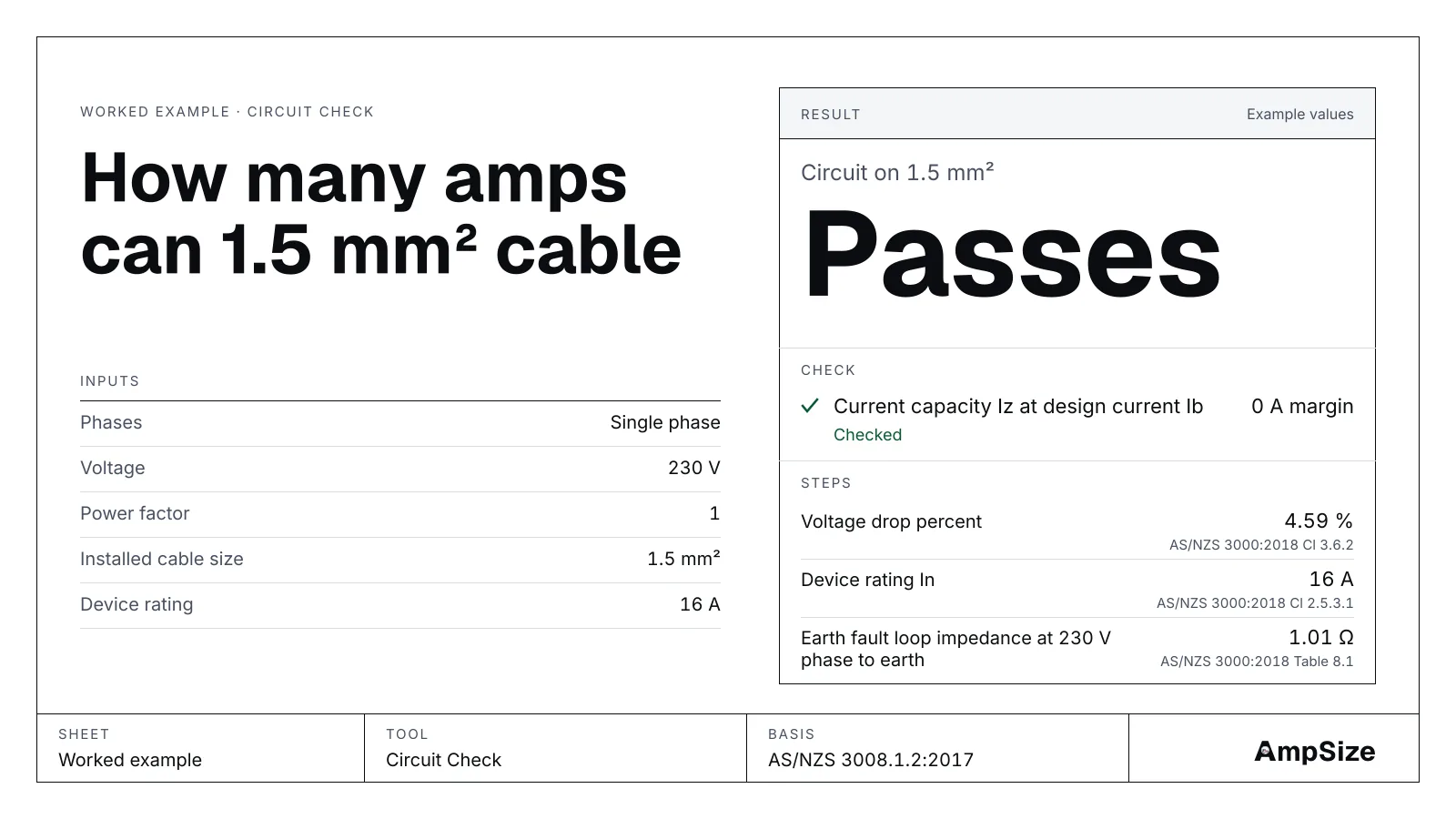
- 1 min readHow many amps can 1.5 mm² cable carry?1.5 mm² copper multicore PVC cable carries 16 A enclosed in air at 30 °C in NZ, so it takes a 16 A breaker. Clipped direct, it carries 17 A.
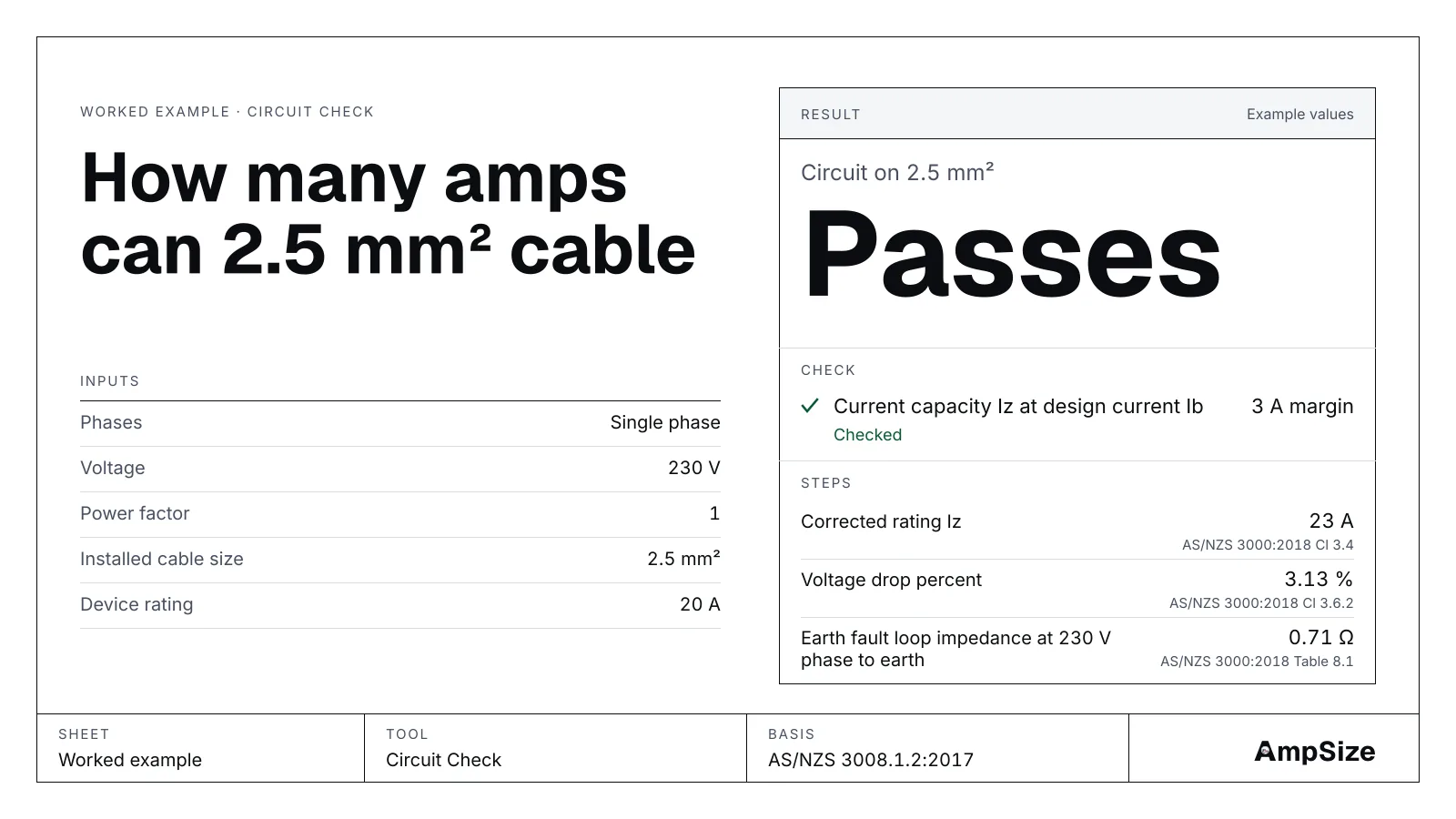
- 1 min readHow many amps can 2.5 mm² cable carry?2.5 mm² copper multicore PVC cable carries 23 A enclosed in air at 30 °C in NZ, so a 20 A breaker protects it. Grouped with two circuits, it carries 16.1 A.
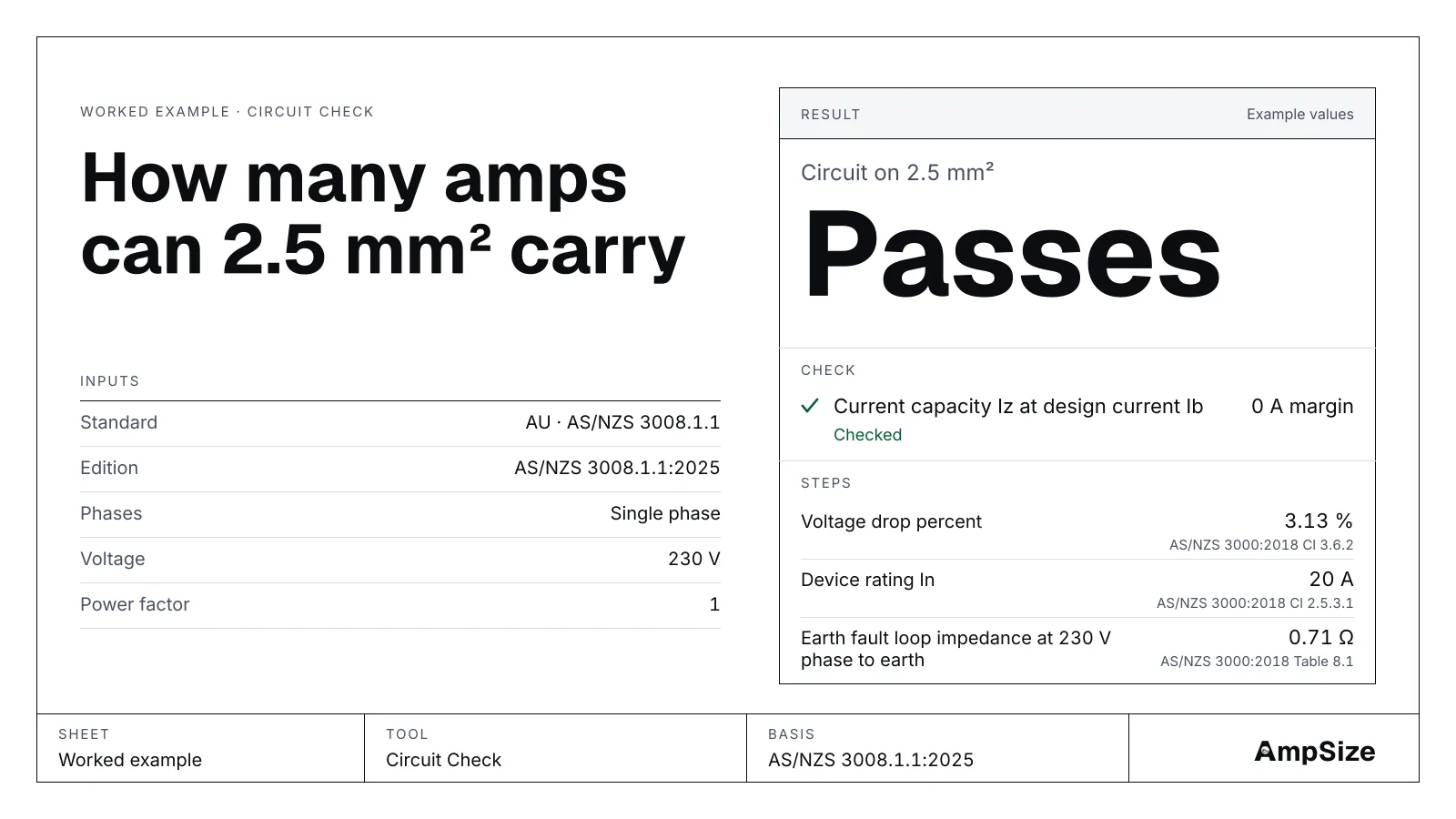
- 1 min readHow many amps can 2.5 mm² carry in Australia?2.5 mm² copper multicore PVC cable carries 20 A enclosed in air at 40 °C on AS/NZS 3008.1.1:2025, exactly a 20 A breaker. Clipped direct, it carries 22 A.
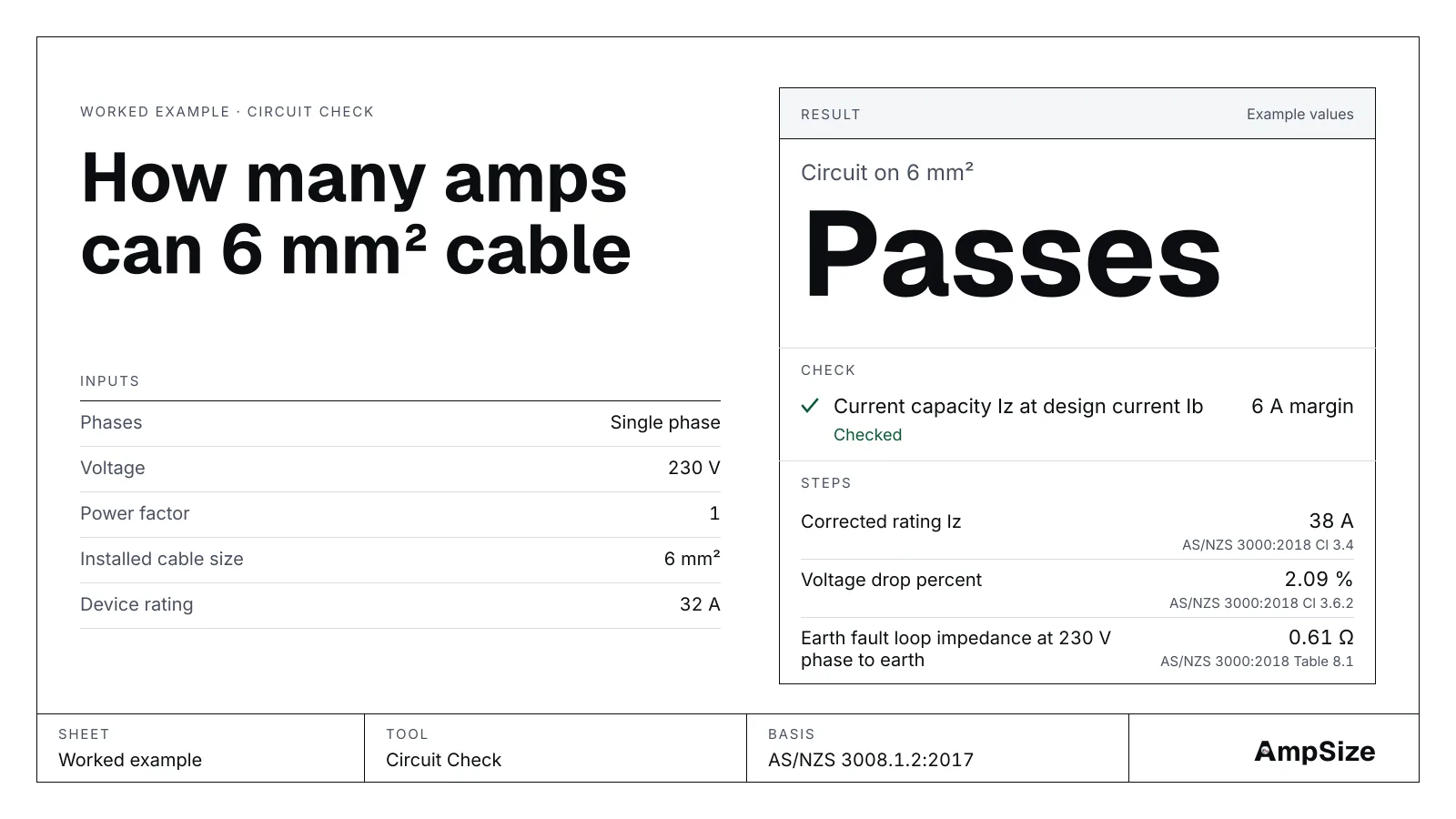
- 1 min readHow many amps can 6 mm² cable carry?6 mm² copper multicore PVC cable carries 38 A enclosed in air at 30 °C in NZ, so it takes a 32 A breaker. At 40 °C it carries 33.44 A.
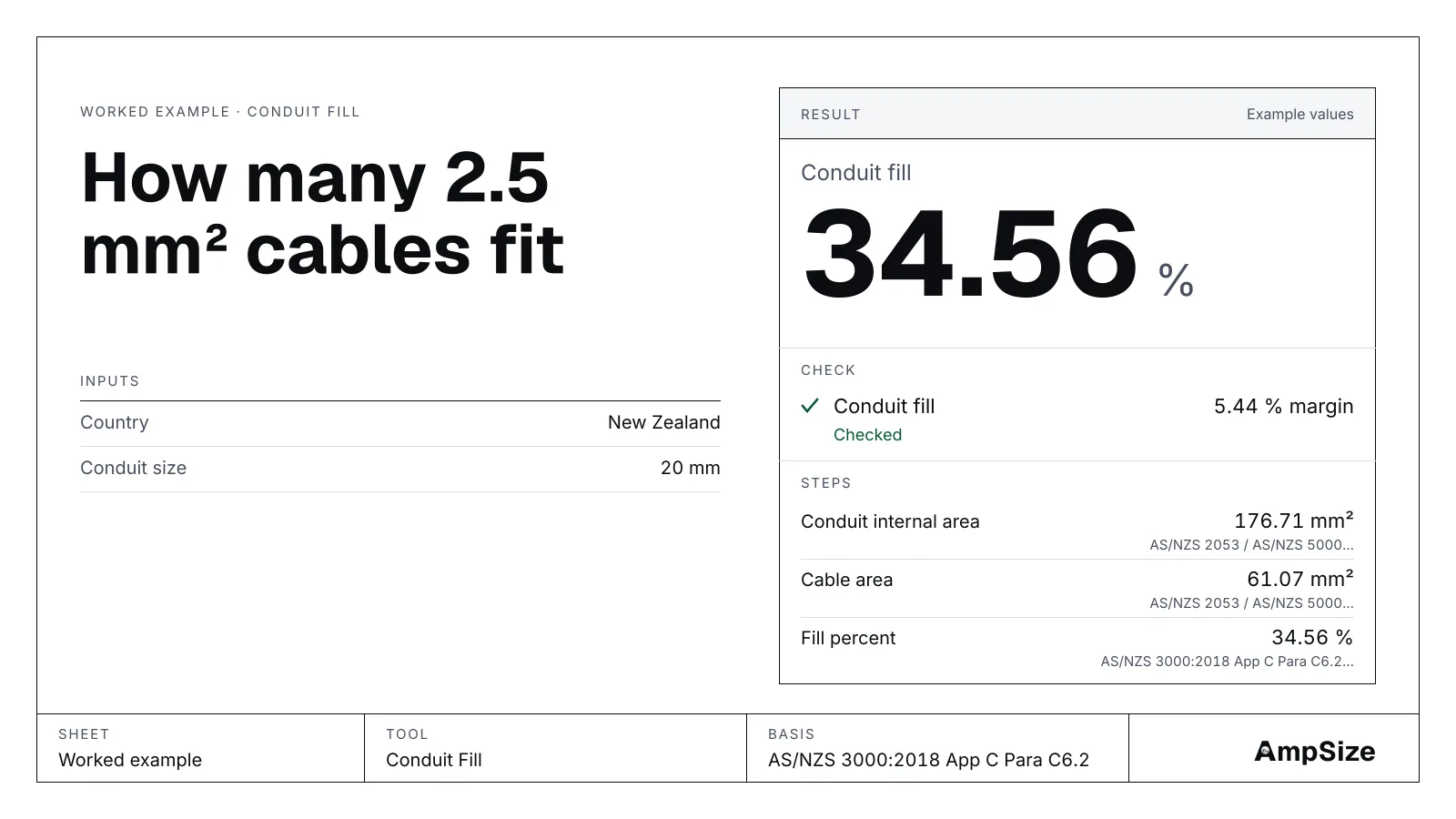
- 1 min readHow many 2.5 mm² cables fit in 20 mm conduit?Six single-core 2.5 mm² cables fit in 20 mm conduit at 34.56 % fill, inside the 40 % limit of AS/NZS 3000 Appendix C. A seventh takes it to 40.32 %.
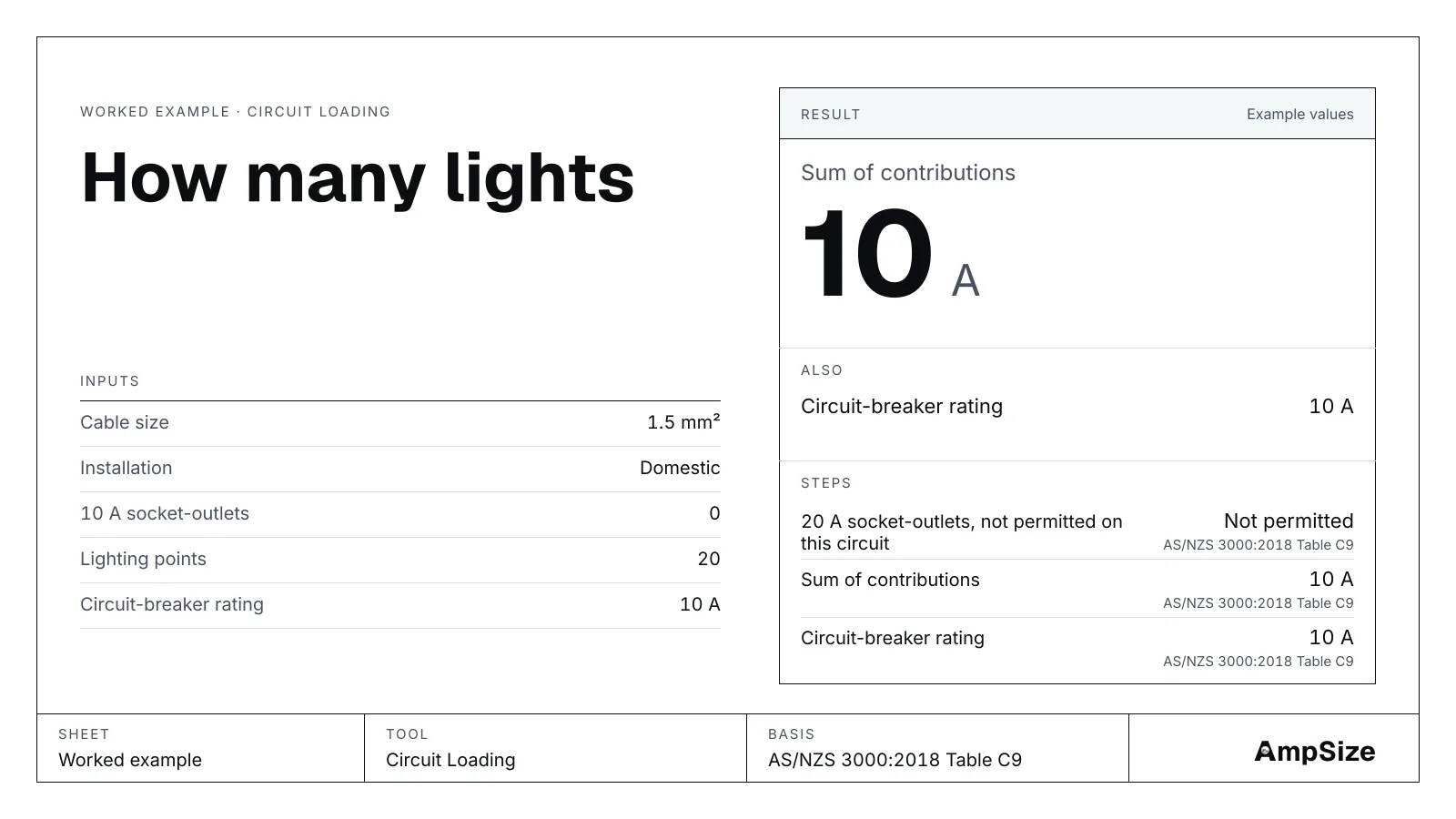
- 1 min readHow many lights on a 10 A circuit?In a home, AS/NZS 3000 Table C9 fills a 10 A circuit at 20 lighting points. A 21st point takes the sum over the circuit-breaker rating.
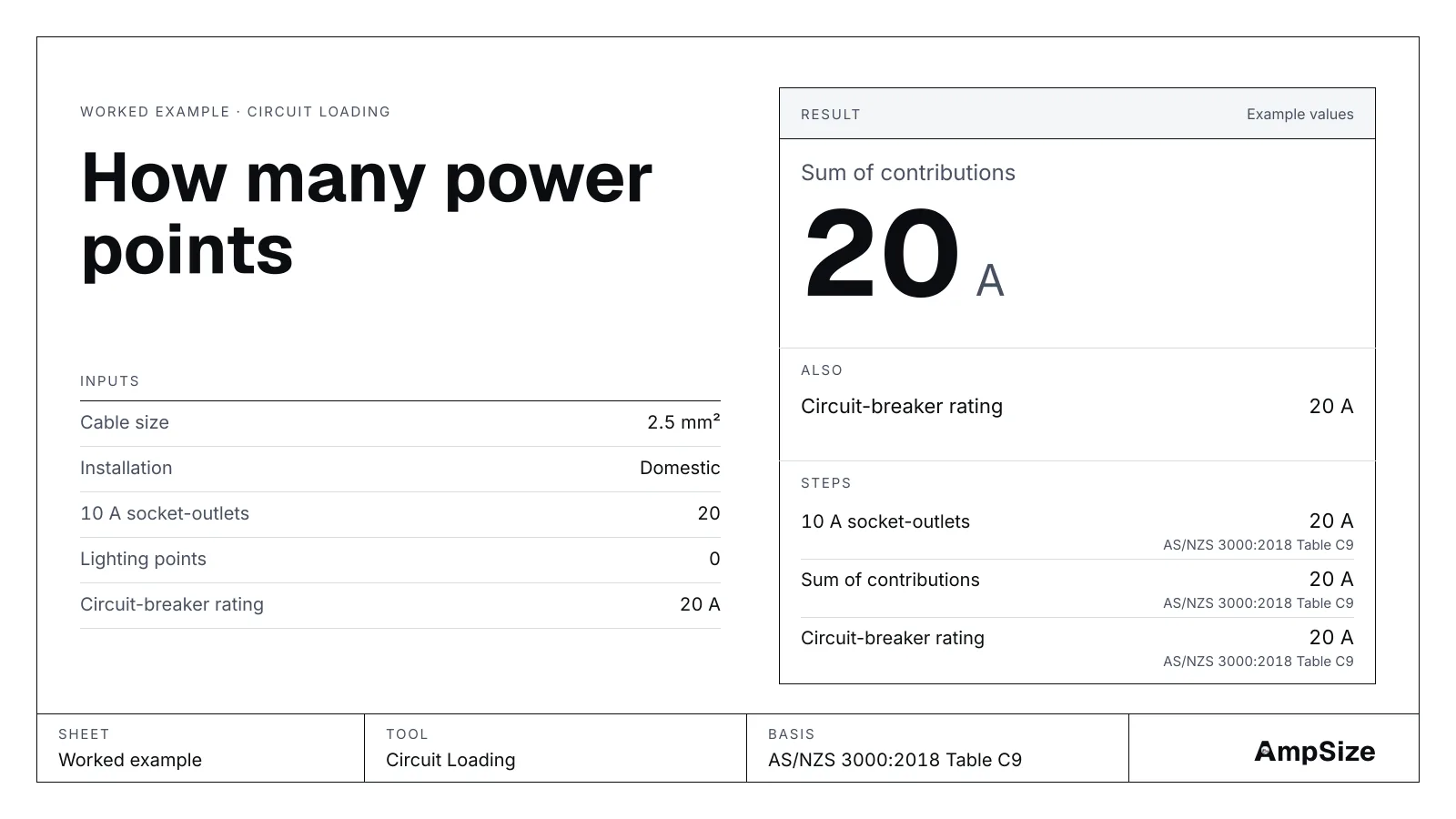
- 1 min readHow many power points on a 20 A circuit?In a home, AS/NZS 3000 Table C9 fills a 20 A circuit at 20 single 10 A socket-outlets. A non-domestic installation counts each one at twice that.
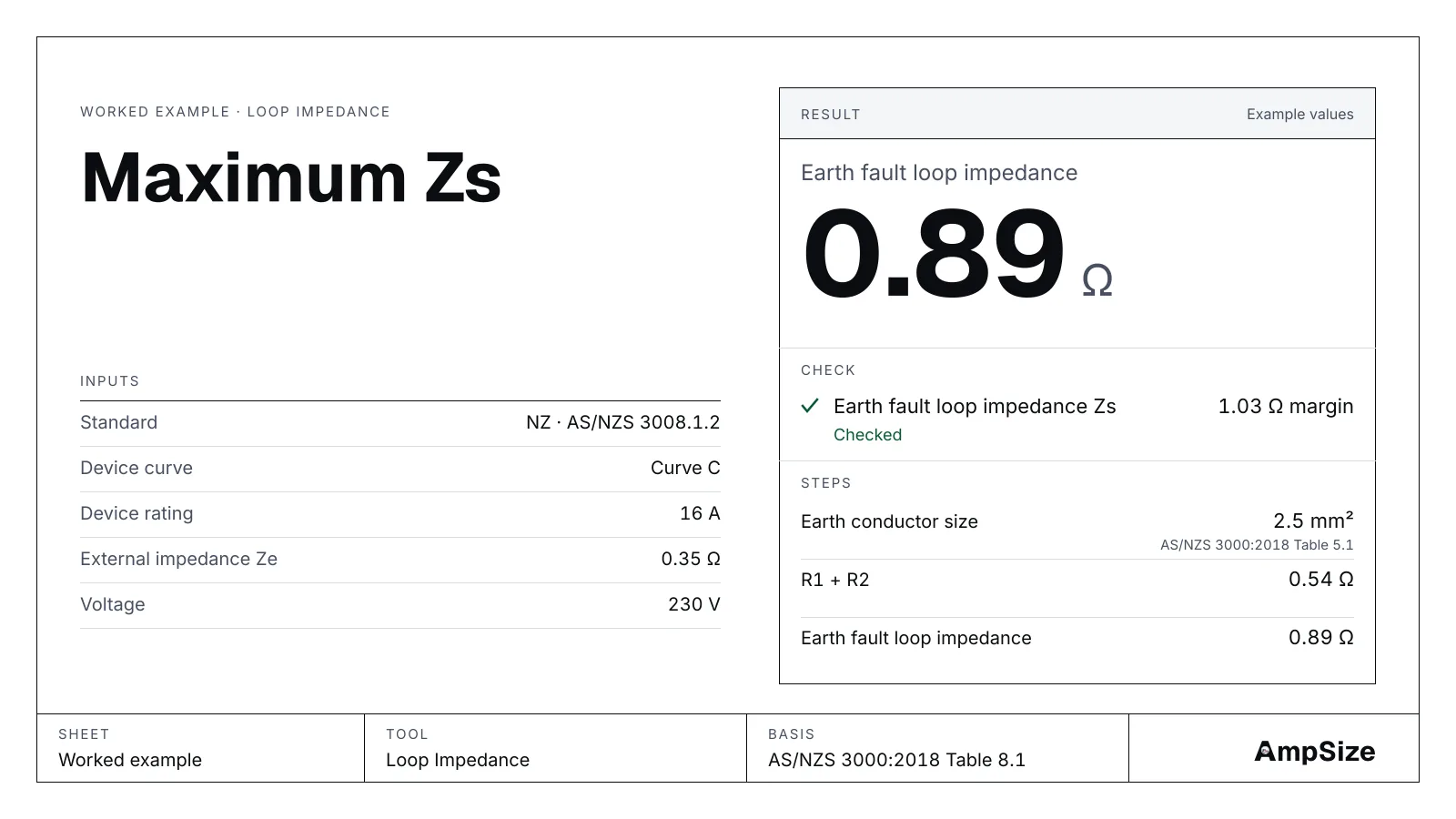
- 1 min readMaximum Zs for a 16 A curve C breakerAS/NZS 3000 Table 8.1 allows a maximum Zs of 1.92 Ω for a 16 A curve C breaker at 230 V. A 30 m run of 2.5 mm² cable reads 0.89 Ω.
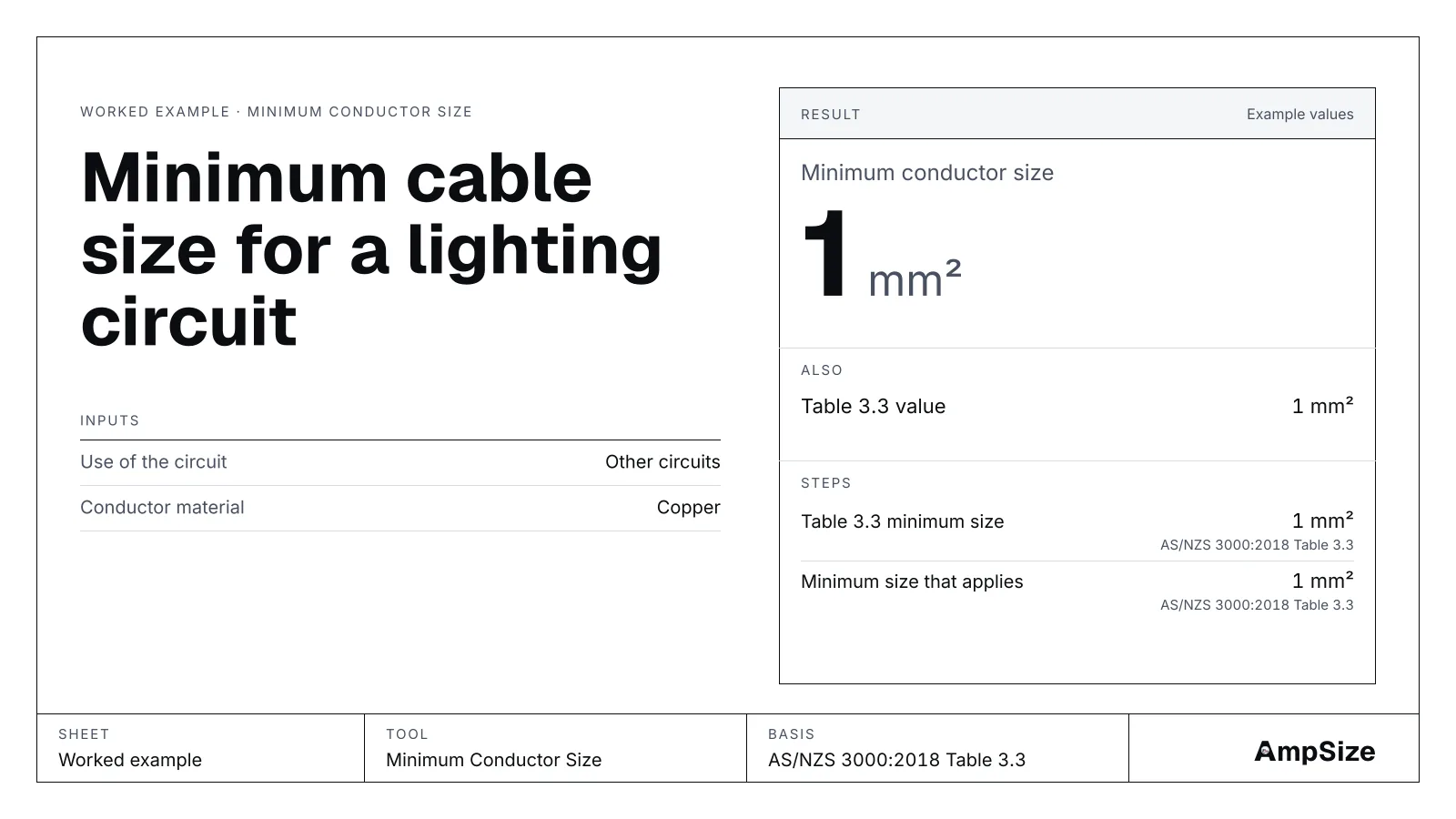
- 1 min readMinimum cable size for a lighting circuitAS/NZS 3000 Table 3.3 sets a minimum of 1 mm² copper for circuits other than socket-outlets, lighting included. The load and the run often need more.
- 1 min readMinimum cable size for power pointsAS/NZS 3000 Table 3.3 sets a minimum of 2.5 mm² copper for a socket-outlet circuit. An exception can allow less, under conditions you must meet first.
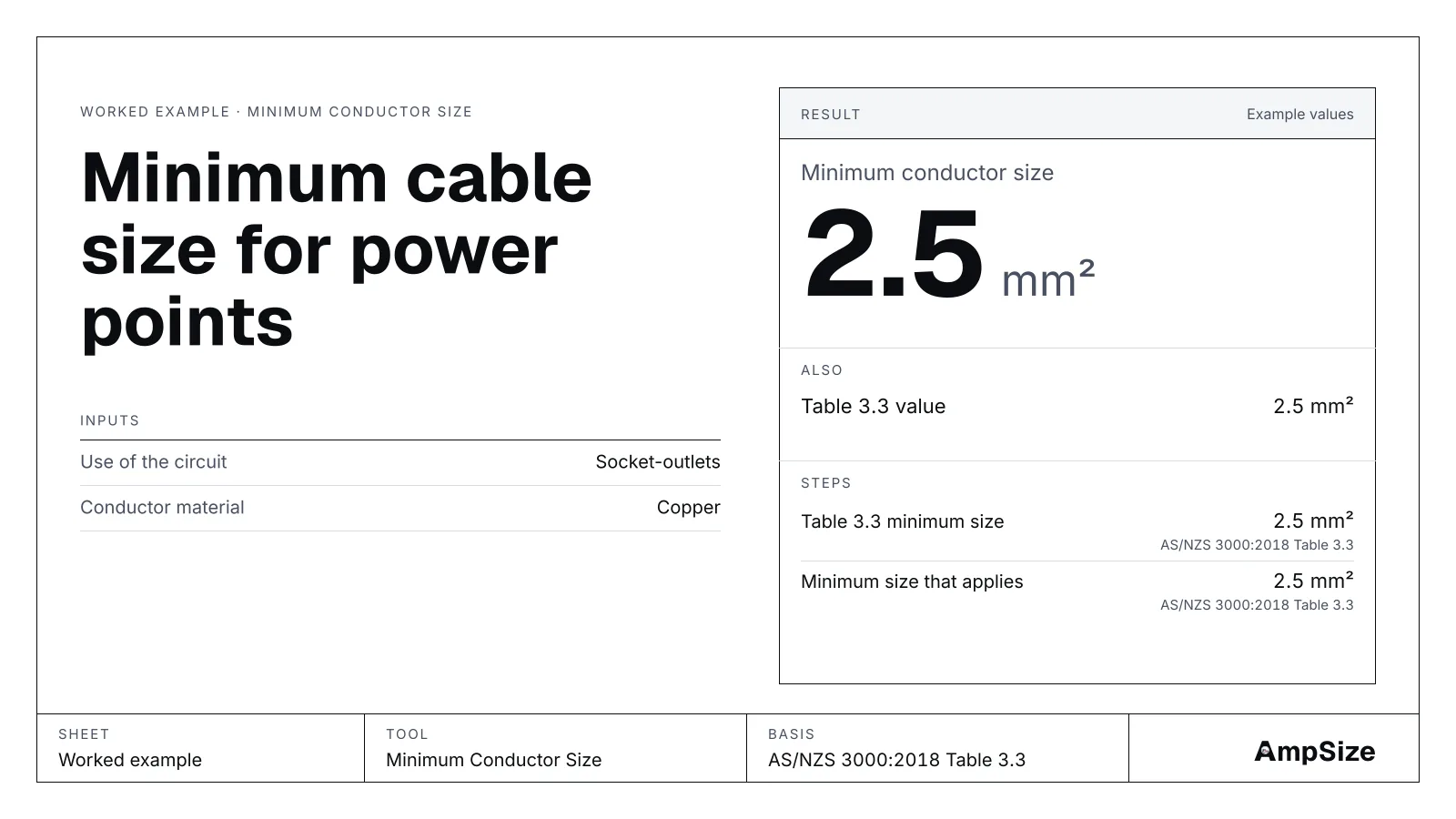
- 3 min readStarting a loaded conveyorA 22 kW conveyor that needs 120 % torque to break away. Why star-delta and a soft starter will not start it, and what a drive or autotransformer does.
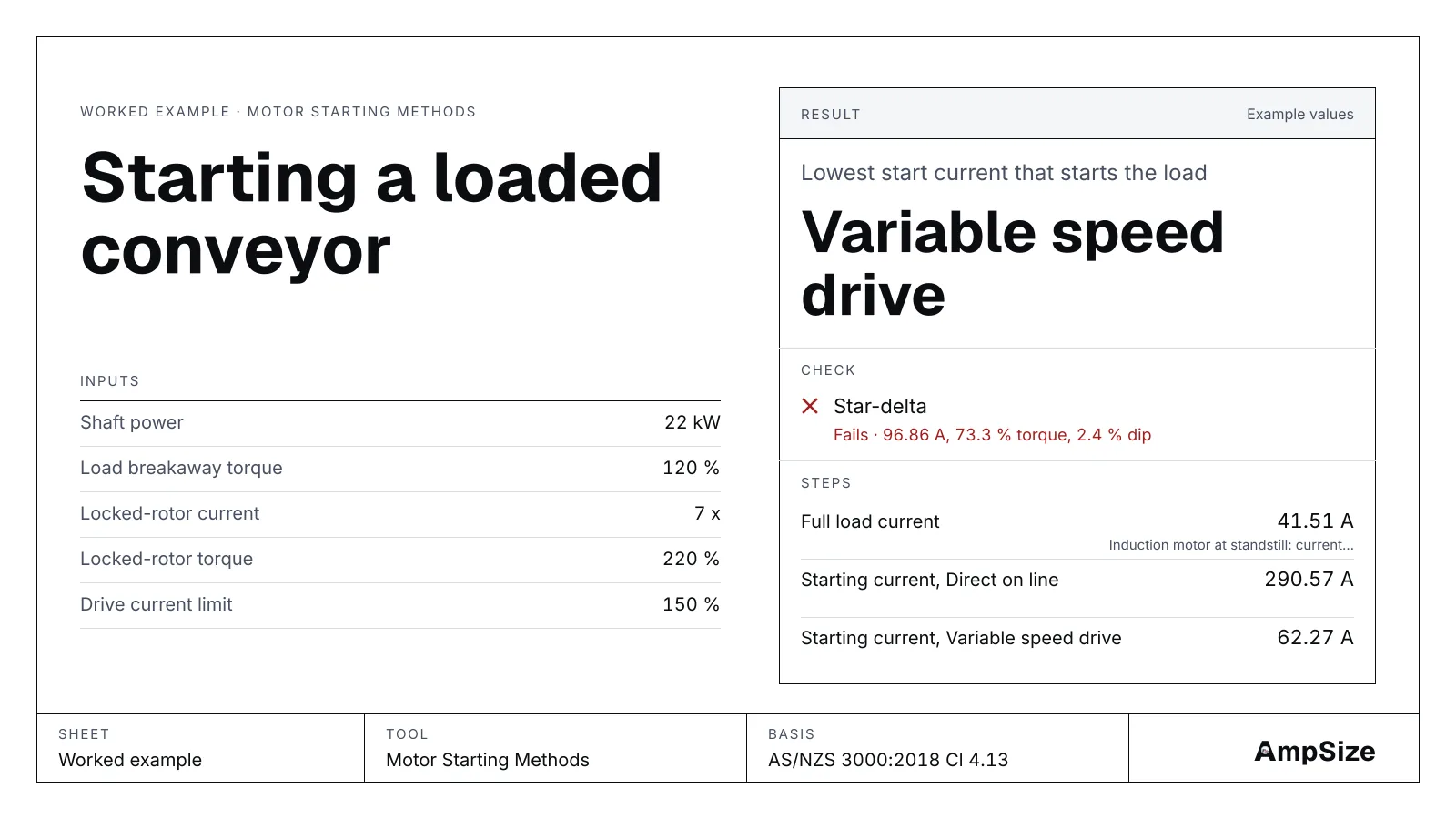
- 1 min readVoltage drop on 2.5 mm² over 30 m20 A on 2.5 mm² copper over 30 m drops 10.81 V, which is 4.7 % at 230 V and close to the 5 % limit. The run can reach 31.91 m.
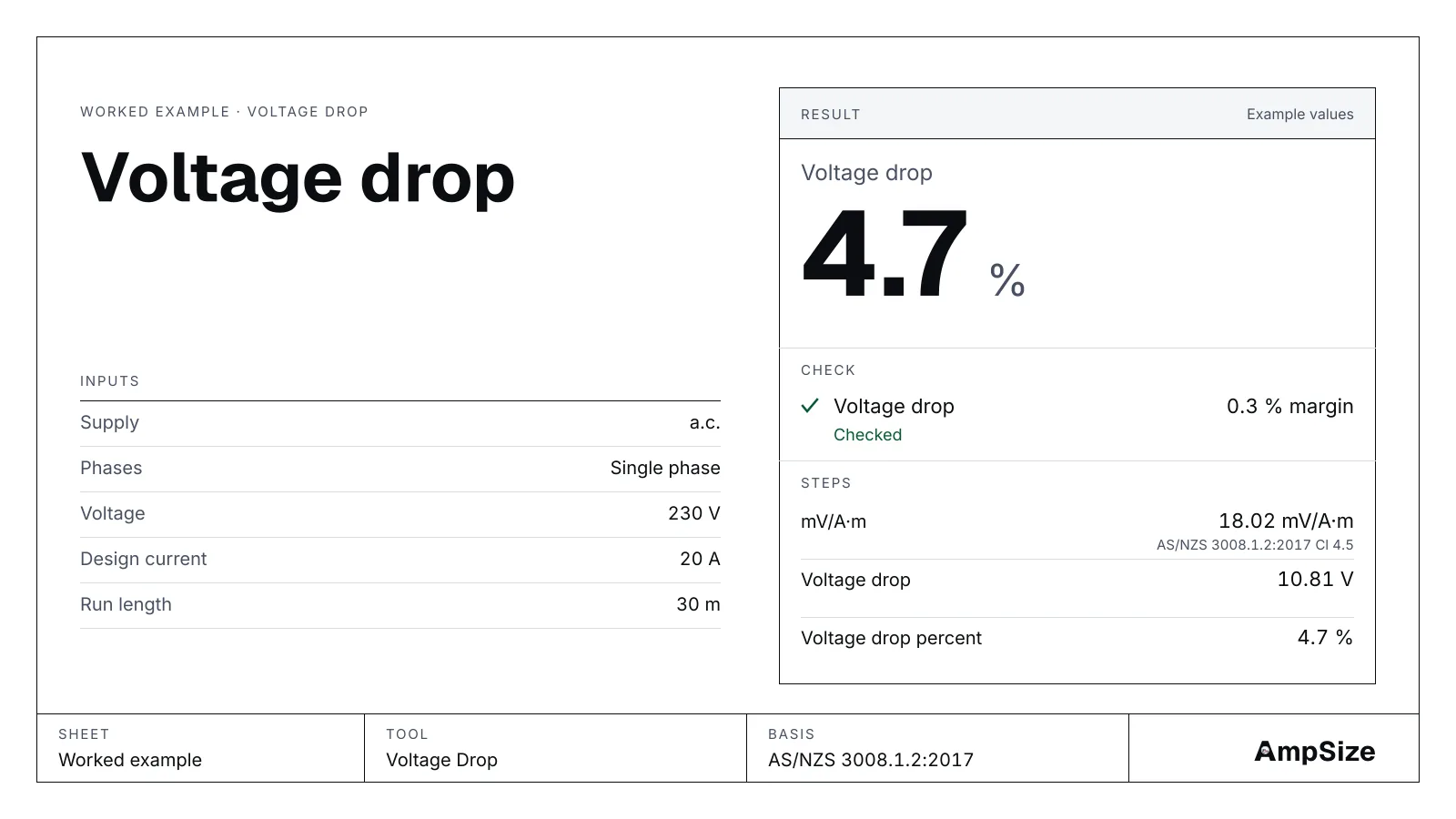
- 1 min readWhat size cable for a 25 A circuit?A 25 A single-phase circuit takes 4 mm² copper on a typical NZ route, with 29 A of derated capacity. 2.5 mm² stops at 23 A, short of the breaker.
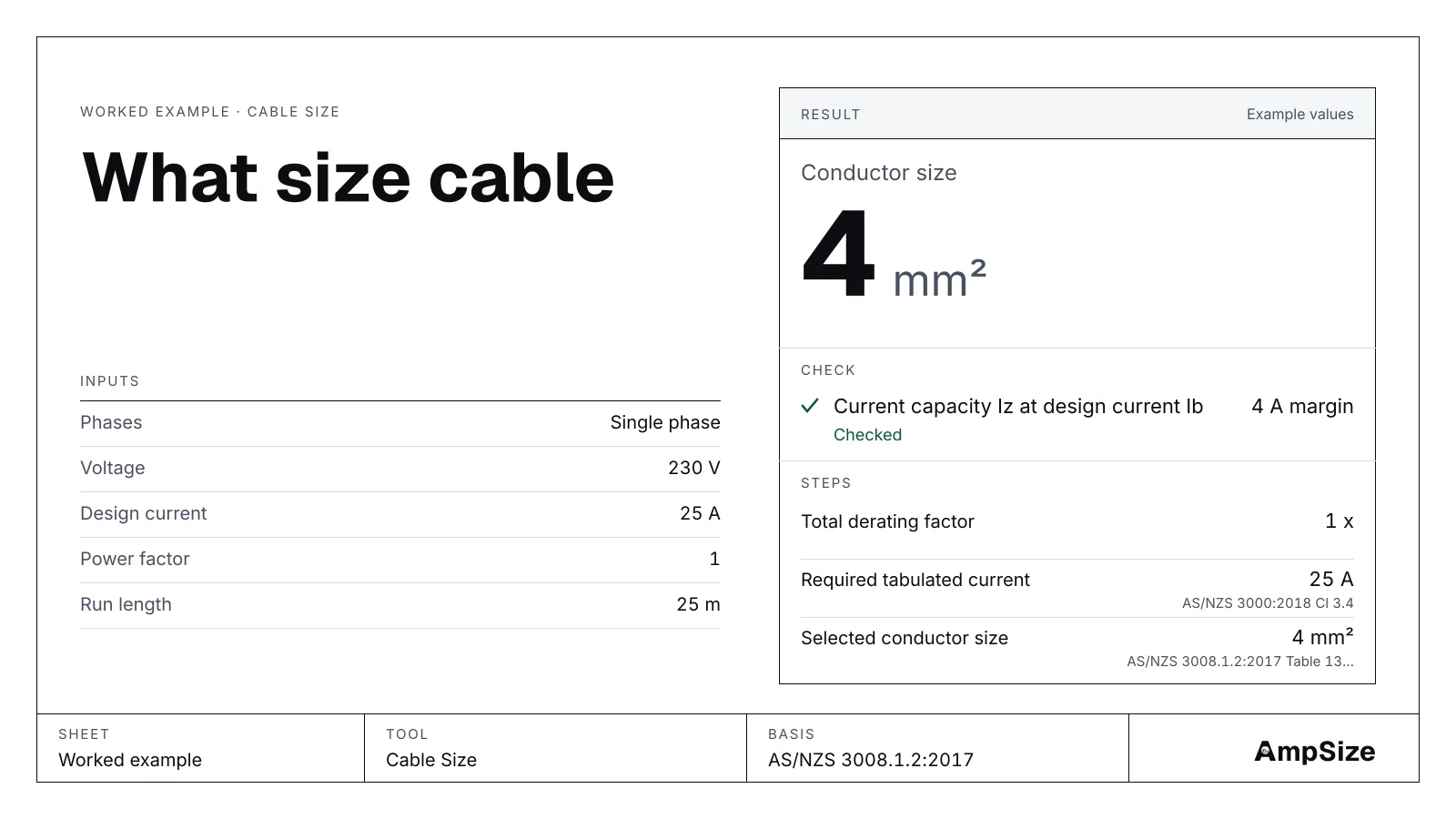
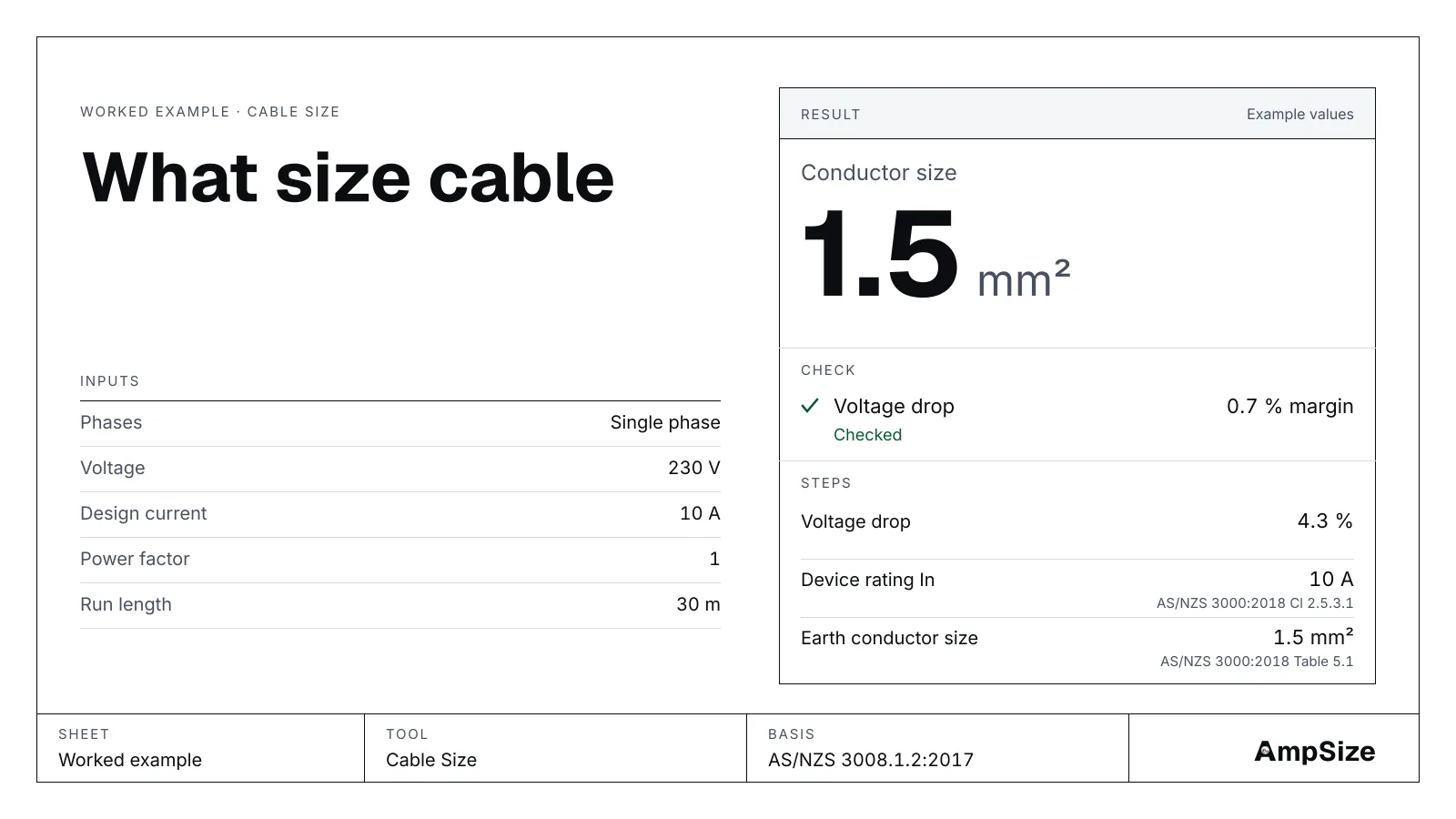
- 1 min readWhat size cable for a lighting circuit in NZ?A 10 A lighting circuit in New Zealand takes 1.5 mm² copper over 30 m, with 16 A of derated capacity and a 4.3 % drop. A 16 A circuit takes 2.5 mm².
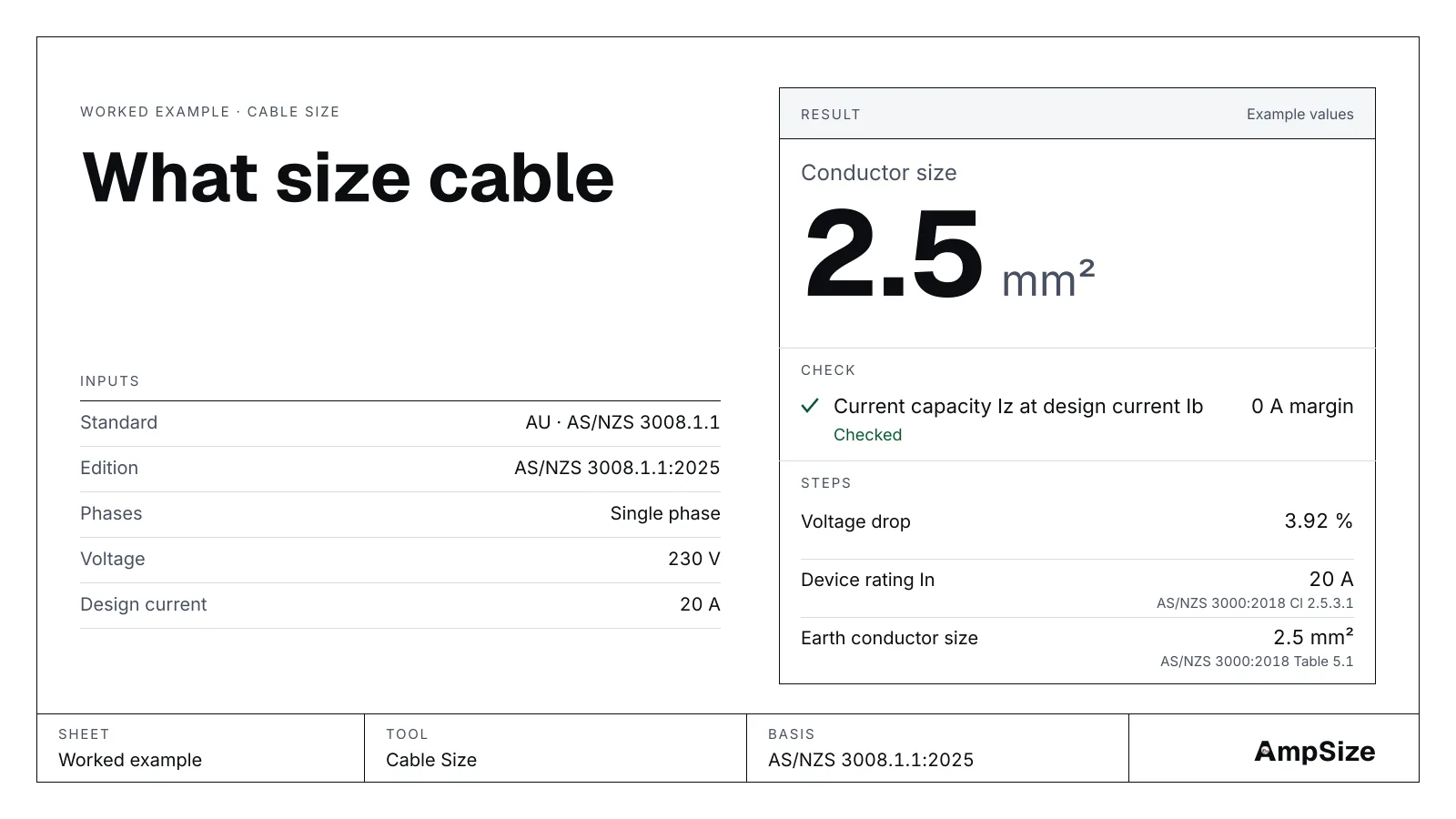
- 1 min readWhat size cable for power points in Australia?A 20 A power point circuit in Australia takes 2.5 mm² copper on AS/NZS 3008.1.1:2025, rated 20 A enclosed in air at 40 °C. Grouping pushes it to 6 mm².
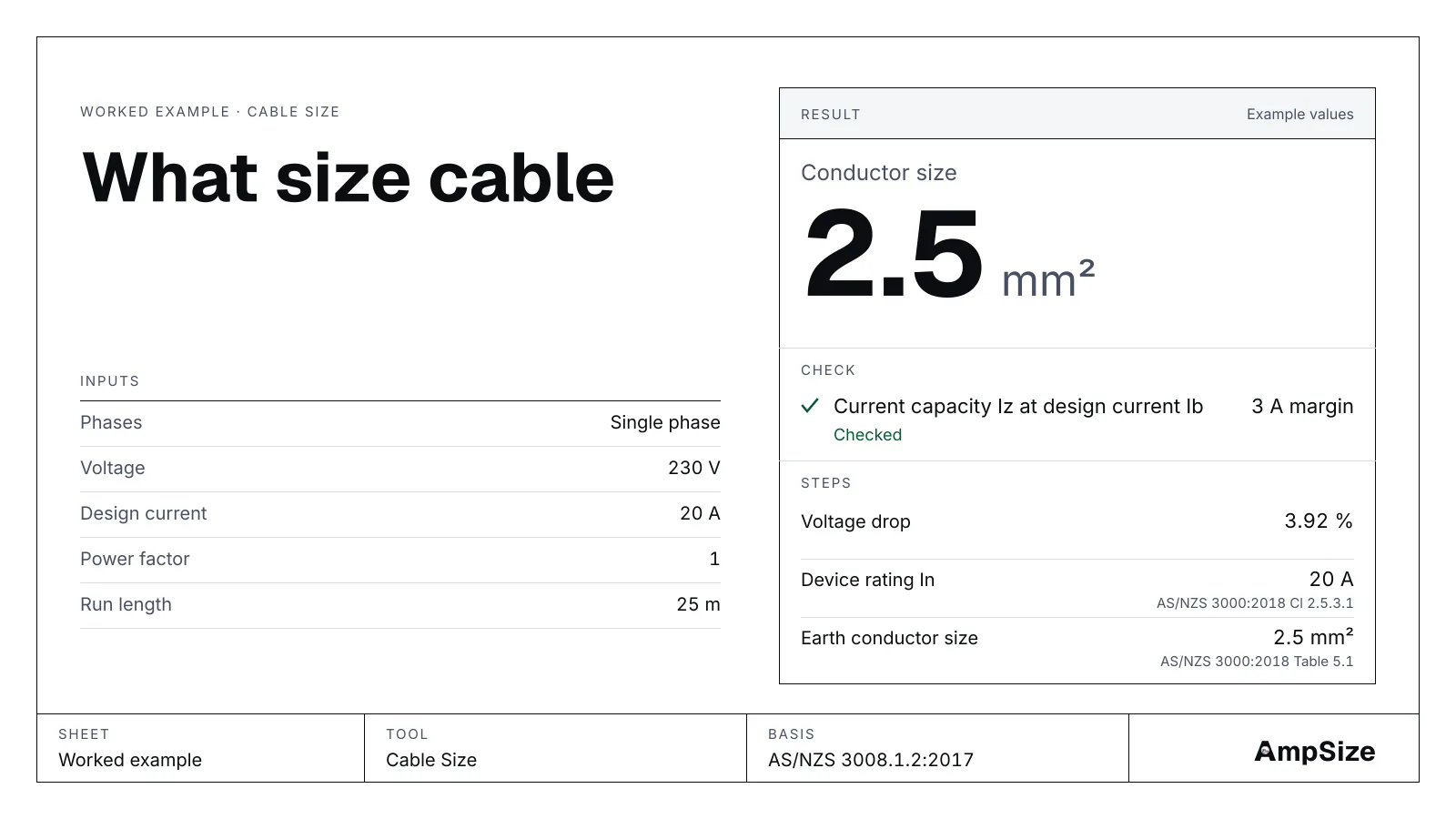
- 1 min readWhat size cable for power points in NZ?A 20 A power point circuit in New Zealand takes 2.5 mm² copper enclosed in air, with 23 A of derated capacity. Ceiling insulation moves it to 4 mm².
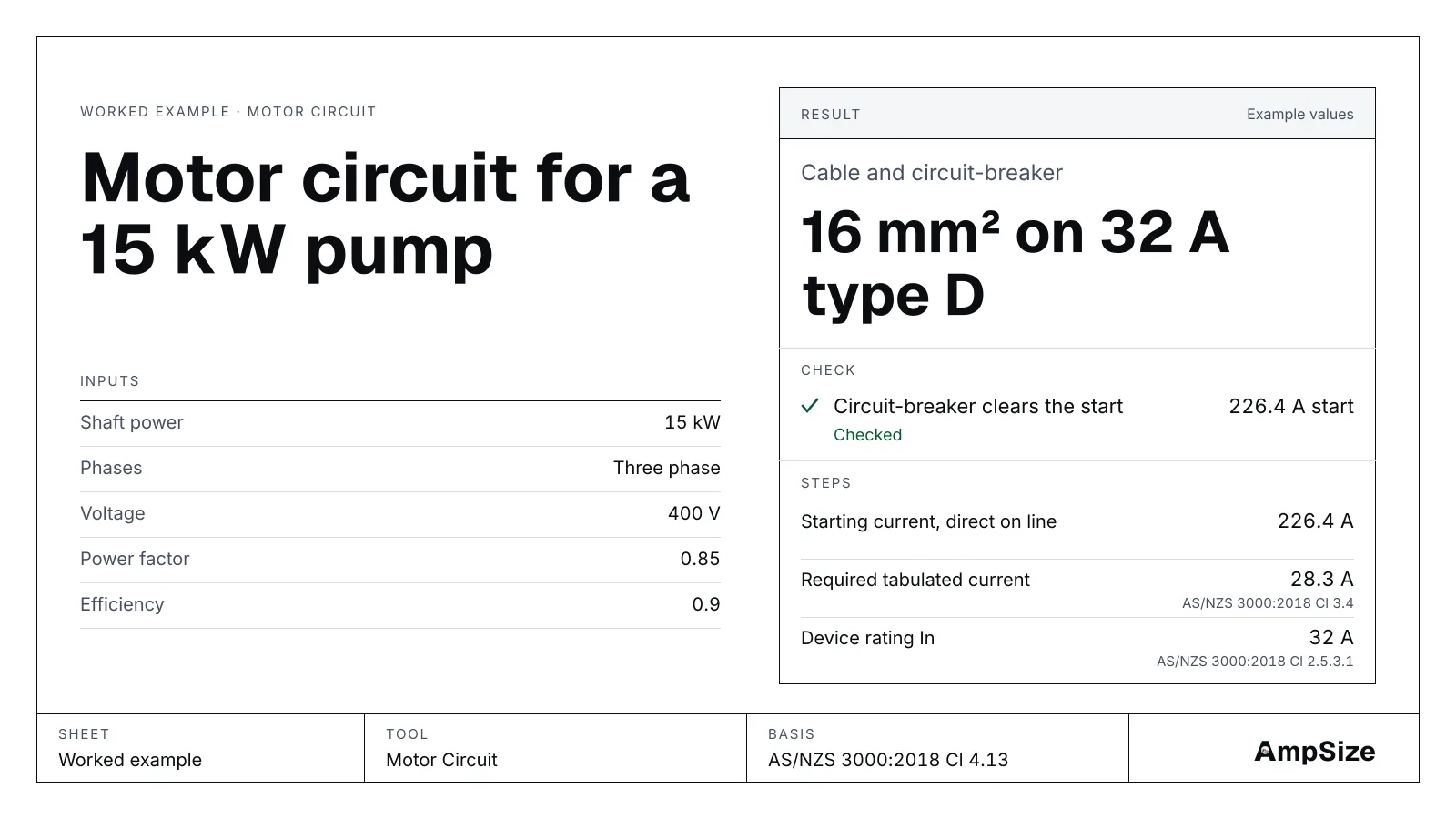
- 4 min readMotor circuit for a 15 kW pump: DOL or star-deltaSize a 15 kW 400 V pump circuit: cable, breaker, contactor and overload relay. Compare DOL, star-delta, soft starter and drive starts.
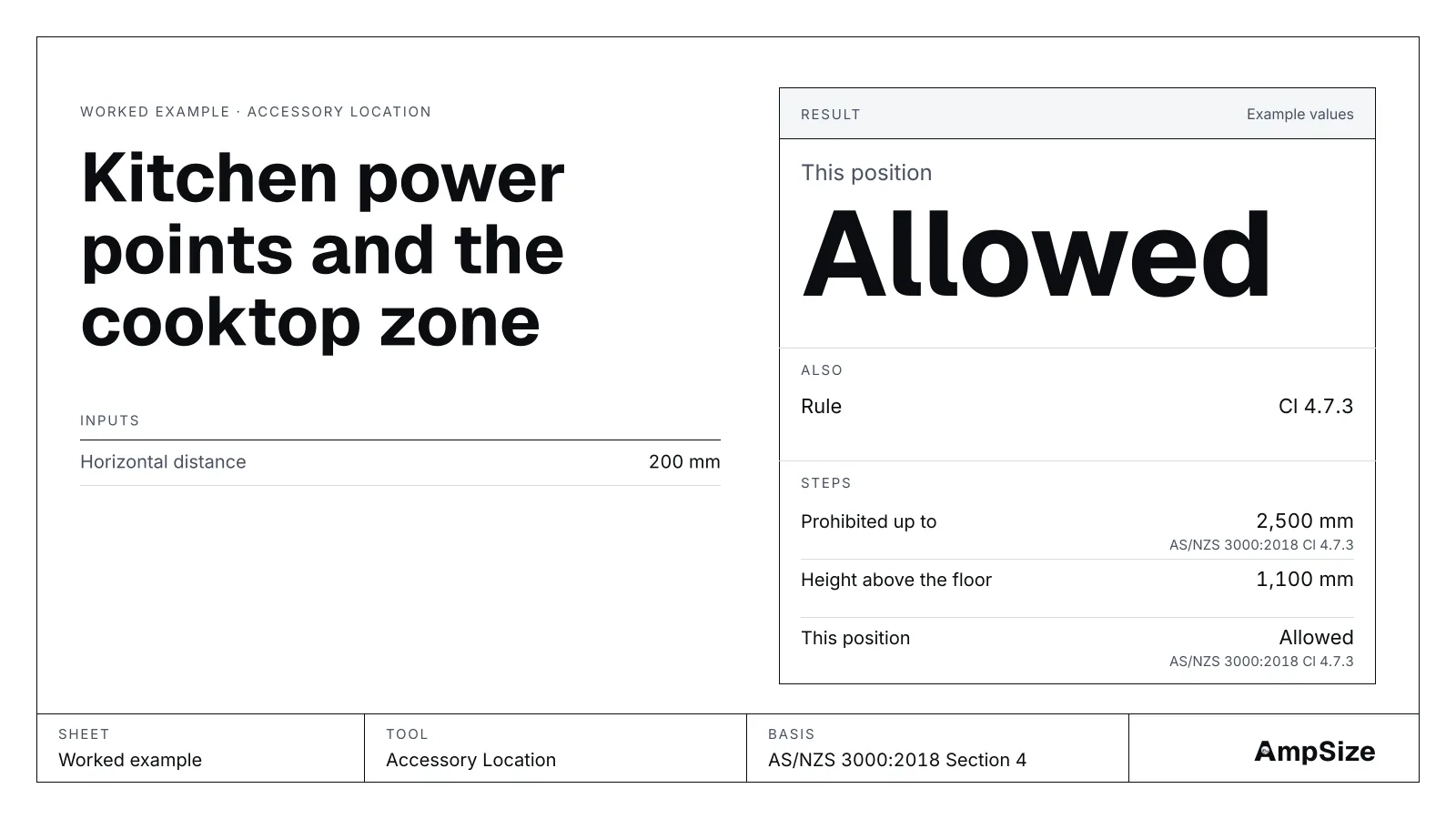
- 5 min readKitchen power points and the cooktop zonePlace power points and switches near a cooktop, an outdoor gas bottle and a gas vent. Check each distance to AS/NZS 3000 and hand the sink to the wet area tool.
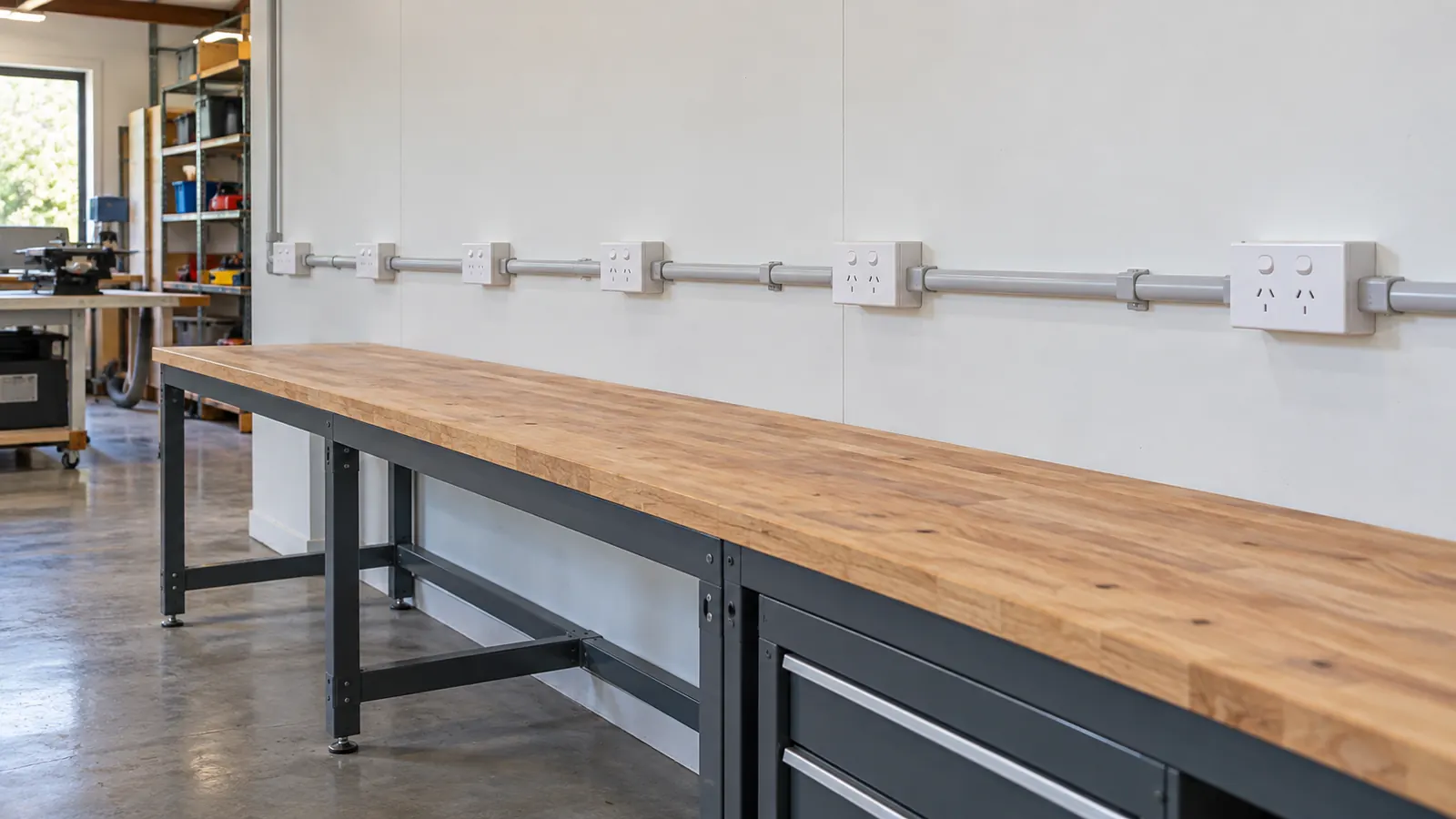
- 3 min readMax cable length for a 20 A C curve subcircuitA 20 A curve C socket circuit on 2.5 mm² runs 40 m. See the Zs the engine returns, the Table 8.1 limit and the maximum length before the circuit fails.
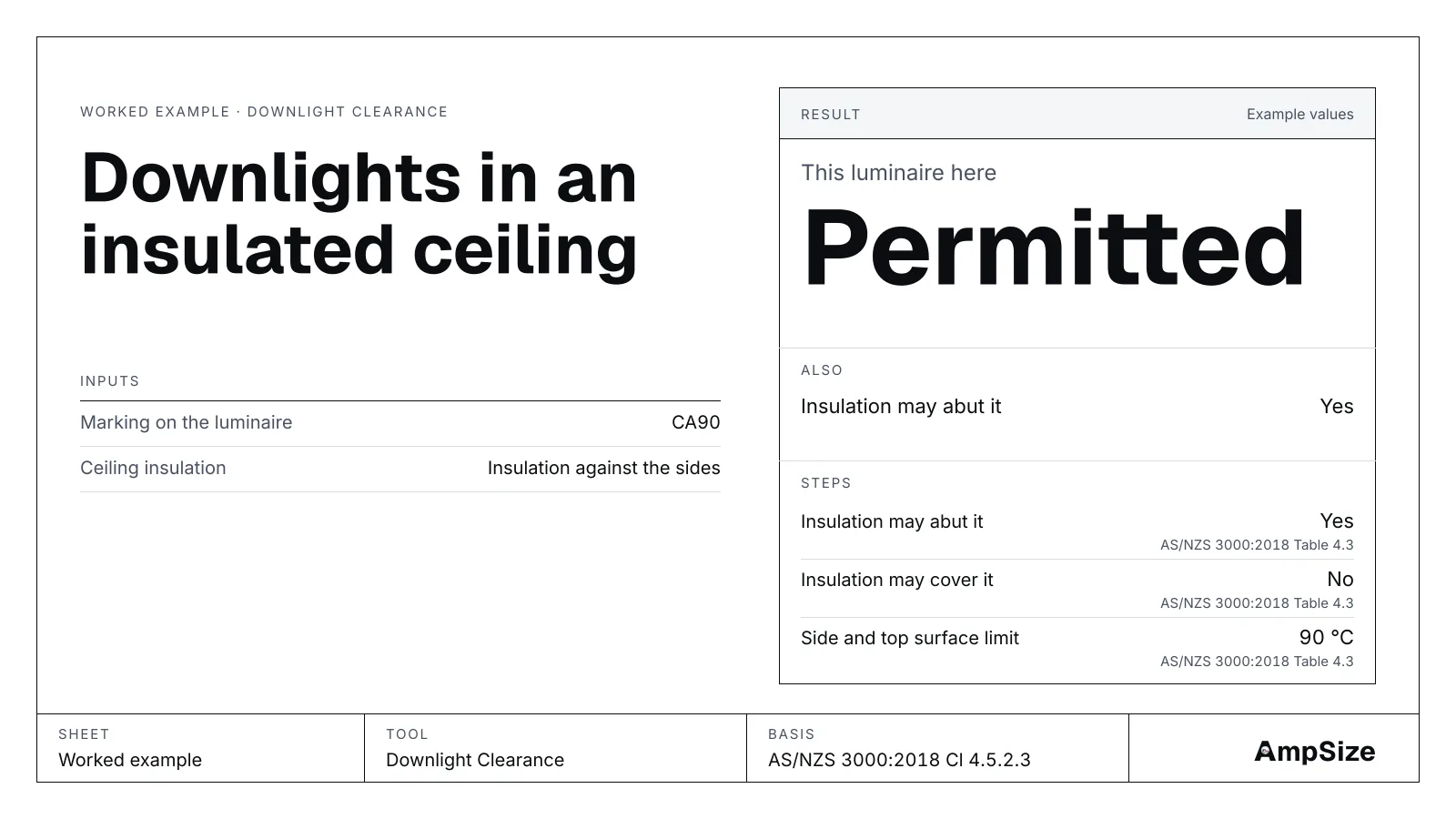
- 4 min readDownlights in an insulated ceilingRe-insulate a NZ ceiling with downlights in it. Check which may be covered, which only abutted, which must come out, and the clearances and roof space sign.
- 3 min readThree‑phase power: kVA to amps at 400 VThe root three relation between amps, kVA and kW on a 400 V board, worked at 50 A and a 0.9 power factor, with the kvar figure the engine returns.

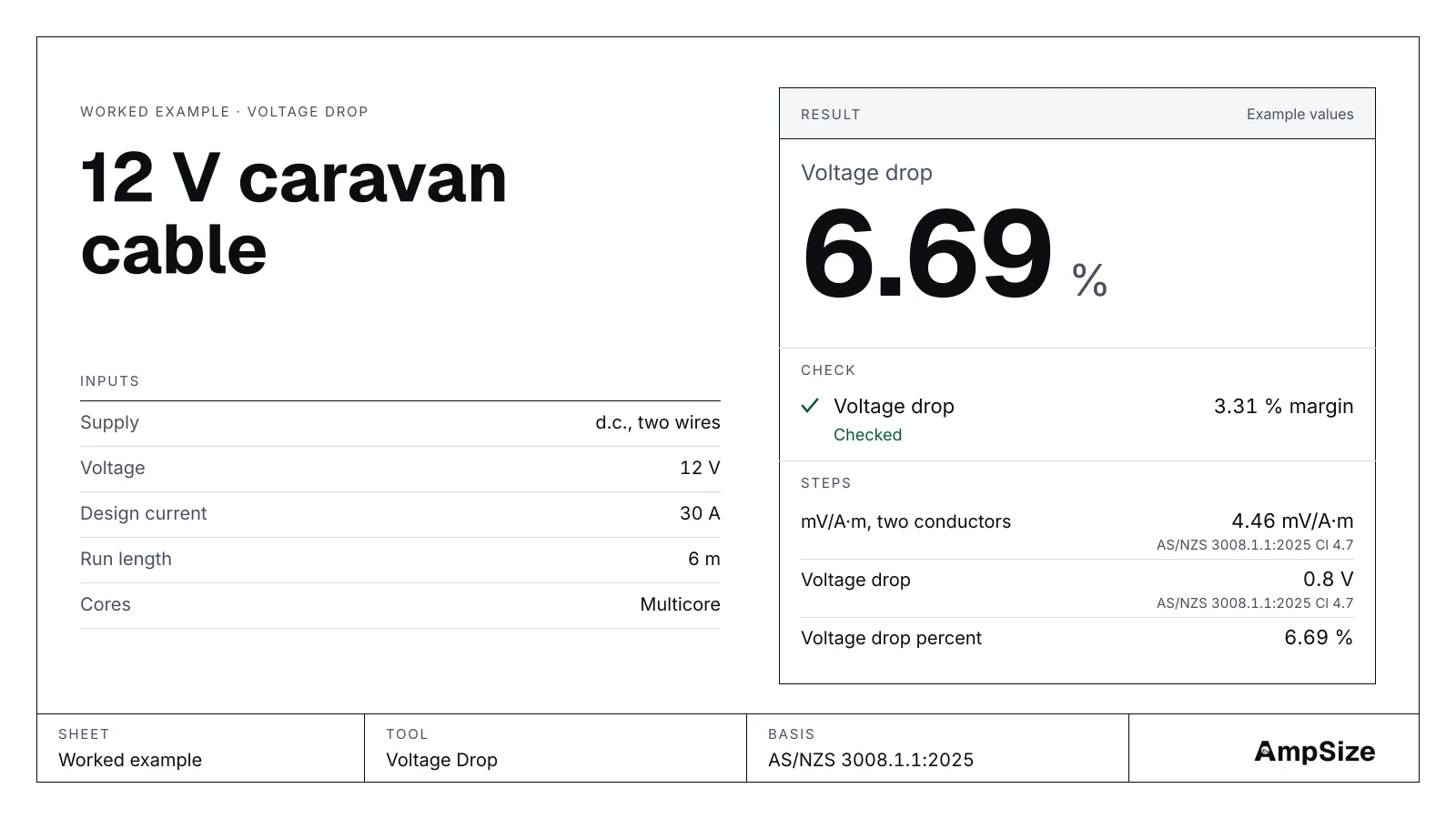
- 5 min read12 V caravan cable: d.c. voltage dropA 12 V caravan feed at 30 A over 6 m, checked on 4, 6 and 10 mm² twin against the 10 % ELV limit, then a 48 V battery-to-inverter run.
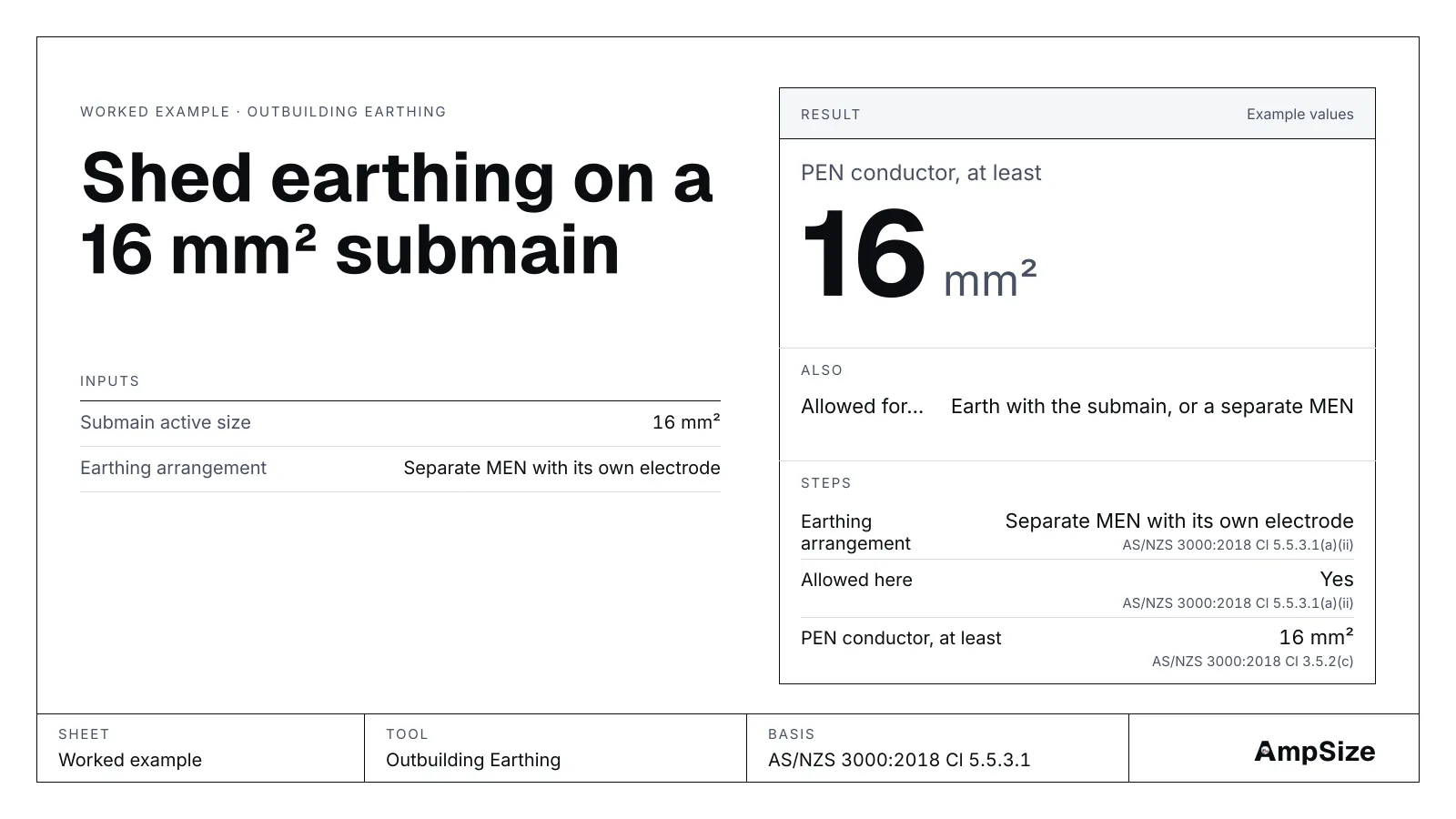
- 3 min readShed earthing on a 16 mm² submainEarth a NZ shed 30 m from the house on a 16 mm² submain. Compare an earth with the submain and a separate MEN with its own rod, and when each is allowed.
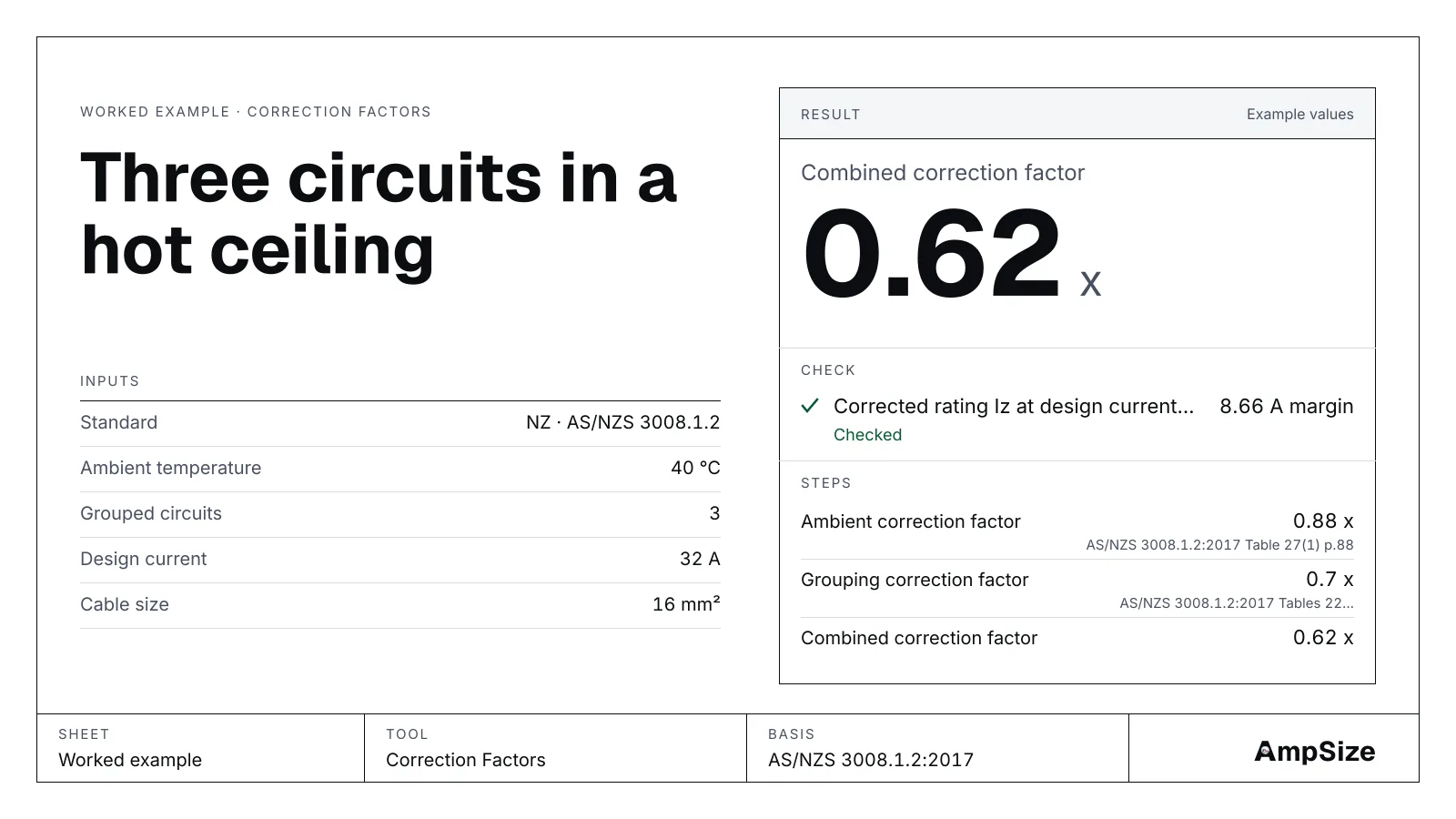
- 5 min readThree circuits in a hot ceiling: correction factorThree 32 A circuits in conduit across a 40 °C and a 50 °C ceiling space, worked with the NZ 2017 tables and again with AS/NZS 3008.1.1:2025.
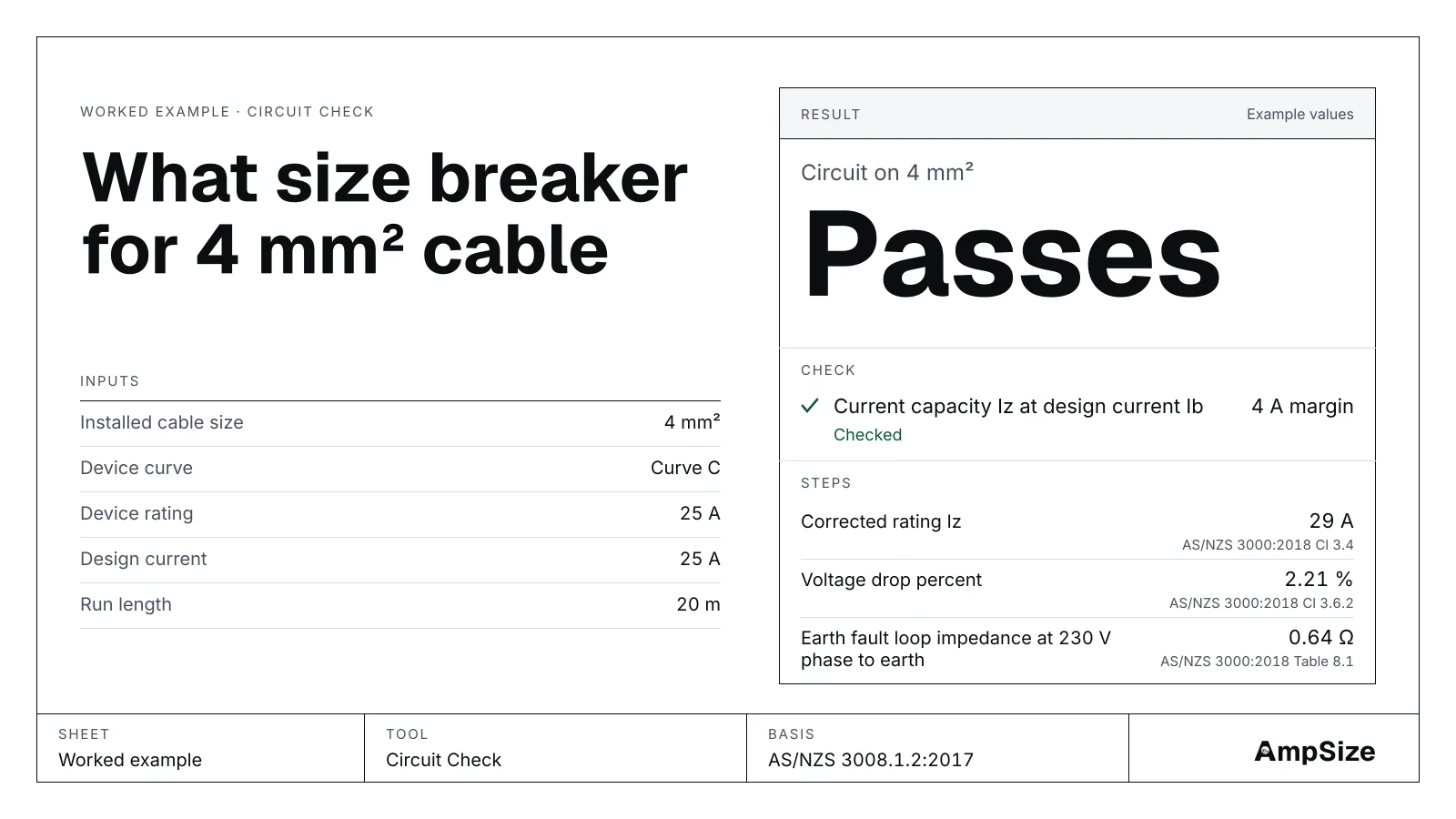
- 5 min readWhat size breaker for 4 mm² cable4 mm² copper enclosed in air takes a 25 A breaker, and 32 A fails at an Iz of 29 A. Grouping, a hot ceiling, insulation and a long run lower it.
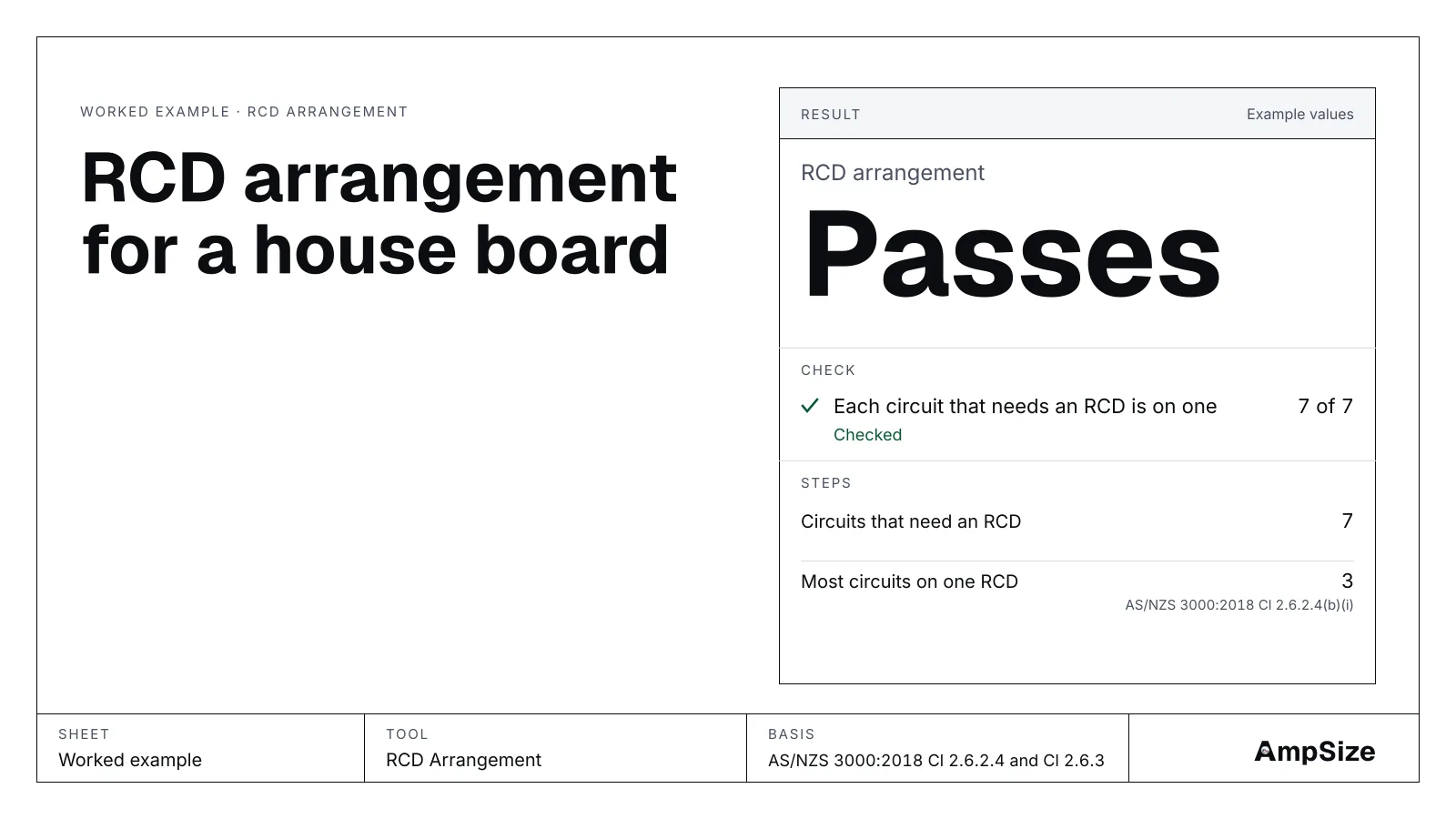
- 4 min readRCD arrangement for a house boardCheck a New Zealand house board of eight circuits on two RCDs. See what fails with a fourth circuit on one RCD or both lights on one, and the AU change.
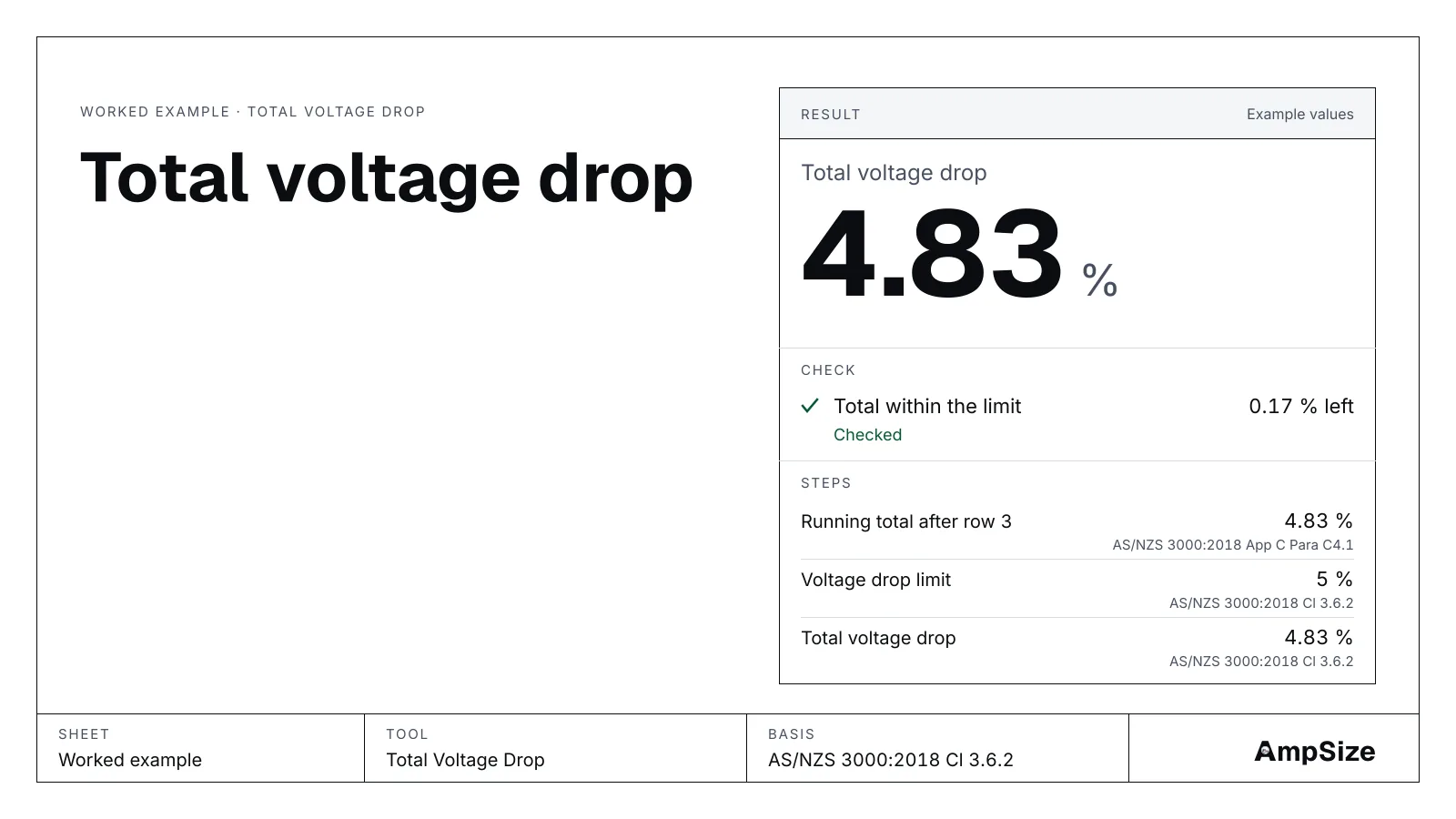
- 4 min readTotal voltage drop: mains, submain and finalAdd the voltage drop of the consumer mains, a shed submain and a final subcircuit against the 5 % limit, and fix a long submain before the shed circuits fail.
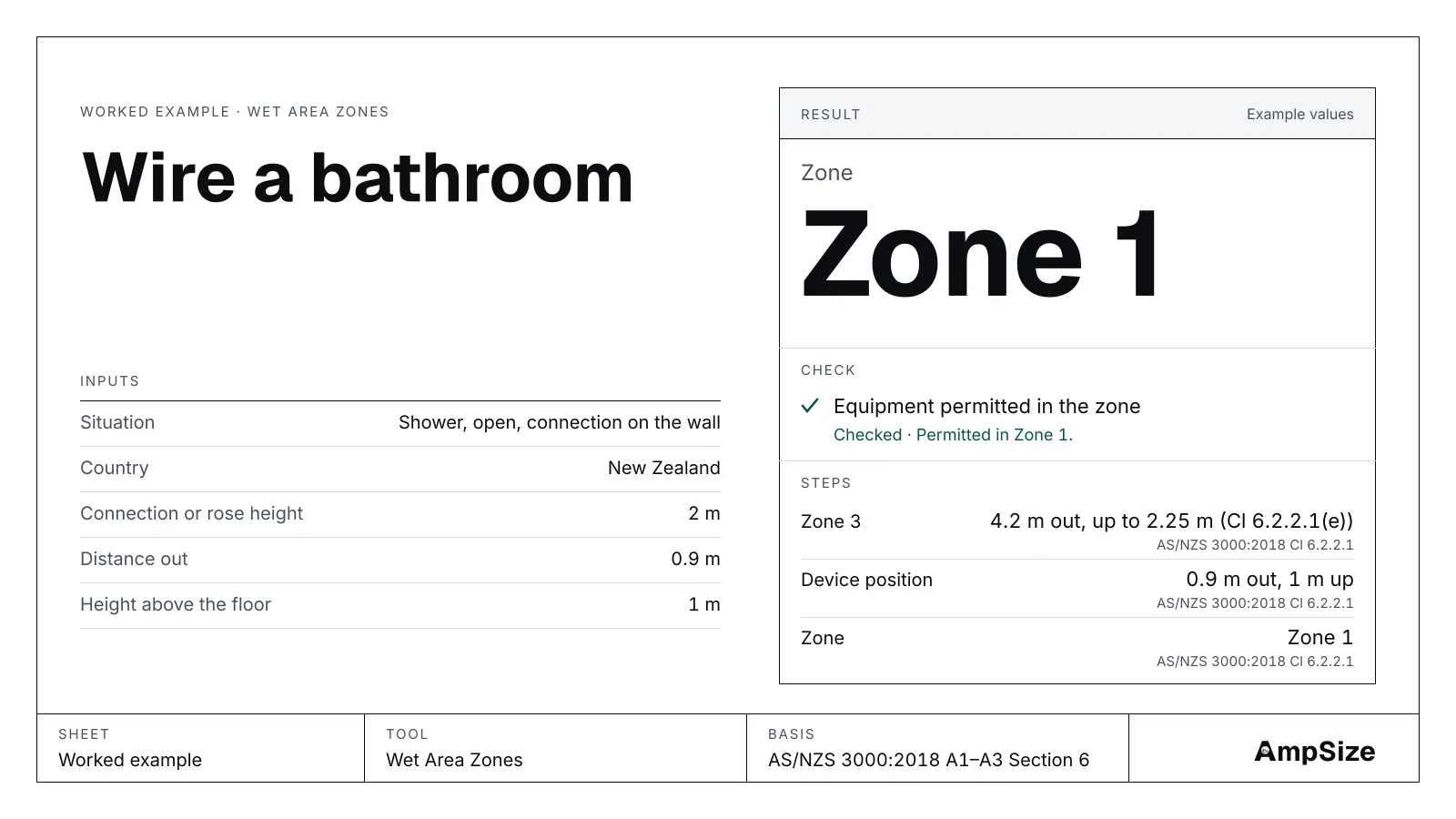
- 5 min readWire a bathroom: zones, IP ratings and the RCDA New Zealand bathroom with a 1.6 m bath and an open shower, worked through the AS/NZS 3000 Section 6 zones, the IP each item needs, the RCD and bonding.
- 6 min readAS/NZS 3008.1.1 table numbers: 2017 to 2025Each AS/NZS 3008.1.1 table AmpSize reads, with its 2017 number, its 2025 number and whether its values moved, and one submain that cites both sets.
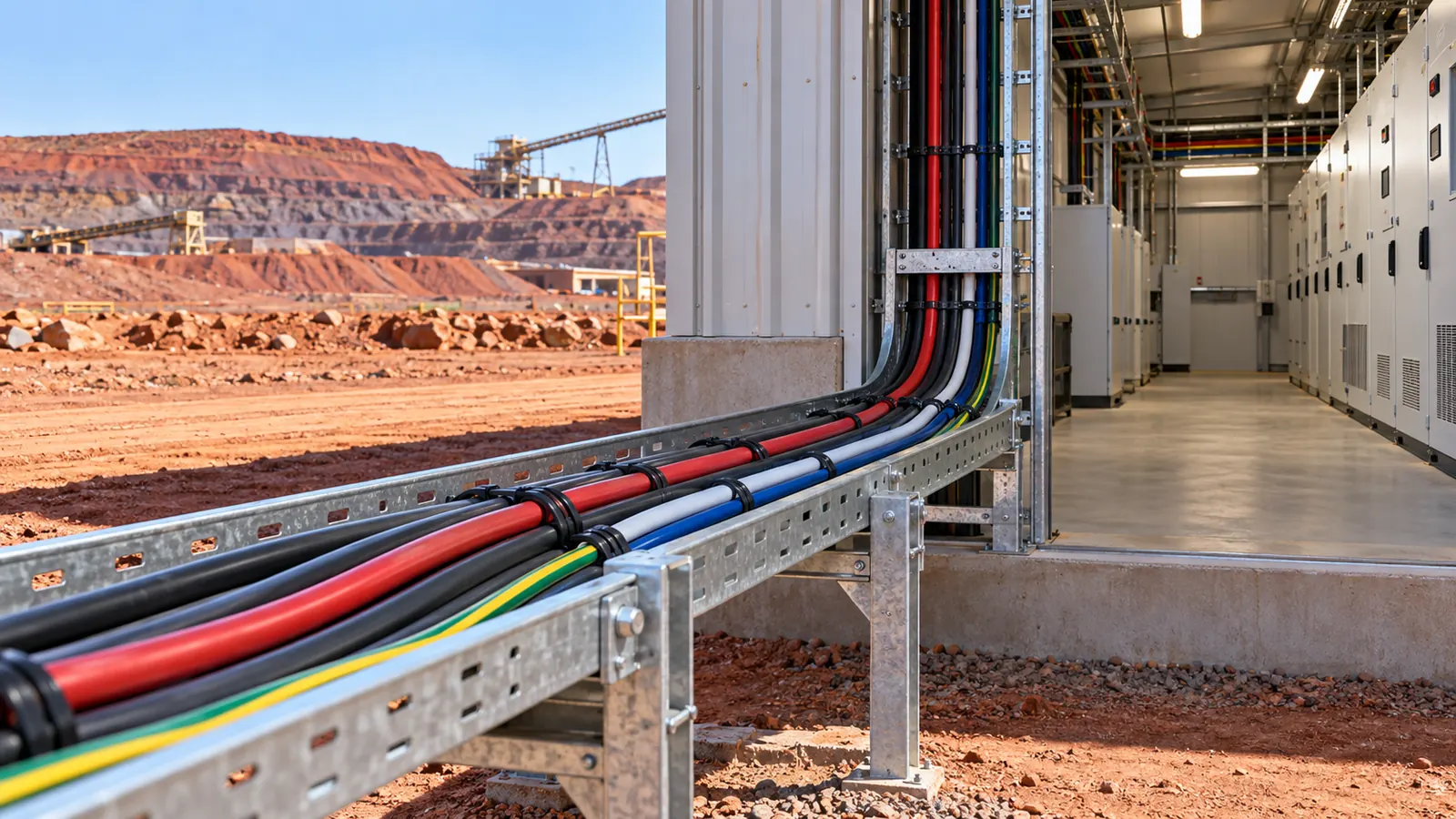
- 4 min readAS/NZS 3008.1.1 vs 3008.1.2: AU and NZ conditionsThe AU part of AS/NZS 3008.1 rates cable at 40 °C air and the NZ part at 30 °C. One 32 A circuit needs 6 mm² in Australia and 4 mm² in New Zealand.
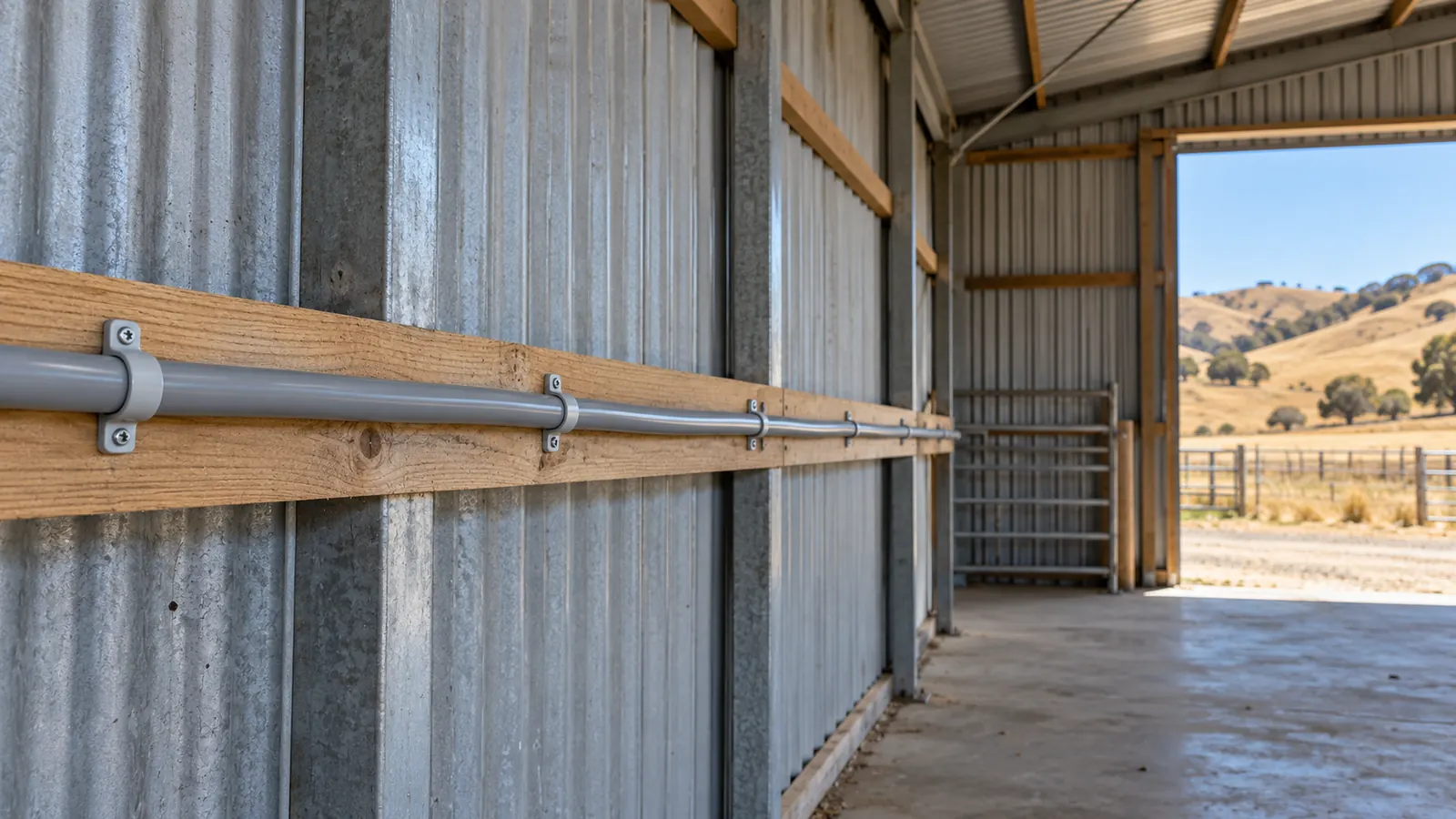
- 4 min readAS/NZS 3008 Table 13 (now 3.18): multicore ratingsWhat AS/NZS 3008 Table 13 gives, why the 2025 AU part calls it Table 3.18, how to read its columns into the calculator, and what moved for buried cable.
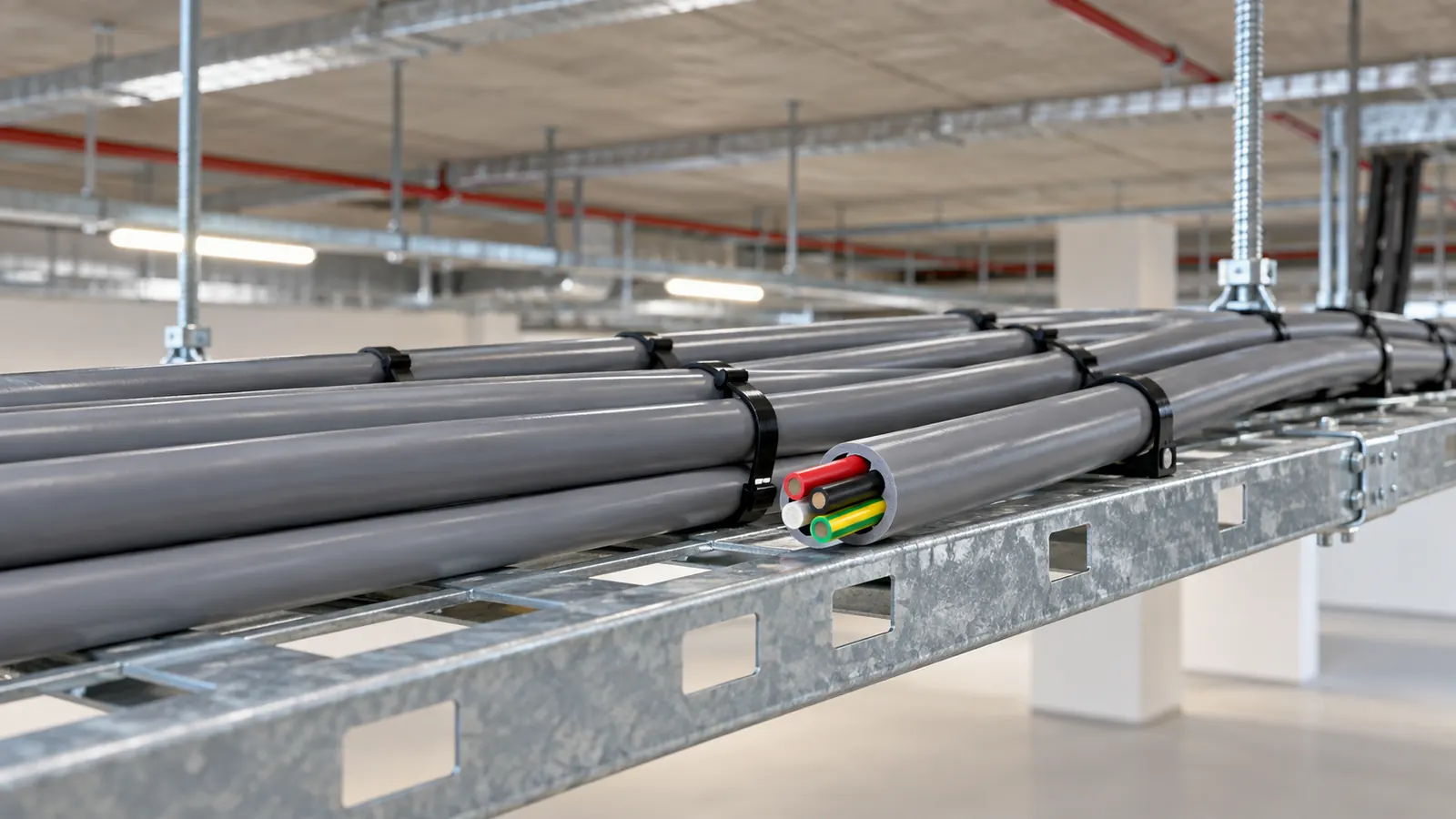
- 3 min readAS/NZS 3008 Table 22 (now 3.33): bunched groupingAS/NZS 3008 Table 22 is the grouping table for bunched circuits, not a temperature table. The 2025 AU part calls it Table 3.33. Read it in the calculator.
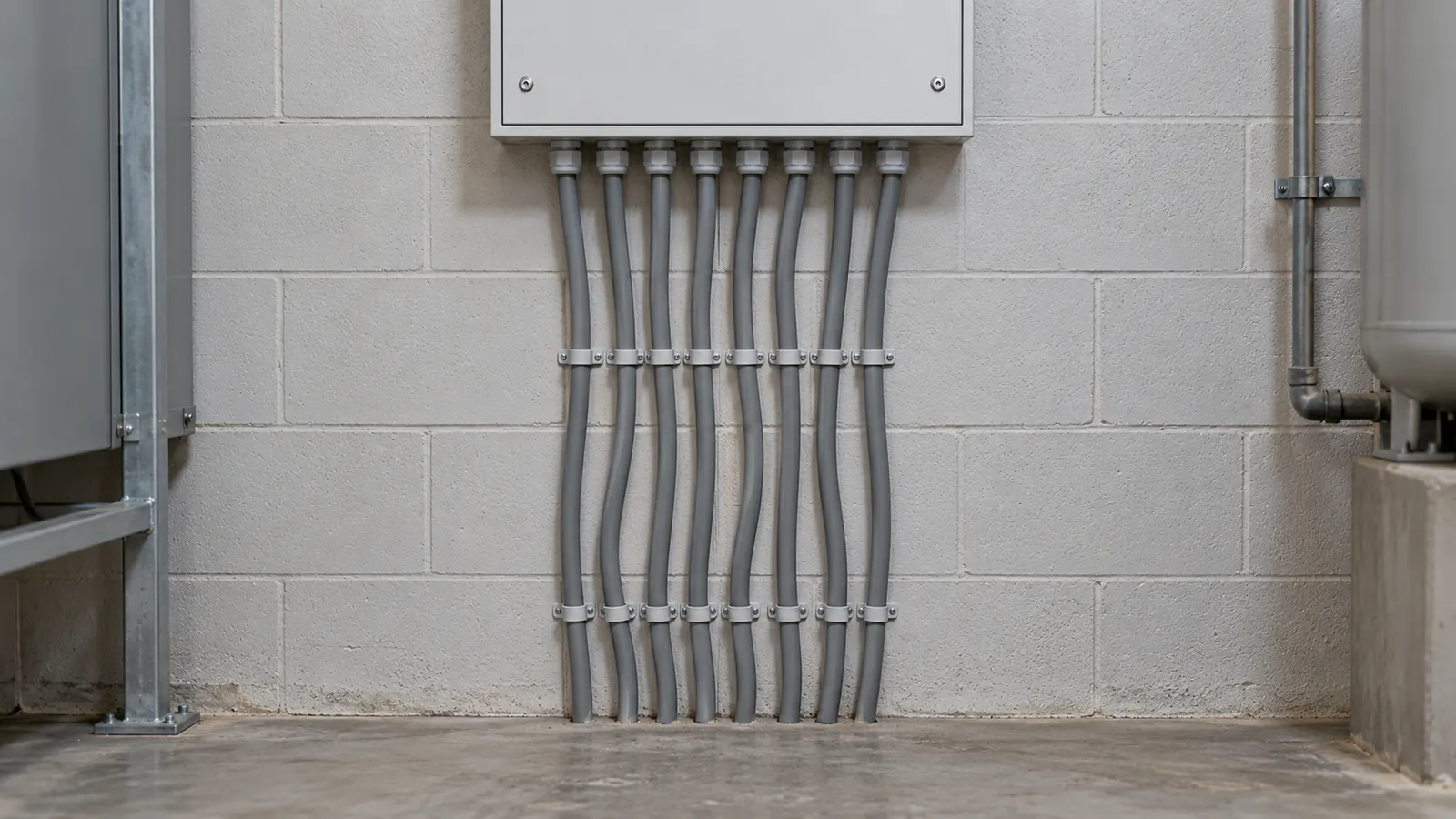
- 3 min readAS/NZS 3008 Table 27 (now 3.44, 3.45): temperatureAS/NZS 3008 Table 27 corrects a cable rating for the air or soil temperature. The 2025 AU part splits it into Tables 3.44 and 3.45 and re-derives the factors.
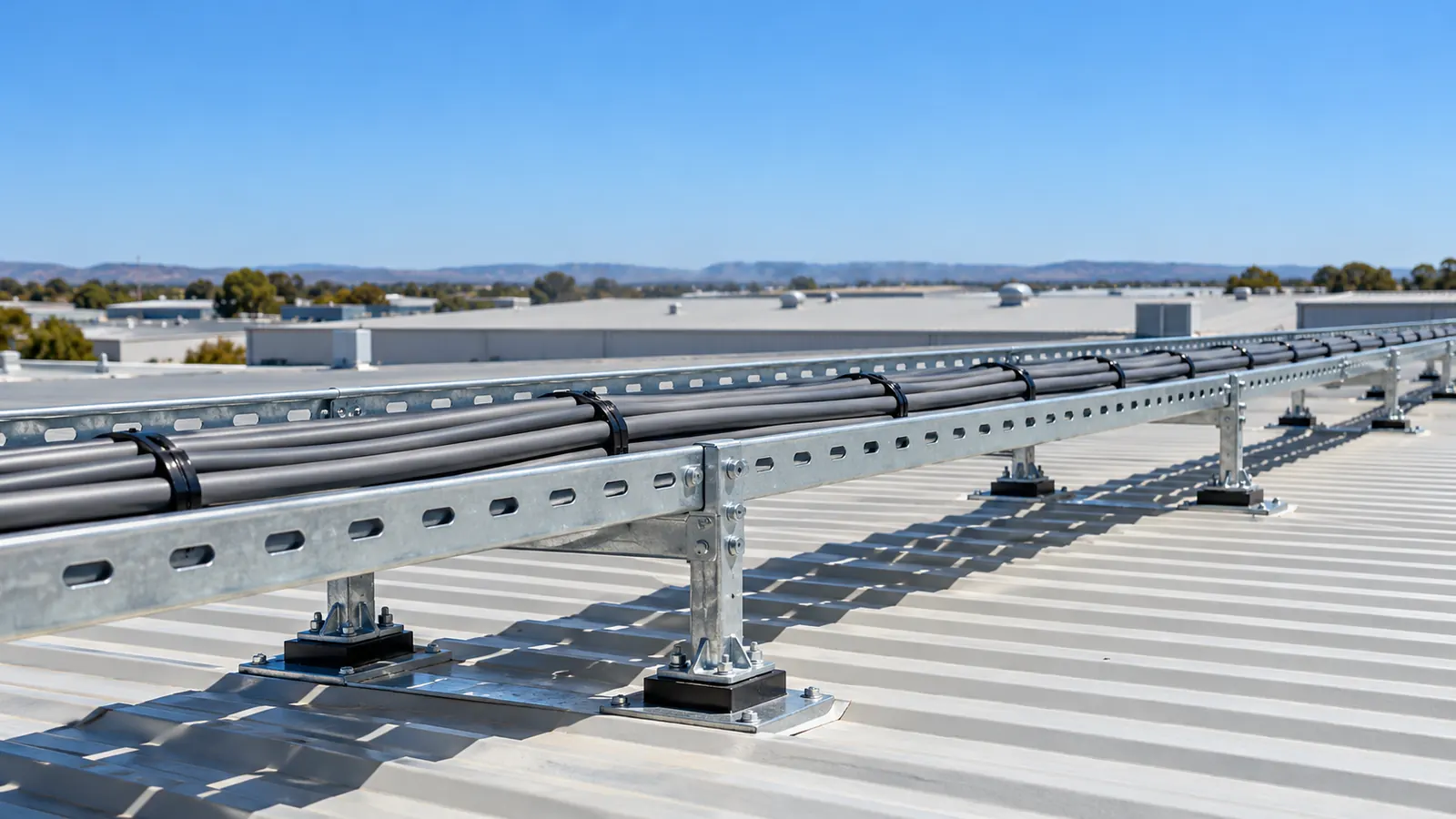
- 5 min readAS/NZS 3008 vs BS 7671: cable sizing comparedHow BS 7671 and AS/NZS 3000 with AS/NZS 3008.1 size a cable, where they differ, and why a BS current rating never converts into an AS/NZS one.
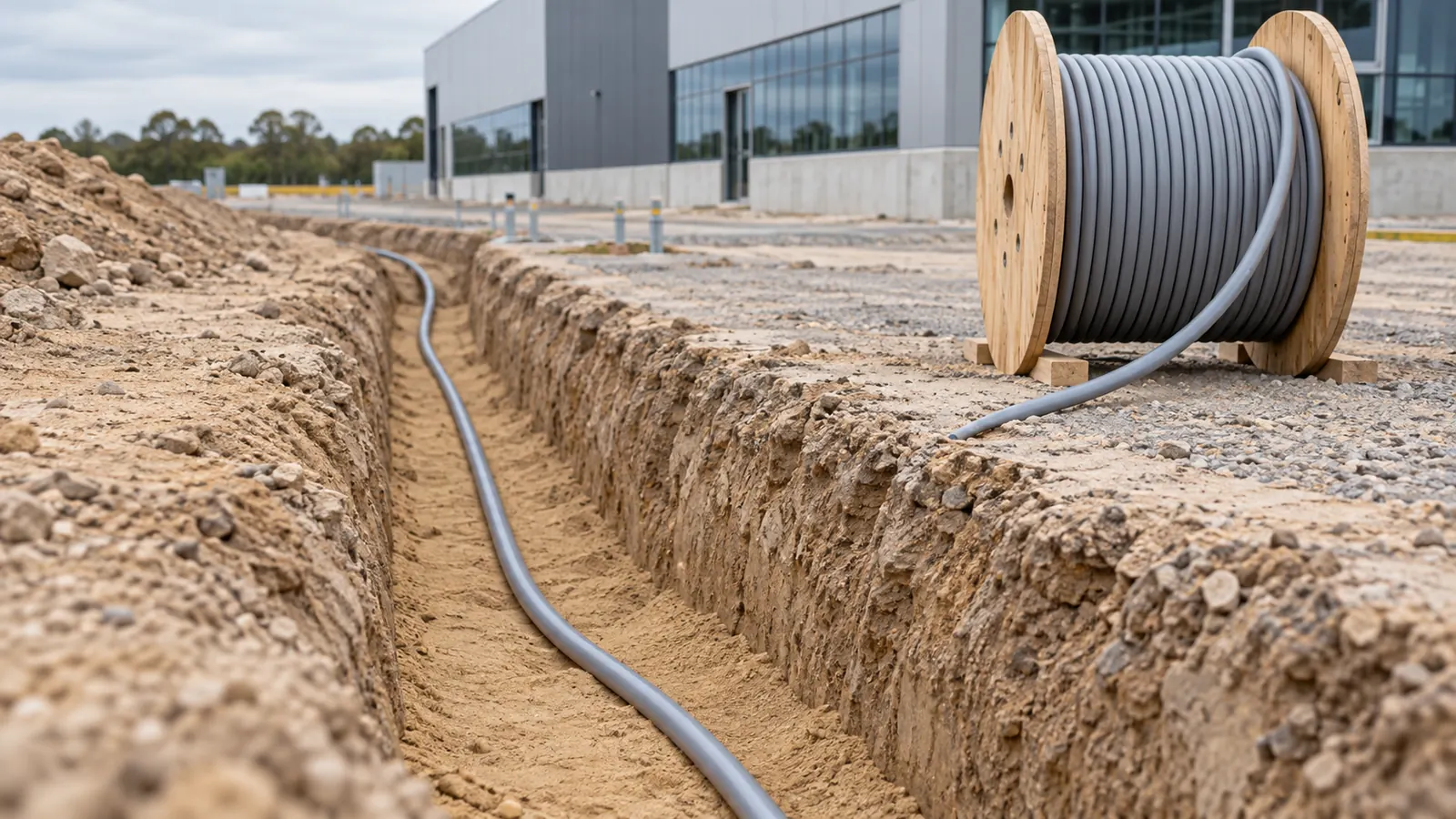
- 4 min readAWG and the NEC for NZ and AU electriciansAWG sizes and the NEC set against AS/NZS 3000 and 3008.1. A gauge converts to mm², but its rating does not, and the NEC 3 % drop figure is only a note.
- 3 min readAS/NZS 3000 Table 8.1: max Zs by curve and ratingTable 8.1 max Zs for a 16 A device, by curve. B allows 3.59 Ω, C allows 1.92 Ω and D allows 1.15 Ω. See why, with a 30 m circuit at 0.89 Ω.
- 3 min readAS/NZS 3000 Clause 3.6.2: voltage drop limitWhat Clause 3.6.2 governs, how the 5 percent budget splits across mains and subcircuits, and a 25 A run over 35 m that returns 2.6 percent from the engine.
- 4 min readCable size for a 32 A single‑phase 25 m runWork through a 32 A single-phase circuit over 25 metres in New Zealand. See every derating factor, the check that sets the size, and the result the tool gives.
- 4 min readDomestic maximum demand with Table C1Assess the maximum demand of a New Zealand house from Table C1, group by group, with a worked example that lands on 52.61 A on a single-phase supply.

- 4 min readEarth fault loop impedance and maximum ZsWhat earth fault loop impedance measures, how the maximum Zs check works, and a 32 A circuit on 6 mm² over 25 m that lands on 0.67 ohms against a 0.96 limit.
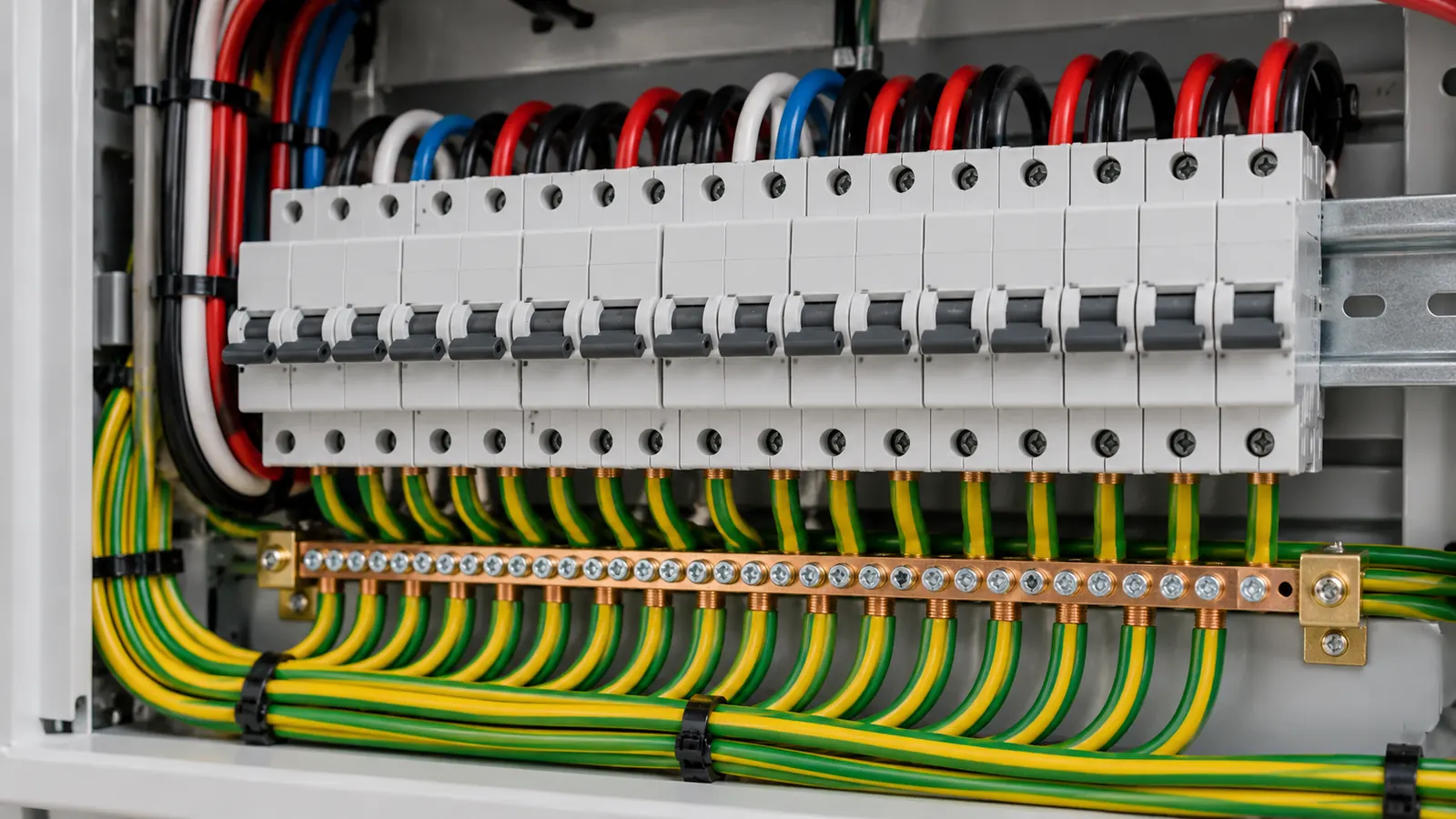
- 3 min readVoltage drop with the mV/A·m methodHow the millivolt per amp metre method works, with a 32 A run over 25 metres on 6 mm² copper and the exact drop, percent and maximum length the tool returns.
Calculators these guides use
- Maximum demand calculatorEstimate maximum demand for domestic or non‑domestic loads.
- Spare capacity calculatorSee if a new load fits the main switch of a supply.
- Cable size calculatorFind the smallest cable size that passes each check.
- Voltage drop calculatorCalculate voltage drop on a cable run and check the limit.
- Site cord length calculatorThe longest a cord or cable may run on a construction site.
- Ohm's law and powerAny two of V, I, R and P give the other two.
- RCD standing leakage budgetHow much standing leakage one RCD can carry.
- Test schedule for a switchboardPrint a board test sheet with the limit for each test.
- Electrical wire colour guideFind wire colours for fixed wiring and cords, old and new.
- Cable fault rating calculatorCheck that a conductor can withstand the fault current.
- PV isolator and earthing calculatorRate the PV array cables, d.c. isolator and earthing.
- Maximum circuit length calculatorLongest run that voltage drop and the fault loop allow.
- Existing circuit checkCheck an installed circuit: cable, device, drop and Zs.
- Conduit fill calculatorCheck that a cable bundle fits in a conduit.
- Circuit loading calculatorCount the points a final subcircuit can carry.
- Earth fault loop impedance calculatorCheck earth fault loop impedance against the maximum Zs.
- Minimum conductor size lookupLook up the smallest conductor allowed for a circuit.
- Motor starting method comparisonCompare DOL, star-delta, soft start and drive starts.
- Motor circuit calculatorCable, breaker, contactor and overload for one motor.
- Power point location checkPower points near a cooktop, gas cylinder, vent or sink.
- Downlight clearance checkIC, CA90 or Non‑IC: may insulation touch the light?
- Three phase power calculatorConvert between power, current, voltage and power factor.
- Outbuilding earthingEarth a shed: earth with the submain, or its own MEN.
- Correction factor calculatorRead each correction factor and the rating a cable needs.
- RCD arrangement checkCheck circuits per RCD and the lighting split.
- Total voltage drop calculatorAdd the drop of mains, submain and final against 5 %.
- Wet area zones checkerFind the Section 6 zone, IP and RCD near water.
- Imperial cable size converterFind the device rating for an old imperial cable.