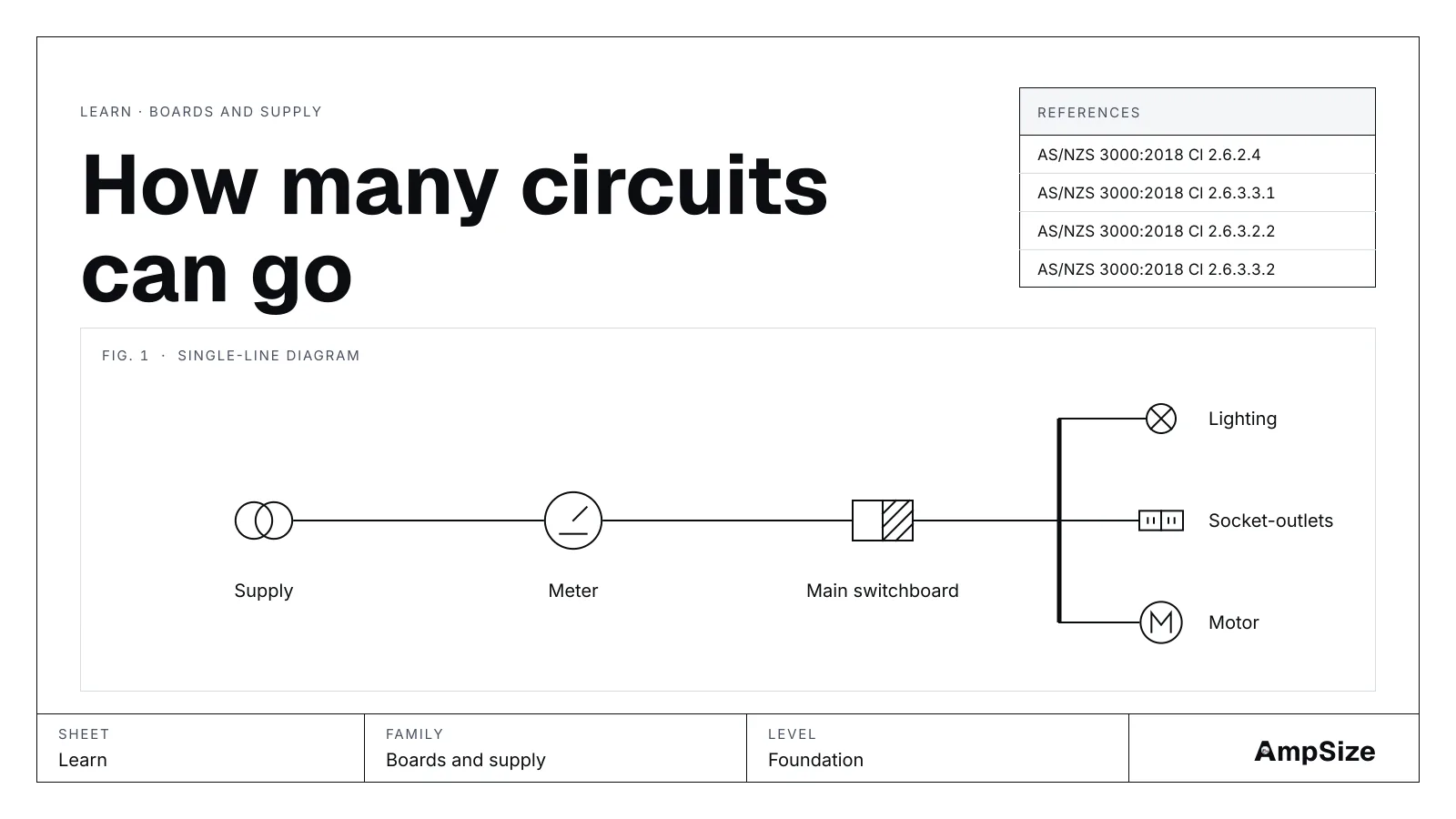
An RCD trips when current leaks to earth. When it trips, every circuit on it goes off. AS/NZS 3000 sets how the circuits of a board are spread over the RCDs, so one fault does not leave a house in the dark. This page explains the rules and which circuits they reach.
Which circuits need an RCD
The arrangement rules apply to the circuits that need additional protection by an RCD.
- New Zealand homes (Cl 2.6.3.3.1). A 30 mA RCD on every final subcircuit that supplies socket-outlets, lighting points or directly connected hand-held equipment. Fans, heater-light units and smoke alarms count as lighting points. A fixed oven or water heater is not reached.
- Australian homes (Cl 2.6.3.2.2). A 30 mA RCD on every final subcircuit, the oven and the water heater included.
- Other buildings. New Zealand sets items for schools, childcare, outdoor and public places and some equipment (Cl 2.6.3.3.2). Australia reaches socket-outlet, lighting and some direct connected circuits up to 32 A (Cl 2.6.3.2.3.3).
In both countries the RCD sits on the switchboard where the final subcircuit starts.
The three arrangement rules
Cl 2.6.2.4 has three parts.
- Spread the lighting (item (a)). In any installation with more than one RCD and more than one lighting circuit, the lighting circuits must be on more than one RCD. One trip then leaves some lights on.
- Three at most (item (b)(i)). In a residential installation, one RCD may protect three final subcircuits at most. Every circuit on that RCD counts, even one that would not need an RCD.
- Two RCDs at least (item (b)(ii)). A residential installation with more than one final subcircuit needs at least two RCDs.
Items (b)(i) and (b)(ii) apply to residential installations only. Item (a) applies to every installation.
How RCBOs count
An RCBO is a circuit breaker and an RCD in one device. It protects one circuit, so it is an RCD with one circuit on it. A board of RCBOs meets the count rule by design, and its lighting circuits are on different RCDs as long as there are two of them.
Why the rules exist
A single RCD for a whole house means one leaky appliance puts out every light and every socket. The rules limit what one trip takes out. A board of eight circuits on two RCDs loses at most three circuits when one RCD trips.
Open a house board with an RCBO.
Check a board with the RCD arrangement checker. For the residual current, trip times and device type of one circuit, use the RCD selection tool. A worked board is in RCD arrangement for a house board.