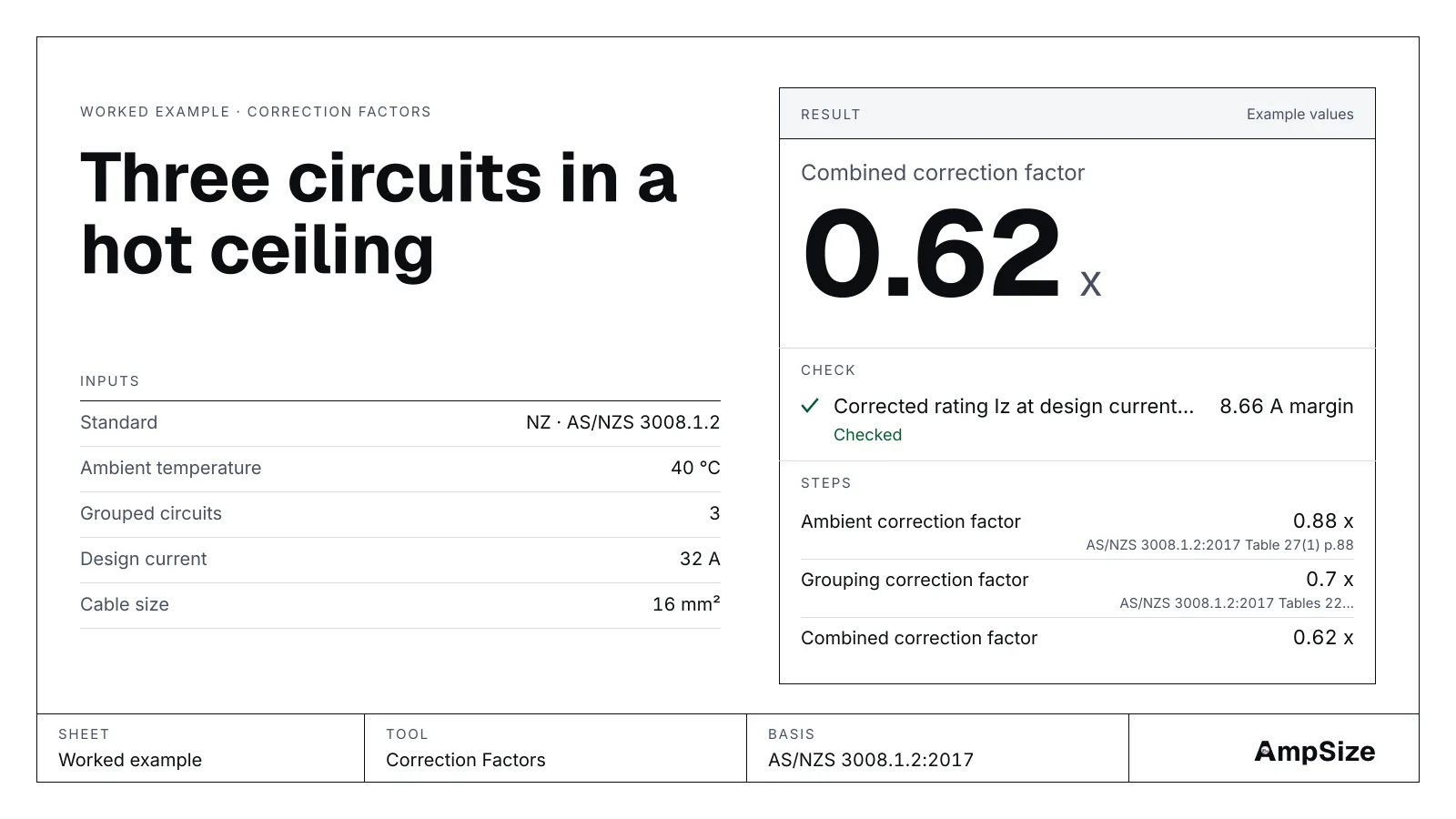
A roof space in summer is often far hotter than the room below. A cable there also shares its route with other circuits. Both conditions lower the current the cable can carry. This guide works one ceiling route with the correction factors tool. It finds the size that passes, then runs the same route on the Australian 2025 tables.
The factors themselves are explained in Correction factors in the 2017 and 2025 editions.
The site
- A new kitchen and laundry in a house in New Zealand.
- Three single-phase circuits run in one conduit across the ceiling space, for about 12 m.
- Each circuit has a design current of 32 A.
- The cable is two-core and earth, copper, PVC insulated.
- The roof is dark steel. The air in the ceiling space reaches 40 °C on a normal summer day.
- Under the ridge, near the hot-water cylinder, it can reach 50 °C.
The tool works on the tabulated rating, not the cable size. So it asks for the route first, then one size to test.
Step 1. Set the route
Pick New Zealand. The tool then reads AS/NZS 3008.1.2:2017. That part rates cables for 30 °C air, so a 40 °C ceiling gives an ambient factor below 1.
Set the method to enclosed in air, and the cables to a wiring enclosure. Enter 40 °C and three grouped circuits. Enter 32 A.
The tool reads two factors:
- Ambient correction factor, Table 27(1): 0.88.
- Grouping correction factor, Table 22, bunched or enclosed: 0.7.
The tool multiplies them. The combined correction factor is 0.62. The cable needs a tabulated current of 51.95 A to carry 32 A on this route.
Step 2. Try 6 mm², then 10 mm², then 16 mm²
The tool reads the tabulated rating from Table 13 and multiplies it by the combined factor. The result is the corrected rating Iz.
6 mm² is the first try. Its tabulated rating is 38 A. Its corrected rating is 23.41 A, so it fails by 8.59 A.
10 mm² is the next try. Its tabulated rating is 50 A. Its corrected rating is 30.8 A, so it still fails by 1.2 A.
16 mm² passes. Its tabulated rating is 66 A. Its corrected rating is 40.66 A, a margin of 8.66 A over 32 A.
A 32 A circuit on 16 mm² can surprise people. Two changes help more than a bigger cable. Run the circuits in separate conduits, or take the route below the insulation where the air is cooler.
Step 3. The hot spot at 50 °C
Change the ambient to 50 °C. The ambient factor falls to 0.72. The grouping factor stays at 0.7. The combined factor falls to 0.5, and the cable needs a tabulated 63.49 A.
16 mm² now carries 33.26 A. It still passes, but the margin is only 1.26 A. 10 mm² carries 25.2 A and fails.
Use the hottest point on the route, not the average. The cable is only as good as its worst metre.
Step 4. The same route in Australia, 2025
Now pick Australia and the 2025 edition. The tool reads AS/NZS 3008.1.1:2025. That part rates cables for 40 °C air, not 30 °C. So the tables start from a hotter base, and the numbers move.
At 40 °C, the ambient factor from Table 3.44 is 1. The grouping factor from Table 3.33 is 0.7. The combined factor is 0.7, and the cable needs a tabulated 45.71 A.
The tabulated ratings are lower too, because they already allow for 40 °C air. Table 3.18 gives 16 mm² a rating of 58 A, against 66 A in the New Zealand part. Iz is 40.6 A, almost the same as the 40.66 A in Step 2. 10 mm² carries 30.8 A and fails here too.
So a different factor does not mean a different answer. The base temperature moved, and the tabulated ratings moved with it.
Step 5. 50 °C in 2025 and in 2017
At 50 °C in 2025, the ambient factor is 0.85. The tool shows a combined factor of 0.59. The cable needs a tabulated 53.78 A, and 16 mm² carries 34.51 A. It passes by 2.51 A.
The same route on the superseded 2017 edition reads Table 27(1) instead. Its ambient factor at 50 °C is 0.82. The combined factor is 0.57, and 16 mm² carries 33.29 A.
The 2025 edition changed several ambient factors for PVC in air. Here the change is small, and 16 mm² passes on both editions. On a design near its limit, run both before you reuse an older calculation.
The result
| Route | Combined factor | Required tabulated | 10 mm² Iz | 16 mm² Iz |
|---|---|---|---|---|
| NZ 2017, 40 °C | 0.62 | 51.95 A | 30.8 A, fails | 40.66 A, passes |
| NZ 2017, 50 °C | 0.5 | 63.49 A | 25.2 A, fails | 33.26 A, passes |
| AU 2025, 40 °C | 0.7 | 45.71 A | 30.8 A, fails | 40.6 A, passes |
| AU 2025, 50 °C | 0.59 | 53.78 A | 26.18 A, fails | 34.51 A, passes |
| AU 2017, 50 °C | 0.57 | 55.75 A | 25.26 A, fails | 33.29 A, passes |
16 mm² passes the current check on every route. Before you order, run the cable size calculator. It adds voltage drop, the protective device and the fault loop to the same factors.
See also: Current-carrying capacity and derating, AS/NZS 3008.1.2 Tables 22 to 29: derating and Correction factors in the 2017 and 2025 editions.