A bathroom is the one room in a house where the wiring rules change with the distance from the water. AS/NZS 3000:2018 Section 6 divides the space around a bath and a shower into zones. Each zone sets what may go there and the least IP rating it needs. This guide walks one New Zealand bathroom, item by item, with the wet area zones tool. The zone theory is in Damp situations: the Section 6 zones.
The values come from the A1 to A3 printing of the standard. AmpSize marks the tables derived until a check against the printed page.
The bathroom
- A bath, 1.6 m by 0.7 m, along one wall.
- An open shower with no screen. The fixed plumbing connection is on the wall at 2.0 m.
- A ceiling at 2.4 m. The house is in New Zealand.
- On the plan: a downlight, an extract fan, a light switch, and a heated towel rail.
Measure each item twice: from the bath rim and from the shower connection. Use the zone that gives the stricter answer.
Step 1. Draw the zones
The shower sets the larger zones here (Cl 6.2.2.1(c)).
- Zone 0 is the inside of the bath and the inside of the shower base.
- Zone 1 for the shower runs 1.2 m out from the connection, up to 2.25 m. In Australia it runs to 2.5 m. It would rise to the connection height if that were above 2.25 m. Here it is 2.0 m, so it does not.
- Zone 1 for the bath is the space above the bath, up to the same height.
- Zone 2 runs 0.6 m beyond Zone 1, up to 2.25 m in both countries (Cl 6.2.2.1(d)).
- Zone 3 runs 2.4 m beyond Zone 2 (Cl 6.2.2.1(e)). In New Zealand it stops at 2.25 m.
A screen or a door can make Zone 1 smaller. The tool does not model a barrier, so its zones are the larger ones.
Step 2. The downlight
The downlight sits in the ceiling, 0.8 m from the shower connection, at 2.4 m.
In New Zealand every zone stops at 2.25 m. So the light is outside every zone, and Section 6 asks no IP rating of it. In Australia, Zone 1 runs to 2.5 m and the same light is in Zone 1. There it needs IPX4 (Cl 6.2.4.1(b)). Check the downlight in the tool.
With a ceiling at 2.25 m or lower, the light falls in Zone 1 in New Zealand too. An IPX4 light is then the simple choice. A recessed fitting with all its live parts above the ceiling counts as outside the zone below it (Cl 6.2.1).
Step 3. The extract fan
The fan sits on the wall at 2.1 m, 1.5 m from the shower connection. That is past Zone 1 (1.2 m) and inside Zone 2 (1.8 m), below 2.25 m. So the fan is in Zone 2 and needs IPX4 (Cl 6.2.4.5).
In New Zealand an exhaust fan counts as a lighting point for the RCD rule. Step 6 covers that.
Step 4. The light switch
The switch goes by the door at 1.2 m, 3.5 m from the bath rim and 4.5 m from the shower connection. Zone 3 ends 3.0 m from the bath rim and 4.2 m from the shower connection. So the switch is outside every zone, and Section 6 asks no IP rating of it.
Keep every switch and socket-outlet at 0.3 m or more above the floor of a bathroom or laundry, in or out of a zone (Cl 6.2.4.2 and 6.2.4.3). AmpSize reads that height at the centre of the accessory.
Step 5. The heated towel rail
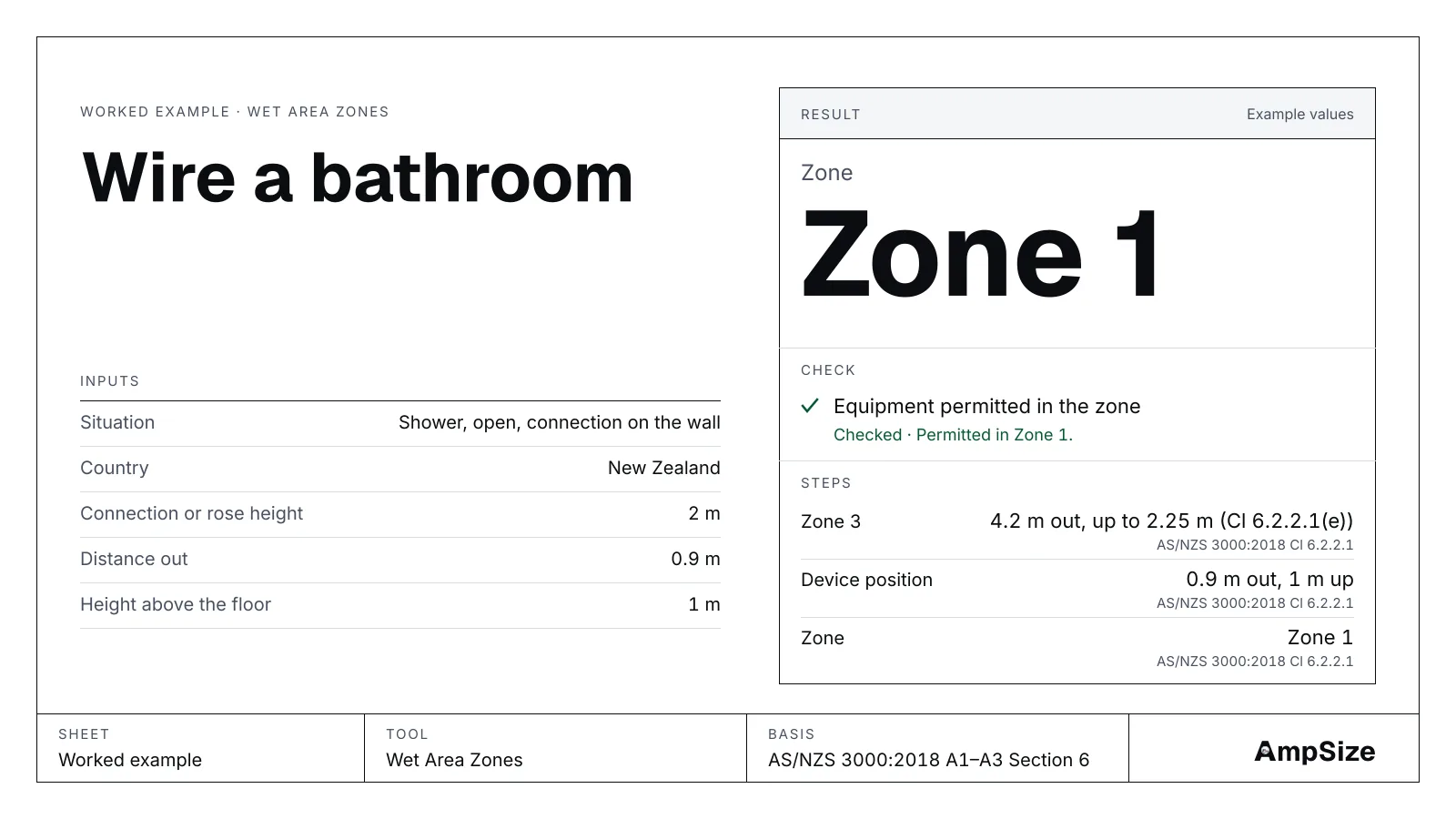
The rail hangs at 1.0 m, 0.9 m from the shower connection. That is inside the 1.2 m of Zone 1, so the rail is in Zone 1.
AS/NZS 3000 has no special rule for a towel rail. It is other electrical equipment, so Zone 1 asks IPX4 (Cl 6.2.4.5). Check the maker's label for IPX4, IPX5 or IPX6. Check the rail in the tool.
From the bath alone, the same rail would be 0.9 m from the rim, in Zone 3. The shower gives the stricter zone, so Zone 1 governs.
Step 6. The RCD
Section 6 asks a 30 mA RCD for a socket-outlet in Zone 2 or Zone 3. None of these items is a socket-outlet.
In a New Zealand home, Cl 2.6.3.3.1 asks 30 mA on the socket-outlet, lighting and hand-held circuits. The downlight and the fan are on the lighting circuit, so they get the RCD. A towel rail on a socket-outlet gets it from that circuit. In an Australian home, every final subcircuit takes a 30 mA RCD. The RCD selection tool gives the device for each circuit. RCD types and where they are required explains the types.
Step 7. Bonding
Bond any conductive reinforcing in a concrete floor or wall of the bathroom to the earthing system (Cl 5.6.2.5). The bonding conductor is 4 mm² or larger (Cl 5.6.3.2(b)).
The result
| Item | Position | Zone (NZ) | Needs |
|---|---|---|---|
| Downlight | 0.8 m from the connection, 2.4 m up | Outside | No IP rating |
| Extract fan | 1.5 m from the connection, 2.1 m up | Zone 2 | IPX4 |
| Light switch | 4.5 m from the connection, 1.2 m up | Outside | 0.3 m above the floor |
| Towel rail | 0.9 m from the connection, 1.0 m up | Zone 1 | IPX4 |
A bathroom also adds load to the house. The domestic maximum demand guide shows the Table C1 group a small fixed item such as a bathroom fan falls in.