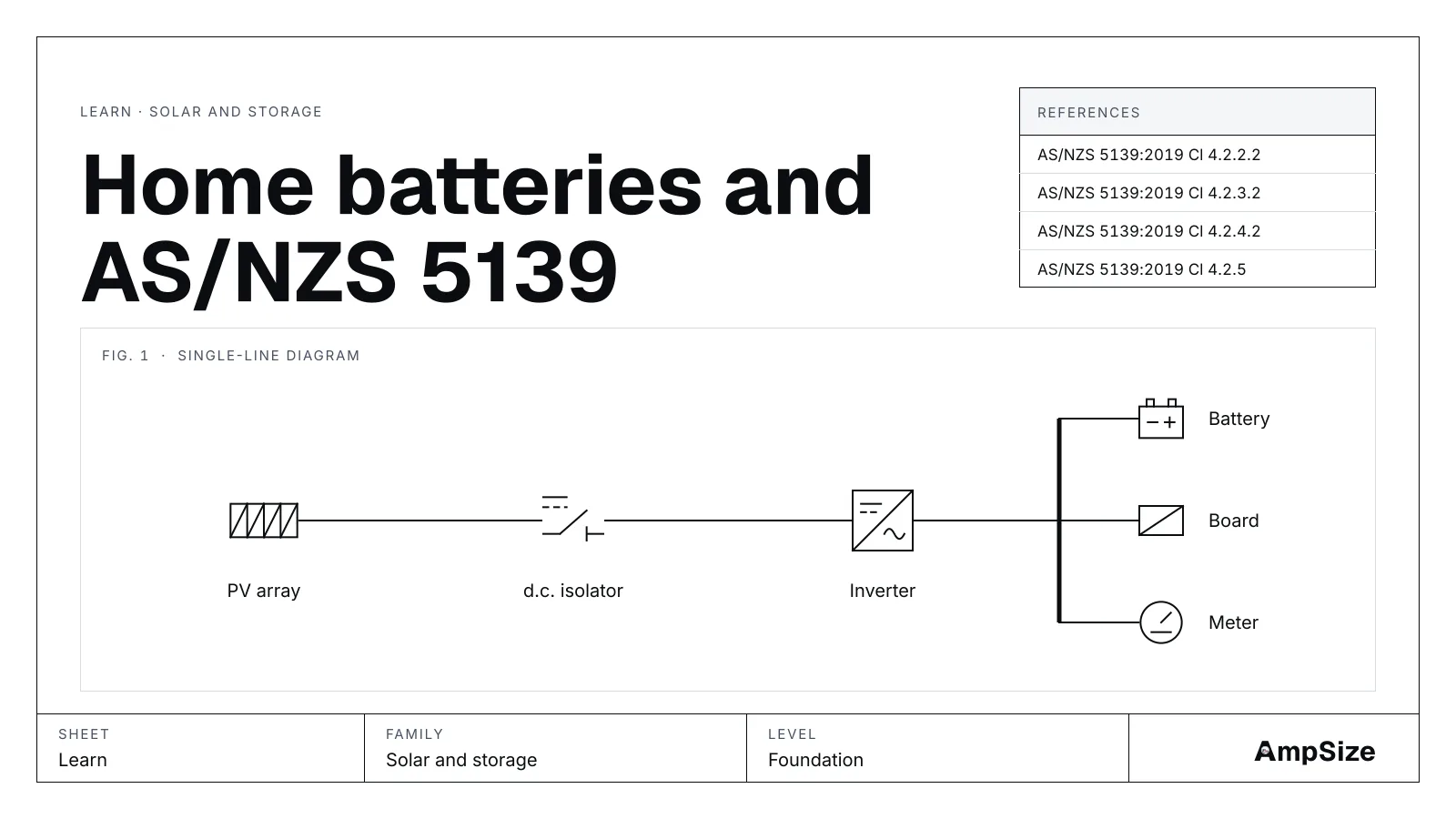
A grid-tied home battery moves solar energy from the middle of the day to the evening. It is sized in kilowatt hours, the energy it holds, and its inverter in kilowatts, the power it can give at once. This page explains the numbers on a battery data sheet and the rules for where it goes.
Energy and power
- kWh is energy. A home that uses 16 kWh in the evening needs a battery that can deliver 16 kWh between sunset and sunrise.
- kW is power. The inverter must carry the largest load that runs at once, such as an oven, a heat pump and a kettle together.
A big battery with a small inverter cannot run the oven. A small battery with a big inverter runs it, but not for long.
Usable and nominal capacity
A battery never lets you empty its cells. The depth of discharge is the share it lets you use. Lithium iron phosphate home batteries allow about 90 % or more.
- Nominal capacity is the full size on the data sheet.
- Usable capacity is nominal × depth of discharge. A 10 kWh battery at 90 % gives 9 kWh usable.
Round-trip efficiency
Some energy turns to heat as the battery charges and as it discharges. Round-trip efficiency is the energy out over the energy in. At 90 %, about 5 % is lost each way. So the battery must hold a little more than the evening needs, and the panels must put in a little more than that.
How the tool sizes a battery
The solar battery calculator takes the steps in order:
- Evening energy = daily use × the evening share.
- Each extra day of autonomy adds a whole day of use.
- Usable capacity = that energy ÷ the square root of the round-trip efficiency.
- Nominal capacity = usable ÷ the depth of discharge, then rounded up to whole modules.
- Inverter = the next common size at or above the peak load.
- Spare solar = PV size × daily yield, less the daytime use. It must cover the evening energy plus the losses.
Use your power bill for the daily use. A smart meter download shows the evening share.
Where a battery can go
AS/NZS 5139:2019 sets the installation rules for battery systems. Its Section 4 covers a pre-assembled integrated battery energy storage system, the all-in-one home battery.
- Places it must not go (Cl 4.2.2.2): a habitable room of a home, a ceiling space, a wall cavity, under a stairway or walkway, an escape route, and the restricted locations for a switchboard. A roof only where the site is deemed suitable.
- Clearances (Cl 4.2.2.2): 600 mm from an exit, from a window or vent of a habitable room and from other appliances, and 900 mm below them.
- IP rating (Cl 4.2.3.2): IP2X at least, and IP23 outdoors.
- A wall to a habitable room (Cl 4.2.4.2): the wall must be non-combustible 600 mm past each side of the battery and 900 mm above it.
- Working space (Cl 4.2.5): 600 mm on the working side, 900 mm where 230 V a.c. connections are reached, or the maker's figure if larger.
Garages, storage rooms, verandas and outside walls are the usual places.
Off-grid banks
An off-grid or backup system is sized differently: from each load's watts and hours, at a set d.c. voltage, in amp hours. The battery bank calculator does that. Size the battery cable with the DC cable size tool.
What the tool leaves out
The tool uses one average day. Winter solar is lower, and the tool warns when the surplus cannot fill the battery. It reads Section 4 only. AmpSize does not hold Amendment 1 (2025), so check it for changes before you design.