A 12 V feed in a caravan or a ute carries a large current at a low voltage. A small loss in volts is a large share of 12 V. This guide checks one 12 V feed with the voltage drop calculator in d.c. mode. It then checks a 48 V battery run. The theory is in DC voltage drop and conductor resistance.
The circuit
- A ute charges the caravan battery and runs the fridge through one 12 V feed.
- The feed carries 30 A at most.
- The route is 6 m from the battery to the load, measured along the cable.
- The cable is copper twin with PVC insulation: two cores in one sheath.
- The circuit is extra-low voltage, so the limit is 10 % (AS/NZS 3000 Cl 7.5.7). At 12 V that is 1.2 V.
Step 1. Set the tool to d.c.
Open the voltage drop calculator and set Supply to d.c. The phases and power factor fields hide. Set System to Extra-low voltage, then enter 12 V, 30 A and 6 m. Set Cores to multicore, because twin cable has two cores in one sheath.
The tool reads the d.c. resistance of one conductor from AS/NZS 3008.1.1:2025. Multicore cable reads Table 4.8(A). The value is at 75 °C, the maximum conductor temperature for PVC. The tool reads the same table in New Zealand and in Australia.
Step 2. Try 4 mm²
4 mm² copper has a d.c. resistance of 5.61 Ω/km. The tool doubles it for the two wires and gets 11.22 mV/A·m. The drop is 11.22 × 30 A × 6 m ÷ 1000 = 2.02 V. That is 16.83 % of 12 V, so 4 mm² fails. Check 4 mm² in the tool.
Step 3. Try 6 mm²
6 mm² has a resistance of 3.75 Ω/km, so the figure is 7.5 mV/A·m. The drop is 1.35 V, or 11.25 %. It still fails, just above the limit. The longest run that 6 mm² allows at 30 A is 5.33 m. Check 6 mm² in the tool.
Step 4. Try 10 mm²
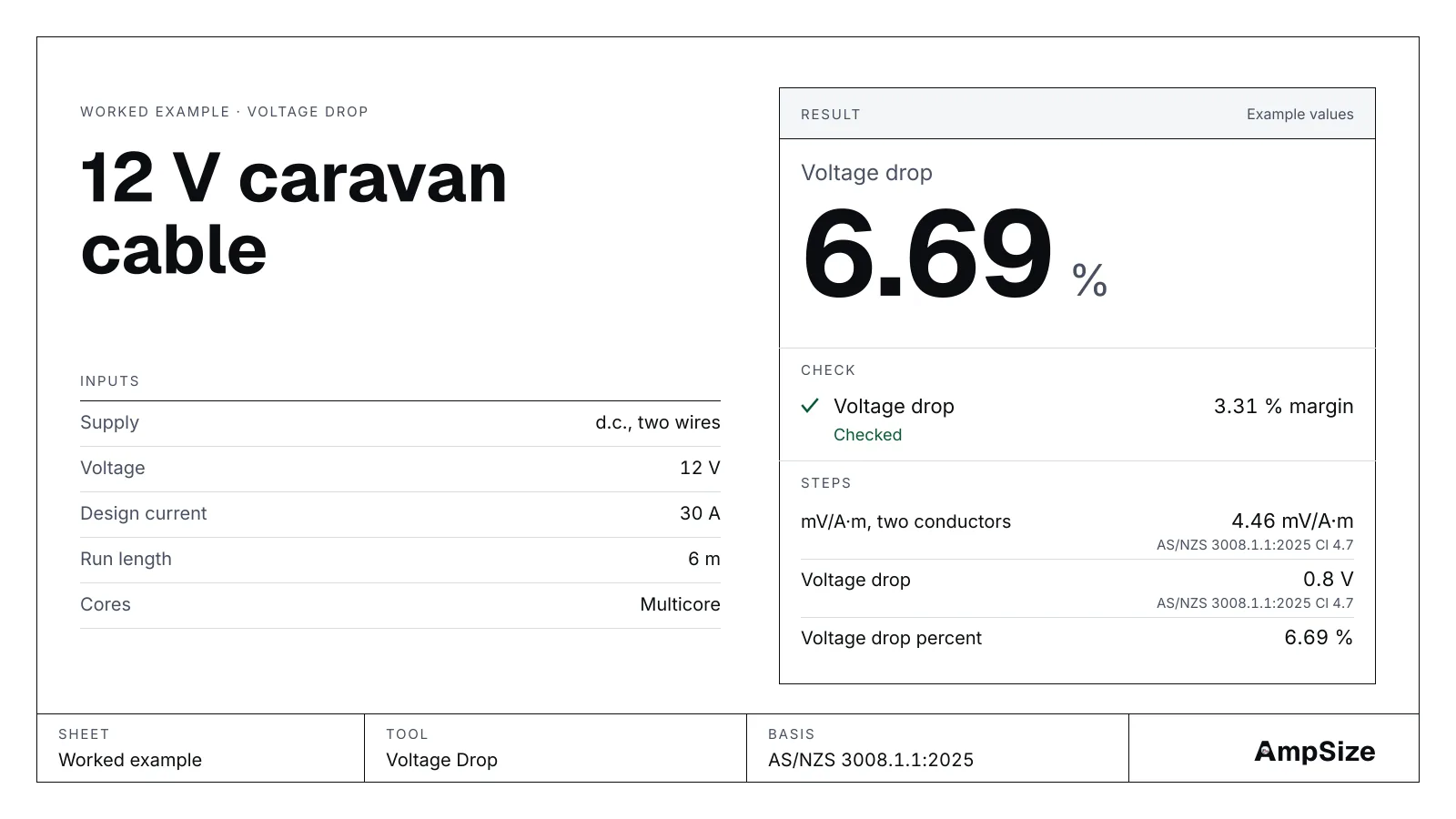
10 mm² has a resistance of 2.23 Ω/km, so the figure is 4.46 mV/A·m. The drop is 0.8 V, or 6.69 %. It passes. The maximum length at the limit is 8.97 m, so the run has some room. Check 10 mm² in the tool.
| Twin cable | Resistance | mV/A·m | Drop | Percent | 10 % limit |
|---|---|---|---|---|---|
| 4 mm² | 5.61 Ω/km | 11.22 | 2.02 V | 16.83 % | Fails |
| 6 mm² | 3.75 Ω/km | 7.5 | 1.35 V | 11.25 % | Fails |
| 10 mm² | 2.23 Ω/km | 4.46 | 0.8 V | 6.69 % | Passes |
Why the length counts twice
The current leaves the battery on the positive wire and returns on the negative wire. A 6 m route therefore puts 12 m of conductor in the circuit. That is why the tool doubles the resistance.
Check it on 6 mm². One 12 m conductor at 30 A drops 30 × 3.75 × 12 ÷ 1000 = 1.35 V. That is the same 1.35 V that the tool gives for the 6 m route.
The drop also rises in step with the route. Move the load to the back of the van, 12 m from the battery. On 6 mm² the drop doubles to 2.7 V, or 22.5 %. Check 6 mm² over 12 m. Halve the route to 3 m and the drop falls to 0.68 V, or 5.63 %. Check 6 mm² over 3 m.
At 12 m, 10 mm² fails at 1.61 V, or 13.38 %. Check 10 mm² over 12 m. 16 mm² passes at 1.01 V, or 8.4 %. The tool warns that this is close to the limit. Check 16 mm² over 12 m.
A short run saves copper, so put the battery near the load where you can.
Step 5. A 48 V battery to an inverter
A house battery at 48 V feeds an inverter 5 m away. The inverter draws 100 A from the bank. The cables are two single-core copper cables with PVC insulation, so set Cores to single core. The tool then reads Table 4.6(A). The circuit is still extra-low voltage, so the limit is 10 %, or 4.8 V.
35 mm² has a resistance of 0.637 Ω/km, so the figure is 1.27 mV/A·m. The drop is 0.64 V, or 1.33 %. The maximum length at the limit is 37.68 m. Check the 48 V run in the tool.
Even 16 mm² passes the drop at 1.4 V, or 2.92 %. Check 16 mm² at 48 V. At 48 V the same 10 % allows four times the volts of a 12 V circuit. On a short battery run, the current rating usually sets the size, not the drop.
Size for current as well
The voltage drop calculator checks the drop only. It does not check that the cable carries the current. The DC cable size calculator sizes the cable for current and drop together. It reads the printed d.c. mV/A.m of Tables 4.16 to 4.23. Its drop can differ from this tool in the last digit. DC cable size: 48 V battery and 600 V PV array works the 48 V case that way.
Protect the feed
Fit a fuse or circuit breaker at the battery end of every feed. A battery can deliver a large fault current, so check the device against the battery maker's figure.
See also: DC voltage drop and conductor resistance, Voltage drop basics and 24 V DC voltage drop on an instrument loop.
This page is a design aid. Verify every value against the current edition of the standard.