

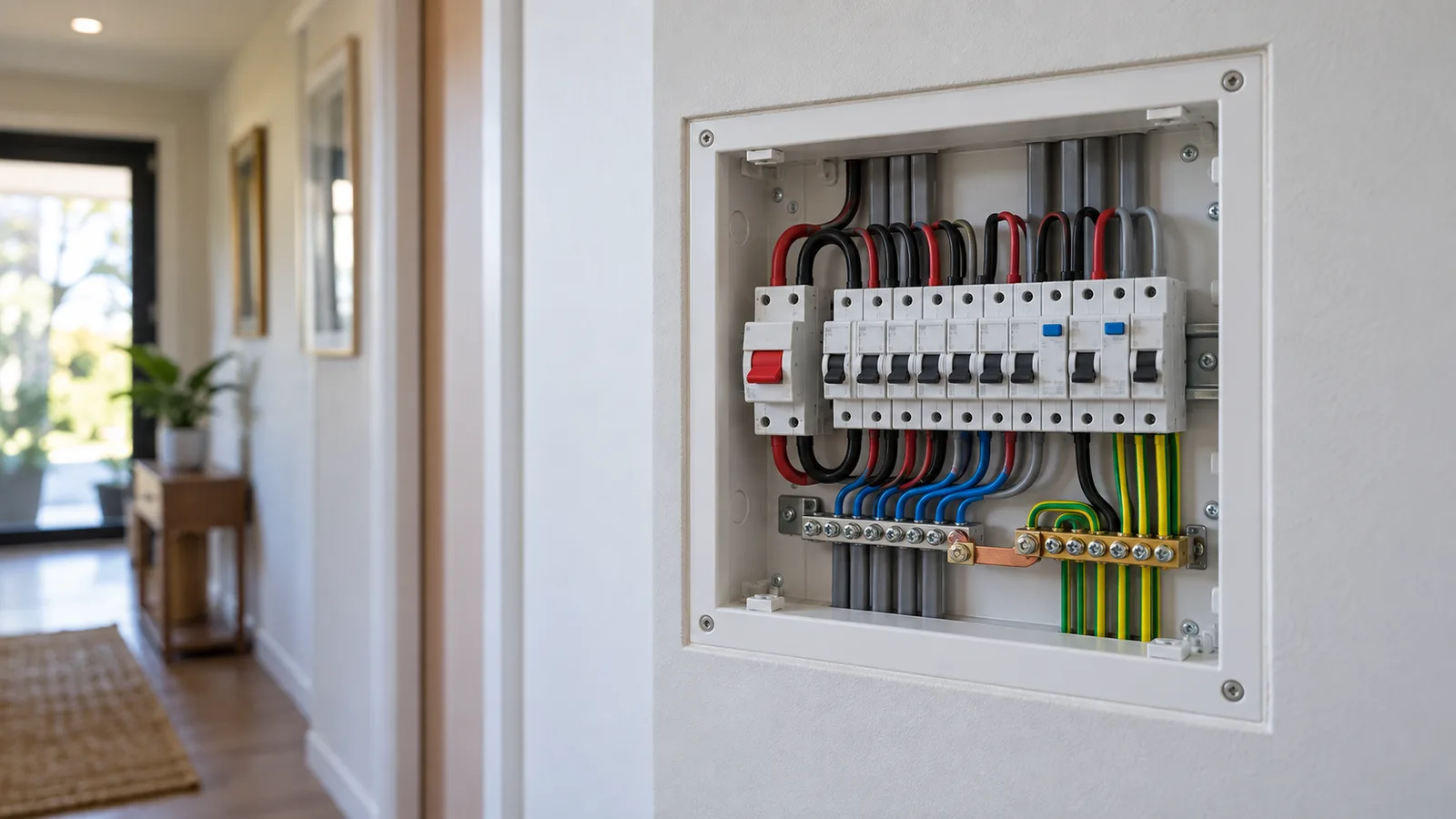
An earth fault only clears if enough current flows. Enough current only flows if the loop the fault travels around has a low enough impedance. That is the whole idea behind the maximum Zs check, and it is why a circuit can be correctly sized for current and still be unsafe.
The loop
Picture the path. Current leaves the supply transformer, runs down the active conductor to the fault, returns along the earth conductor, and goes back through the supply. Every part of that path has impedance. Added together they are Zs.
Zs splits into two parts:
- Ze is everything outside the installation: the transformer, the network and the service. It is measured at the origin, or taken from the network operator.
- R1 + R2 is everything inside: the active conductor out and the earth conductor back.
Cl 5.7.4 of AS/NZS 3000:2018 is the requirement. The impedance has to be low enough for the protective device to open inside the disconnection time.
A worked circuit
A 32 A curve C circuit breaker feeds a 25 m run. The active is 6 mm² copper with PVC insulation, 230 V to earth. The earth conductor is left on automatic, so the tool sizes it from the table. Ze is 0.35 Ω.
The tool works through it like this.
Earth conductor. Table 5.1 gives the smallest earth for a 6 mm² active. Here that is 2.5 mm². The earth is smaller than the active, which is normal and is exactly why it dominates the resistance of the loop.
R1 + R2 per kilometre. The active and earth resistances add to 12.76 Ω/km at the operating temperature.
R1 + R2 for the run. Over 25 m that is 0.32 Ω.
Zs. 0.35 Ω of supply plus 0.32 Ω of cable gives 0.67 Ω.
The limit. Table 8.1 gives the highest loop impedance for a 32 A curve C device. That is 0.96 Ω. The circuit passes, with about a third of the budget spare.
Fault current. At 0.67 Ω the prospective earth fault current is 343.8 A, which is well into the instantaneous region of a curve C device at this rating.
The number that matters most
The tool also reports the maximum length at Zs: 47.68 m. That is how far this circuit could run before the loop impedance reaches the limit. It turns the check into a design rule you can carry around. On this cable, with this device and this Ze, stay under about 47 m.
What pushes Zs up
Length. The relationship is linear. Double the run, double R1 + R2.
A small earth conductor. The automatic size is the minimum, not the best. Going up one size on the earth alone is often the cheapest way to bring a long circuit inside the limit.
A high Ze. Rural and end-of-line supplies can have a much higher Ze than the value used in an urban design. If Ze is not known, measure it rather than assume it.
A curve D device. Curve D needs far more current to trip instantaneously, so its maximum Zs is much lower than curve B or curve C at the same rating. Swapping a curve C for a curve D to stop nuisance tripping can quietly break the loop impedance check.
Calculated against measured
The figure here is a design value. It uses tabulated conductor data at the operating temperature. The value you measure at the outlet with a loop tester is taken at ambient temperature and on the installation as built, so the two will not match exactly. Both have a place: calculate at design time to choose the conductors, measure at commissioning to prove the result.
If the measured value is close to the limit, look at the earth conductor size and the route length before anything else. They are the two things you can change.
AmpSize is a design aid. Verify results against the current standard.