Solar guides
Voltage rise on inverter and array cables, and sizing a battery cable for a solar job.
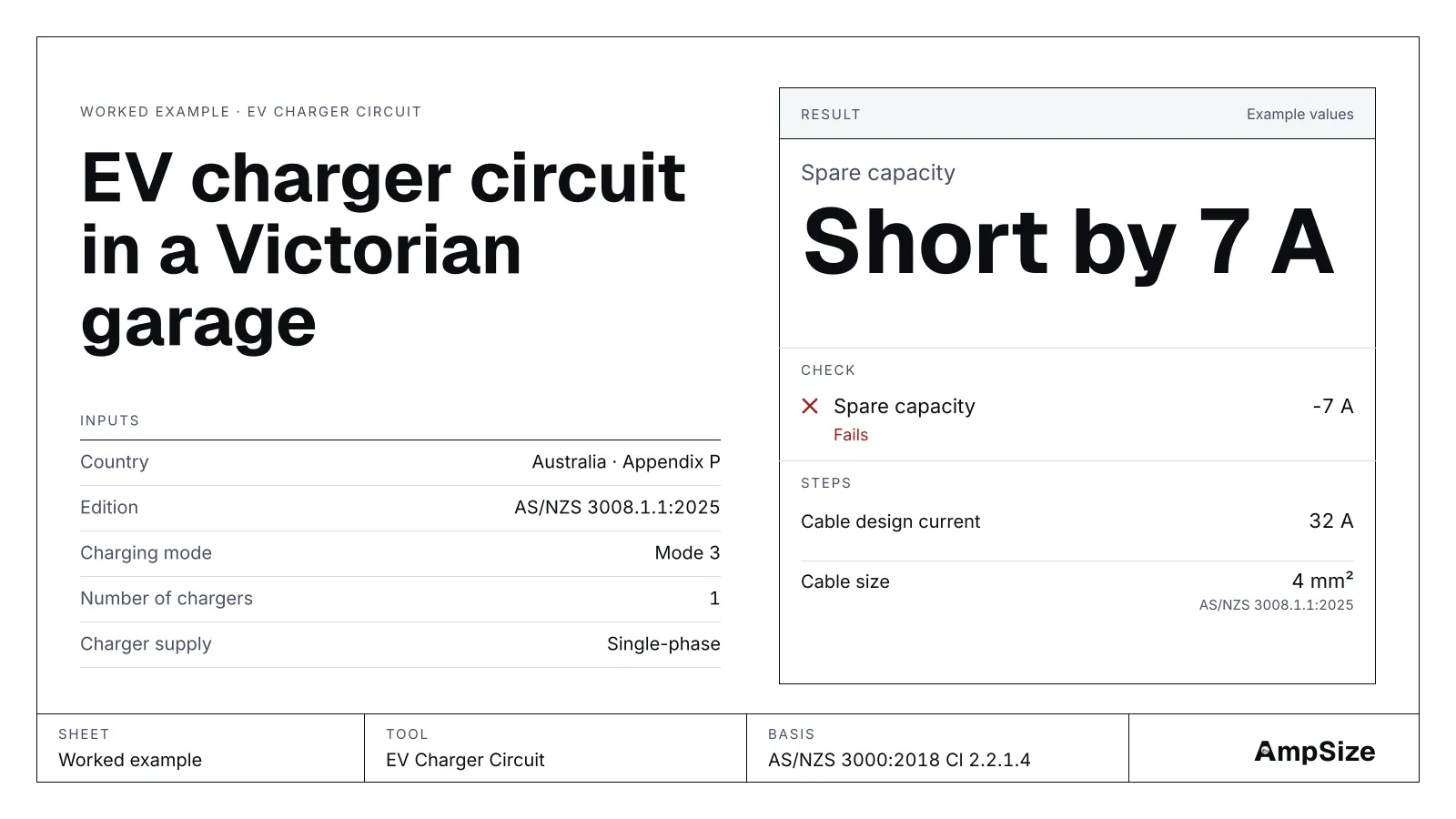
- 4 min readEV charger circuit in a Victorian garageA 32 A single-phase EV charger on a Victorian house board, checked against spare capacity with the Appendix P demand, then closed with load management.
- 5 min readWorked examples index by tool and tradeEvery AmpSize worked example in one place, grouped by calculator and tagged with the trade it was written for, from house circuits to industrial boards.
- 3 min readPV cable conduit size for six 6 mm² singlesSix 6 mm² single core PV string cables in 32 mm conduit, with the fill percent against the 40 percent space factor and the smallest conduit that fits them.
- 3 min readAS/NZS 3000 Cl 7.9: EV charging in NZWhat Clause 7.9 of AS/NZS 3000 governs for EV charging circuits, which tools read it, and a 32 A garage charger that lands on 10 mm² over 25 m.
- 3 min readVoltage rise on a long rural PV run of 80 mVoltage rise for a 5 kW inverter over an 80 m rural run on 25 mm² cable, with the rise in volts and percent and the maximum length at the 2 % limit.
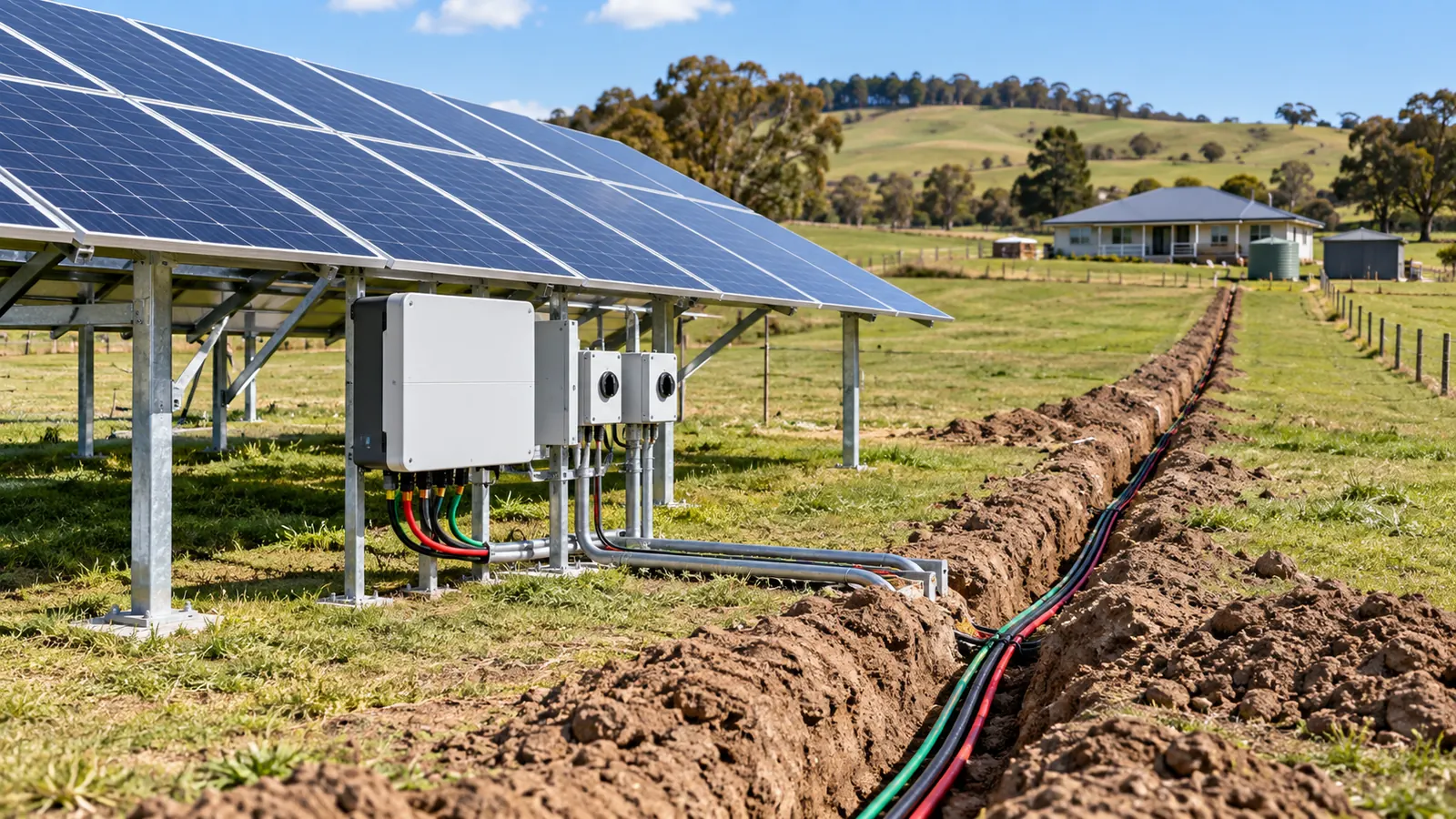
- 3 min readBattery bank for three days autonomy in winterBattery capacity for three days autonomy from a 6 kWh daily load at 48 V, with depth of discharge, inverter efficiency and a winter temperature factor.
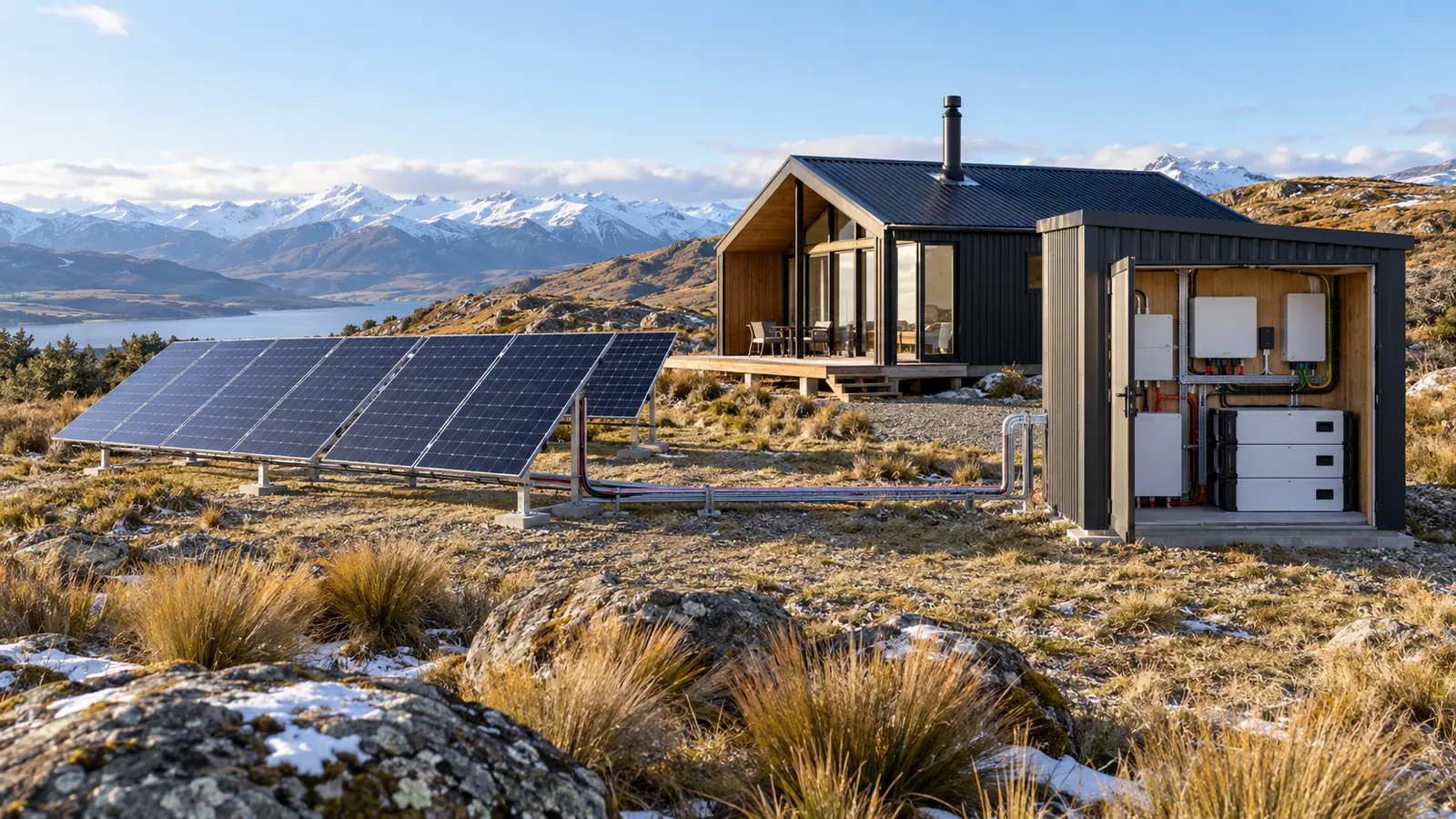
- 3 min readVoltage rise for a 10 kW three‑phase inverterVoltage rise for a 10 kW three-phase inverter on 50 m of 6 mm² cable, with the inverter current, the rise in volts and percent, and the maximum length.
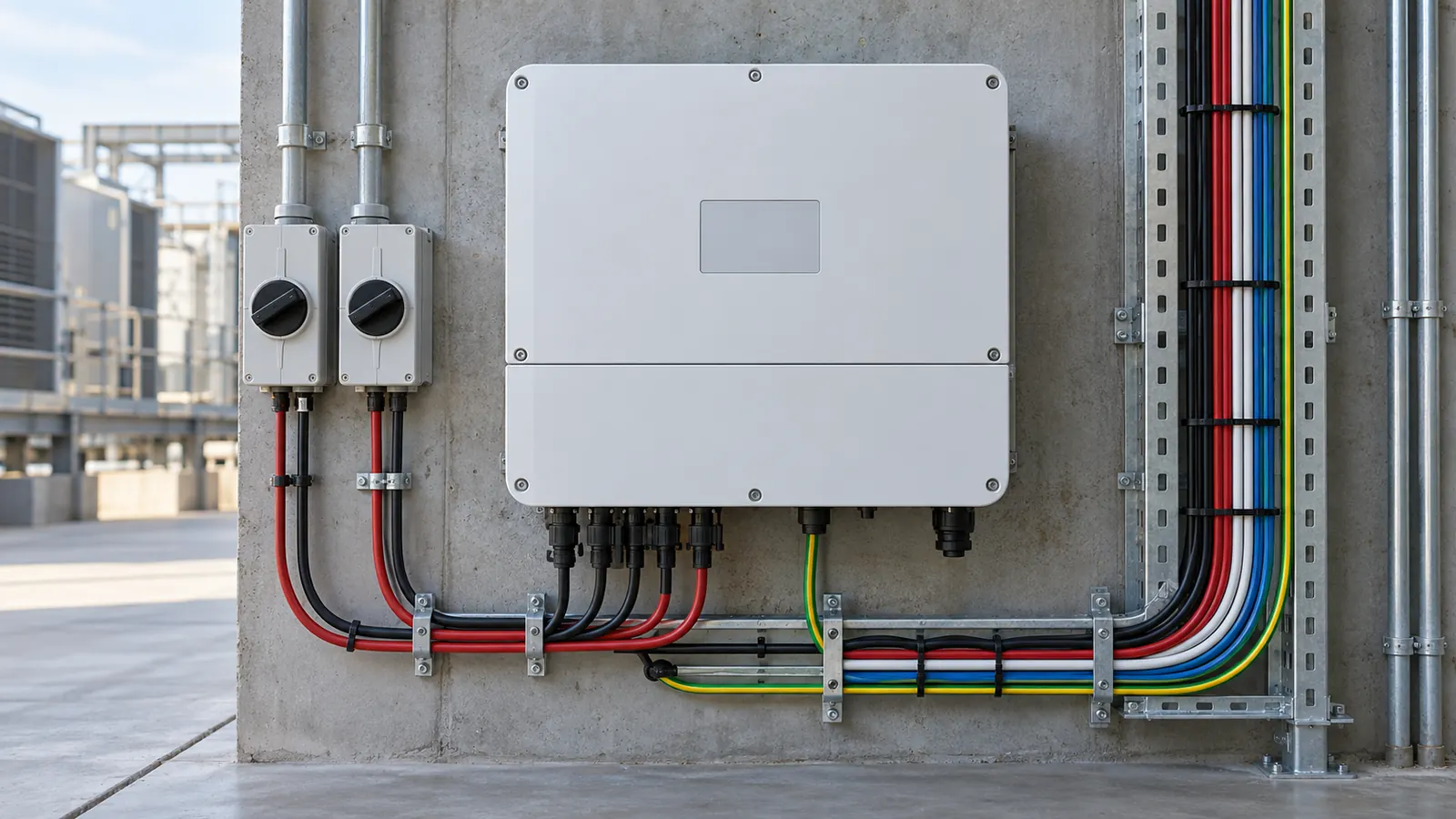
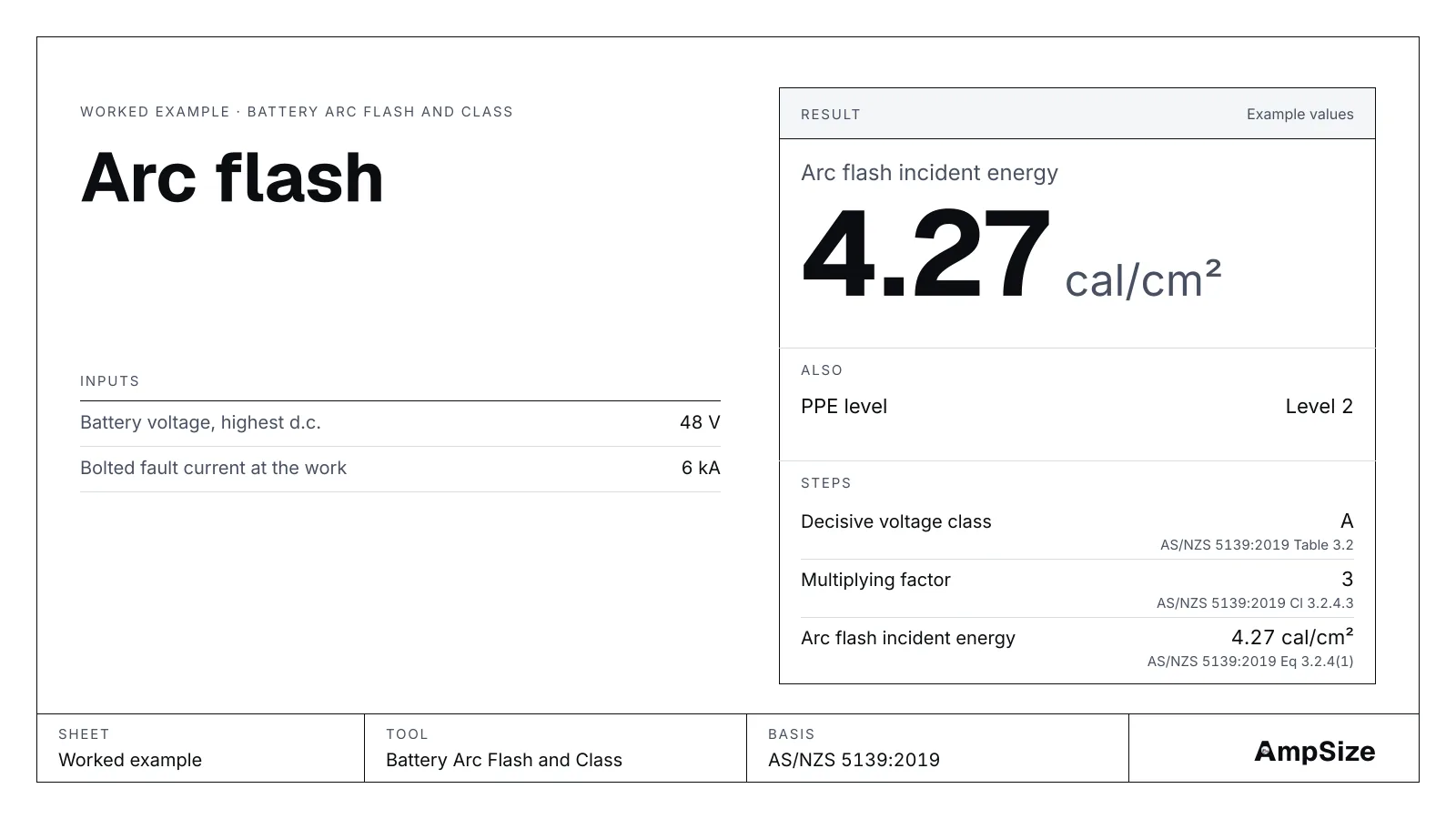
- 5 min readArc flash at a 48 V home batteryClass a 48 V lithium home battery with 6 kA at its terminals by AS/NZS 5139, find its arc flash energy and PPE level, then bring it down with fuses.
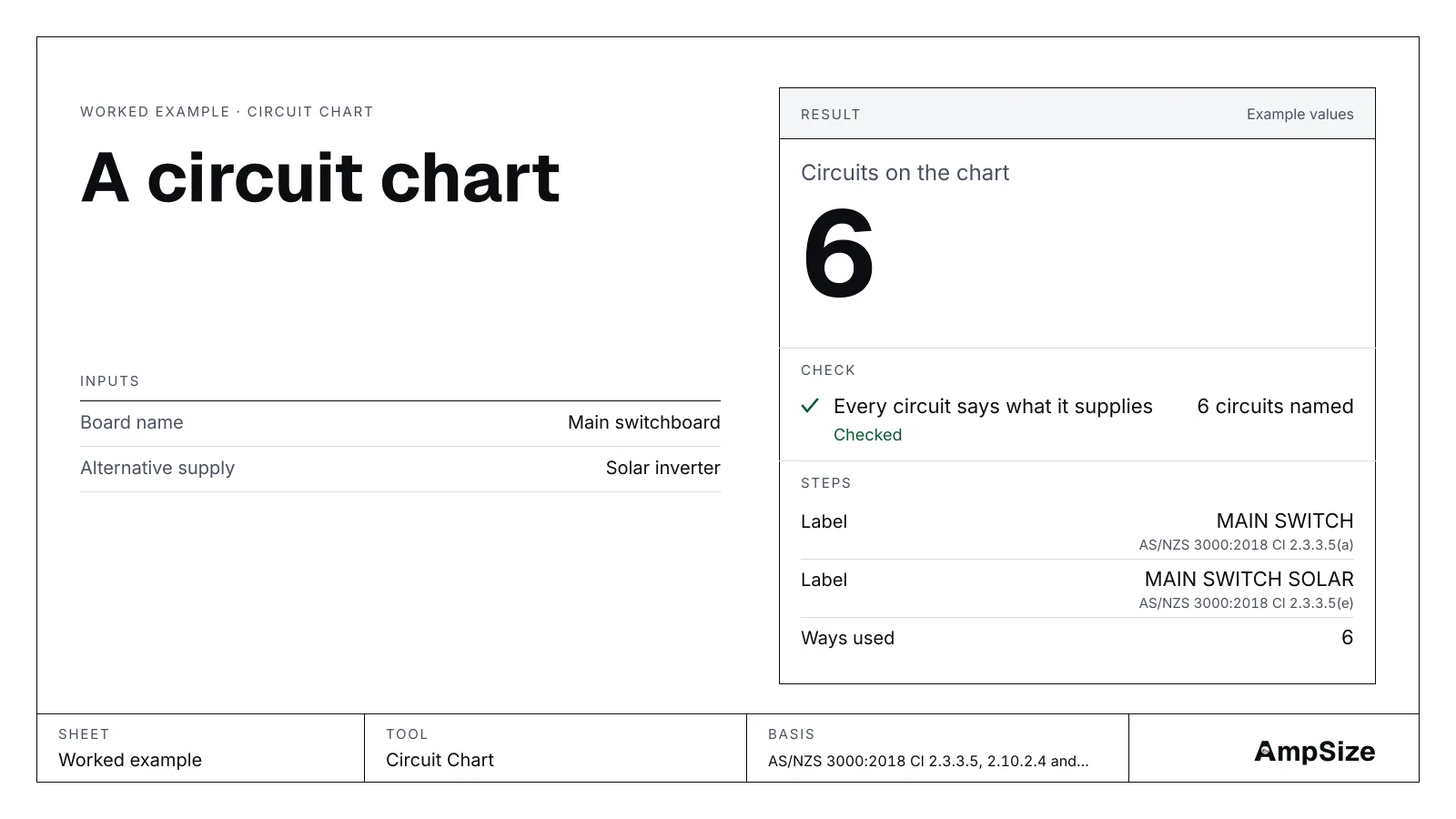
- 2 min readA circuit chart for a house board with solarThe circuit chart and labels for a six-circuit house board with a solar inverter: ways, devices, RCDs, MAIN SWITCH, MAIN SWITCH SOLAR and a shared neutral.
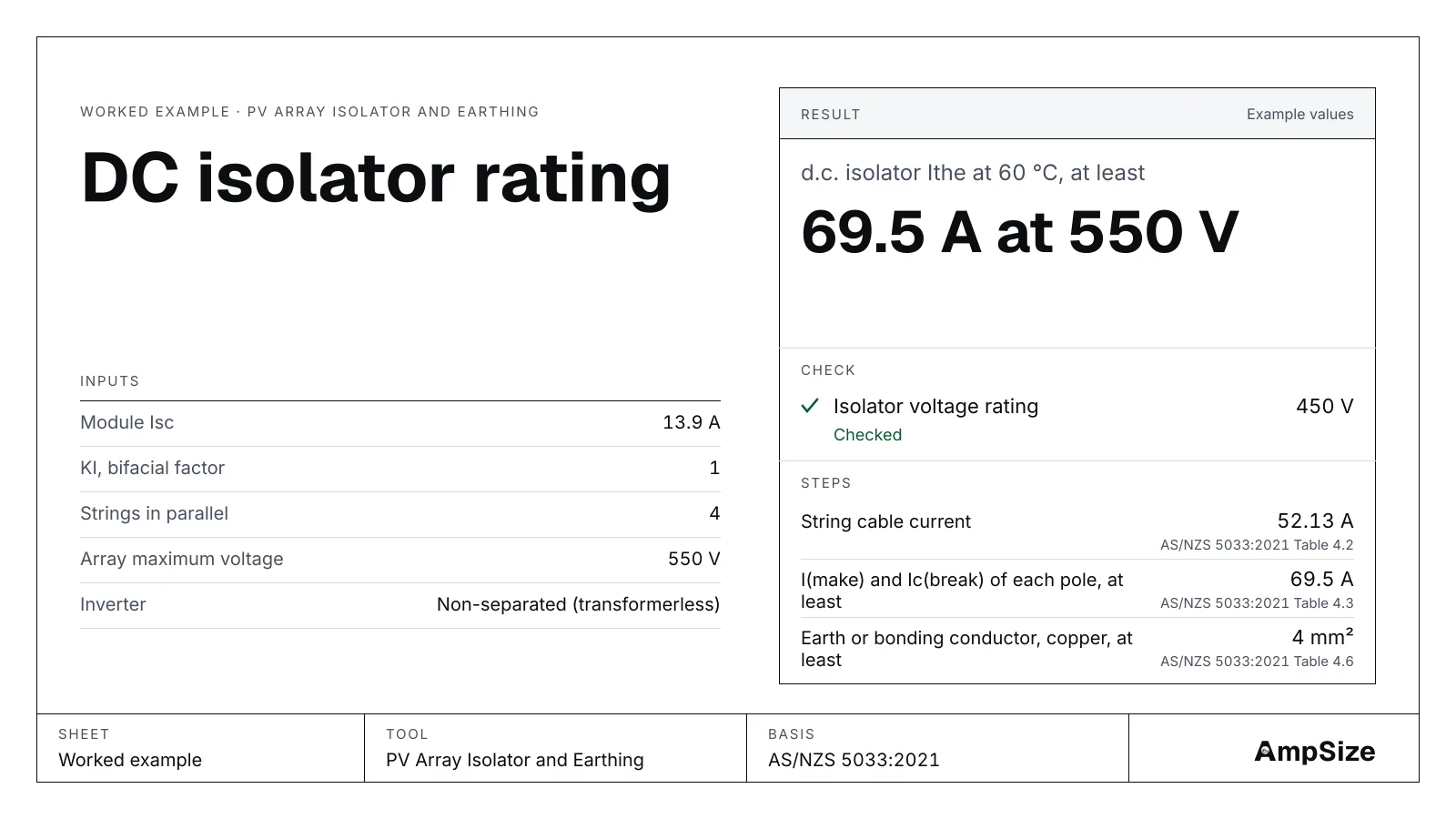
- 3 min readDC isolator rating for a 10 kW solar arrayRate the d.c. isolator and size the frame earth for a four-string domestic array. Check one data sheet that passes and one that fails per pole.
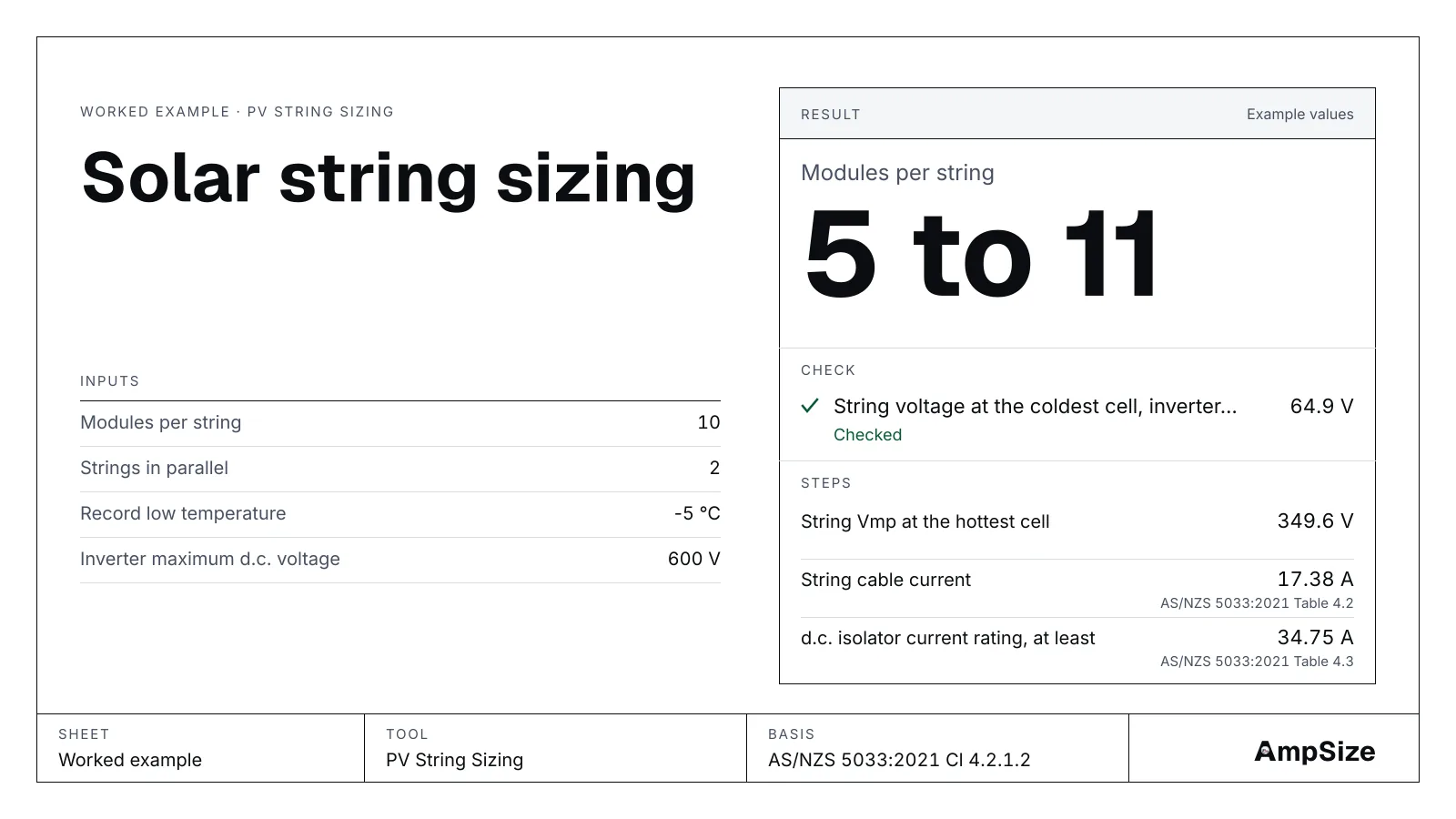
- 3 min readSolar string sizing for a 600 V inverterHow many 49.5 V modules fit a string on a 600 V inverter at -5 °C? Work cold Voc, hot Vmp, the string current, fuses and the d.c. isolator by AS/NZS 5033.
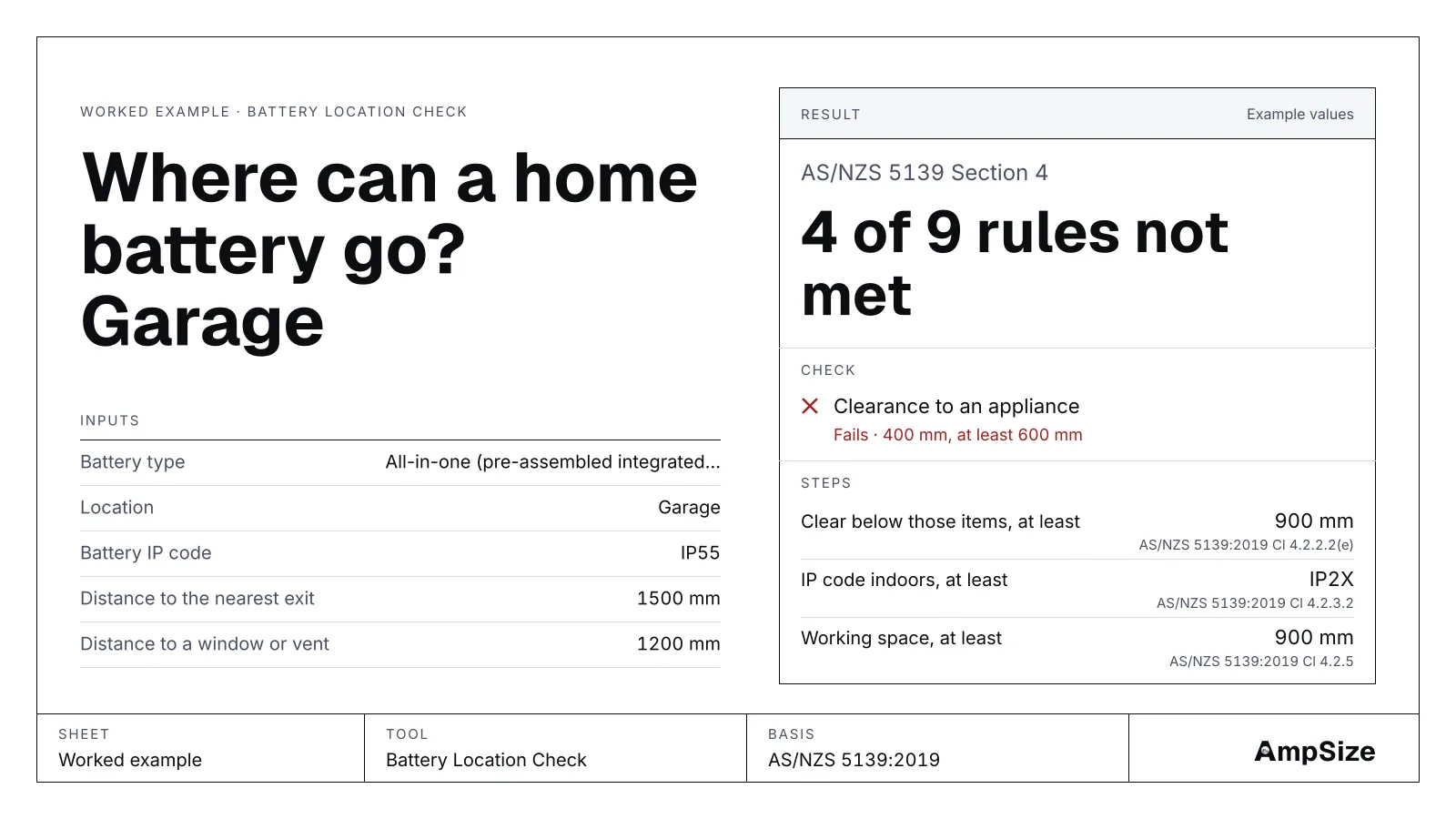
- 3 min readWhere can a home battery go? Garage wallsA garage wall that backs onto a bedroom, with a hot water cylinder nearby. See which AS/NZS 5139 location rules fail for a home battery, then fix each one.
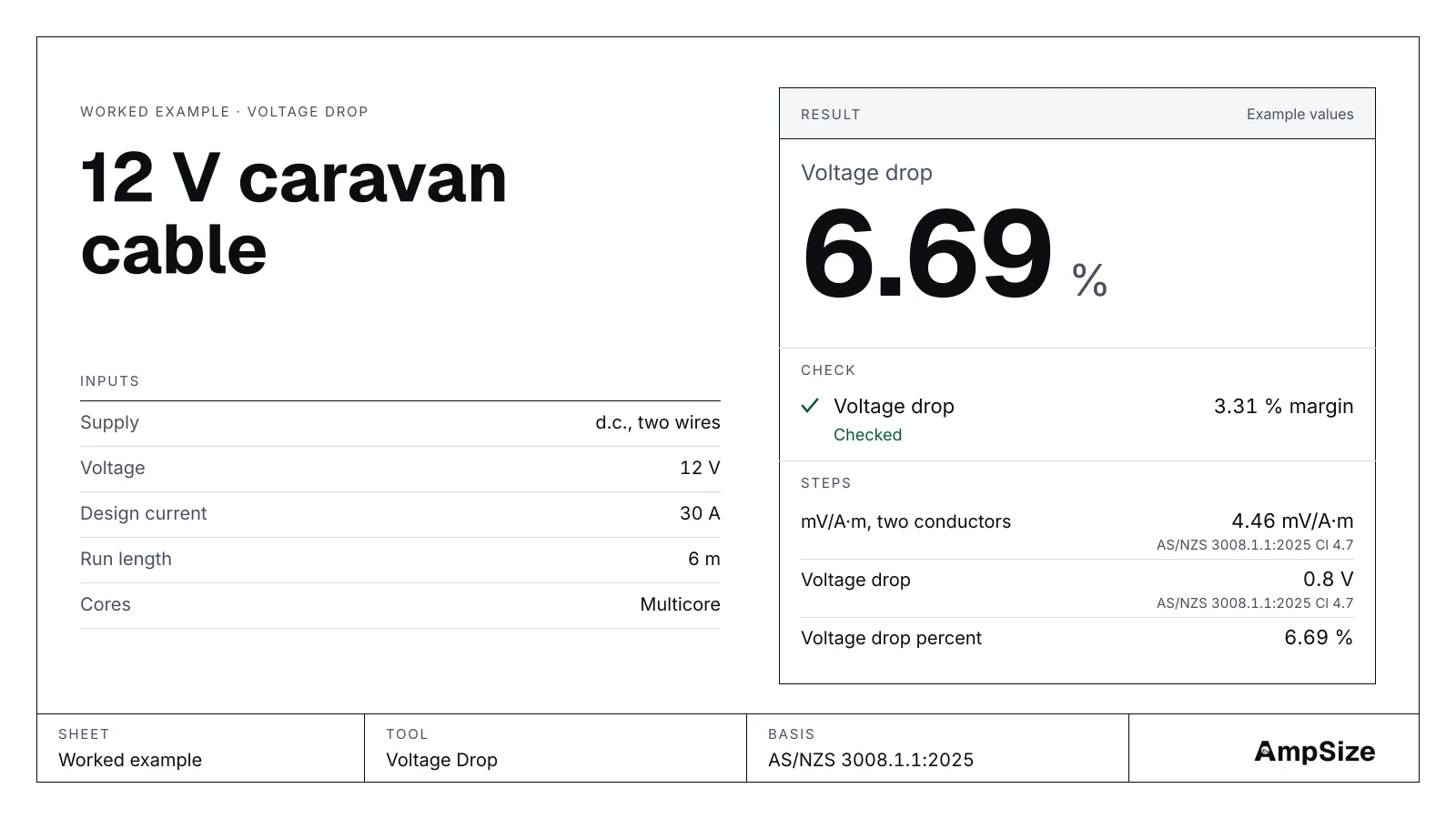
- 5 min read12 V caravan cable: d.c. voltage dropA 12 V caravan feed at 30 A over 6 m, checked on 4, 6 and 10 mm² twin against the 10 % ELV limit, then a 48 V battery-to-inverter run.
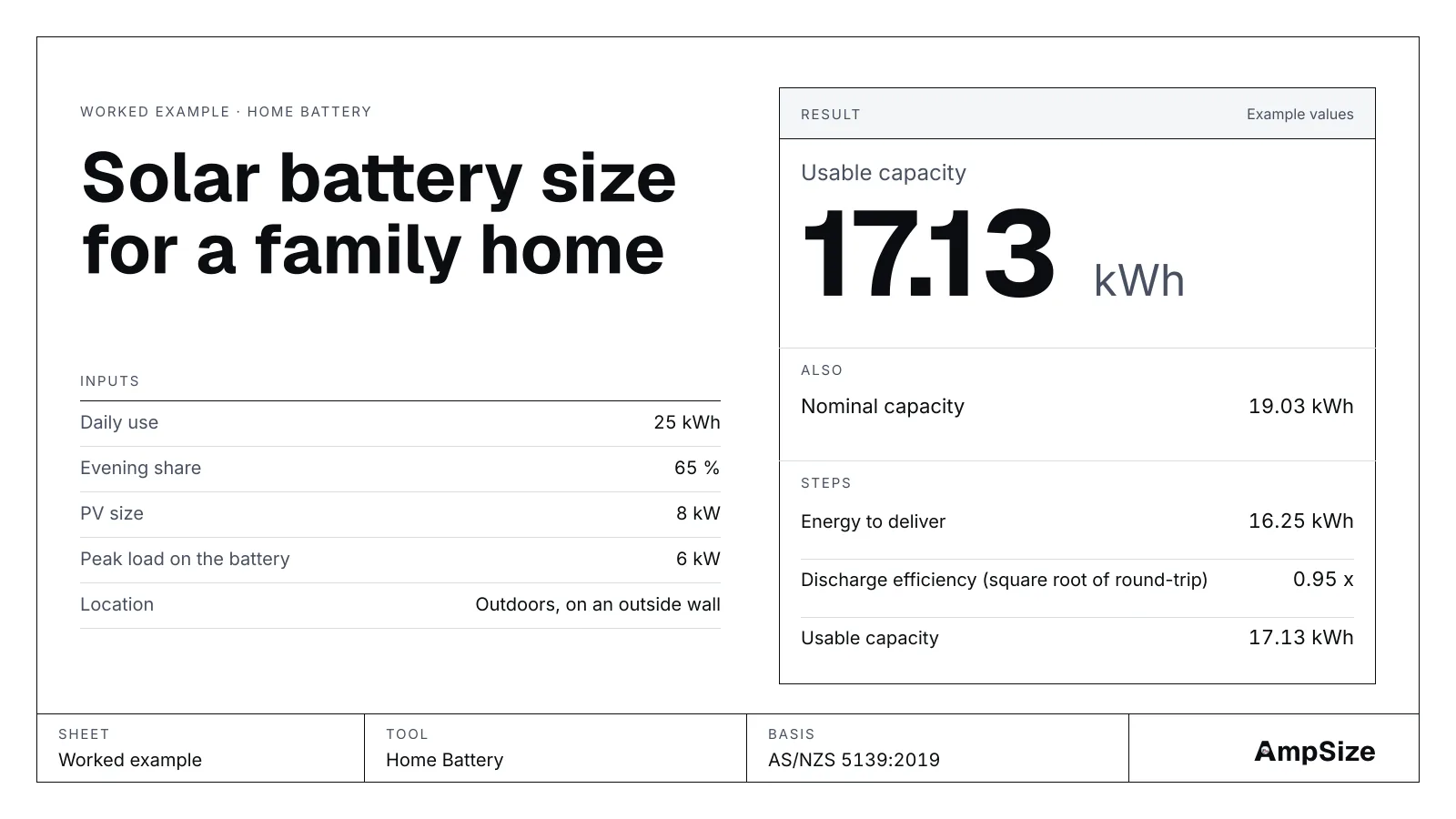
- 4 min readSolar battery size for a family home: 25 kWh a daySize a solar battery for a home that uses 25 kWh a day with an 8 kW array. Usable and nominal kWh, the bank, the inverter, winter solar and where it can go.
- 3 min read22 kW EV charger amps at 400 V three‑phaseA 22 kW three-phase EV charger draws 31.75 A at 400 V. See the inputs, the clause, the arithmetic and the current that feeds cable sizing and demand.
- 3 min readOff-grid battery bank autonomy at 48 VA bach load list of 7600 Wh per day at 48 V needs 703.7 Ah of battery for two days of autonomy at 0.5 depth of discharge, worked step by step.
- 4 min readAS/NZS 3000 Appendix C: conduit space factorWhat the conduit space factor in AS/NZS 3000 Appendix C governs, which tool reads it, and a worked 50 mm conduit that reaches 52.95 % fill against a 40 % limit.
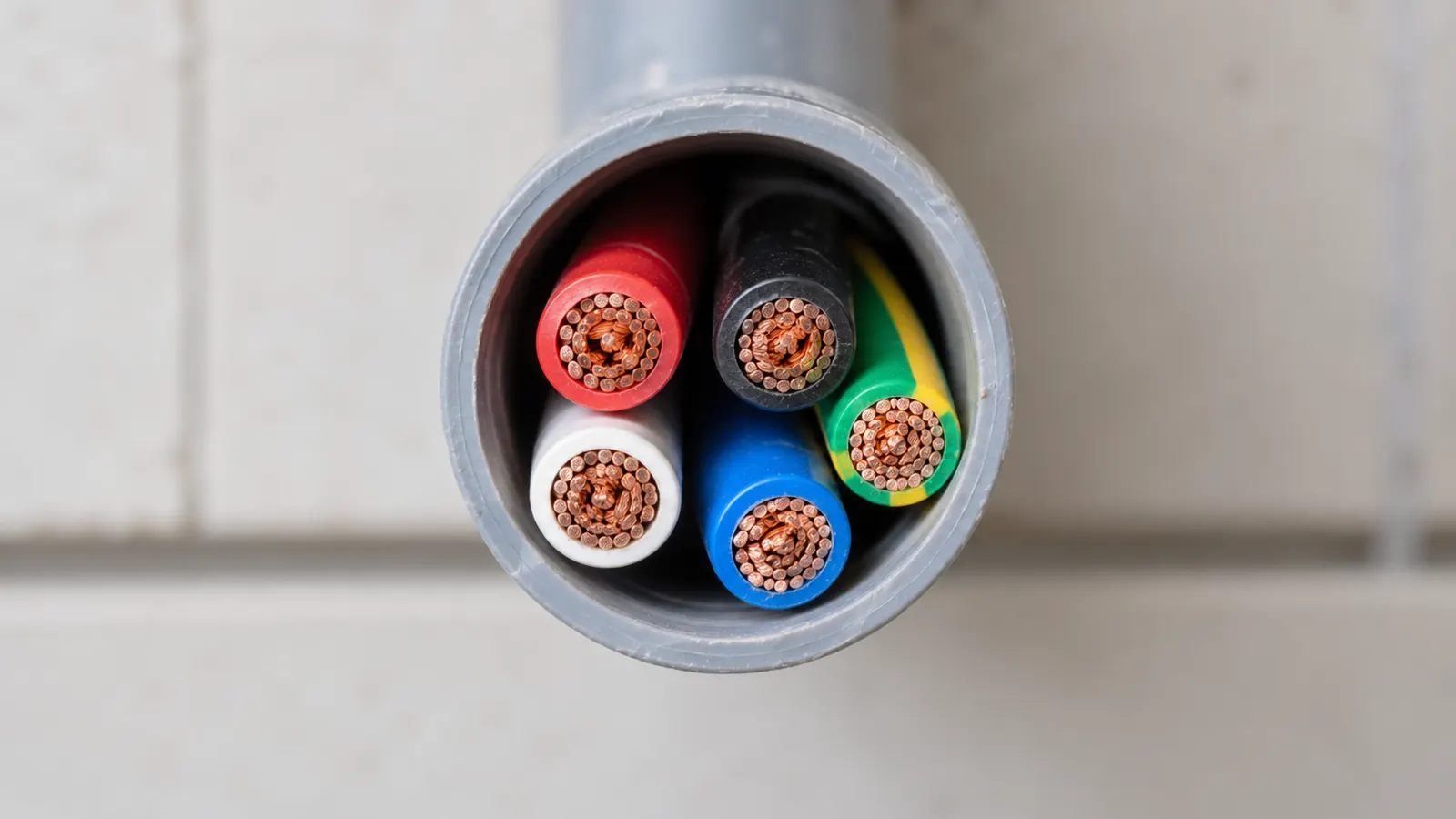
- 3 min readEV charger cable size for a 7 kW 32 A circuitA 7 kW EV charger on a 32 A dedicated circuit over 30 m needs 6 mm², with 38 A derated capacity, 2.85 percent voltage drop and 0.73 Ω loop impedance.
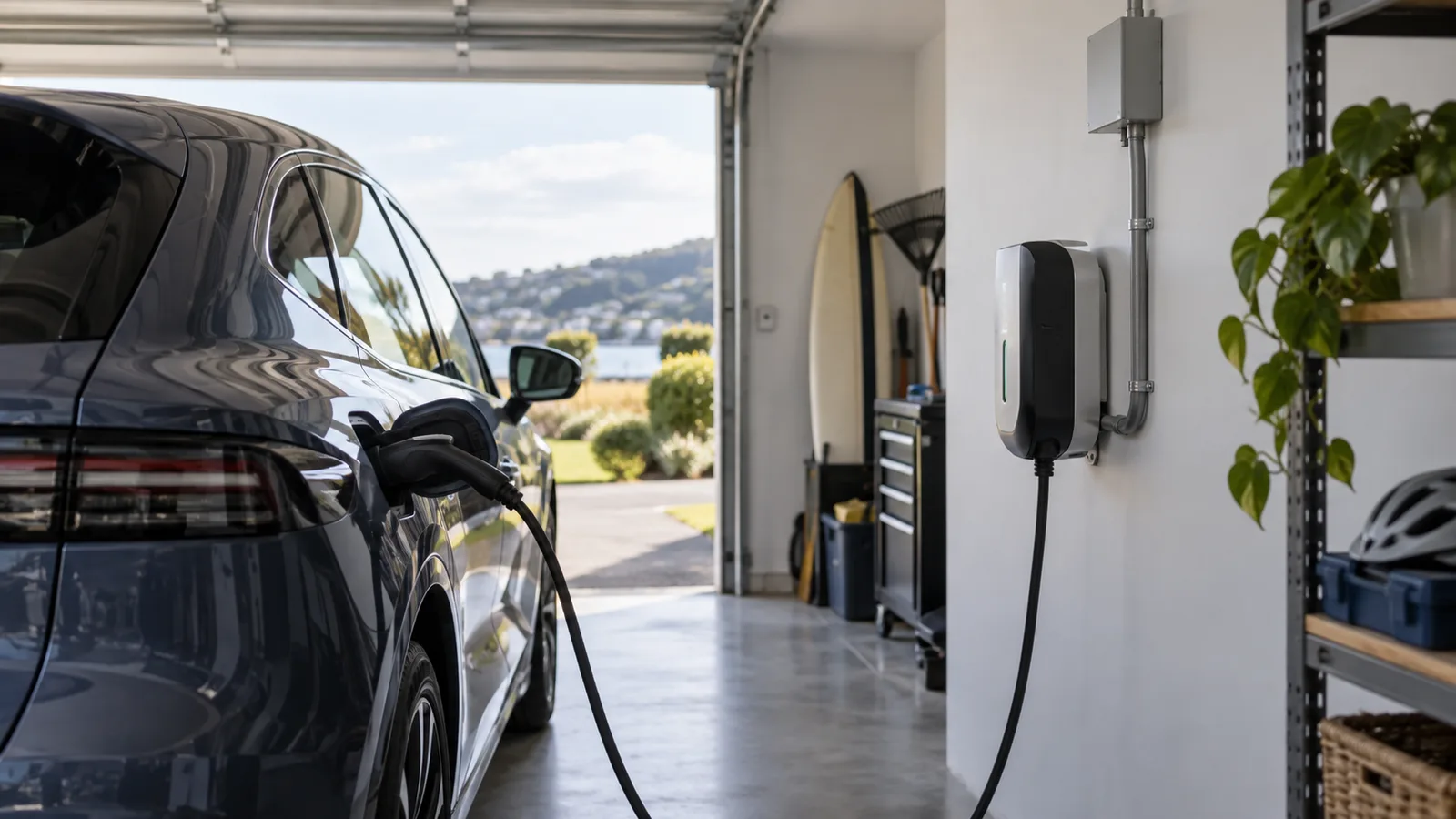
- 4 min readAS/NZS 3008.1.2 Tables 22 to 29: deratingWhat the derating tables govern, how ambient and grouping combine into one factor, and a 63 A feeder whose capacity falls to 78.85 A on 35 mm² copper.
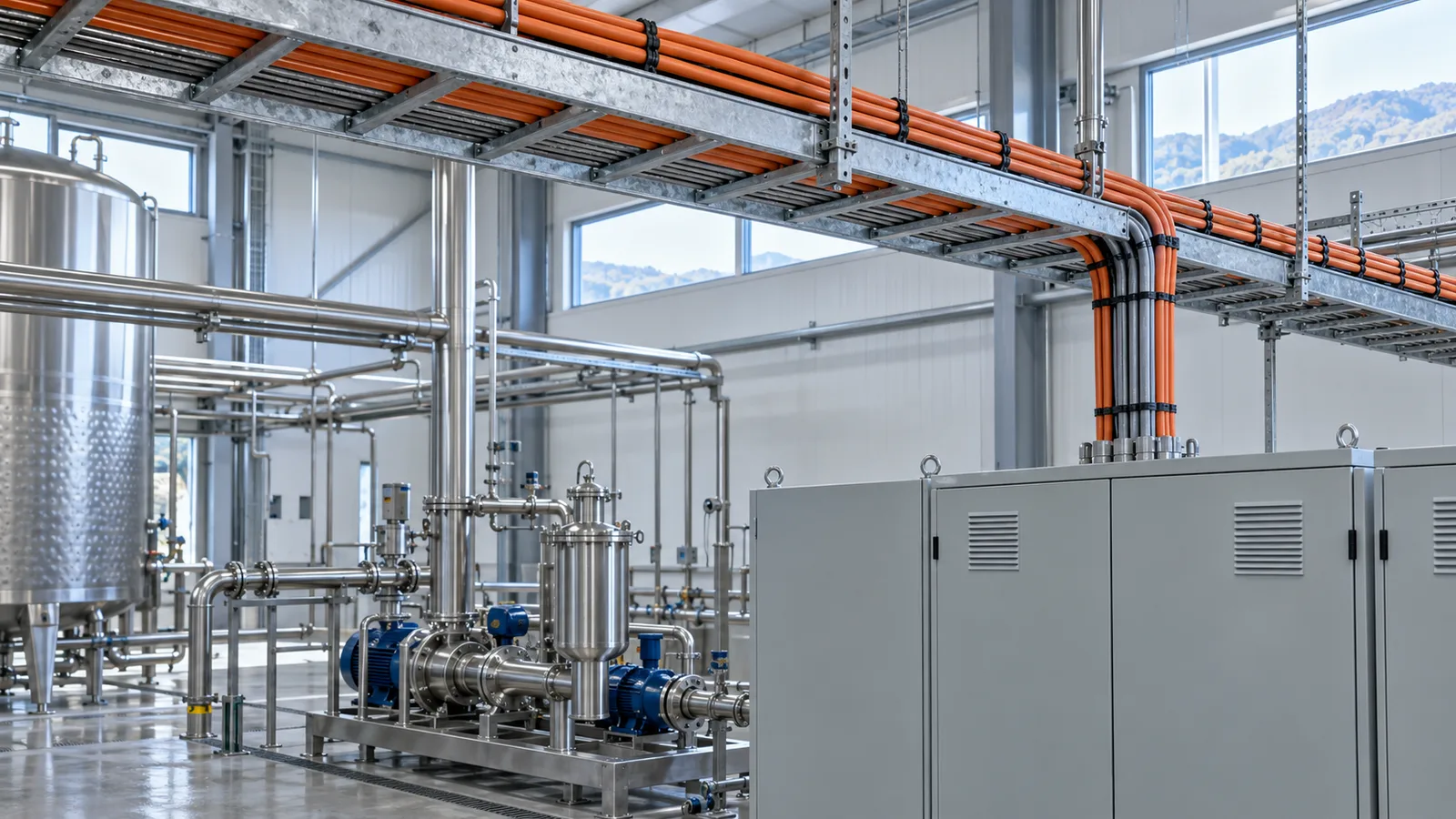
- 3 min readAS/NZS 3008 Table 27 (now 3.44, 3.45): temperatureAS/NZS 3008 Table 27 corrects a cable rating for the air or soil temperature. The 2025 AU part splits it into Tables 3.44 and 3.45 and re-derives the factors.
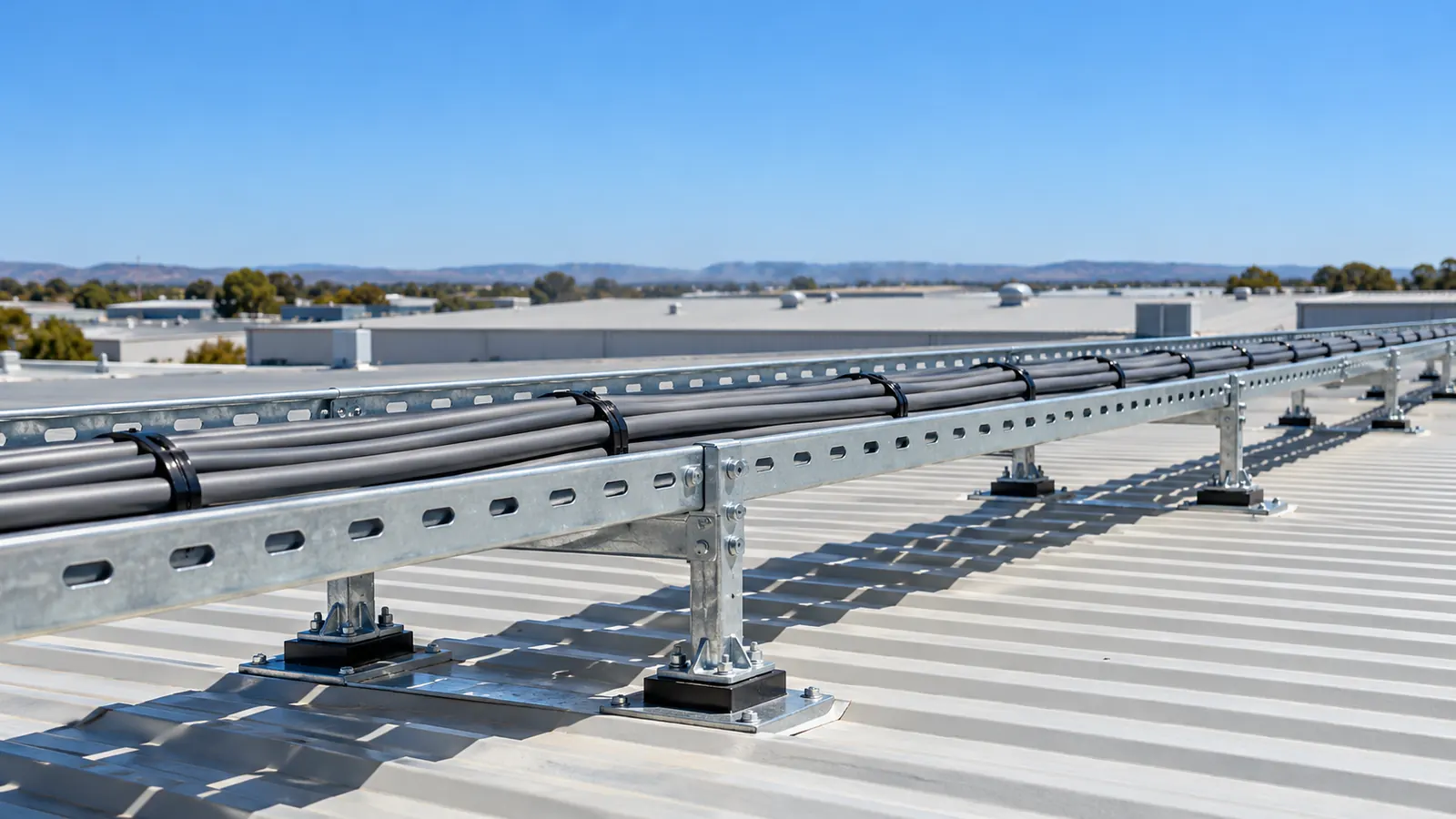
- 5 min readDC cable size: 48 V battery and 600 V PV arrayTwo d.c. circuits sized to AS/NZS 3008.1.1:2025, a 48 V battery-to-inverter run that current sizes and a 600 V array feed that voltage drop sizes.
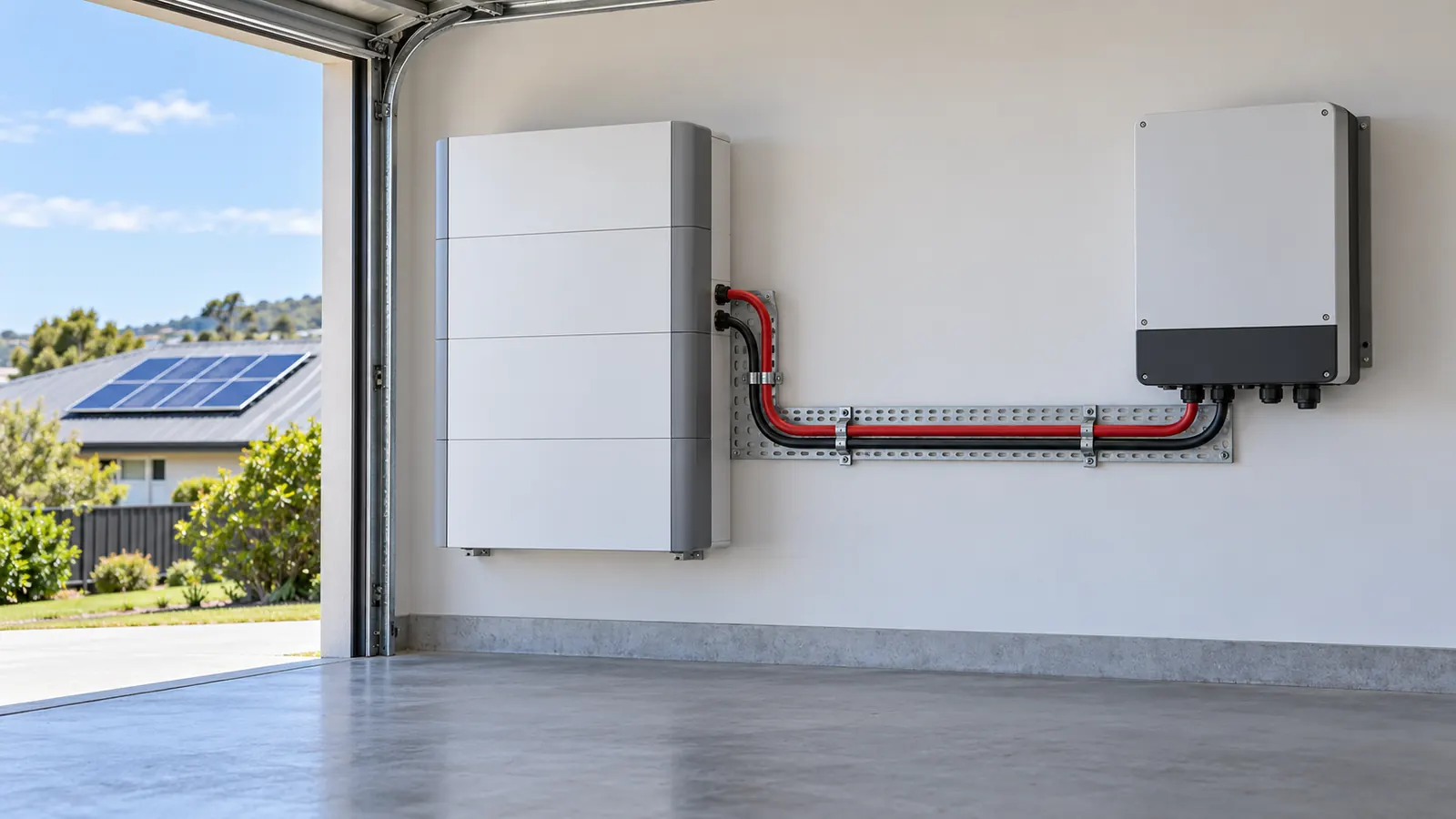
- 3 min readVoltage rise for a 5 kW solar inverter cableA 5 kW single-phase inverter 40 m from the switchboard on 10 mm² copper, with the rise in volts, the percent and the maximum length the tool returns.
Calculators these guides use
- EV charger circuit calculatorCheck EV chargers for spare capacity, cable size and RCD.
- Cable size calculatorFind the smallest cable size that passes each check.
- Conduit fill calculatorCheck that a cable bundle fits in a conduit.
- Voltage rise calculatorCalculate voltage rise for embedded generation or PV.
- Battery bank calculatorCalculate battery bank capacity and autonomy for a load.
- Battery arc flash and classBattery DVC, hazard class, arc flash energy and PPE level.
- Switchboard circuit chartMake a board circuit chart and the labels it needs.
- PV isolator and earthing calculatorRate the PV array cables, d.c. isolator and earthing.
- PV string calculatorModules per string, string current and isolator for PV.
- Battery location checkerCheck where a home battery can go under AS/NZS 5139.
- Voltage drop calculatorCalculate voltage drop on a cable run and check the limit.
- Solar battery calculatorSize a home battery for the solar evening load.
- Full load current calculatorCalculate full load current from power, voltage and phase.
- DC cable size calculatorSize a d.c. cable up to 1500 V for current and voltage drop.