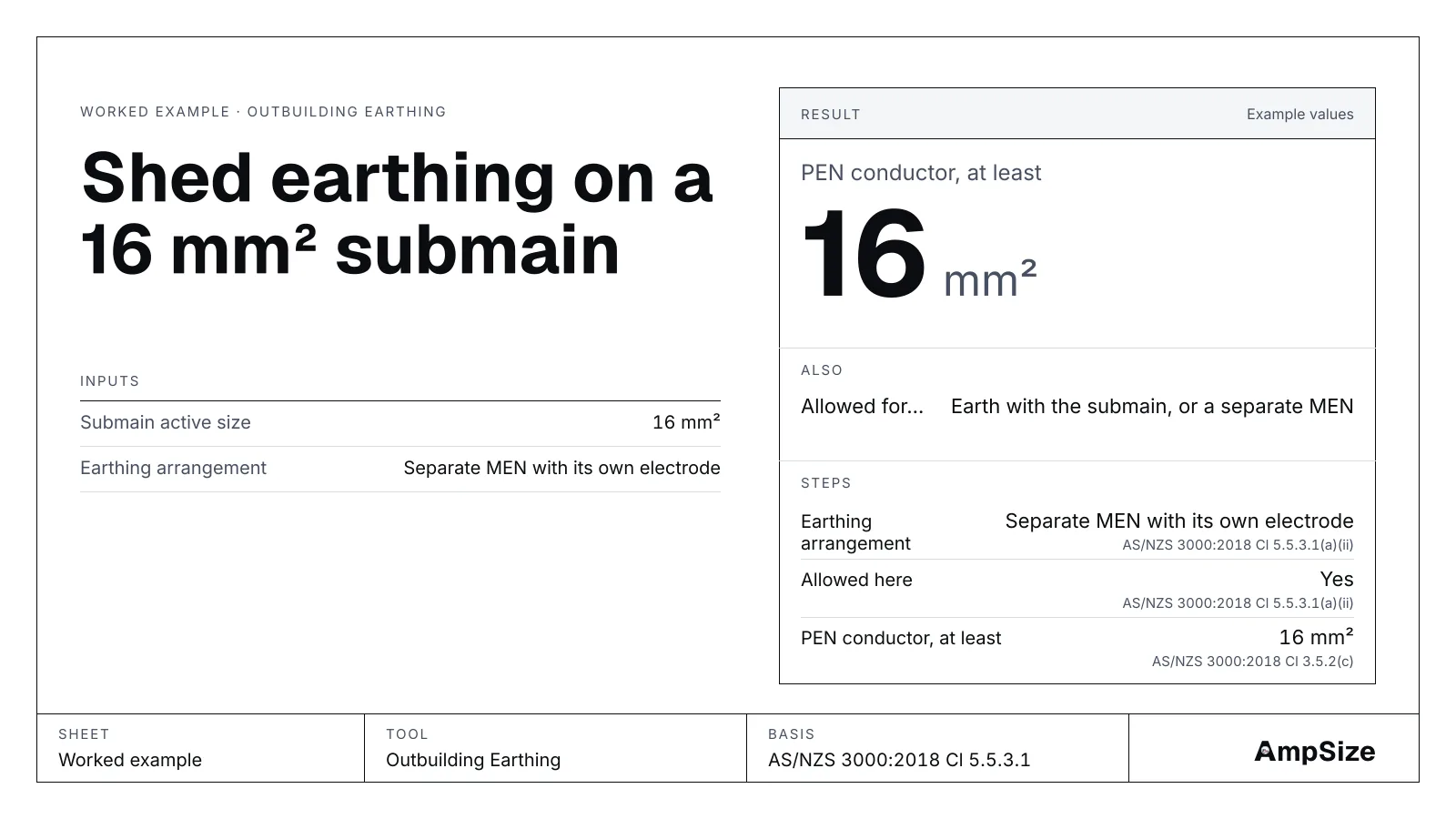
A shed with its own switchboard is an outbuilding. Its earth can come two ways: with the submain from the house, or from its own MEN link and earth electrode. This guide works both for one shed with the outbuilding earthing tool. The rules are explained in Earthing an outbuilding: earth or its own MEN.
The shed
- A detached shed 30 m from the house, on its own slab, with its own switchboard.
- A single-phase submain of 16 mm² copper from the main switchboard.
- New Zealand.
The shed stands apart from the house on its own ground, so it is an individual outbuilding (Cl 1.4.88). Cl 5.5.3.1(a) lets an individual outbuilding take either arrangement.
Option 1. An earth with the submain
Run a protective earthing conductor with the submain, from the main switchboard earth bar to the shed board (Cl 5.5.3.1(a)(i)). The shed has no MEN link and no electrode of its own.
For a 16 mm² copper active, Table 5.1 gives a 6 mm² protective earthing conductor. Open the shed with an earth in the submain.
Option 2. A separate MEN
Run the submain without an earth. The neutral then carries both the load current and the fault current: it is a PEN conductor. The shed board gets its own MEN link and earth electrode, and is treated as a main switchboard (Cl 5.5.3.1(c)).
| Item | Value | Clause |
|---|---|---|
| PEN conductor, at least | 16 mm² | Cl 3.5.2(c) |
| Main earthing conductor to the electrode | 6 mm² | Table 5.1 |
| MEN connections in the shed, at most | 1 | Cl 5.5.3.1(c)(i) |
| Electrode | dia 12 mm copper-clad steel rod, 250 µm | Table 5.2 |
| Electrode driven depth, at least | 1.8 m | Cl 5.3.6.3(b) |
Open the shed as a separate MEN.
The submain must run straight from the main switchboard, or through other outbuilding boards to one board in this shed (Cl 5.5.3.1(c)(iv)).
Which to pick
An earth with the submain is the simpler choice. It needs one more core in the cable and no rod.
A separate MEN saves that core, but it puts the neutral to work as the earth. If a metal water pipe, a cable sheath or a covered walkway joins the two buildings, it can carry neutral current in parallel with the PEN. Cl 5.5.3.1(c)(vi) says to avoid that path. The tool warns when you say conductive services run between the buildings. Open the shed with a metal pipe between the buildings.
Two sheds on one slab
Two structures on the same foundation, or under one metal roof or frame, are a combined outbuilding (Cl 1.4.89). A combined outbuilding takes an earth with the submain only. A separate MEN is not allowed (Cl 5.5.3.1(b)), and the tool fails it. Open the combined outbuilding.
In Australia
The arrangements and the conductor sizes are the same. The electrode depths differ (Cl 5.3.6.3):
| Electrode | New Zealand | Australia |
|---|---|---|
| Driven rod, depth at least | 1.8 m | 1.2 m |
| Strip in a trench, length at least | 7.5 m | 3 m |
| Strip in a trench, cover at least | 0.5 m | 0.5 m |
The result
| Arrangement | What the shed needs |
|---|---|
| Earth with the submain | A 6 mm² protective earthing conductor |
| Separate MEN | A 16 mm² PEN, a 6 mm² main earthing conductor, a rod driven 1.8 m |
To size the submain itself, use the cable size calculator. For the trench and its cover, use the underground cable tool. For the main earth and bonds of the house, use the earthing calculator.