A house board needs more than the right RCDs. AS/NZS 3000 also sets how the final subcircuits are spread over them, so one trip does not black out the whole house. This guide checks one board with the RCD arrangement checker. The rules are explained in How many circuits can go on one RCD.
The board
A New Zealand house with eight final subcircuits:
| Circuit | Supplies | Rating | RCD |
|---|---|---|---|
| 1 | Lighting | 10 A | RCD 1 |
| 2 | Socket-outlets | 20 A | RCD 1 |
| 3 | Socket-outlets | 20 A | RCD 1 |
| 4 | Lighting | 10 A | RCD 2 |
| 5 | Socket-outlets | 20 A | RCD 2 |
| 6 | Socket-outlets | 20 A | RCD 2 |
| 7 | Fixed equipment (oven) | 32 A | None |
| 8 | Fixed equipment (water heater) | 20 A | None |
Step 1. Which circuits need an RCD
In a New Zealand home, Cl 2.6.3.3.1 calls for a 30 mA RCD on every final subcircuit that supplies socket-outlets, lighting points or directly connected hand-held equipment. Six of the eight circuits need one. The oven and the water heater are fixed equipment, so the clause does not reach them. All six sit on an RCD: 6 of 6.
Step 2. Count the circuits on each RCD
In a residential installation, one RCD may protect three final subcircuits at most (Cl 2.6.2.4(b)(i)). RCD 1 and RCD 2 each carry three. The board has two RCDs, which Cl 2.6.2.4(b)(ii) asks for where there is more than one final subcircuit.
Step 3. Check the lighting spread
Where there is more than one RCD and more than one lighting circuit, the lighting circuits must be on more than one RCD (Cl 2.6.2.4(a)). Circuit 1 is on RCD 1 and circuit 4 on RCD 2, so a trip leaves half the lights on. The board passes every check.
What fails
- A fourth circuit on RCD 1. Add a socket-outlet circuit to RCD 1 and it protects 4 final subcircuits. The arrangement fails: a residential RCD may protect 3. Open the fourth circuit.
- Both lights on one RCD. Put both lighting circuits on RCD 1 and the lighting spread fails: the lights are on 1 RCD. Open the board.
- One RCD for a small board. A board of three circuits on one RCD fails the two-RCD rule, even though three is within the count. Open the small board.
Every circuit on an RCD counts toward the three, even one that would not need an RCD.
Add an RCBO
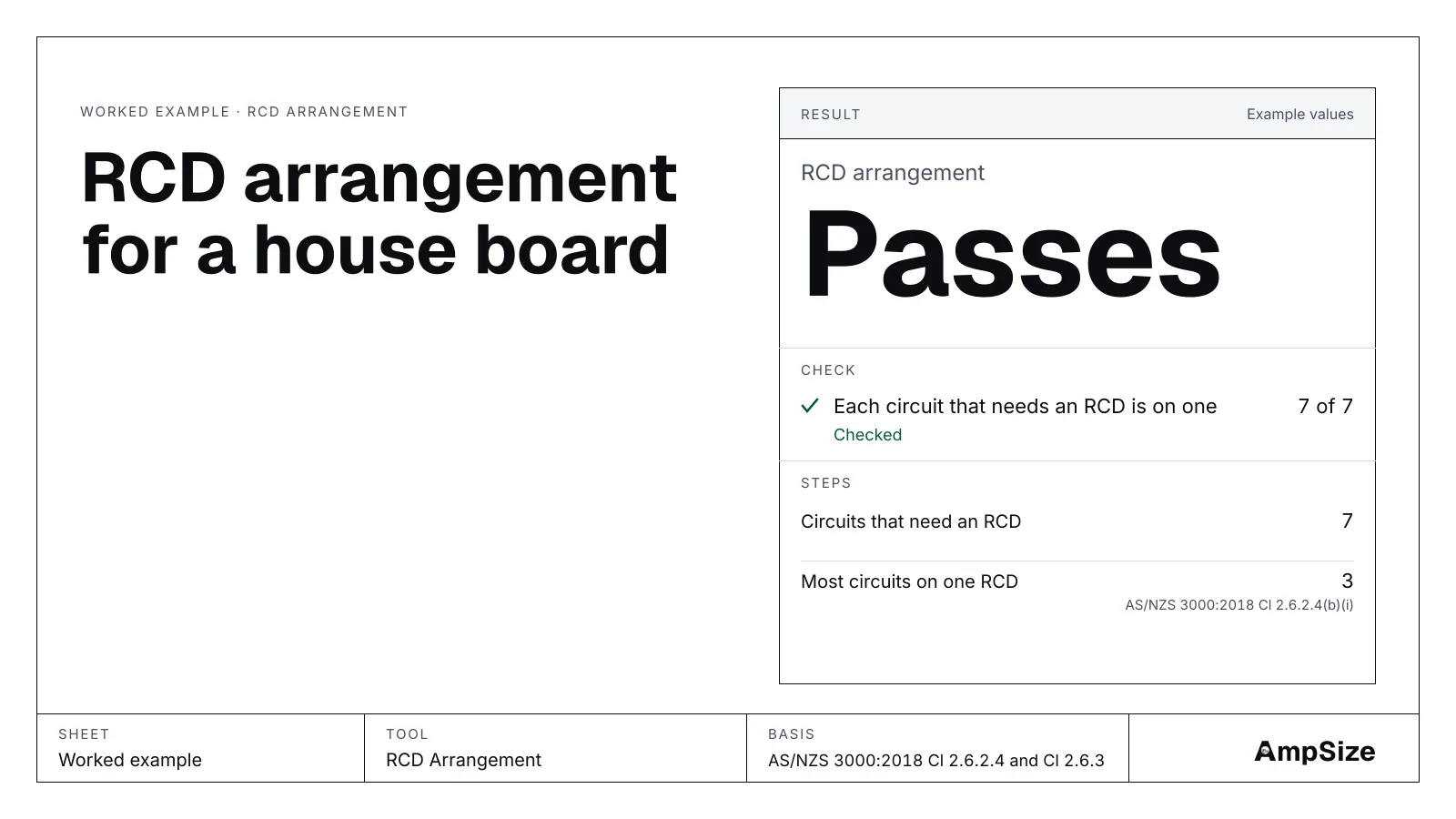
An RCBO is a circuit breaker and an RCD in one. It protects one circuit, so it counts as its own RCD with one circuit. To add a seventh circuit that needs an RCD, put it on an RCBO as RCD 3. The board then has 3 RCDs, 3 on the fullest RCD, 7 of 7 circuits on an RCD, and it passes. Open the board with an RCBO.
In Australia
Cl 2.6.3.2.2 calls for a 30 mA RCD on every final subcircuit of a domestic installation. The oven and the water heater need one too. The same board in Australia fails: 6 of 8 circuits are on an RCD. Open the board in Australia.
Put the oven and the water heater on RCBOs as RCD 3 and RCD 4. Then 8 of 8 are on an RCD, the fullest RCD has 3, and the board passes. Open the fixed board.
The result
The tool reads Passes for the fixed board.
| Check | New Zealand board |
|---|---|
| Each circuit that needs an RCD is on one | 6 of 6 |
| At most three circuits on any one RCD | 3 on the fullest RCD |
| At least two RCDs | 2 RCDs |
| Lighting spread over the RCDs | On 2 RCDs |
The checker takes each socket-outlet as 10 A. For a larger socket-outlet, a trip time or a device type, use the RCD selection tool.