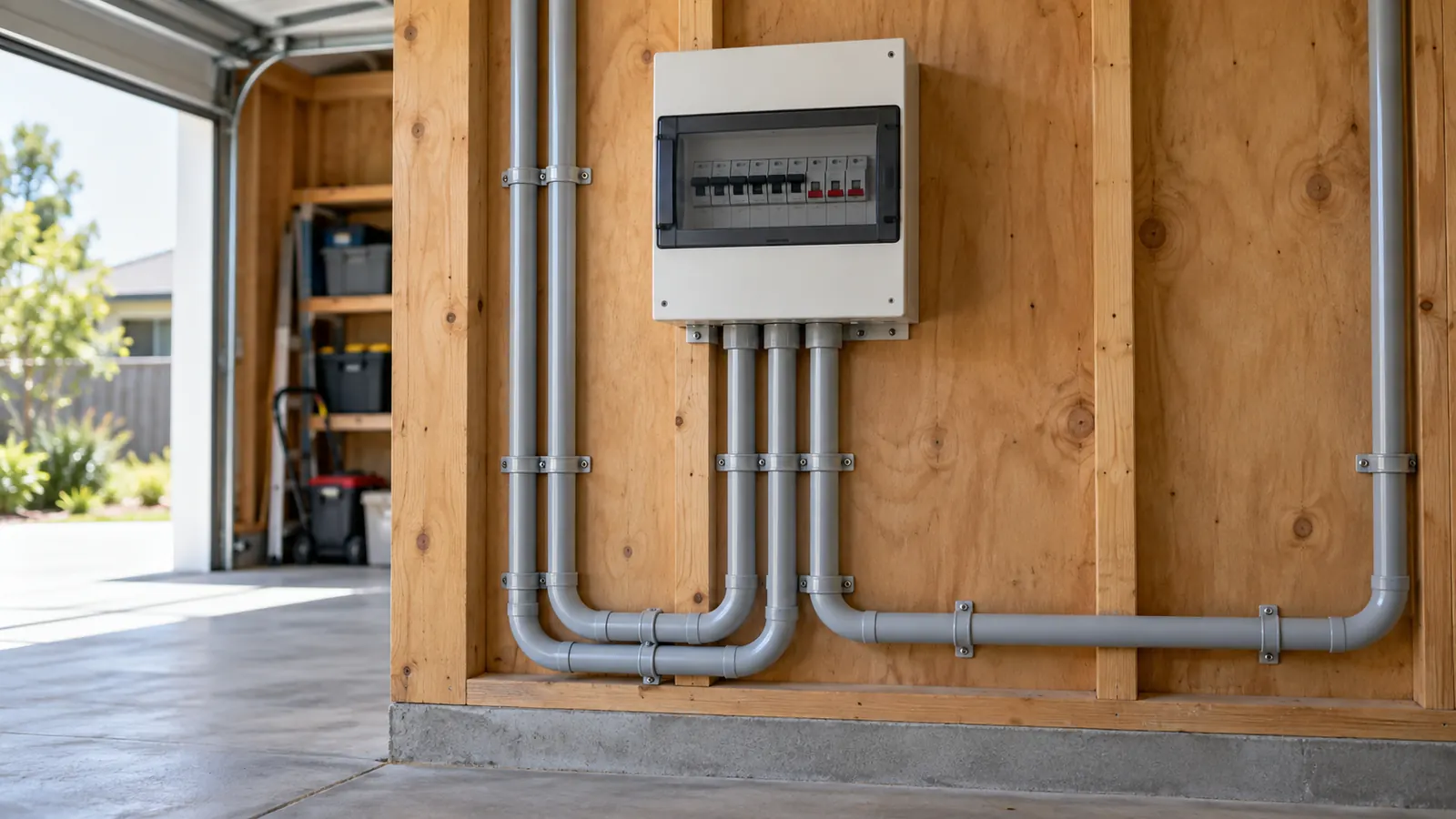
Two questions sit behind every conduit run. The first asks how many cables fit in the tube. The second asks what the tube does to the rating of those cables. They are separate questions with separate answers, and the second one is the one that gets missed.
The space factor
A conduit is sized on area, not on count. Add the overall cross-sectional area of every cable, including insulation and sheath. Compare that total against the internal area of the conduit. The share the cables occupy is the fill percent. Para C6.2 of AS/NZS 3000:2018 App C sets the space factors.
The limit used in the tool is 40 %. The free space left over lets a cable be drawn in without damage. It also lets heat move out of the bundle.
A worked run
Take five 6 mm² single-core cables in a 25 mm conduit.
- Conduit internal area: 301.72 mm²
- Cable area: 102.14 mm²
- Fill: 33.85 %
- Permitted fill: 40 %
The run passes. Move the same five cables into a 32 mm conduit. The internal area rises to 539.13 mm². The fill falls to 18.95 %. The cable area does not change. Only the denominator moves.
The tool reports a recommended conduit of 25 mm for both cases. That is the smallest standard size that holds the bundle under the limit.
Open the conduit fill calculator with these inputs.
Fill percent against the count tables
AS/NZS 3000:2018 Tables C10 to C12 give maximum cable counts for common combinations. The counts are a lookup and the fill percent is a calculation. They answer the same question by different routes.
Use the tables when the cable type and conduit type match a tabulated row. Use the fill percent when they do not. That covers most mixed runs, and any cable the tables do not list. The tool states which method it applied in every result.
What the conduit does to the rating
Enclosing a cable changes its current-carrying capacity. Heat that would leave a surface-clipped cable has to cross the air in the conduit and then the conduit wall. AS/NZS 3008.1.2:2017 Tables 3(1) to 3(4) list the installation methods, and each method points at a rating column.
Grouping applies on top of that. Several circuits in one conduit heat each other, so the grouping factor in Cl 3.5.6 reduces the rating again. A conduit that passes the fill check can still hold cables that are too small for the load.
Site names and standard names
The picker in the cable size tool uses short names. The standard uses method numbers and column headings. The mapping is worth learning once.
Enclosed in air. Cable in a conduit, duct or trunking that sits in free air, or in a wall cavity. This is the usual choice for a conduit run down a plant room wall.
Unenclosed, touching. Cable clipped to a surface, on a tray, or on a ladder, with the cables in contact. This is the usual choice for a tray run above a ceiling.
Enclosed in thermal insulation. Cable surrounded by building insulation for part or all of its length. This gives the lowest rating of the three.
Buried direct or in underground conduit. Soil resistivity and depth of cover apply here, and they bring their own factors.
A run often changes method along its length. The rating comes from the worst section, not the average. A tray run that passes through 3 m of insulated wall takes the insulated rating for the whole circuit.
Order of work
Size the conductor first, on load current, derating, voltage drop and disconnection time. Then size the conduit around the conductors that survived those checks. Sizing the conduit first invites a second trip. A cable that grows by one size can push the fill past the limit.
Two habits keep the pair of checks honest. Count every cable in the conduit, including spares pulled in for later use. Check the overall diameter of the cable against the maker's data. A sheathed multicore and four singles of one size occupy different areas.
This page is a design aid. Verify every value against the current edition of the standard.