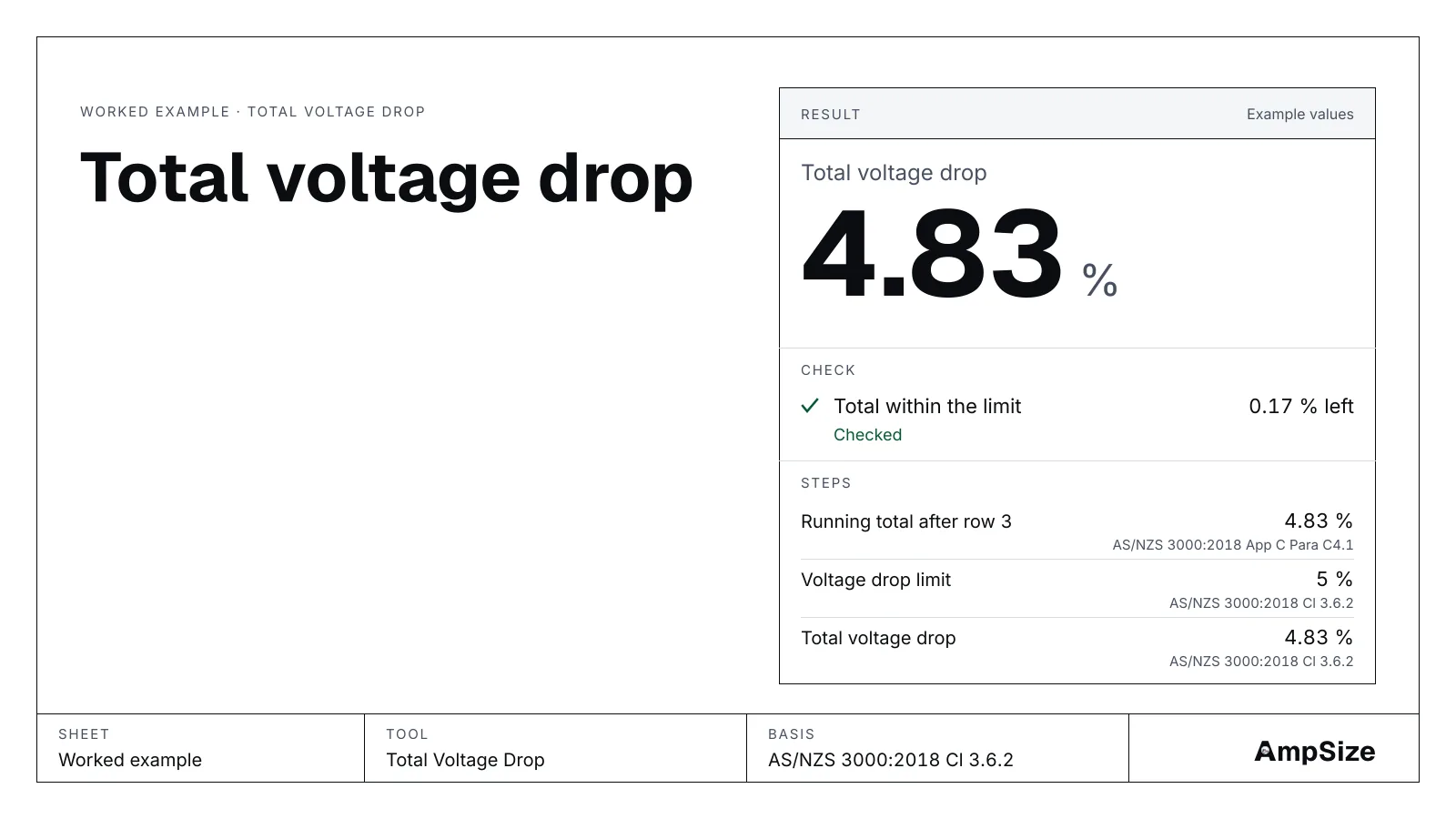
AS/NZS 3000 sets one voltage drop limit for the whole installation. The consumer mains, every submain and the final subcircuit share it. Each run can pass on its own and the total can still fail. This guide adds the parts of one house run with the total voltage drop calculator. The rule itself is explained in The 5 % voltage drop limit from supply to load.
The house
- Consumer mains: 20 m of 16 mm² copper, single phase, at a maximum demand of 40 A.
- A submain to a shed: 30 m of 6 mm² copper, at 25 A.
- A socket-outlet circuit in the shed: 15 m of 2.5 mm² copper, at 16 A.
- PVC insulated multicore cable throughout, a power factor of 0.9, New Zealand.
Step 1. Work each part
The tool works each part with the voltage drop calculation of AS/NZS 3008.1.2 Cl 4.5. It reads the mV/A·m of the cable, then multiplies by the current and the length.
| Part | mV/A·m | Drop | Percent of 230 V |
|---|---|---|---|
| Mains, 16 mm², 40 A, 20 m | 2.595 | 2.08 V | 0.9 % |
| Submain, 6 mm², 25 A, 30 m | 6.834 | 5.13 V | 2.23 % |
| Final, 2.5 mm², 16 A, 15 m | 16.307 | 3.91 V | 1.7 % |
Open the tool with this house.
Step 2. Add the percents
Each drop is a percent of its own circuit voltage. AS/NZS 3000 App C Para C4.1 adds those percents directly, so the total is 0.9 + 2.23 + 1.7 = 4.83 %. That is inside the 5 % of Cl 3.6.2, but close. The tool warns when a total is above 80 % of the limit.
The mains and submain take 3.13 %. That leaves 1.87 % for any final subcircuit in the shed.
Step 3. Move the shed further away
Put the shed 60 m from the house on the same 6 mm² submain. The submain drop doubles to 4.46 %. The total is now 7.06 %, and the run fails. The mains and submain take 5.36 % on their own, so no final subcircuit in the shed can pass.
| Submain | Submain drop | Total | Left for a final | Result |
|---|---|---|---|---|
| 6 mm², 30 m | 2.23 % | 4.83 % | 1.87 % | Passes |
| 6 mm², 60 m | 4.46 % | 7.06 % | -0.36 % | Fails |
| 10 mm², 60 m | 2.67 % | 5.27 % | 1.43 % | Fails |
| 16 mm², 60 m | 1.69 % | 4.29 % | 2.41 % | Passes |
A 10 mm² submain is still 0.27 % over. A 16 mm² submain brings the total to 4.29 %. Open the 60 m submain on 16 mm².
The same fix works at the other end. A shorter final subcircuit, or one with a lower current, takes less of what the submain leaves.
There is no 2 % and 3 % split
Cl 3.6.2 sets one limit from the point of supply to any point. It does not give the mains 2 % and the final subcircuits 3 %. Many designers plan a split like that, so the final circuits have room later. It is a design choice, not a rule. The tool shows what the upstream parts take and what is left, so you can set your own split.
A substation on the premises
Where the point of supply is the low voltage side of a substation on the premises, and it supplies only this installation, the limit is 7 % (Cl 3.6.2 Exception 3). A factory with 60 m of 240 mm² aluminium mains, an 80 m 35 mm² submain and a 40 m 6 mm² three-phase final adds to 6.27 %. That fails 5 % but passes 7 %. Open the factory run.
The result
| Item | Value |
|---|---|
| Total voltage drop | 4.83 % |
| Voltage drop limit | 5 % |
| Mains and submains | 3.13 % |
| Left for a final subcircuit | 1.87 % |
To size one run on its own, use the voltage drop calculator. To pick a cable that also carries the current, use the cable size calculator.