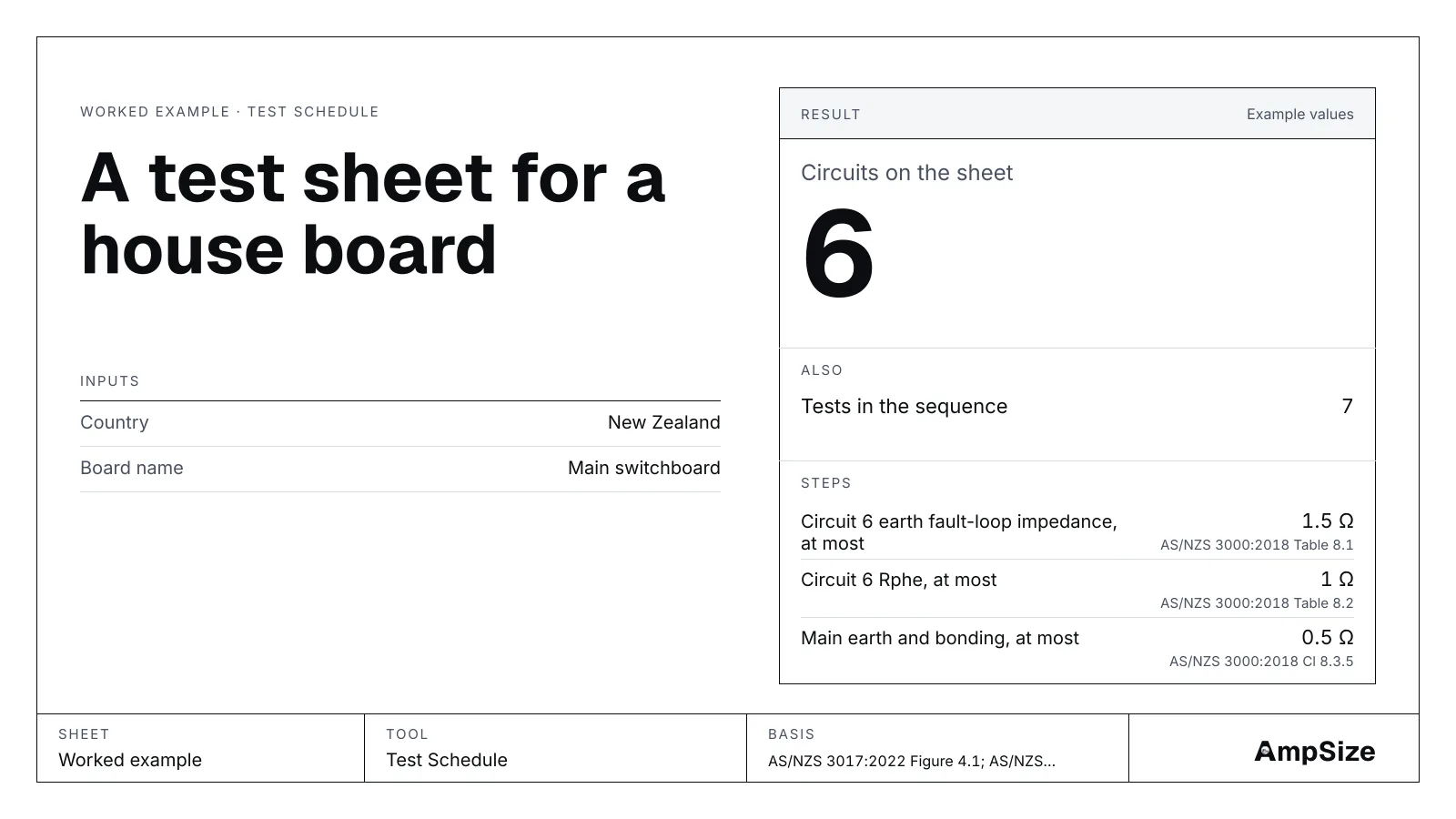
Before a new installation is livened, each circuit is tested, in an order that keeps one test from hiding a fault another would find. This guide makes the sheet for a house board with the test schedule tool. Why the order matters is in The order of verification tests.
The board
| Circuit | Supplies | Device | Active | RCD |
|---|---|---|---|---|
| 1 | Lights | C10 | 1.5 mm² | 30 mA |
| 2 | Lounge and bedroom sockets | C20 | 2.5 mm² | 30 mA |
| 3 | Kitchen sockets | C20 | 2.5 mm² | 30 mA |
| 4 | Laundry and bathroom | C20 | 2.5 mm² | 30 mA |
| 5 | Oven | C32 | 6 mm² | None |
| 6 | Hot water | C20 | 2.5 mm² | None |
Step 1. The order
The sheet lists the tests in the order of AS/NZS 3017 Figure 4.1:
- Prove the circuit de-energized.
- Earth continuity: the main earthing conductor, then the circuit earths and bonds.
- Insulation resistance.
- Polarity and the correct connection of each circuit.
- Earth fault-loop impedance.
- Each RCD.
A fault found later can upset an earlier test, so after a fix, repeat the tests it may have affected.
Step 2. The limits
Each circuit carries the limits its readings are judged against:
- Insulation resistance at least 1 MΩ at 500 V on every circuit.
- Earth continuity Re at most 1 Ω for the 10 A lighting circuit and 0.5 Ω for the 20 A circuits, from Table 8.2. The oven has no Table 8.2 row for a 32 A device on 6 mm², so it falls back to the 0.5 Ω main earth figure, and the sheet says so.
- Earth fault-loop impedance at most 3.1 Ω for the C10, 1.5 Ω for each C20 and 1 Ω for the C32, from Table 8.1 at a 0.4 s disconnection time.
- RCD: each 30 mA RCD operates at its rated current and trips within 300 ms, the Electricity (Safety) Regulations figure the test results tool uses.
The main earthing conductor and the bonding are tested against 0.5 Ω.
Step 3. Print it
The PDF prints each circuit with its limits and empty boxes for the insulation, Re, Zs, polarity and RCD readings. Fill it in on site, then put any reading in doubt into the test results tool.
In Australia
Open the Australian sheet. The tests and the AS/NZS 3000 limits are the same. AS/NZS 3017 asks that each RCD operates at about its rated residual current and disconnects the circuit, and prints no trip time, so the sheet states none.
A circuit with no Table 8.1 row
A device rating Table 8.1 does not list, such as 250 A, gets "No row" in the Zs column. Work its limit with the loop impedance tool.