Working level
The ideas behind a real job: maximum demand, loop impedance and cable selection tables.
- 4 min readAS/NZS 3008.1.1:2025: what the AU part coversWhat AS/NZS 3008.1.1:2025 covers, a.c. to 0.6/1 kV and d.c. to 1500 V at 40 °C air and 25 °C soil, how its sections run, and where the d.c. tables are.
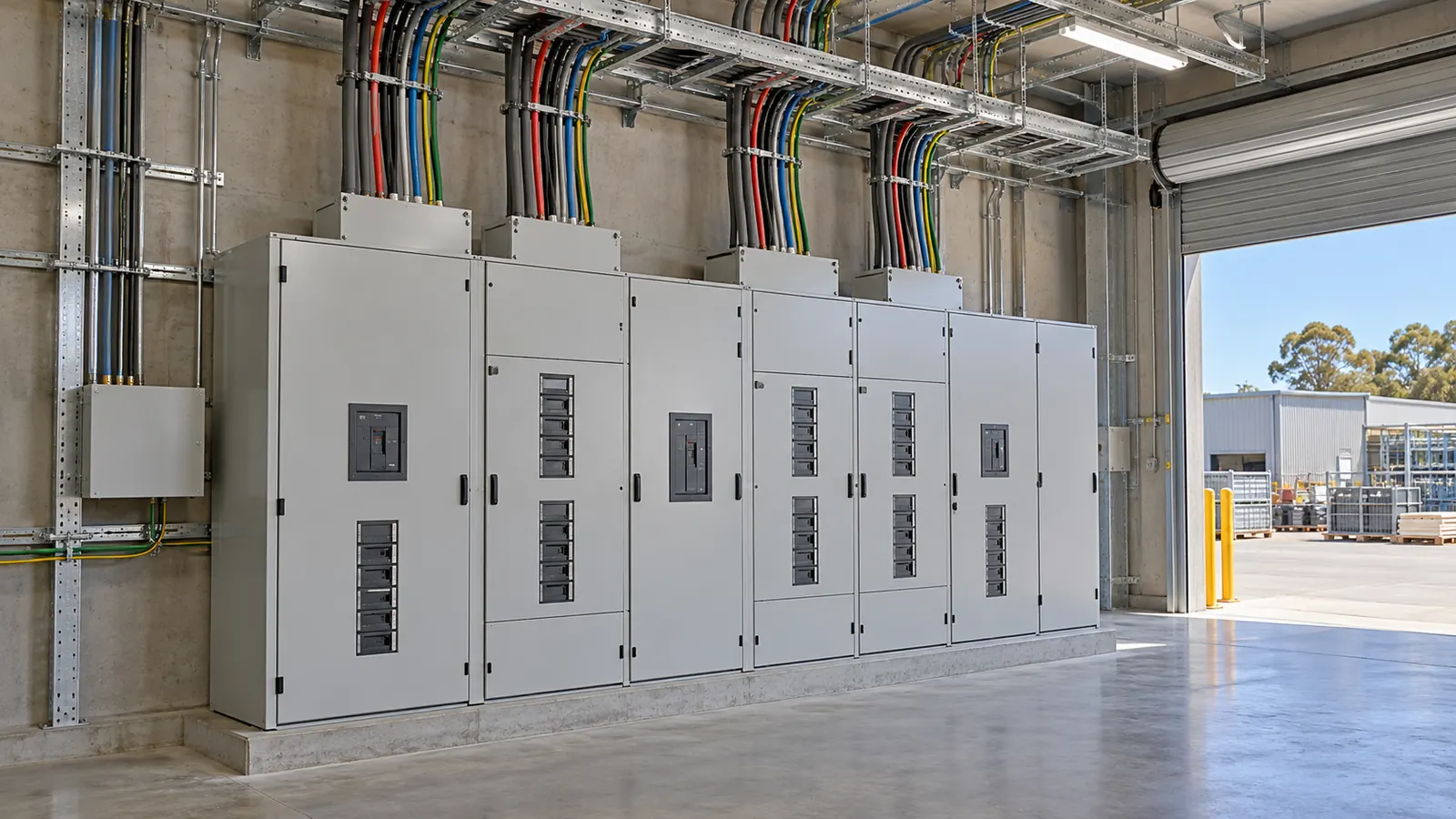
- 5 min readBattery classes and arc flash in AS/NZS 5139How AS/NZS 5139 classes a battery system by hazard and decisive voltage class, works its arc flash energy, and sets the PPE, consequence and home limits.
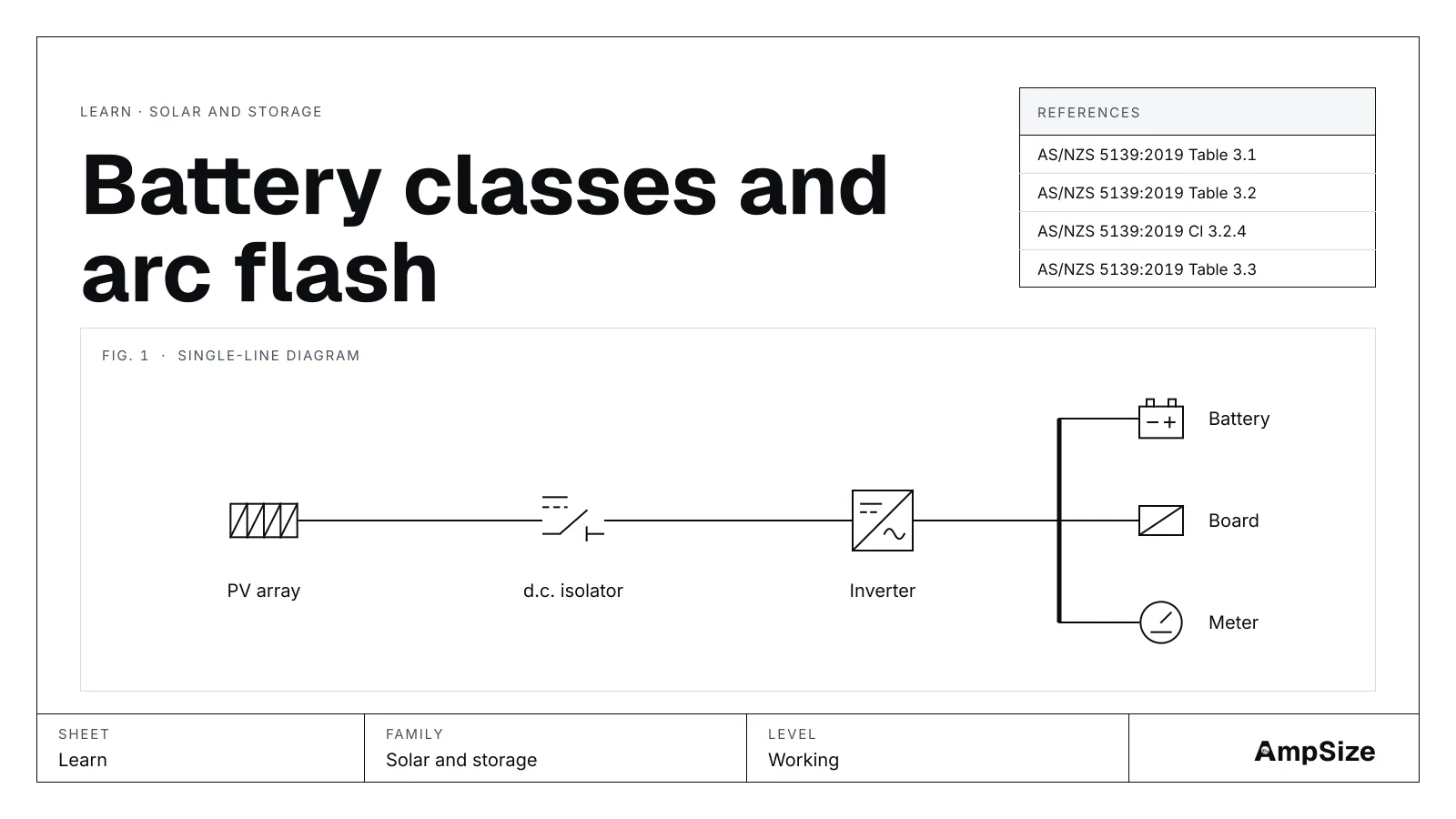
- 4 min readCable tray fill: one layer, tiers and groupingHow cables lie on a tray or ladder for AS/NZS 3008.1, touching or spaced, when a run needs another tier, and why there is no fill percentage to work to.
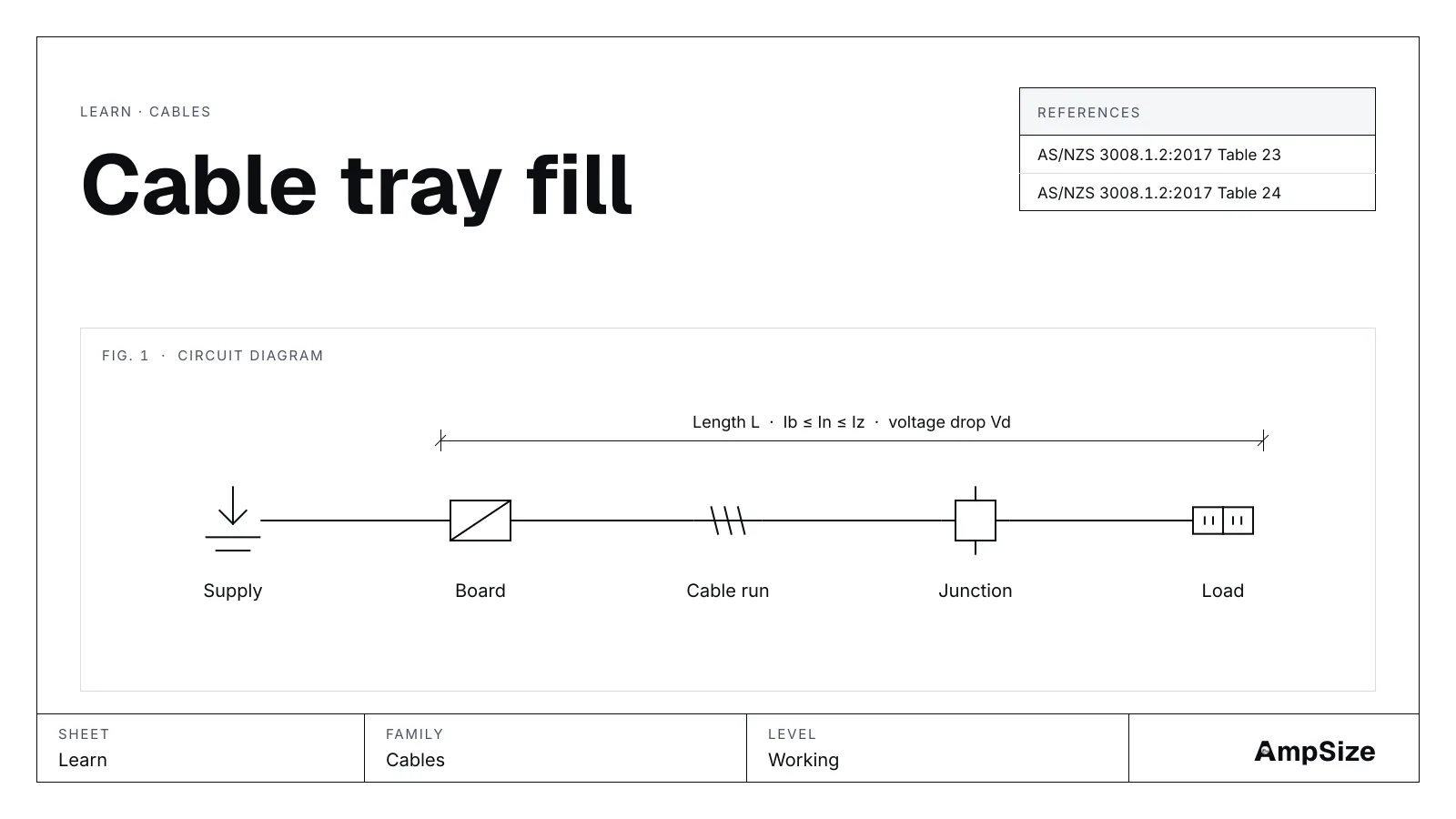
- 5 min readChecking an existing circuitThe five checks AmpSize runs on an installed circuit, from Iz and voltage drop to Zs and fault withstand, and what a site test adds that a calculation cannot.
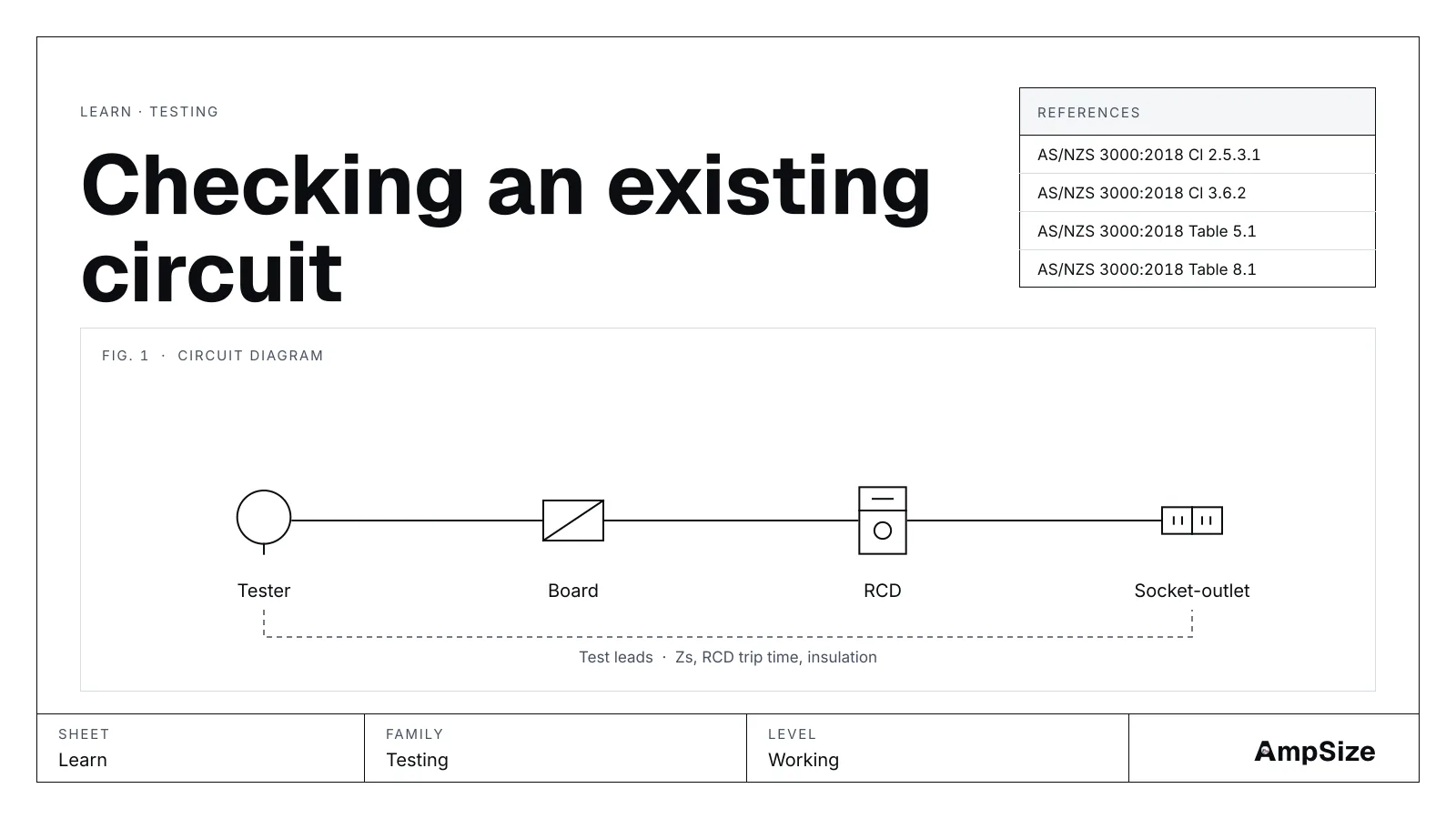
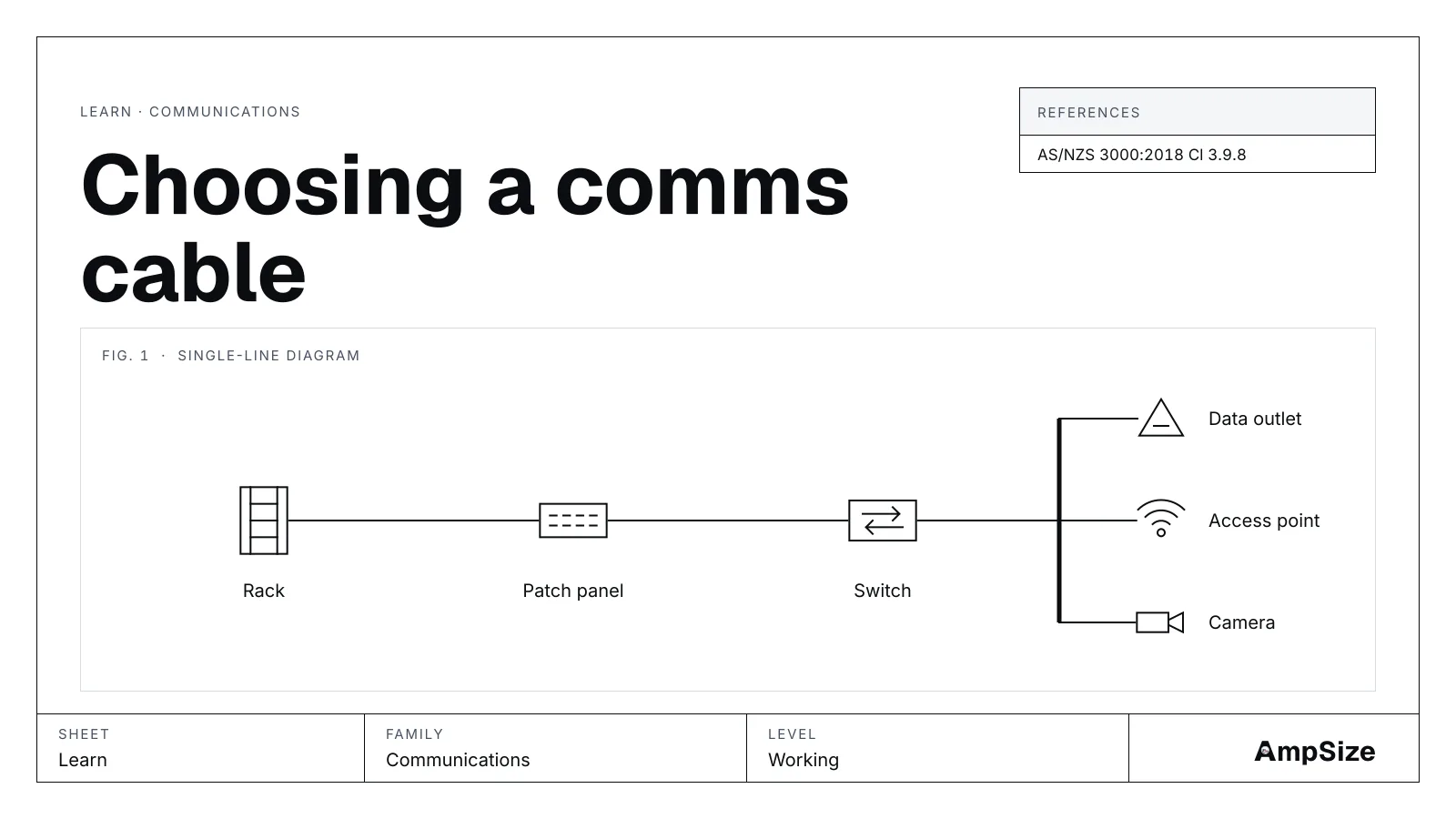
- 4 min readChoosing a comms cable: length and screenCheck a comms cable run before you order it. Length limits for RS-485 and Ethernet, the 4-20 mA loop and the screen rule, with three worked runs.
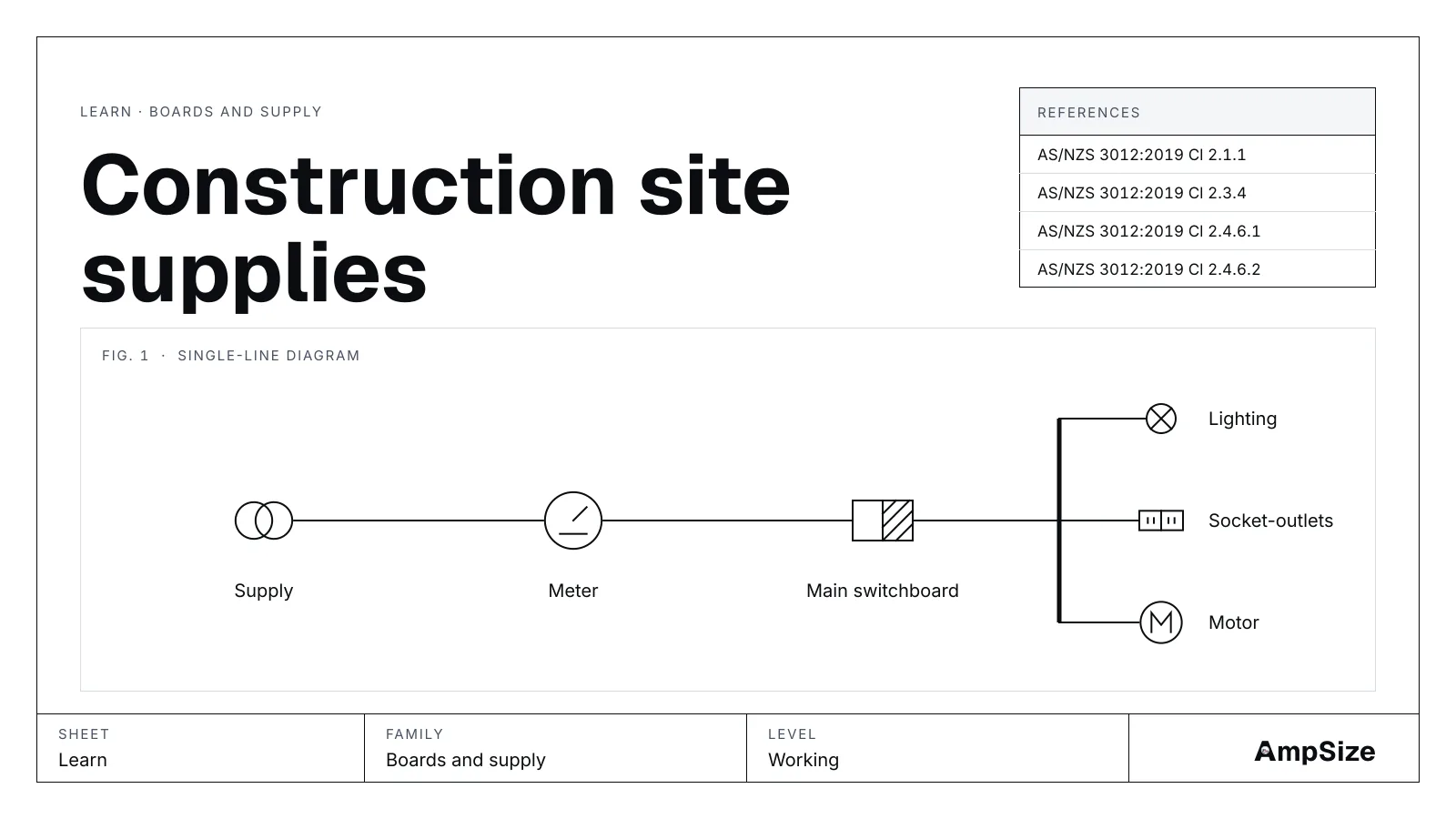
- 6 min readConstruction site supplies: AS/NZS 3012What AS/NZS 3012:2019 asks of the electrical supply on a construction or demolition site, from the supply and the RCDs to cords, generators and testing.
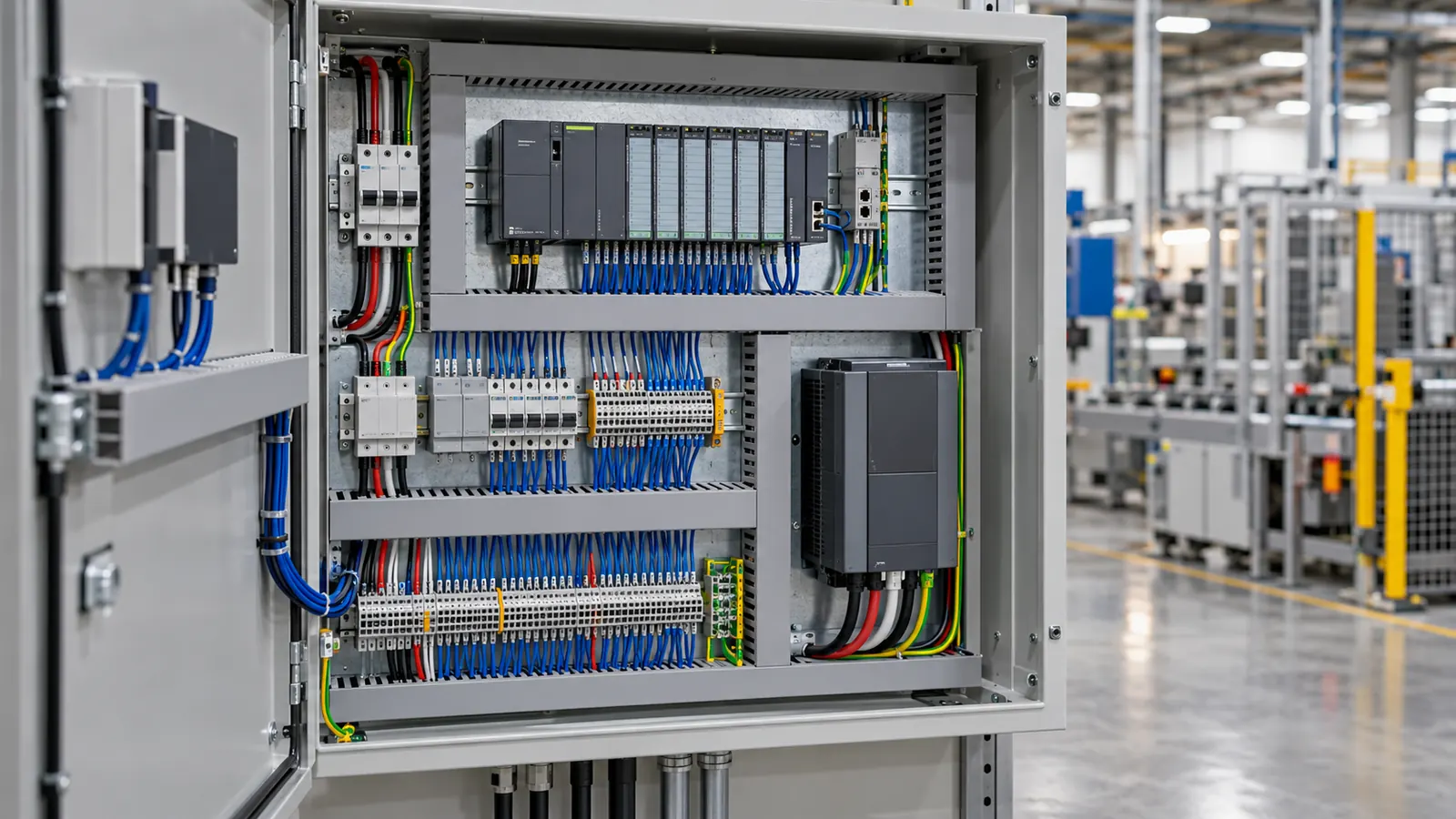
- 4 min readControl panels and PLC wiringSegregation of LV and ELV in a control panel, terminal and numbering practice, panel earthing, and the 24 V DC voltage drop that long instrument loops fail on.
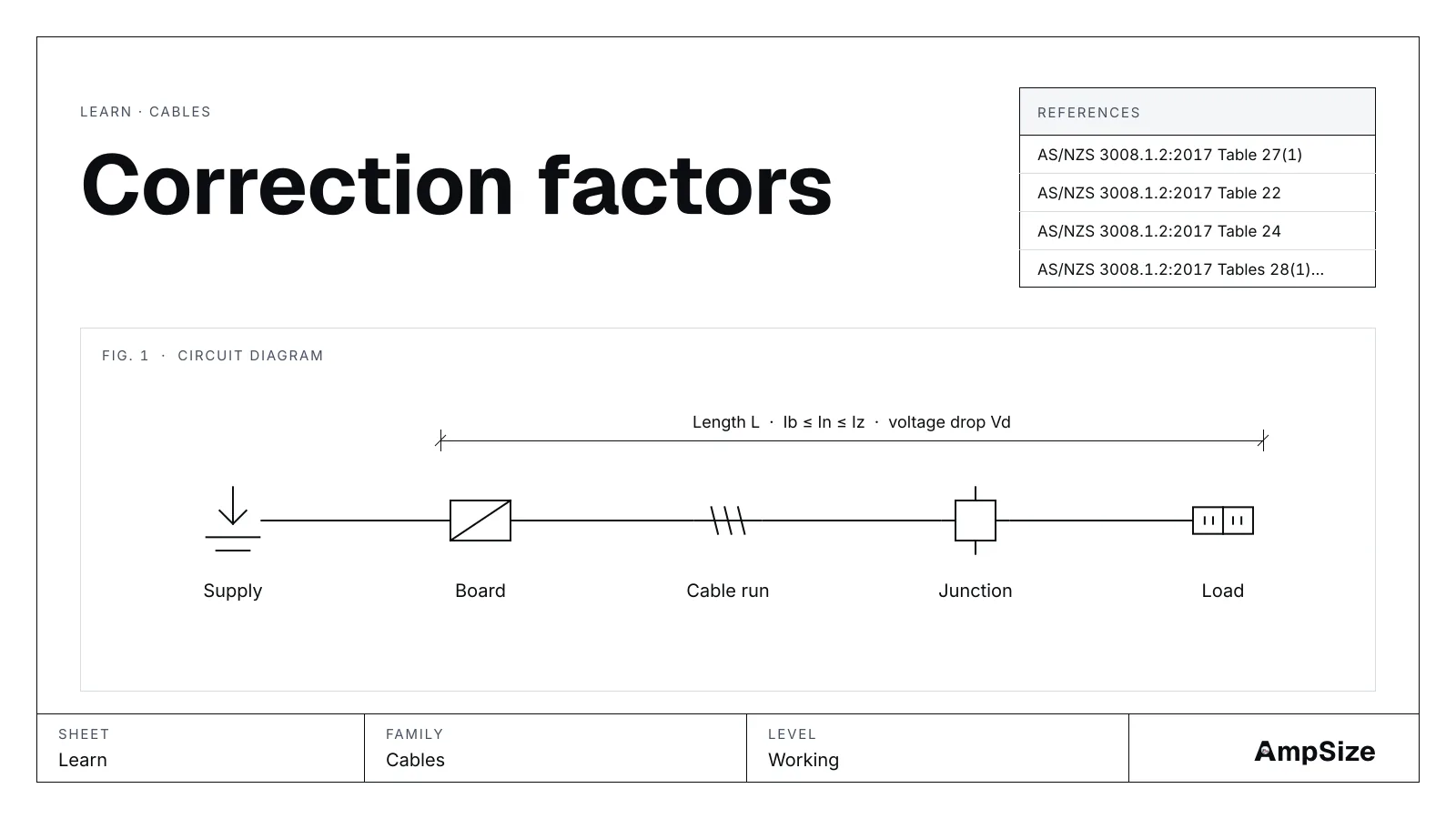
- 5 min readCorrection factors in the 2017 and 2025 editionsWhat each AS/NZS 3008 correction factor does, how the factors multiply, and which values changed when AS/NZS 3008.1.1:2025 replaced the 2017 tables.
- 5 min readDamp situations: the Section 6 zonesHow AS/NZS 3000 Section 6 zones the space around baths, showers, basins, spas, pools, fountains and saunas, how to read an IP code, and what A2 changed.
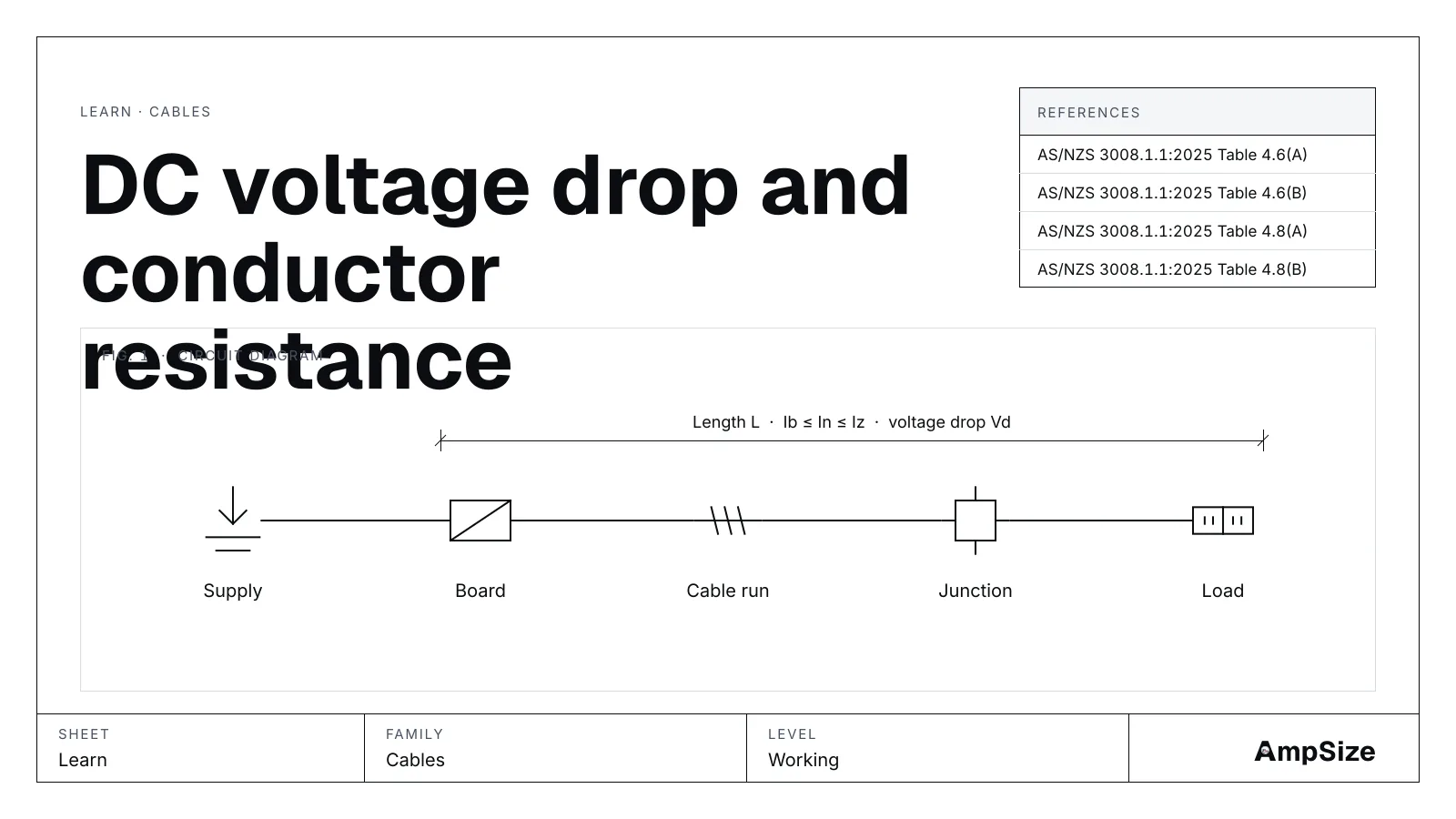
- 5 min readDC voltage drop and conductor resistanceWhy d.c. drop is 2 × I × R × L, why it has no reactance or power factor, and how the hot resistance, the cable tables, the limit and parallel cables change it.
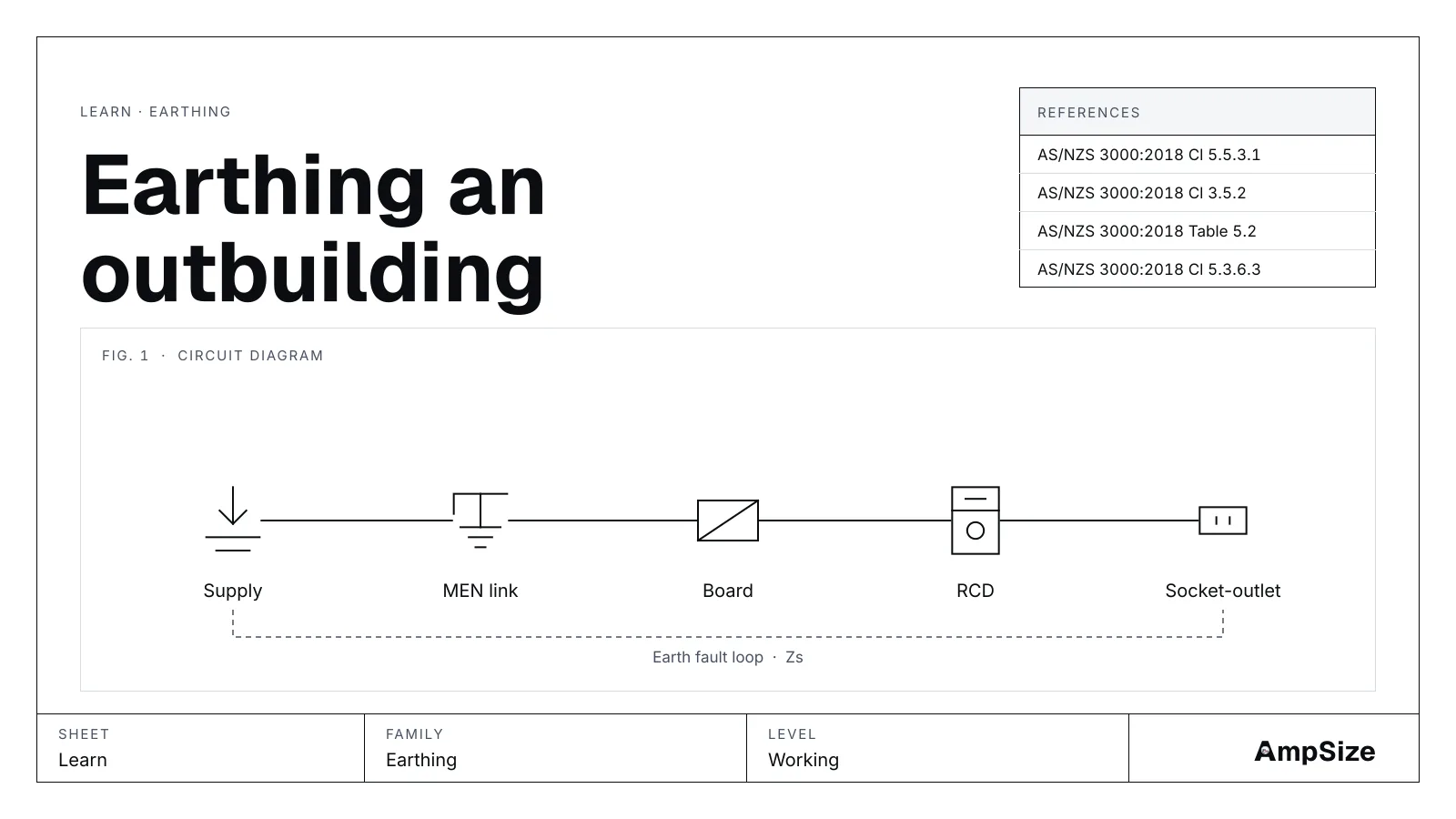
- 3 min readEarthing an outbuilding: earth or its own MENWhen a shed or sleep-out takes an earth with its submain and when it may have its own MEN link and electrode, the PEN size, and the electrode depths to use.
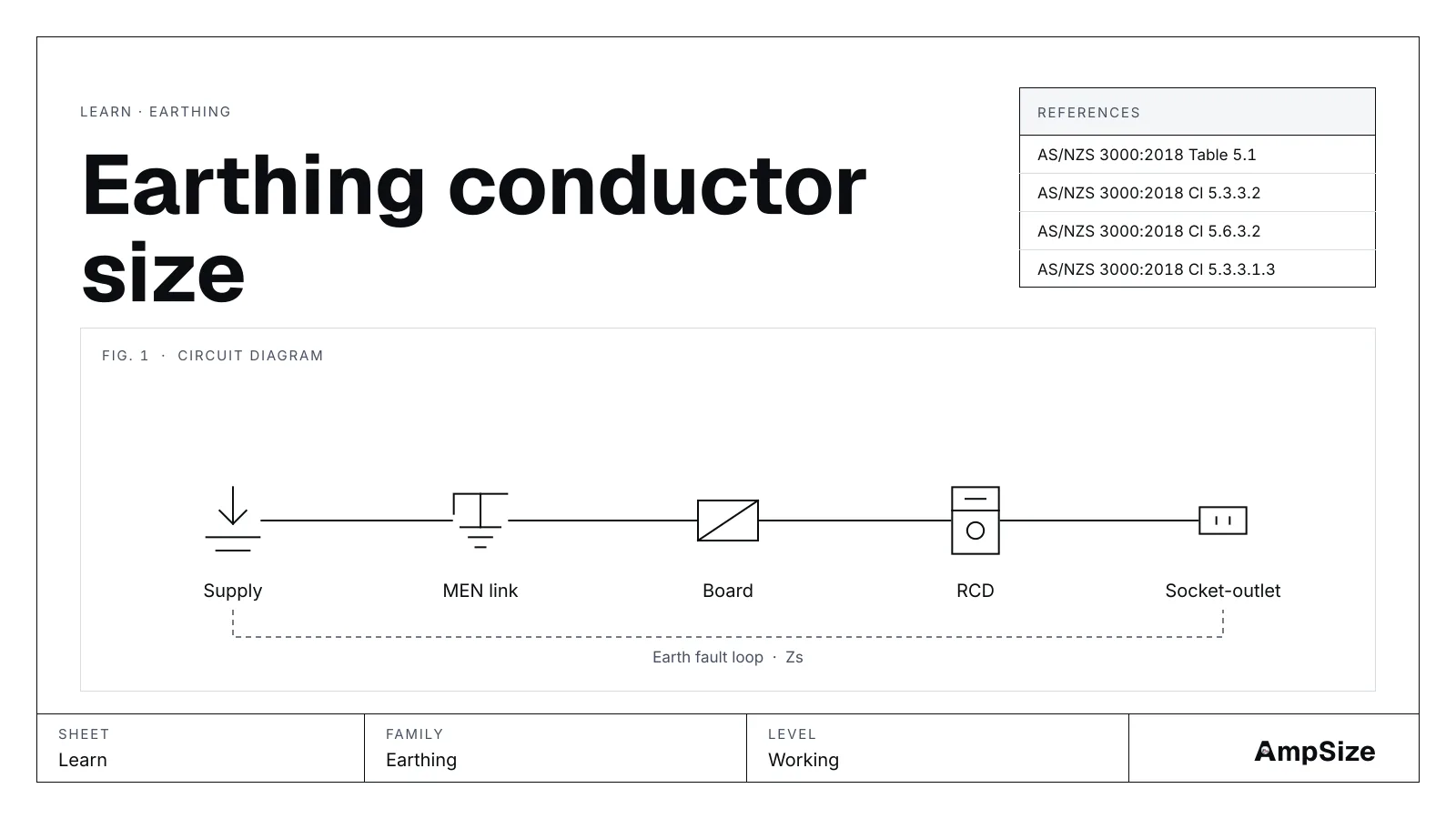
- 3 min readEarthing conductor size: table or calculationHow the protective earthing conductor, the main earthing conductor and the bonding conductor are sized, worked on a 25 mm² active with a 3 kA fault.
- 4 min readEV charging load and spare capacityHow an EV charger counts in maximum demand in NZ and Australia, what spare capacity at the board means, and how load management and the RCD type fit in.
- 3 min readFire alarm cabling: size, stranding and ratingWhat the NZS 4512 cabling clauses set for each fire alarm circuit type, worked on a detector circuit and a transmission circuit, and the checks left to you.

- 5 min readGenerator sizing for motor startingWhy a motor's start, not its running load, often sets a generator's size. Running and starting kVA, voltage dip, starting methods and derating.
- 3 min readIB ≤ IN ≤ IZ: the overload rule on a 32 A circuitThe overload rule is IB ≤ IN ≤ IZ. A grouped 32 A circuit fails on 6 mm² and passes on 10 mm², with an IZ of 37.6 A. Why the order matters.
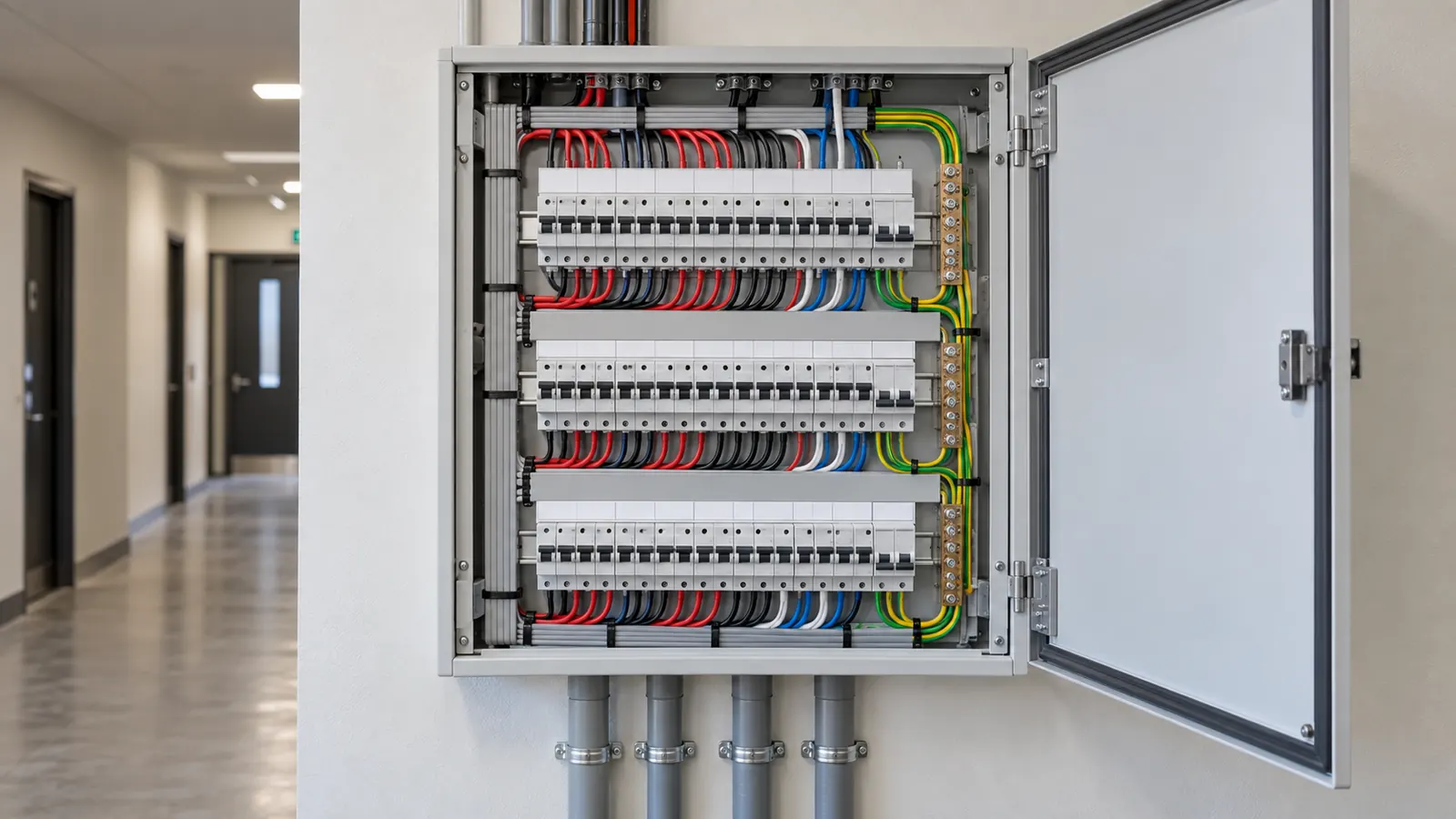
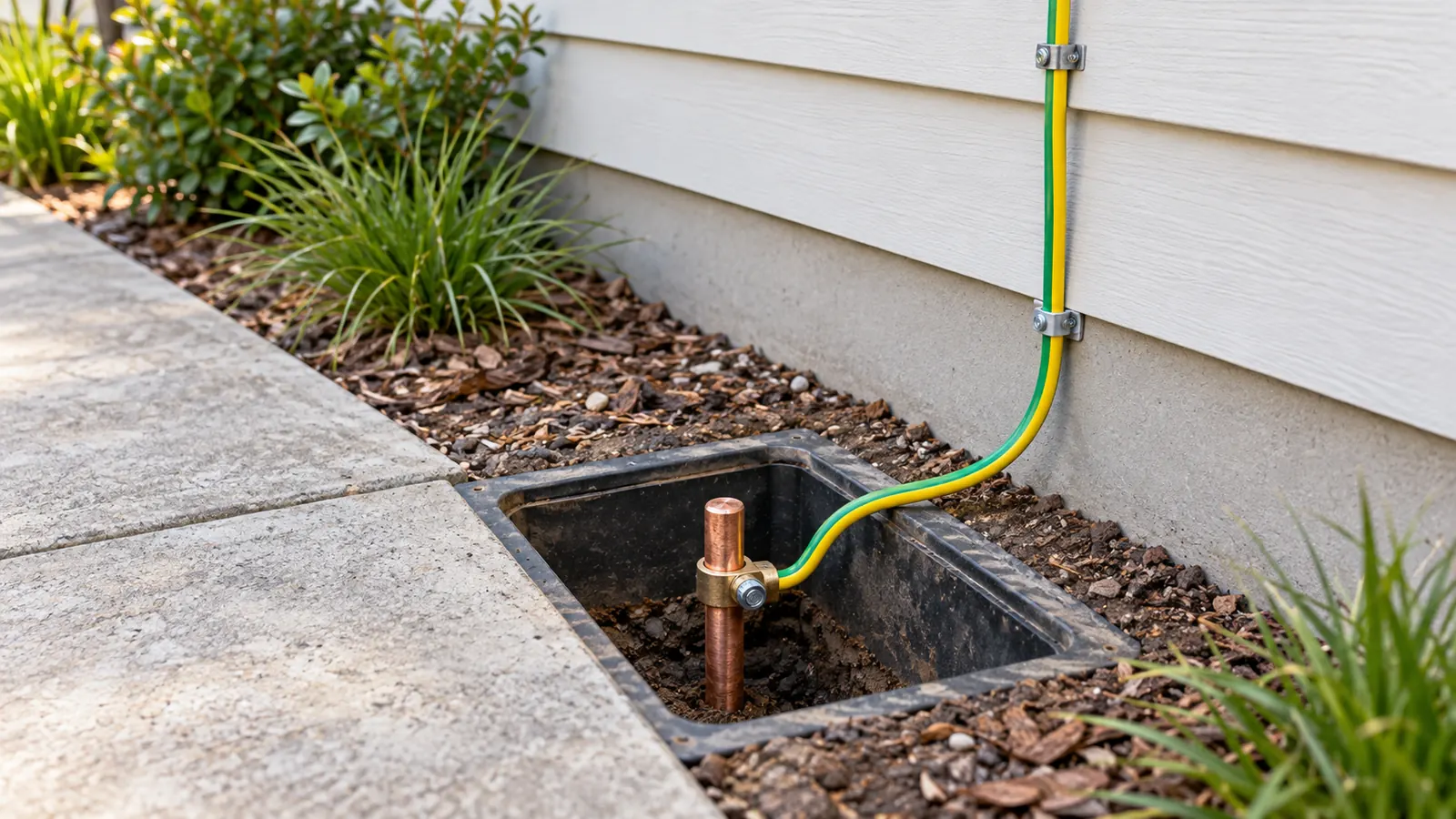
- 4 min readIEC 60364 and the Wiring RulesIEC 60364 is the international series that AS/NZS 3000 stays aligned with. See how its parts are numbered, what TN-C-S, TT and IT mean, and where MEN fits.
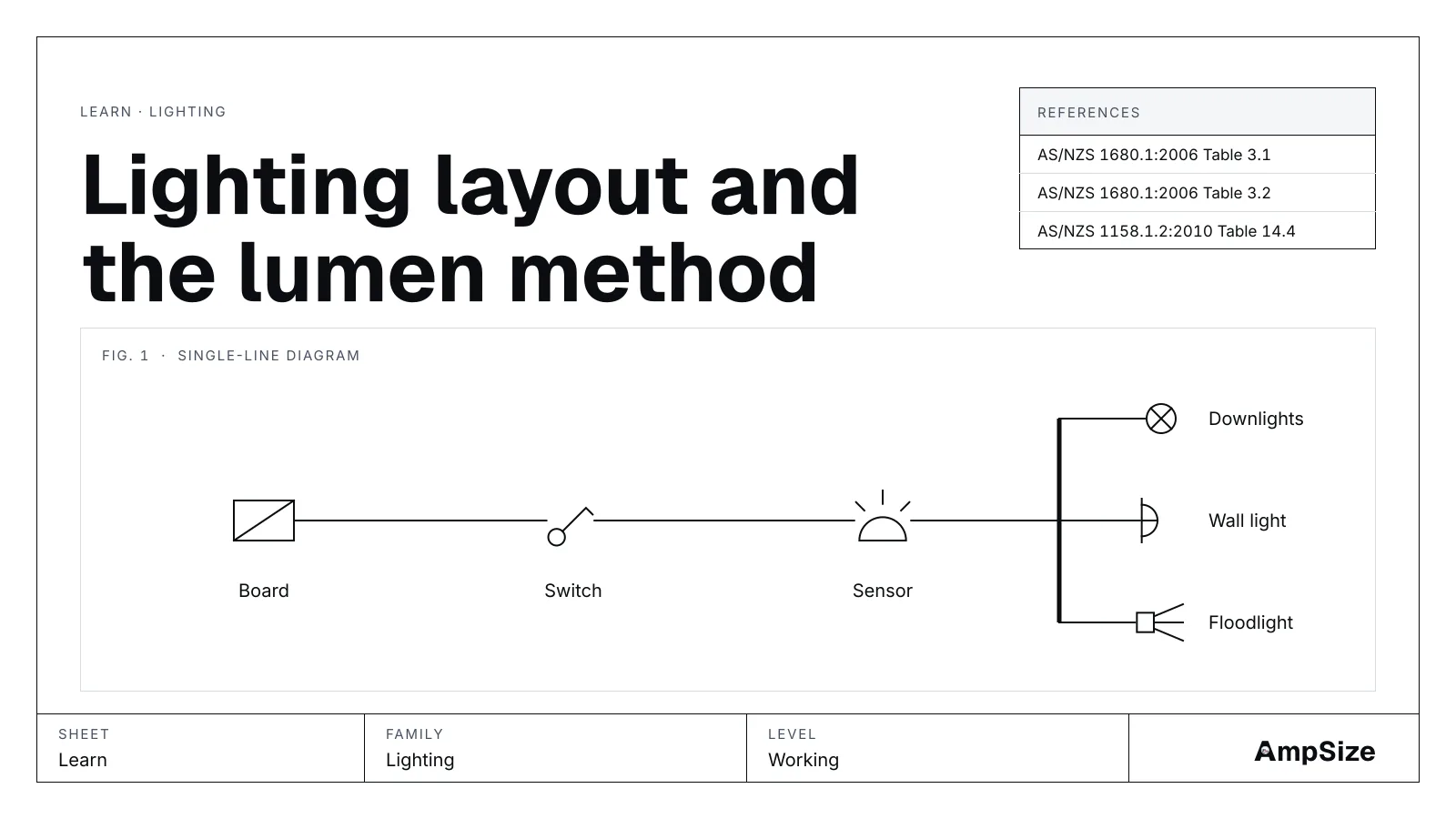
- 4 min readLighting layout and the lumen methodHow many luminaires does a room need? The lumen method from target lux to a grid, worked on an 8 m by 6 m office, with the checks the tool applies.
- 5 min readLoop impedance and disconnection timeZe, R1+R2, Zs and Ia, and the two disconnection times, worked on a 32 A curve C circuit over 30 m that returns 0.79 Ω against a 0.96 Ω limit.
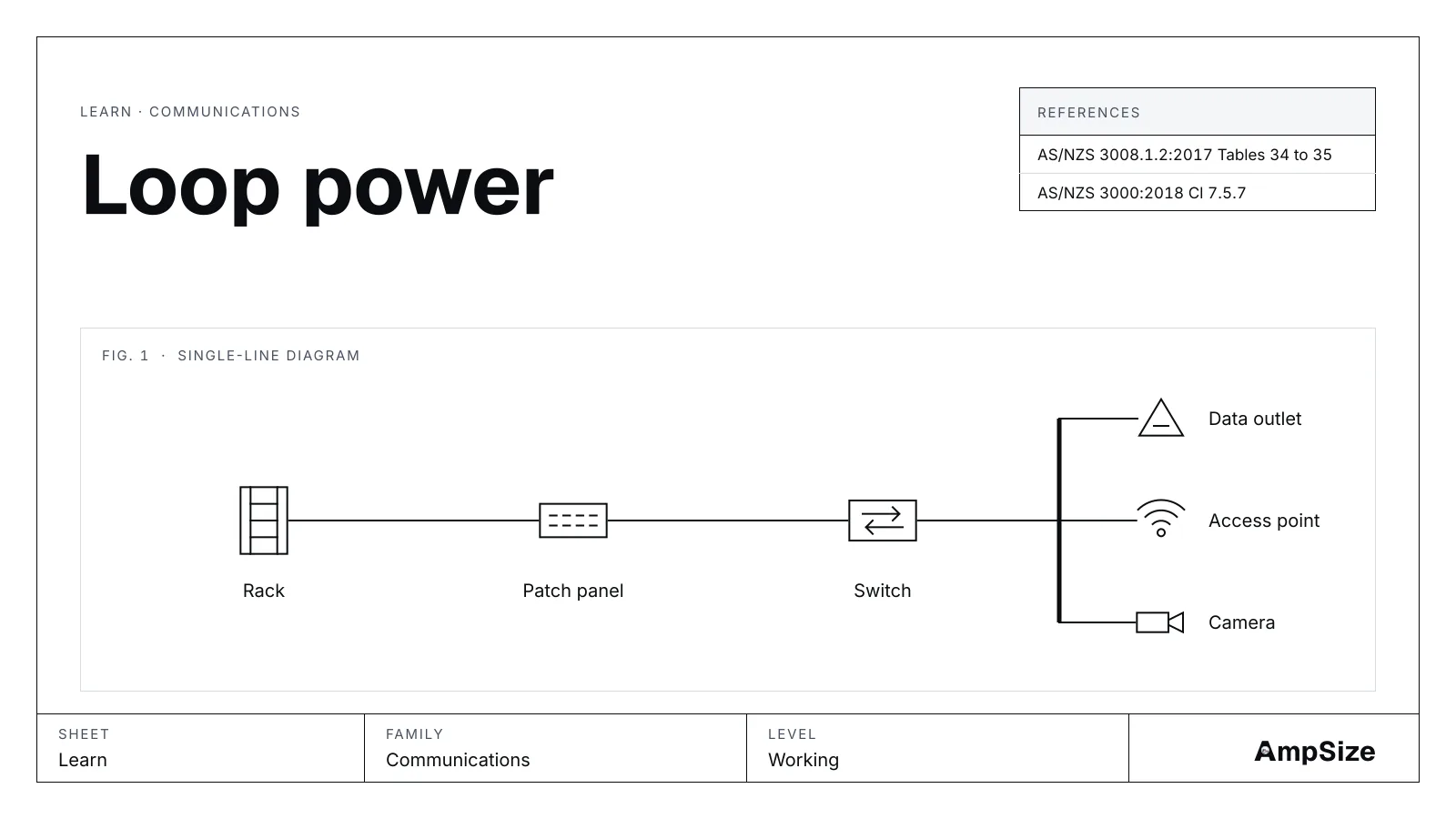
- 4 min readLoop power and the 4–20 mA voltage budgetWill a two-wire transmitter get enough voltage at full scale? The loop power budget from supply to lift-off, worked on a 500 m run, with the fix when it fails.
- 4 min readMaximum demand and diversityWhy consumer mains are smaller than the sum of the loads. The four methods of Cl 2.2.2, the Table C1 groups, and a house that lands on 70.18 A.

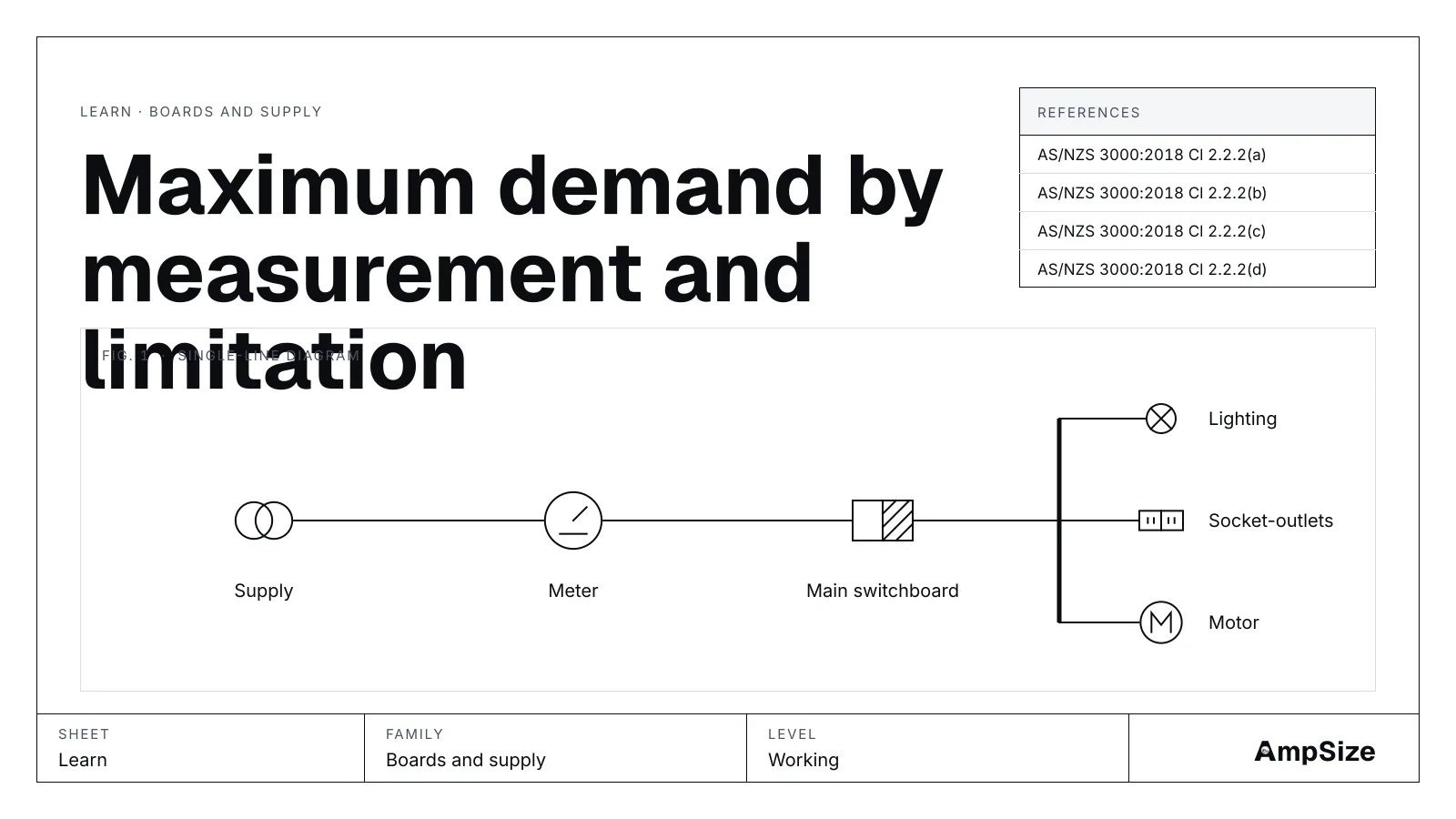
- 4 min readMaximum demand by measurement and limitationHow to find the maximum demand of an existing supply by recording it or by limitation, the measured-above-calculated rule, and the spare capacity per phase.
- 4 min readMaximum demand per phase on a three‑phase supplyFind the demand on each phase of a three-phase supply, see why the heaviest phase sets the size, and read the imbalance figure, worked with Table C1 loads.
- 4 min readMotor circuits and startingHow full load current sizes the cable and starting current sizes the device on a motor circuit, with a worked 22 kW 400 V motor and the cable the tool selects.
- 4 min readMotor starters, contactors and overload relaysHow to choose a motor starter: locked-rotor current, star-delta, soft starters, AC-3 and AC-23 duty, the overload relay and when motor protection applies.
- 3 min readMotor starting methods: current and torqueWhy a cage motor draws six or seven times full load current at start, and how star-delta, an autotransformer, a soft starter and a drive trade it for torque.
- 4 min readObtrusive light and the 4282 zonesHow AS/NZS 4282 limits spill light from outdoor lighting at a neighbour's window, by environmental zone A0 to A4, curfew, intensity and upward light ratio.
- 4 min readPower factor and reactive powerWhat power factor is, why a low one costs current and capacity, how a capacitor bank corrects it in steps, and when harmonics call for a detuned bank.
- 4 min readPV and inverter basicsHow a grid-connected PV system connects to an installation, why voltage rise sets the inverter cable, and which standards the AmpSize tools cannot quote.

- 4 min readPV array isolators and earthingHow parallel strings feed a fault, what Ithe, Ie and make and break mean for a d.c. isolator, and how AS/NZS 5033 earths and alarms a PV array.
- 3 min readPV string voltage and temperatureWhy a PV string's voltage rises in the cold and falls in the heat, how AS/NZS 5033 limits it, and how the string current, fuses and isolator follow.
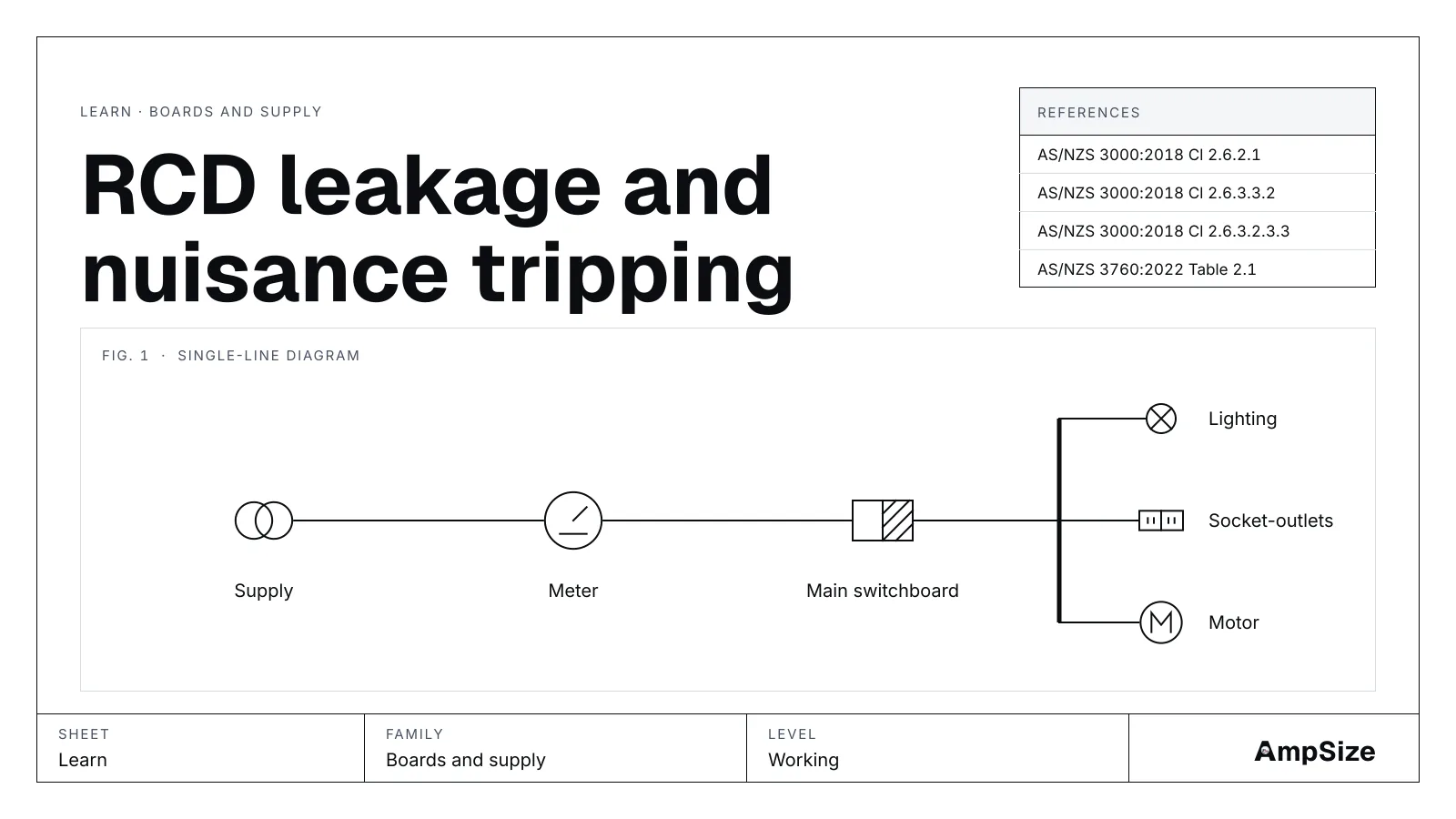
- 4 min readRCD leakage and nuisance trippingWhy an RCD trips with no fault. Where standing leakage comes from, the one-third and one-half points of Cl 2.6.2.1, class limits against measured figures.
- 5 min readRCD types and where they are requiredType AC, A, F and B, what each one detects, and the clauses that place them. The fault path behind them, worked on a 20 A circuit over 25 m.
- 4 min readShort-circuit withstand and the k factorThe adiabatic check in plain terms: prospective fault current, clearing time and k, worked on 25 mm² copper XLPE at 10 kA for 0.1 s.
- 4 min readTesting to Section 8: what each test provesThe Section 8 test sequence, what each test shows, and how a calculated earth fault loop impedance compares with the value a tester reads on site.
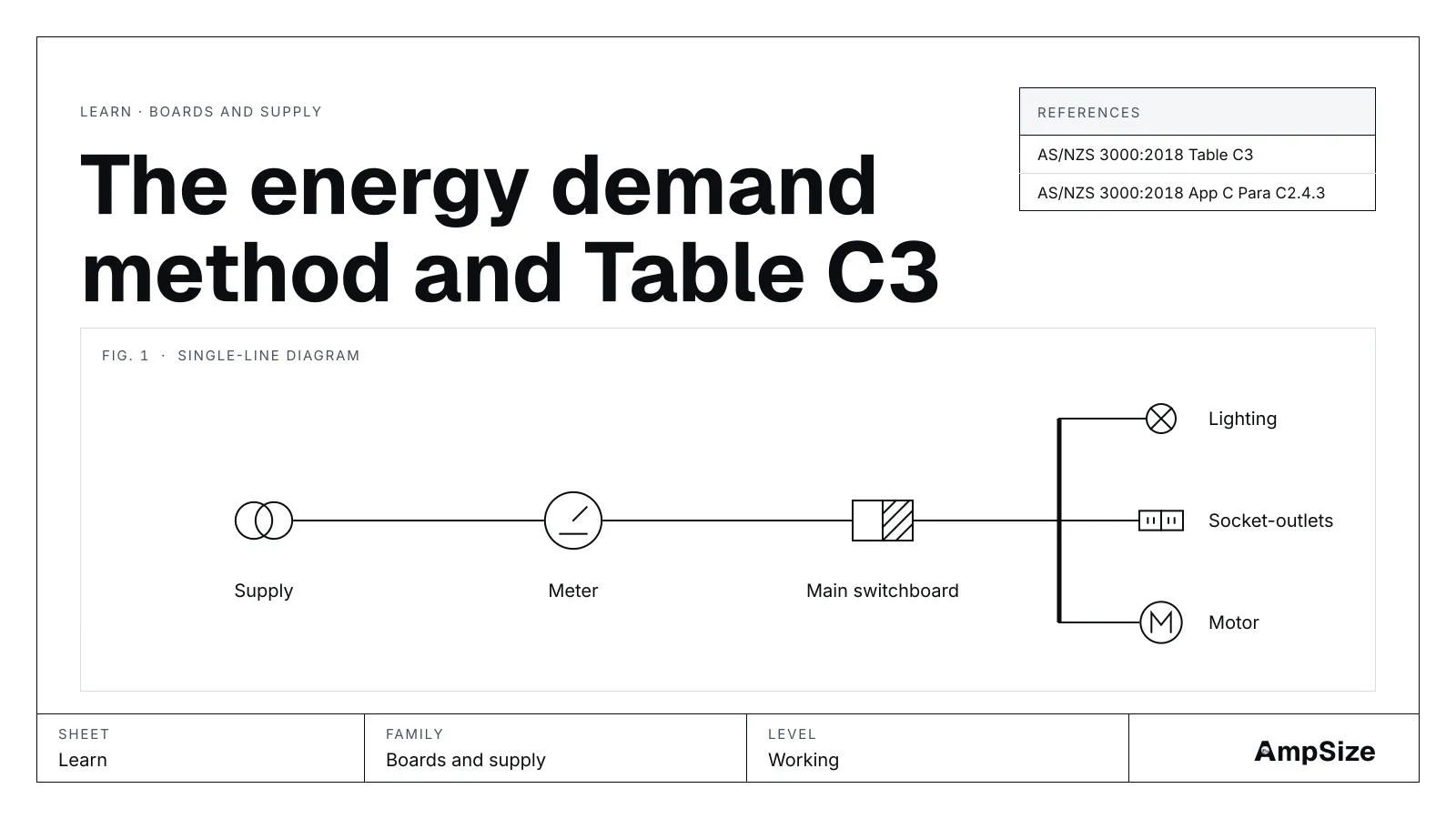
- 4 min readThe energy demand method and Table C3How AS/NZS 3000 Table C3 finds maximum demand from floor area in VA/m2, what moves the figure, how EV charging is added, and when to use Table C2 instead.
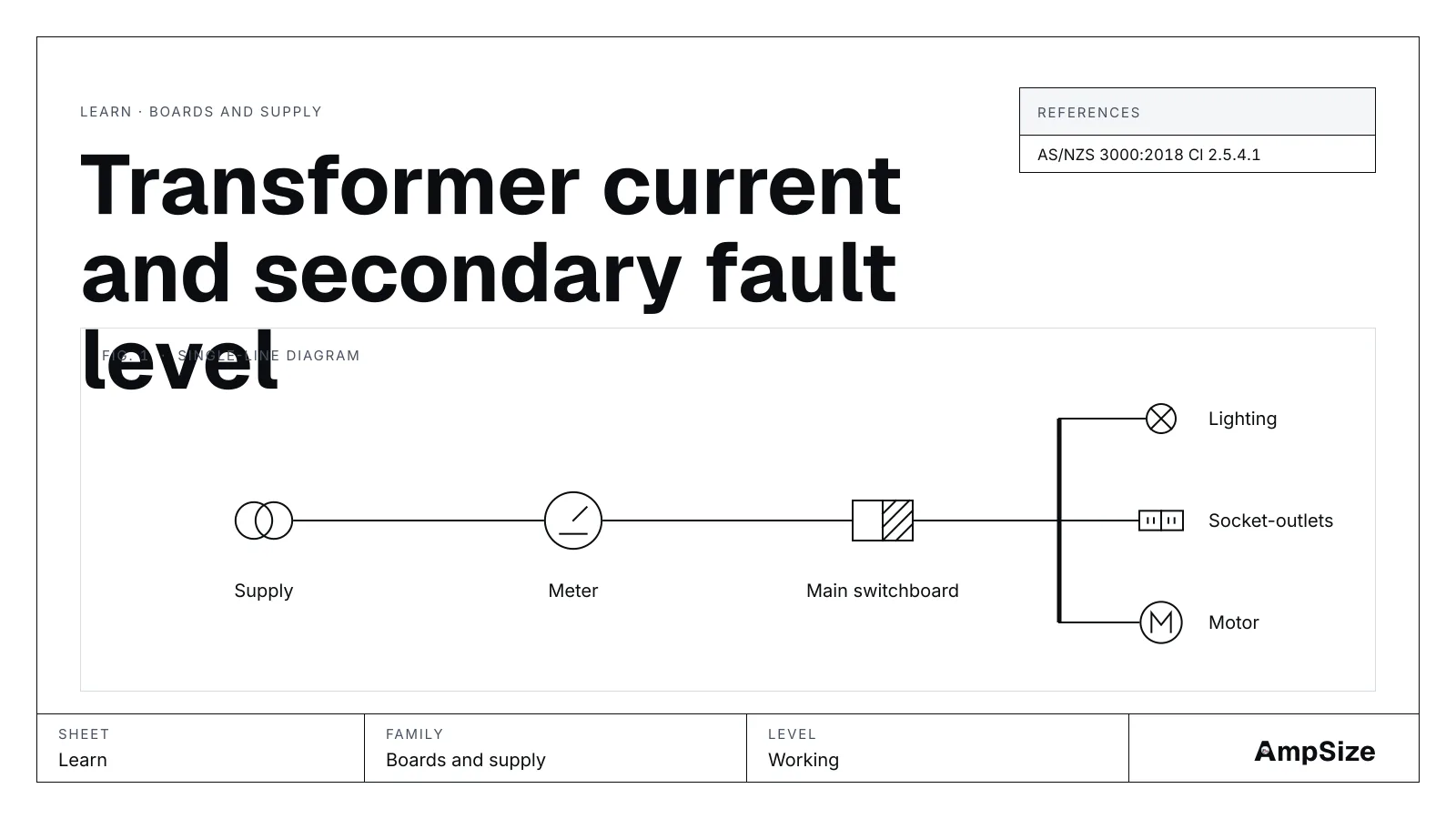
- 4 min readTransformer current and secondary fault levelHow to find the full load current on both sides of a transformer and the fault current at its secondary, worked on a 500 kVA 11 kV to 400 V unit.
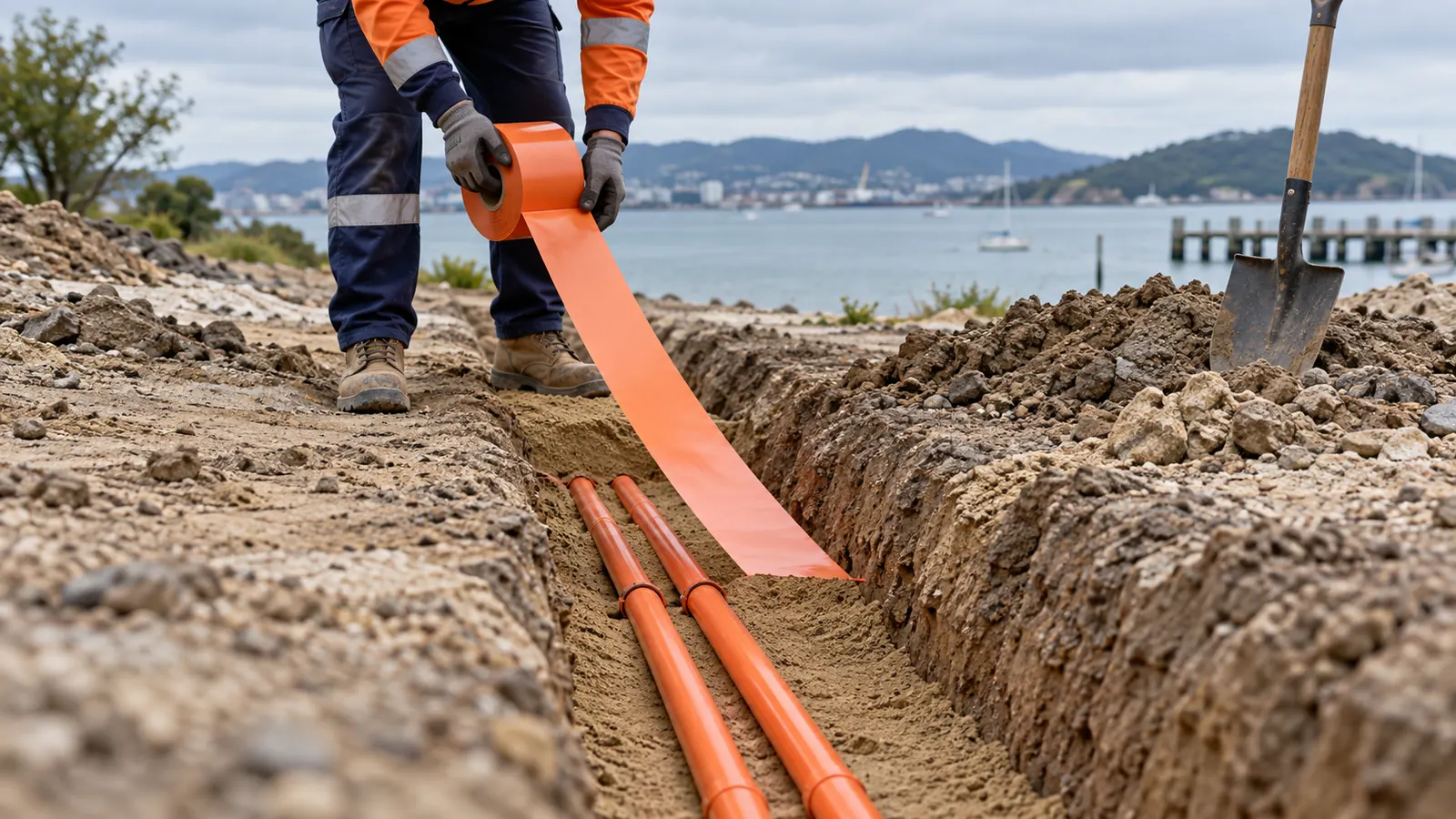
- 4 min readUnderground cables and civil interfacesBurial categories, depth of cover, bedding and separation for underground cables, with a worked 100 A submain that changes size when the trench changes.
Calculators these guides use
- Cable size calculatorFind the smallest cable size that passes each check.
- DC cable size calculatorSize a d.c. cable up to 1500 V for current and voltage drop.
- Battery arc flash and classBattery DVC, hazard class, arc flash energy and PPE level.
- Solar battery calculatorSize a home battery for the solar evening load.
- Arc flash calculatorEstimate the energy of an arc flash and its PPE category.
- Cable tray and ladder fillTray or ladder width, tiers, kg/m and the grouping factor.
- Correction factor calculatorRead each correction factor and the rating a cable needs.
- Existing circuit checkCheck an installed circuit: cable, device, drop and Zs.
- Earth fault loop impedance calculatorCheck earth fault loop impedance against the maximum Zs.
- Comms cable selectorPick a comms cable and check the run length.
- Loop power budget for 4–20 mA loopsCheck the voltage a 4–20 mA loop leaves the transmitter.
- Construction site supply calculatorSupply, RCD and test rules for a construction site.
- Site cord length calculatorThe longest a cord or cable may run on a construction site.
- Test and tag intervalsRetest intervals and pass limits for portable gear.
- Hand-held appliance supplyRead the supply arrangements regs 88 to 89A list.
- Show and carnival wiring checkerShow wiring RCD checks, plus site wiring depth and height.
- Voltage drop calculatorCalculate voltage drop on a cable run and check the limit.
- Battery bank calculatorCalculate battery bank capacity and autonomy for a load.
- Full load current calculatorCalculate full load current from power, voltage and phase.
- Cable screen earthing selectorFind where to earth a screen, drain wire or armour.
- Wet area zones checkerFind the Section 6 zone, IP and RCD near water.
- RCD selection calculatorCheck if an RCD is required and test the trip time.
- Outbuilding earthingEarth a shed: earth with the submain, or its own MEN.
- Earthing and bonding calculatorSize earthing, main earth and bonding conductors.
- Cable fault rating calculatorCheck that a conductor can withstand the fault current.
- EV charger circuit calculatorCheck EV chargers for spare capacity, cable size and RCD.
- Maximum demand calculatorEstimate maximum demand for domestic or non‑domestic loads.
- Fire alarm cabling lookupLook up cable and circuit rules for fire alarm systems.
- Fire alarm battery calculatorSize the standby battery for a fire alarm panel.
- Fire detector spacing calculatorDetector spacing and count for a room or corridor.
- Generator sizing from a load listSize a generator from a load list with motor starting.
- Generator current calculatorFull load and fault current of a generator from its kVA.
- Motor calculatorFind motor full load current, starting current and torque.
- Lighting lumen method calculatorLuminaire count and grid for a room by the lumen method.
- Three phase power calculatorConvert between power, current, voltage and power factor.
- Spare capacity calculatorSee if a new load fits the main switch of a supply.
- Maximum demand per phase calculatorSpread the load over three phases and see the imbalance.
- Motor circuit calculatorCable, breaker, contactor and overload for one motor.
- Motor starting method comparisonCompare DOL, star-delta, soft start and drive starts.
- Obtrusive light checkerCheck outdoor light at a boundary window by AS/NZS 4282.
- Power factor correction calculatorFind the capacitor kvar to lift a power factor.
- Voltage rise calculatorCalculate voltage rise for embedded generation or PV.
- PV isolator and earthing calculatorRate the PV array cables, d.c. isolator and earthing.
- PV string calculatorModules per string, string current and isolator for PV.
- RCD standing leakage budgetHow much standing leakage one RCD can carry.
- RCD arrangement checkCheck circuits per RCD and the lighting split.
- Transformer calculatorCalculate transformer full load current and impedance.
- Test results checkerCheck measured test results against Section 8 limits.
- Floor area demand calculatorEstimate commercial demand from floor area and use.
- Fault level calculatorProspective fault current at a board from its source.
- Underground cable depth calculatorDepth of cover and separation for a buried cable.
- Conduit fill calculatorCheck that a cable bundle fits in a conduit.