Working level
Ang mga ideyang nasa likod ng totoong job: maximum demand, loop impedance at cable selection table.
- 4 min basahinAS/NZS 3008.1.1:2025: what the AU part coversWhat AS/NZS 3008.1.1:2025 covers, a.c. to 0.6/1 kV and d.c. to 1500 V at 40 °C air and 25 °C soil, how its sections run, and where the d.c. tables are.
- 5 min basahinBattery classes and arc flash in AS/NZS 5139How AS/NZS 5139 classes a battery system by hazard and decisive voltage class, works its arc flash energy, and sets the PPE, consequence and home limits.
- 4 min basahinCable tray fill: one layer, tiers and groupingHow cables lie on a tray or ladder for AS/NZS 3008.1, touching or spaced, when a run needs another tier, and why there is no fill percentage to work to.
- 5 min basahinChecking an existing circuitThe five checks AmpSize runs on an installed circuit, from Iz and voltage drop to Zs and fault withstand, and what a site test adds that a calculation cannot.
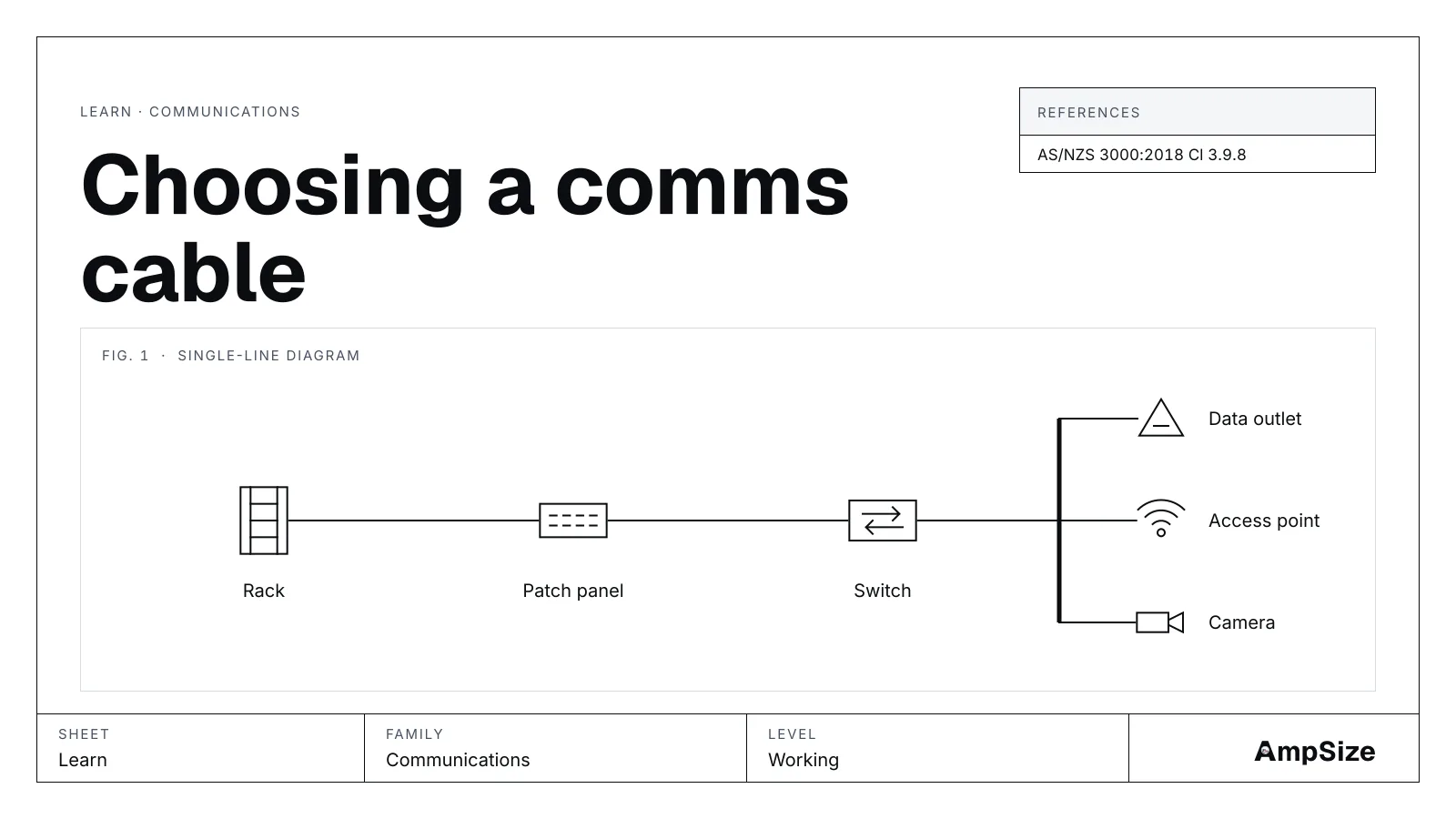
- 4 min basahinChoosing a comms cable: length and screenCheck a comms cable run before you order it. Length limits for RS-485 and Ethernet, the 4-20 mA loop and the screen rule, with three worked runs.
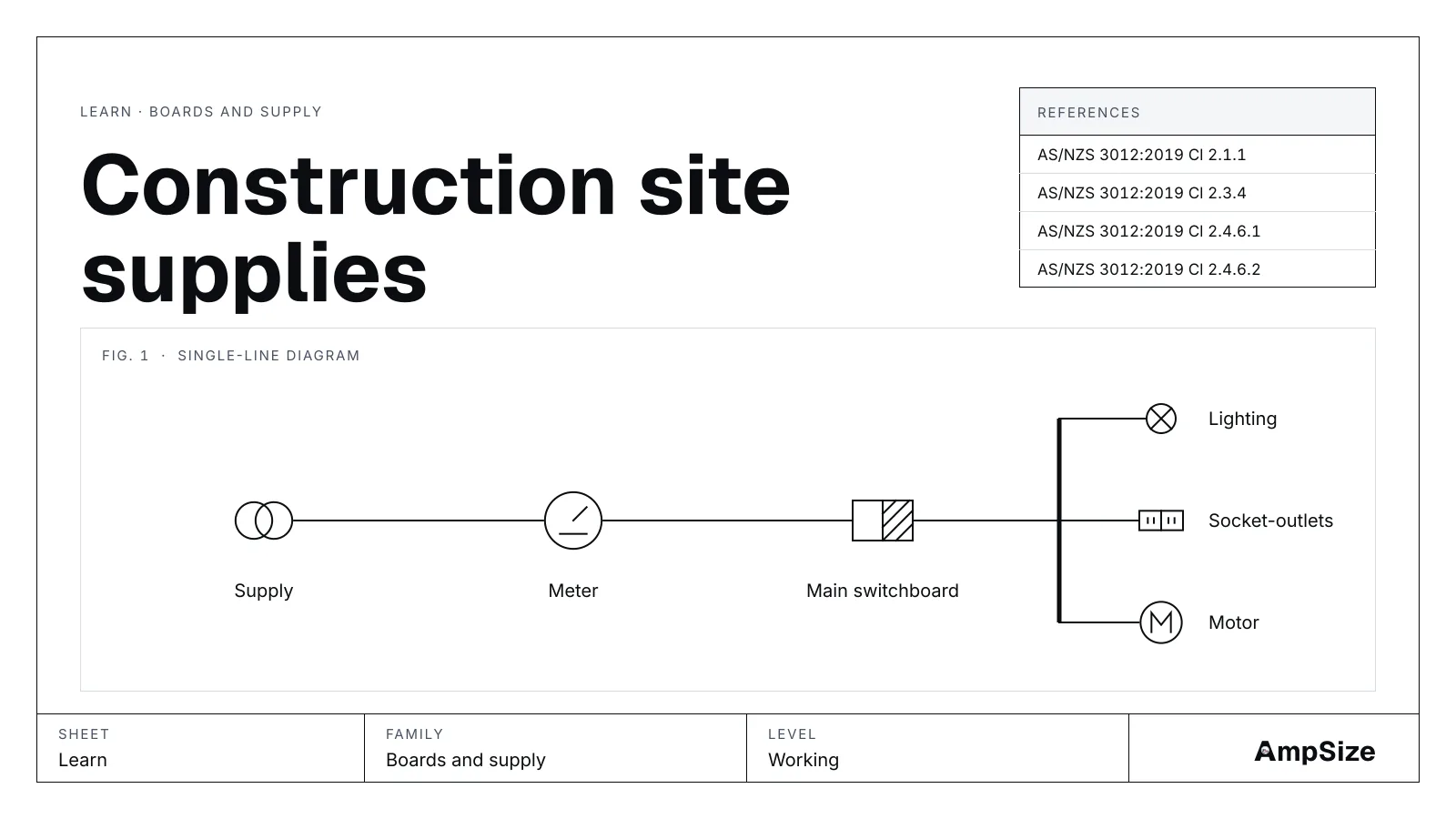
- 6 min basahinConstruction site supplies: AS/NZS 3012What AS/NZS 3012:2019 asks of the electrical supply on a construction or demolition site, from the supply and the RCDs to cords, generators and testing.
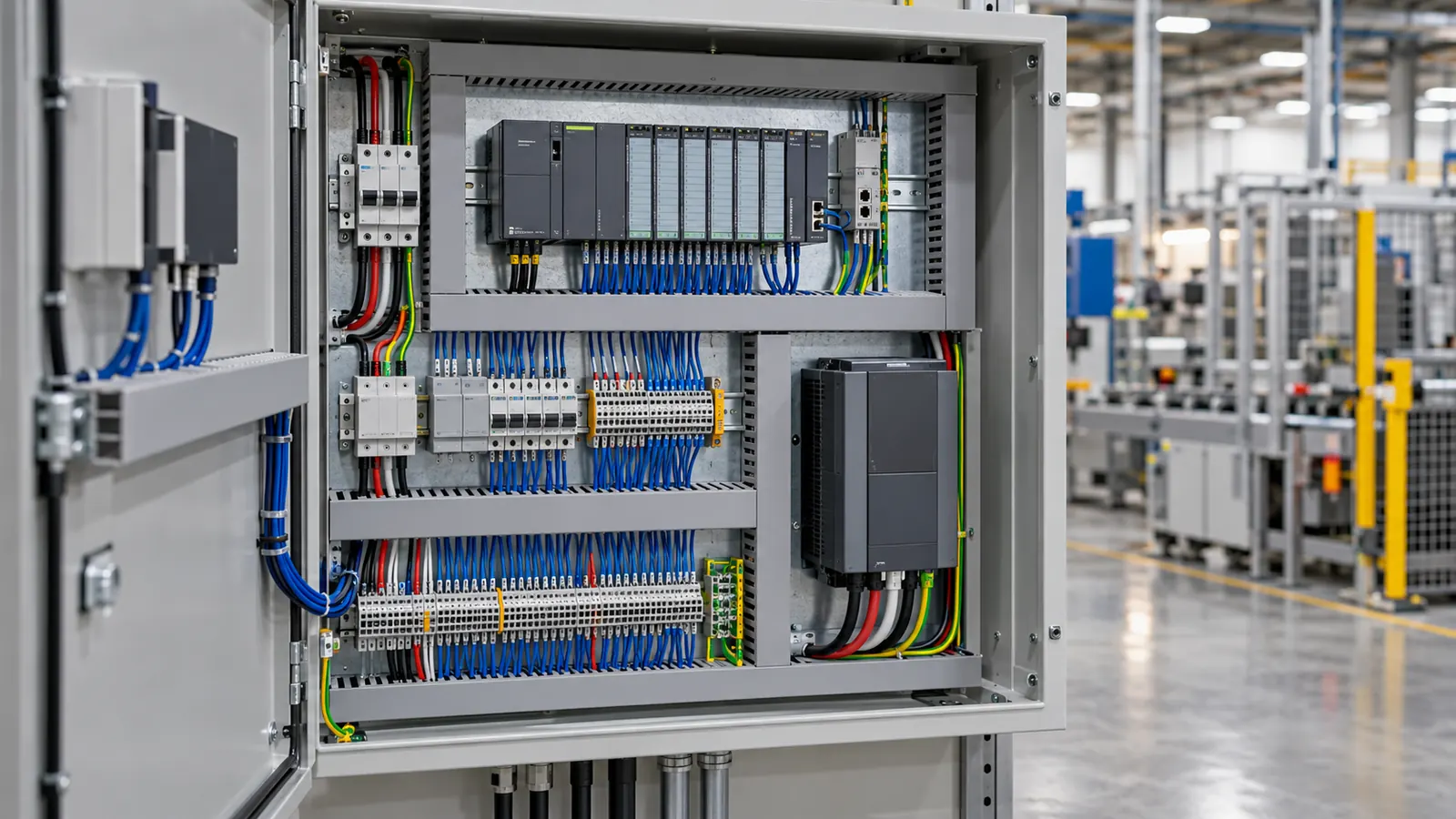
- 4 min basahinControl panels and PLC wiringSegregation of LV and ELV in a control panel, terminal and numbering practice, panel earthing, and the 24 V DC voltage drop that long instrument loops fail on.
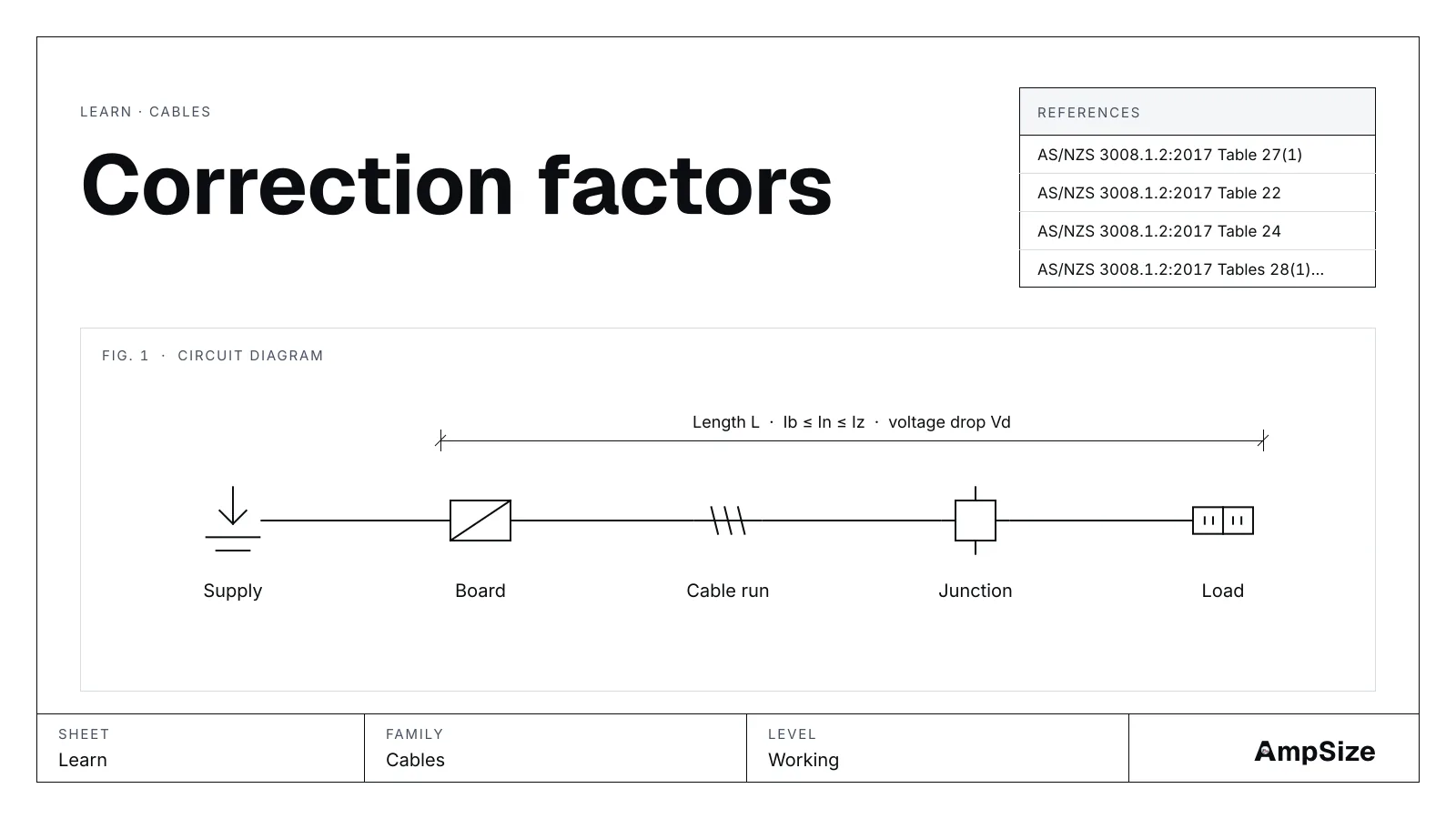
- 5 min basahinCorrection factors in the 2017 and 2025 editionsWhat each AS/NZS 3008 correction factor does, how the factors multiply, and which values changed when AS/NZS 3008.1.1:2025 replaced the 2017 tables.
- 5 min basahinDamp situations: the Section 6 zonesHow AS/NZS 3000 Section 6 zones the space around baths, showers, basins, spas, pools, fountains and saunas, how to read an IP code, and what A2 changed.
- 5 min basahinDC voltage drop and conductor resistanceWhy d.c. drop is 2 × I × R × L, why it has no reactance or power factor, and how the hot resistance, the cable tables, the limit and parallel cables change it.
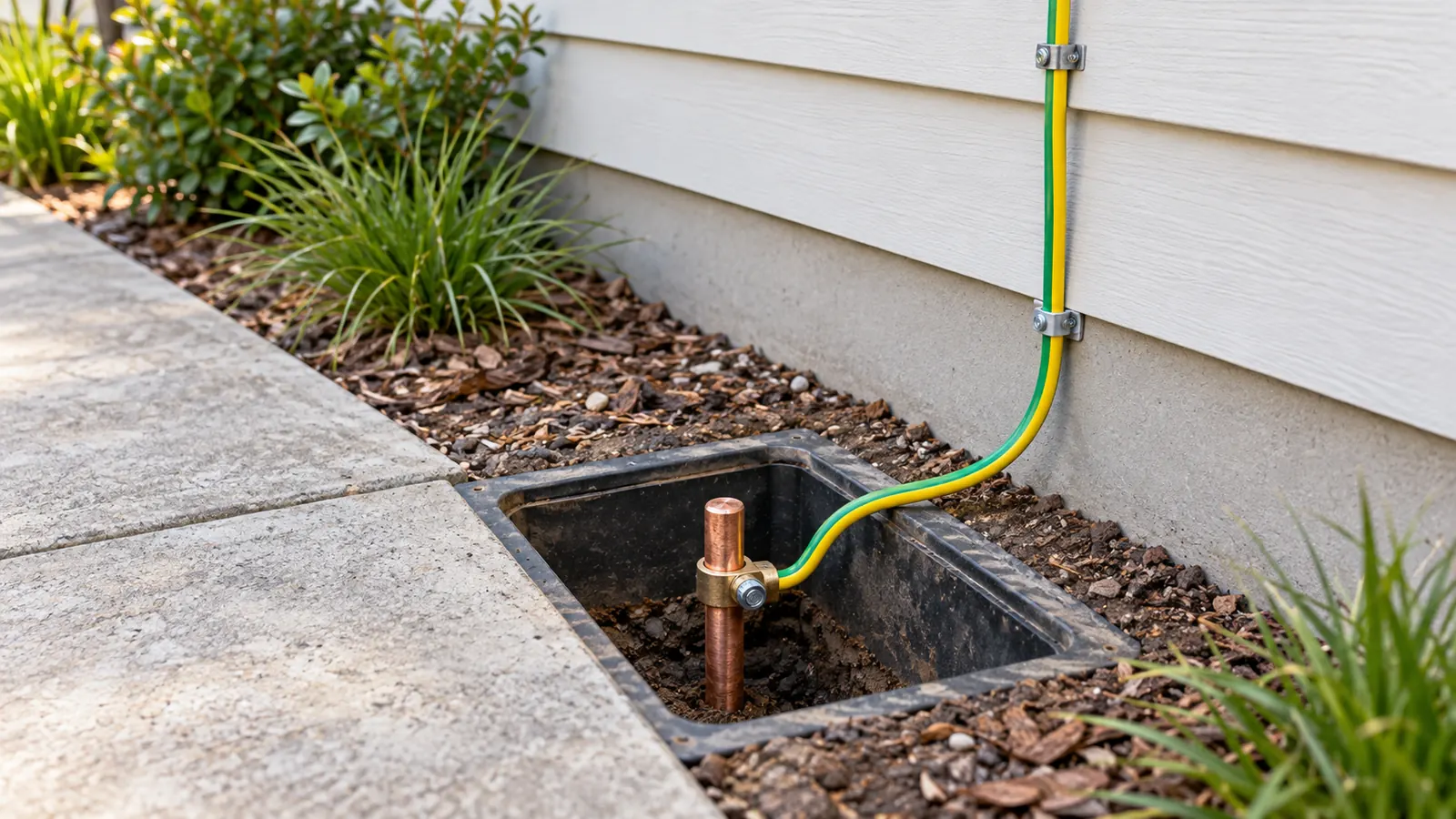
- 3 min basahinEarthing an outbuilding: earth or its own MENWhen a shed or sleep-out takes an earth with its submain and when it may have its own MEN link and electrode, the PEN size, and the electrode depths to use.
- 5 min basahinGenerator sizing for motor startingWhy a motor's start, not its running load, often sets a generator's size. Running and starting kVA, voltage dip, starting methods and derating.
- 3 min basahinIB ≤ IN ≤ IZ: the overload rule on a 32 A circuitThe overload rule is IB ≤ IN ≤ IZ. A grouped 32 A circuit fails on 6 mm² and passes on 10 mm², with an IZ of 37.6 A. Why the order matters.
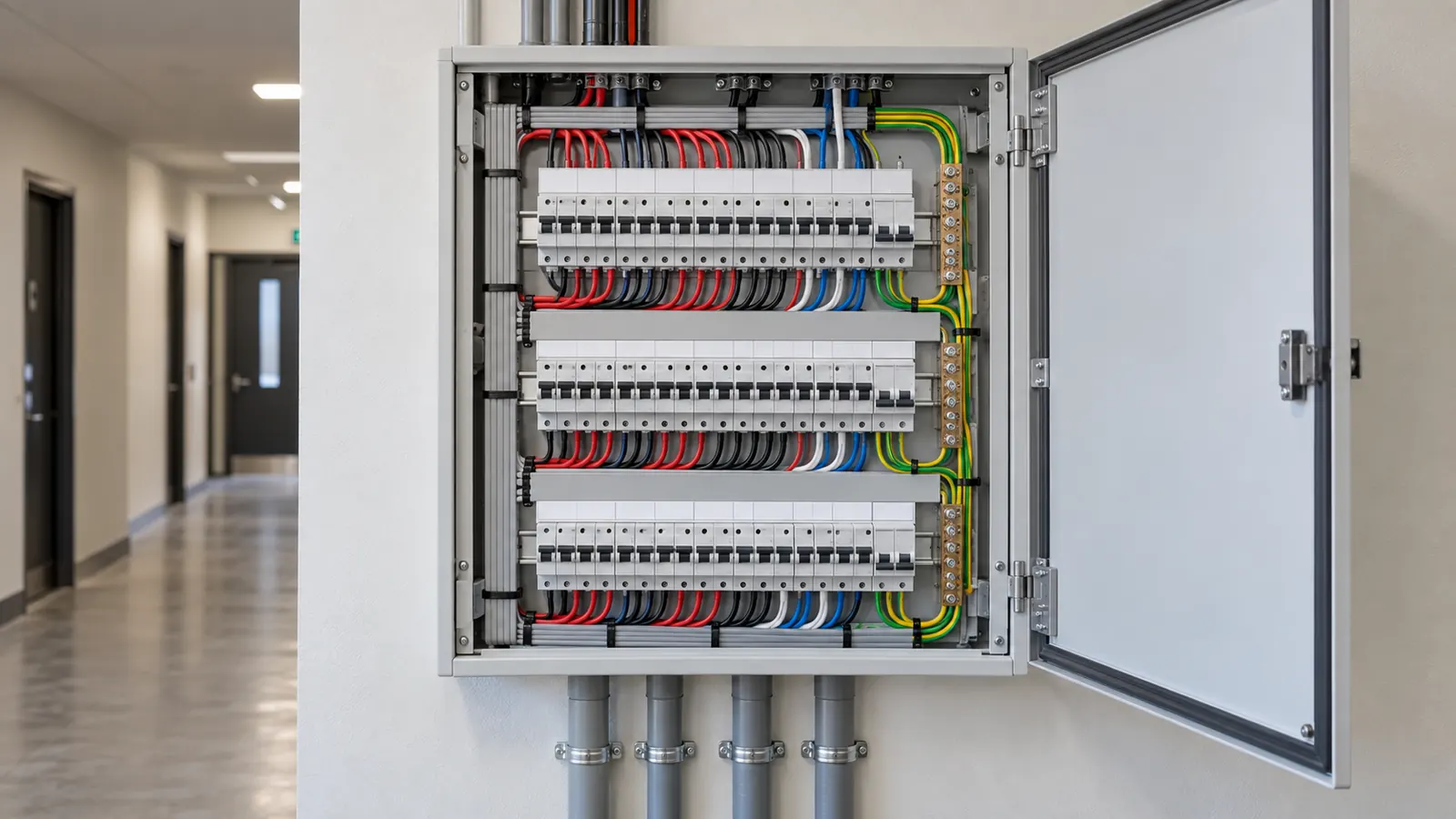
- 4 min basahinIEC 60364 and the Wiring RulesIEC 60364 is the international series that AS/NZS 3000 stays aligned with. See how its parts are numbered, what TN-C-S, TT and IT mean, and where MEN fits.
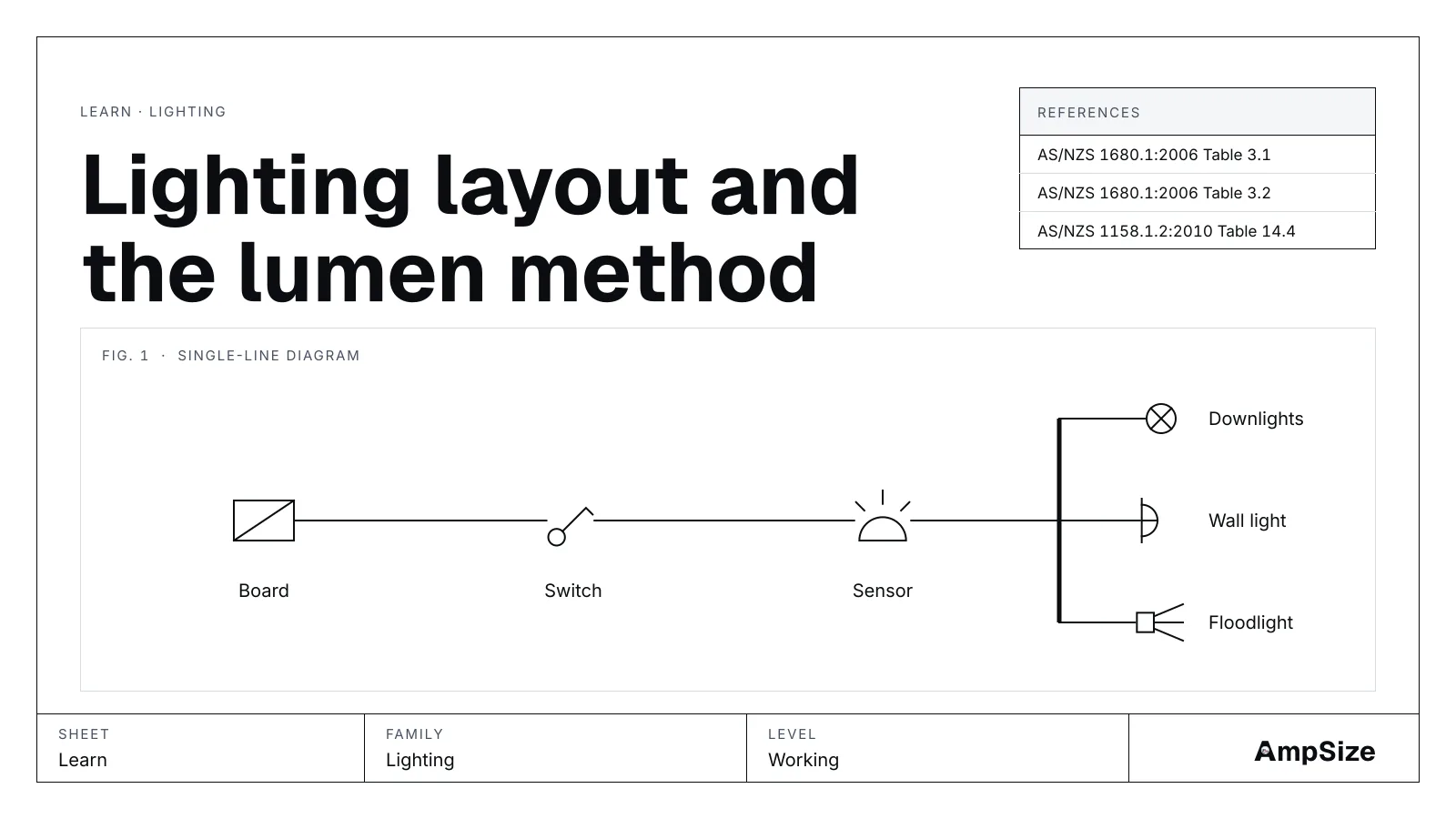
- 4 min basahinLighting layout and the lumen methodHow many luminaires does a room need? The lumen method from target lux to a grid, worked on an 8 m by 6 m office, with the checks the tool applies.
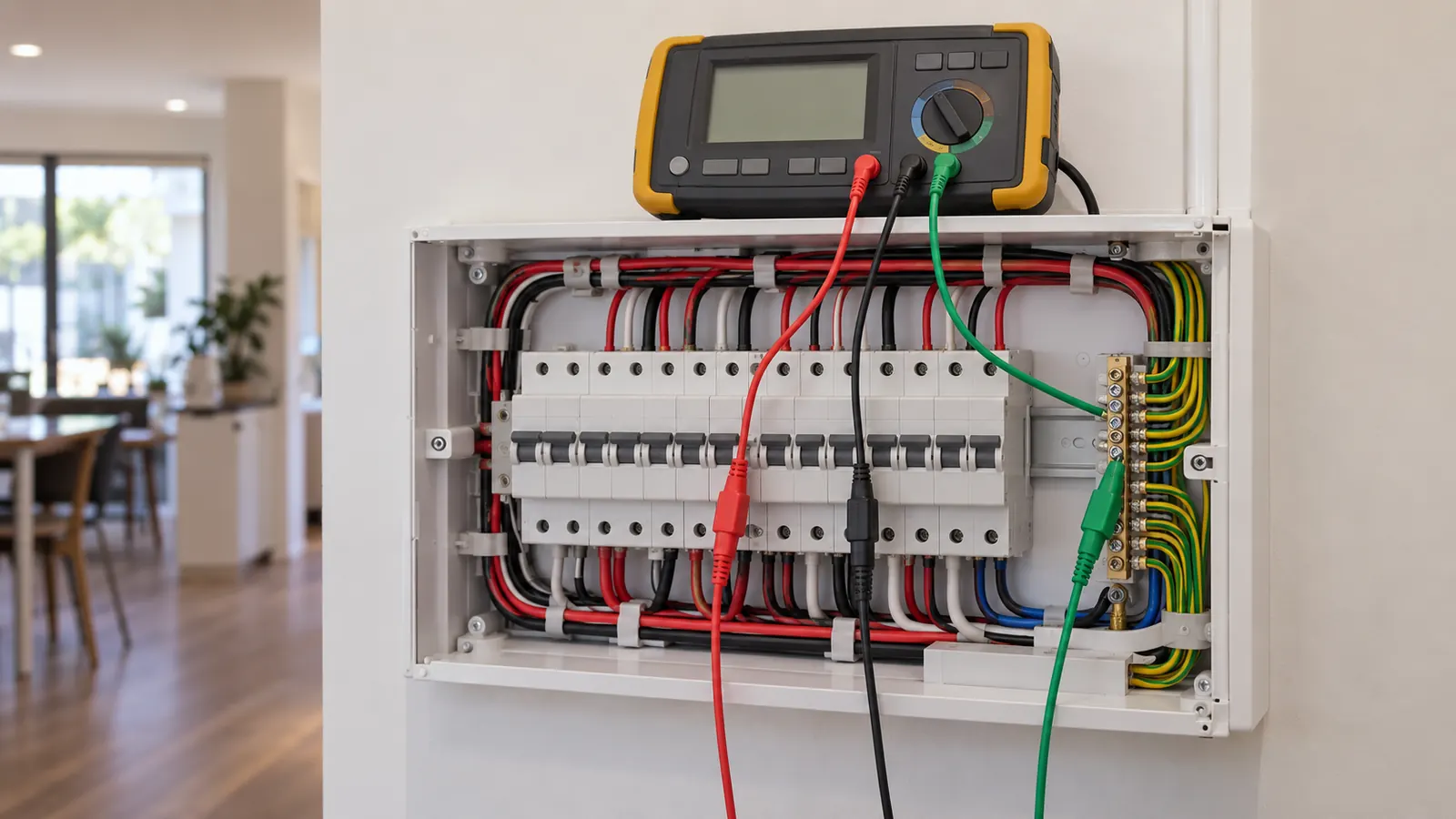
- 5 min basahinLoop impedance and disconnection timeZe, R1+R2, Zs and Ia, and the two disconnection times, worked on a 32 A curve C circuit over 30 m that returns 0.79 Ω against a 0.96 Ω limit.
- 4 min basahinMaximum demand and diversityWhy consumer mains are smaller than the sum of the loads. The four methods of Cl 2.2.2, the Table C1 groups, and a house that lands on 70.18 A.
- 4 min basahinMotor circuits and startingHow full load current sizes the cable and starting current sizes the device on a motor circuit, with a worked 22 kW 400 V motor and the cable the tool selects.
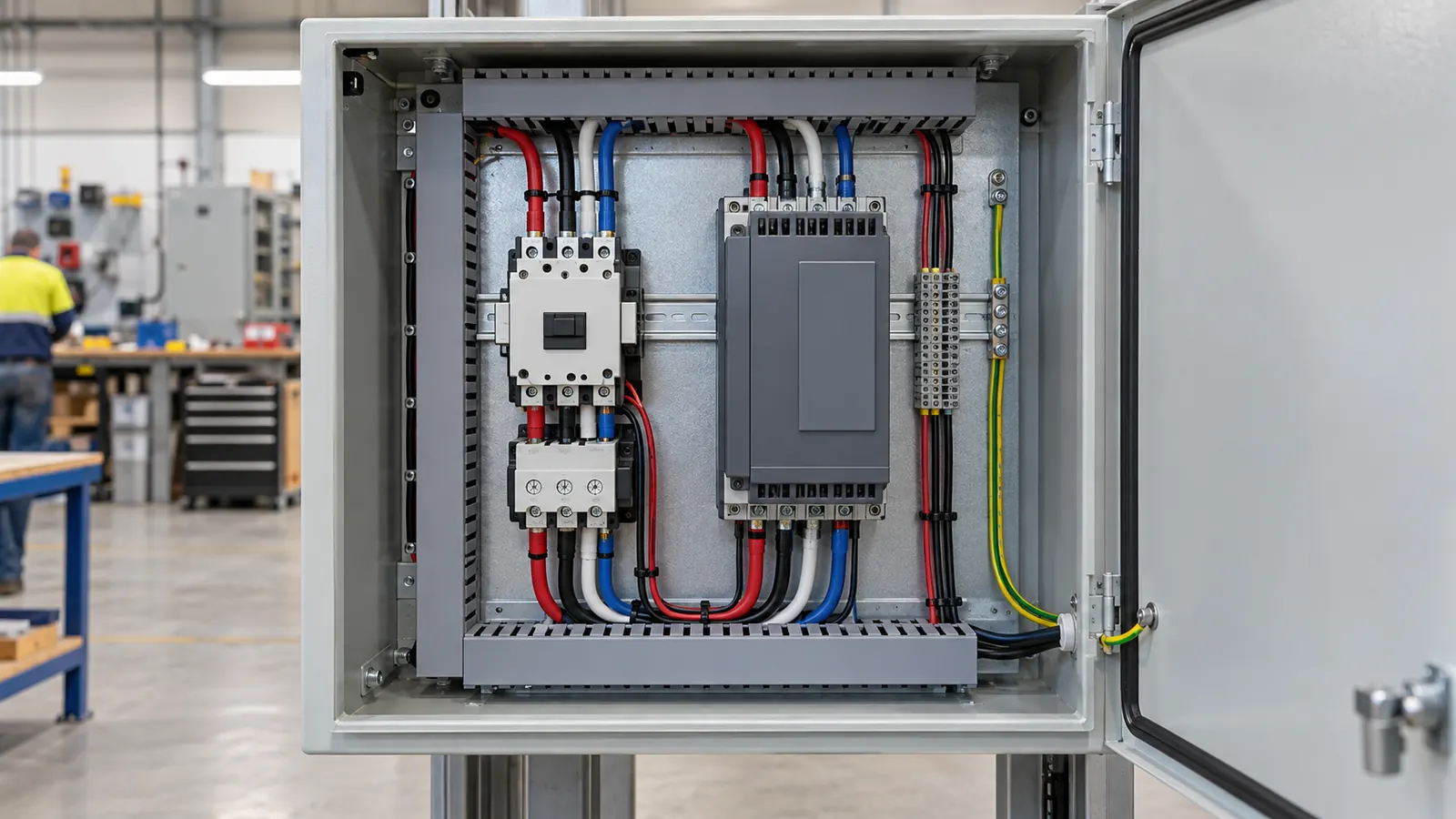
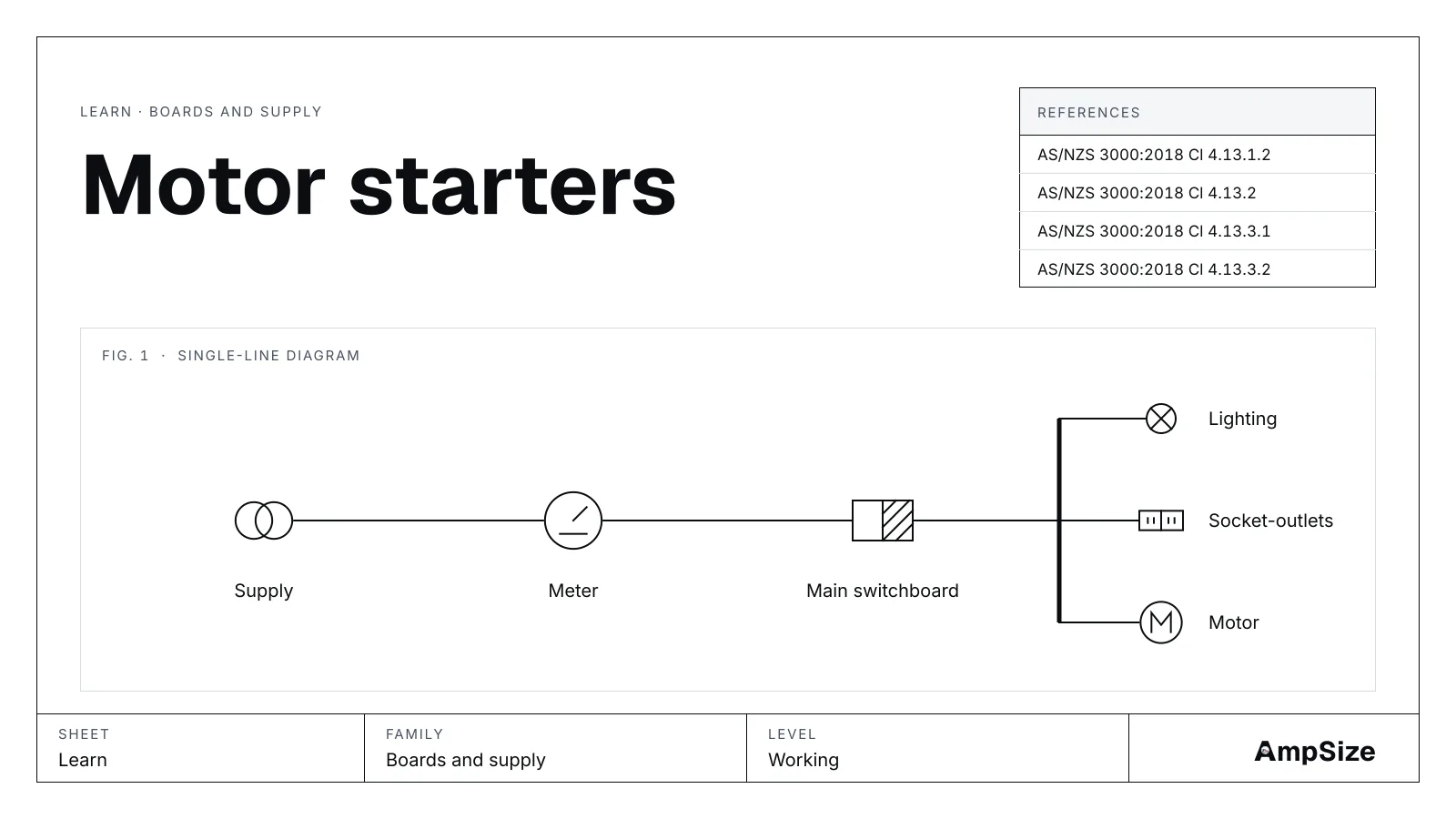
- 4 min basahinMotor starters, contactors and overload relaysHow to choose a motor starter: locked-rotor current, star-delta, soft starters, AC-3 and AC-23 duty, the overload relay and when motor protection applies.
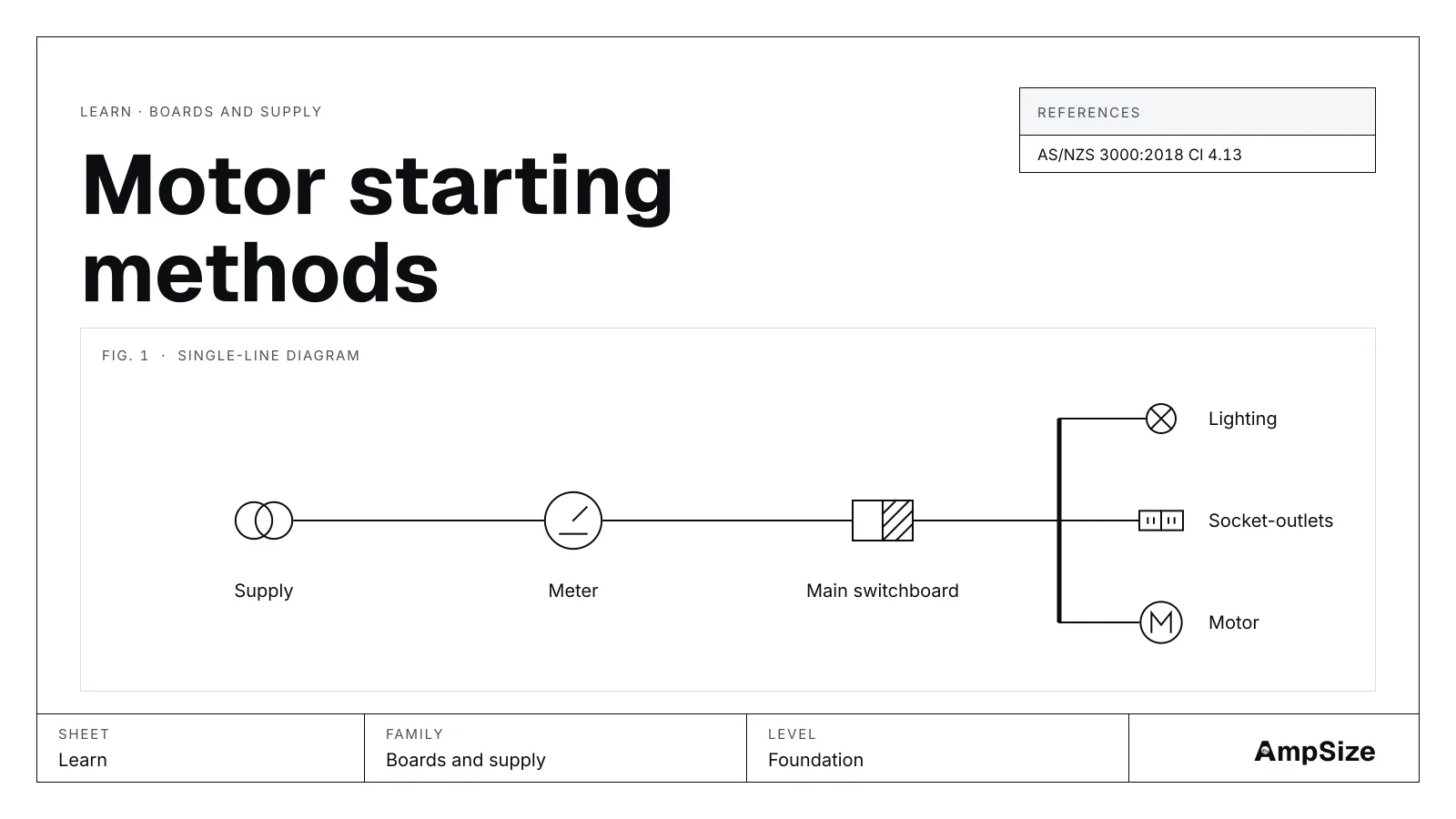
- 3 min basahinMotor starting methods: current and torqueWhy a cage motor draws six or seven times full load current at start, and how star-delta, an autotransformer, a soft starter and a drive trade it for torque.
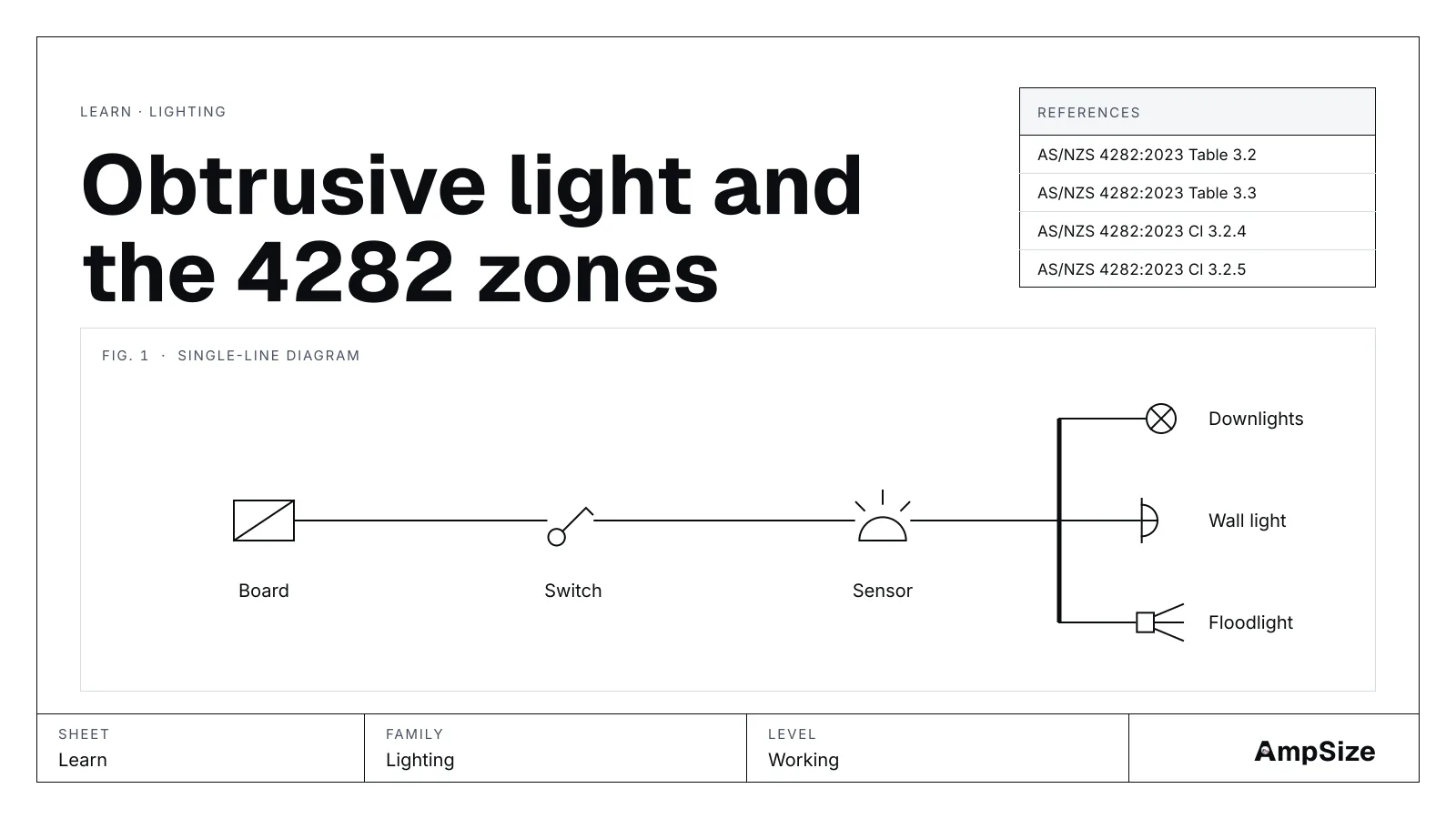
- 4 min basahinObtrusive light and the 4282 zonesHow AS/NZS 4282 limits spill light from outdoor lighting at a neighbour's window, by environmental zone A0 to A4, curfew, intensity and upward light ratio.
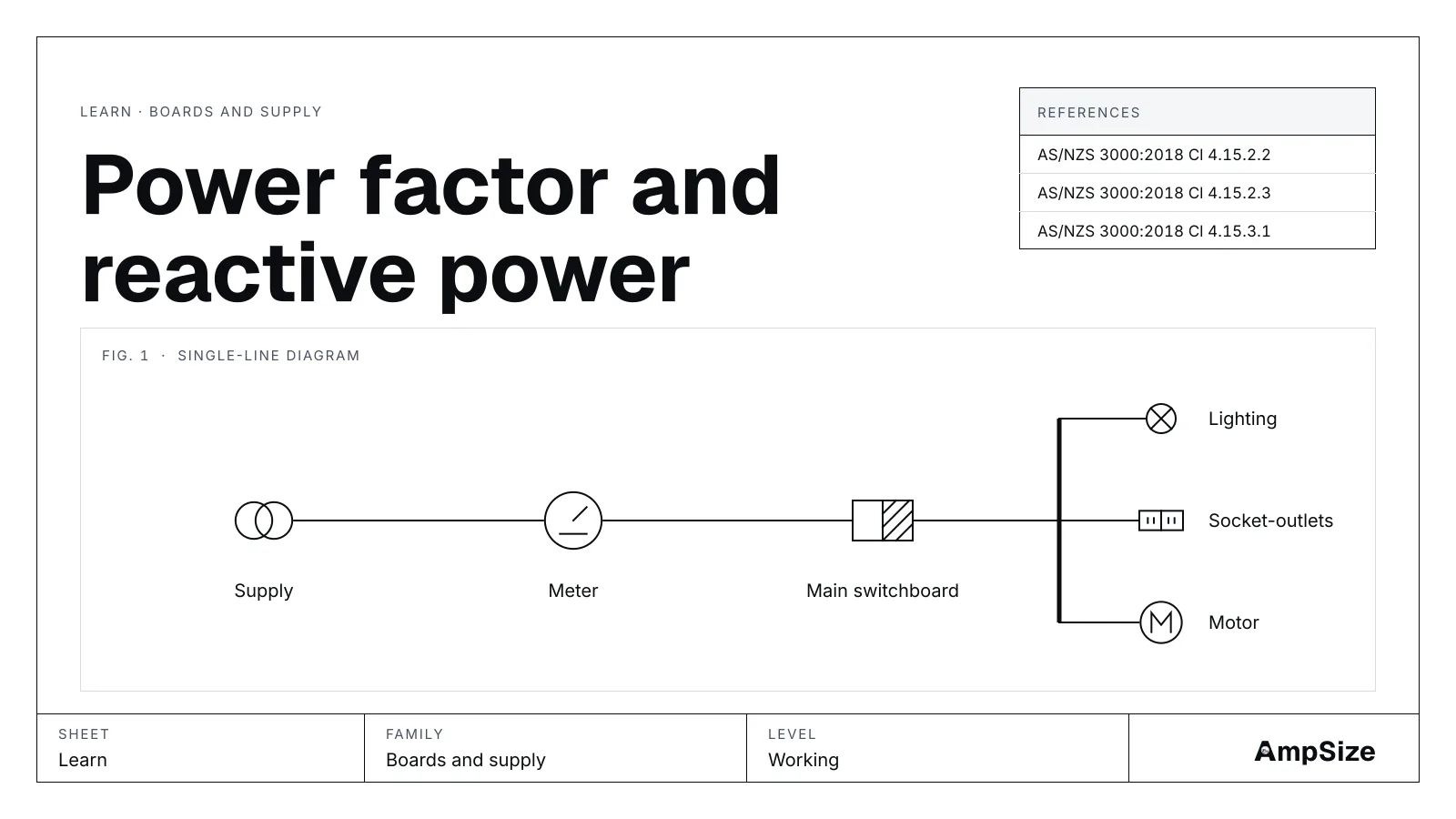
- 4 min basahinPower factor and reactive powerWhat power factor is, why a low one costs current and capacity, how a capacitor bank corrects it in steps, and when harmonics call for a detuned bank.
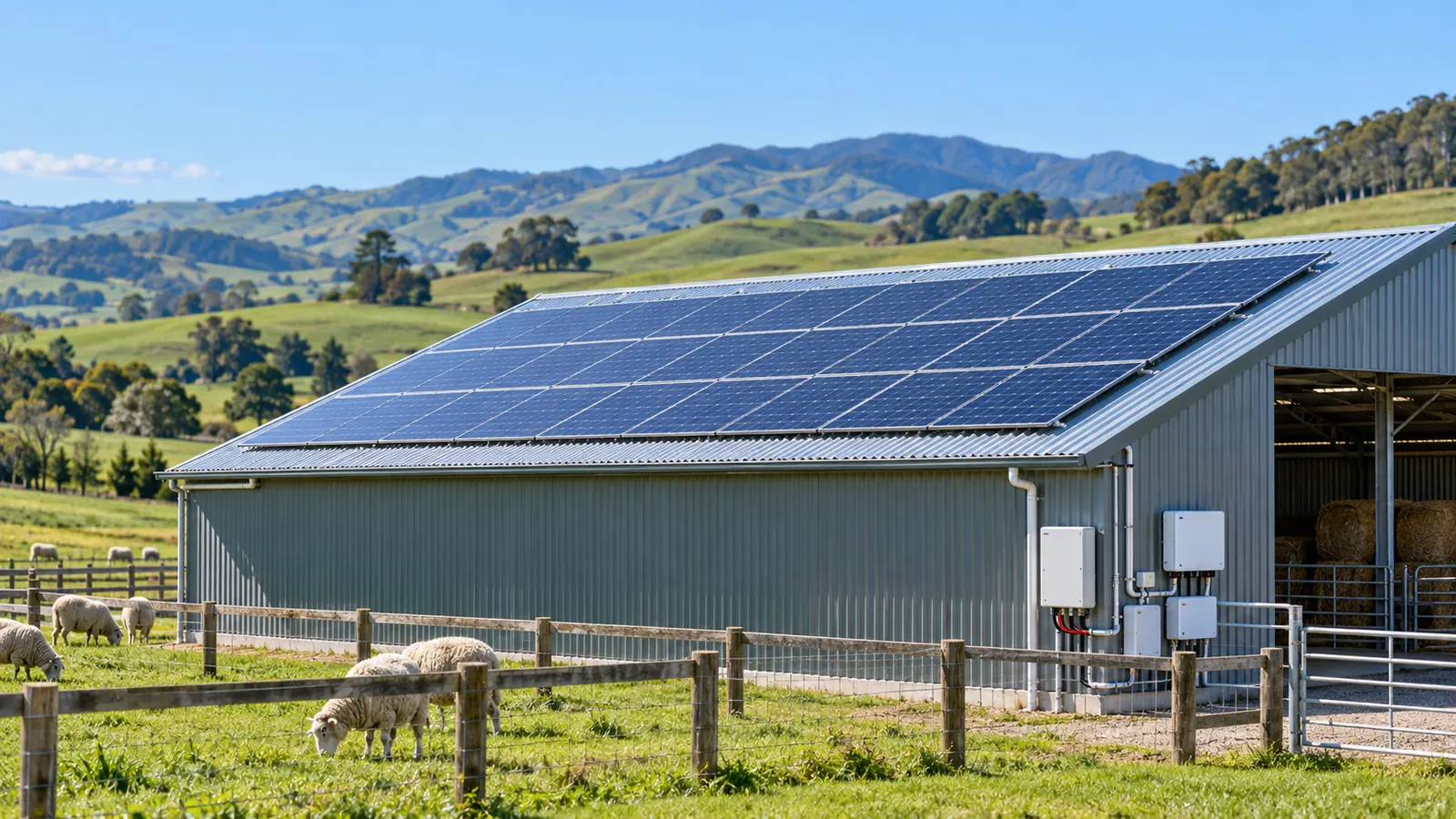
- 4 min basahinPV and inverter basicsHow a grid-connected PV system connects to an installation, why voltage rise sets the inverter cable, and which standards the AmpSize tools cannot quote.
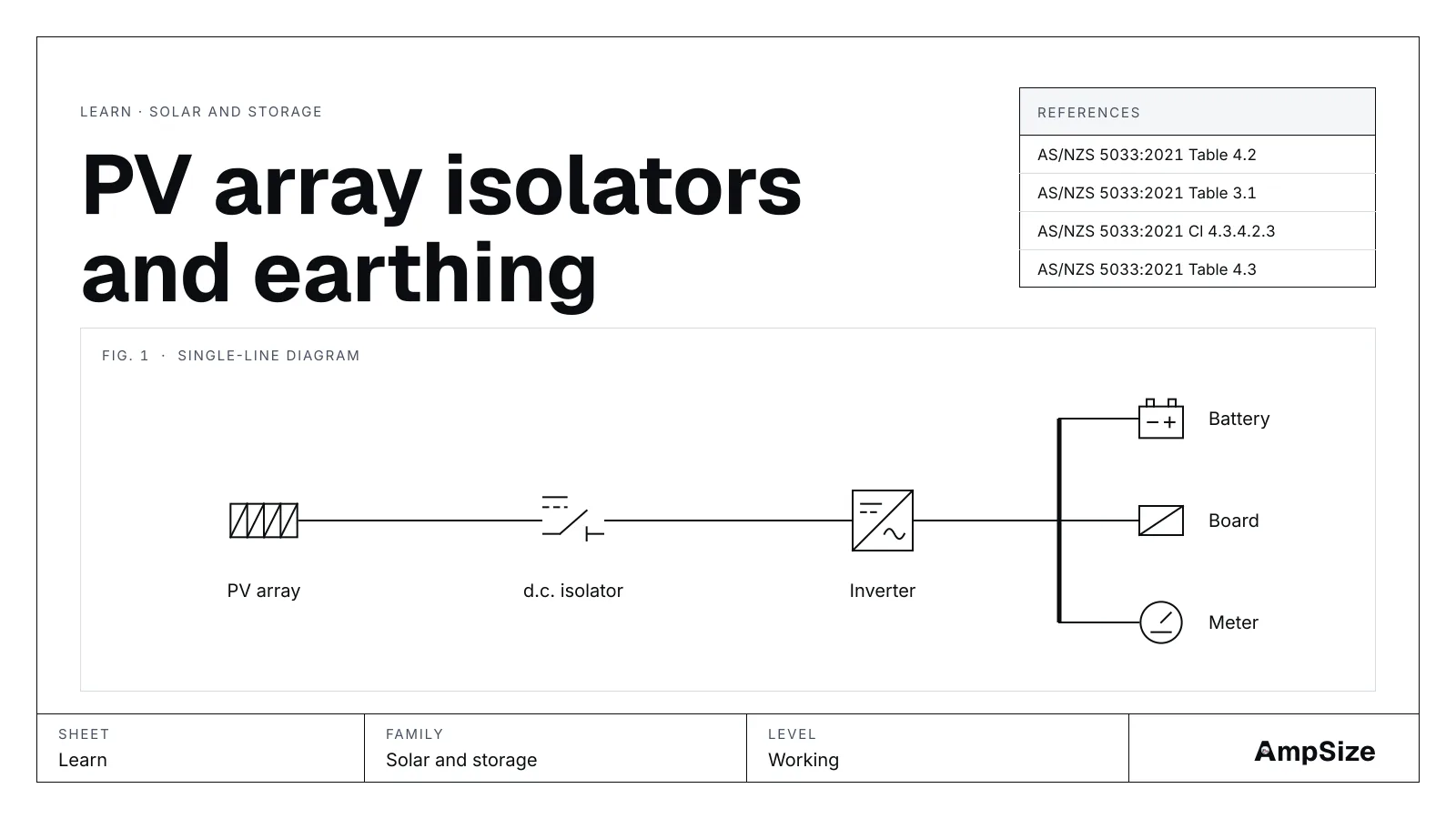
- 4 min basahinPV array isolators and earthingHow parallel strings feed a fault, what Ithe, Ie and make and break mean for a d.c. isolator, and how AS/NZS 5033 earths and alarms a PV array.
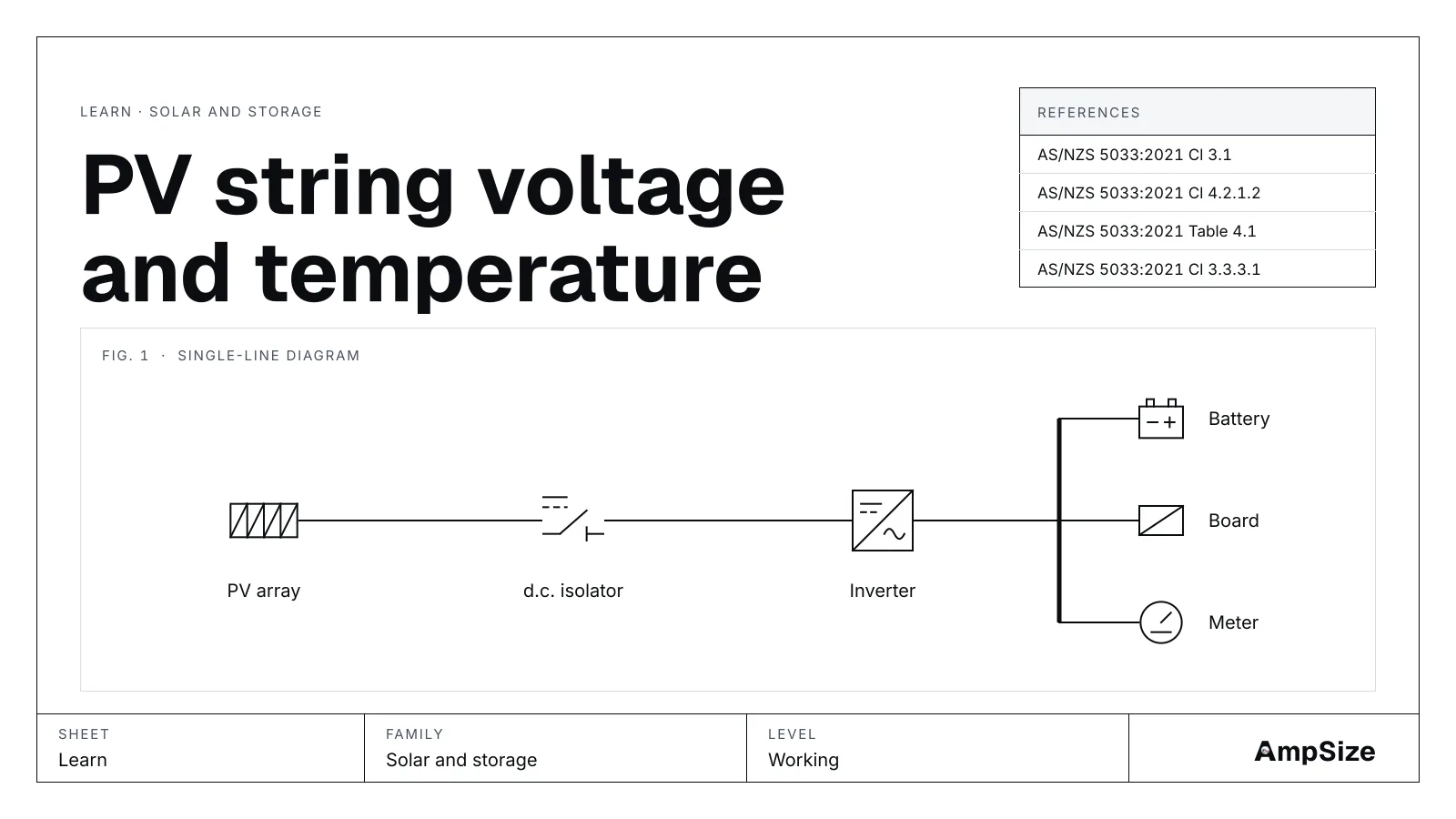
- 3 min basahinPV string voltage and temperatureWhy a PV string's voltage rises in the cold and falls in the heat, how AS/NZS 5033 limits it, and how the string current, fuses and isolator follow.
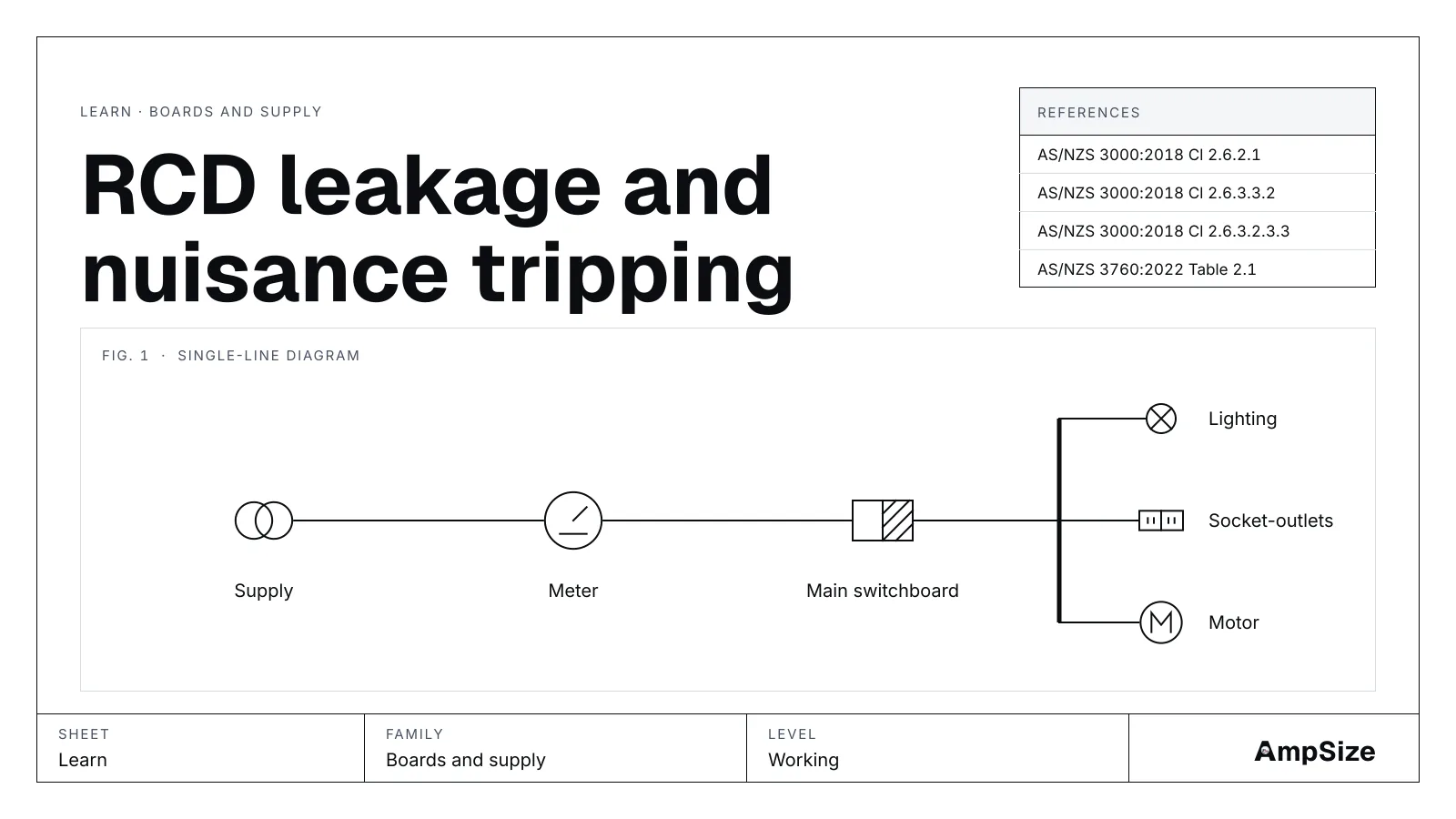
- 4 min basahinRCD leakage and nuisance trippingWhy an RCD trips with no fault. Where standing leakage comes from, the one-third and one-half points of Cl 2.6.2.1, class limits against measured figures.
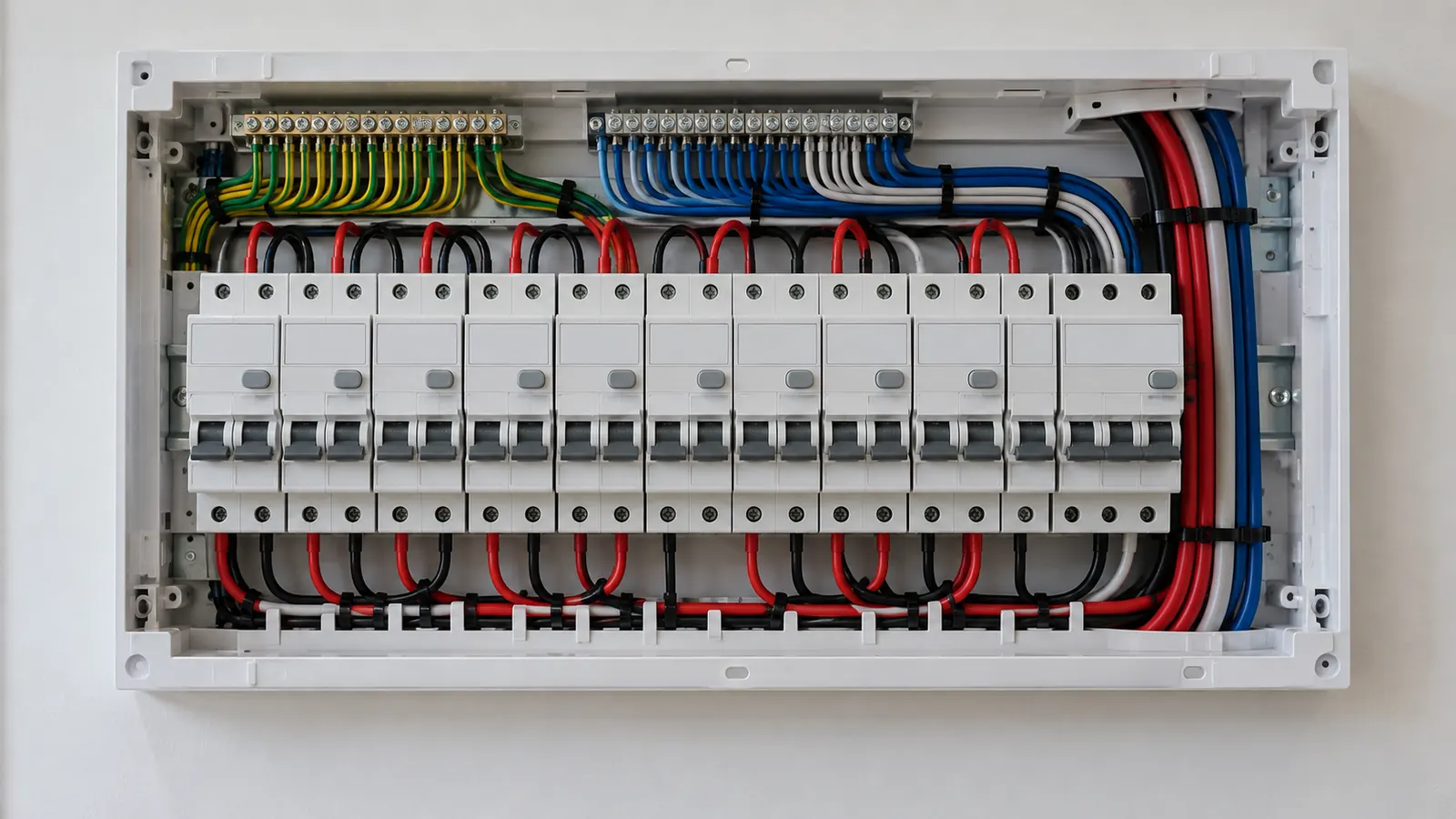
- 5 min basahinRCD types and where they are requiredType AC, A, F and B, what each one detects, and the clauses that place them. The fault path behind them, worked on a 20 A circuit over 25 m.
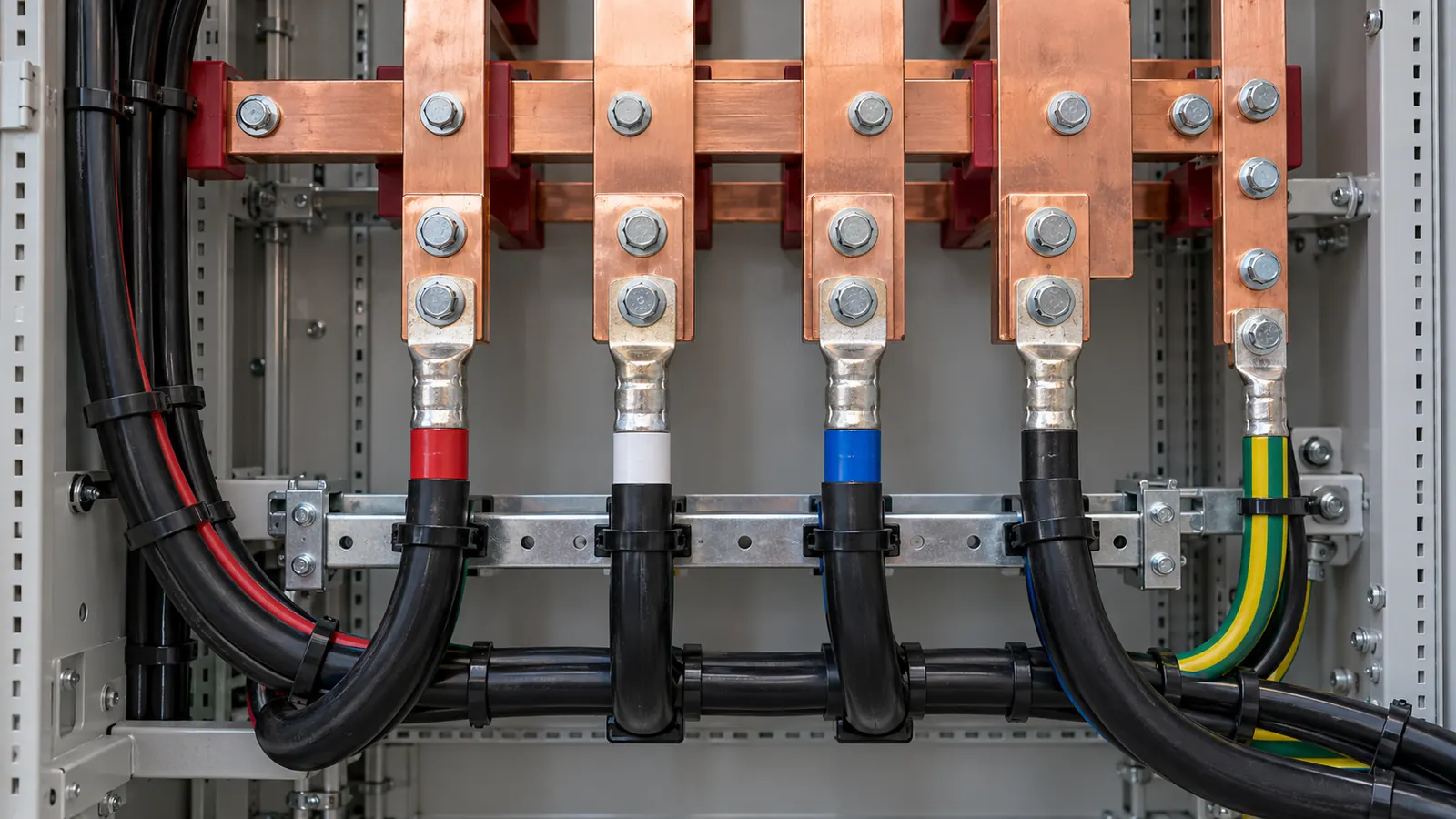
- 4 min basahinShort-circuit withstand and the k factorThe adiabatic check in plain terms: prospective fault current, clearing time and k, worked on 25 mm² copper XLPE at 10 kA for 0.1 s.
- 4 min basahinTesting to Section 8: what each test provesThe Section 8 test sequence, what each test shows, and how a calculated earth fault loop impedance compares with the value a tester reads on site.
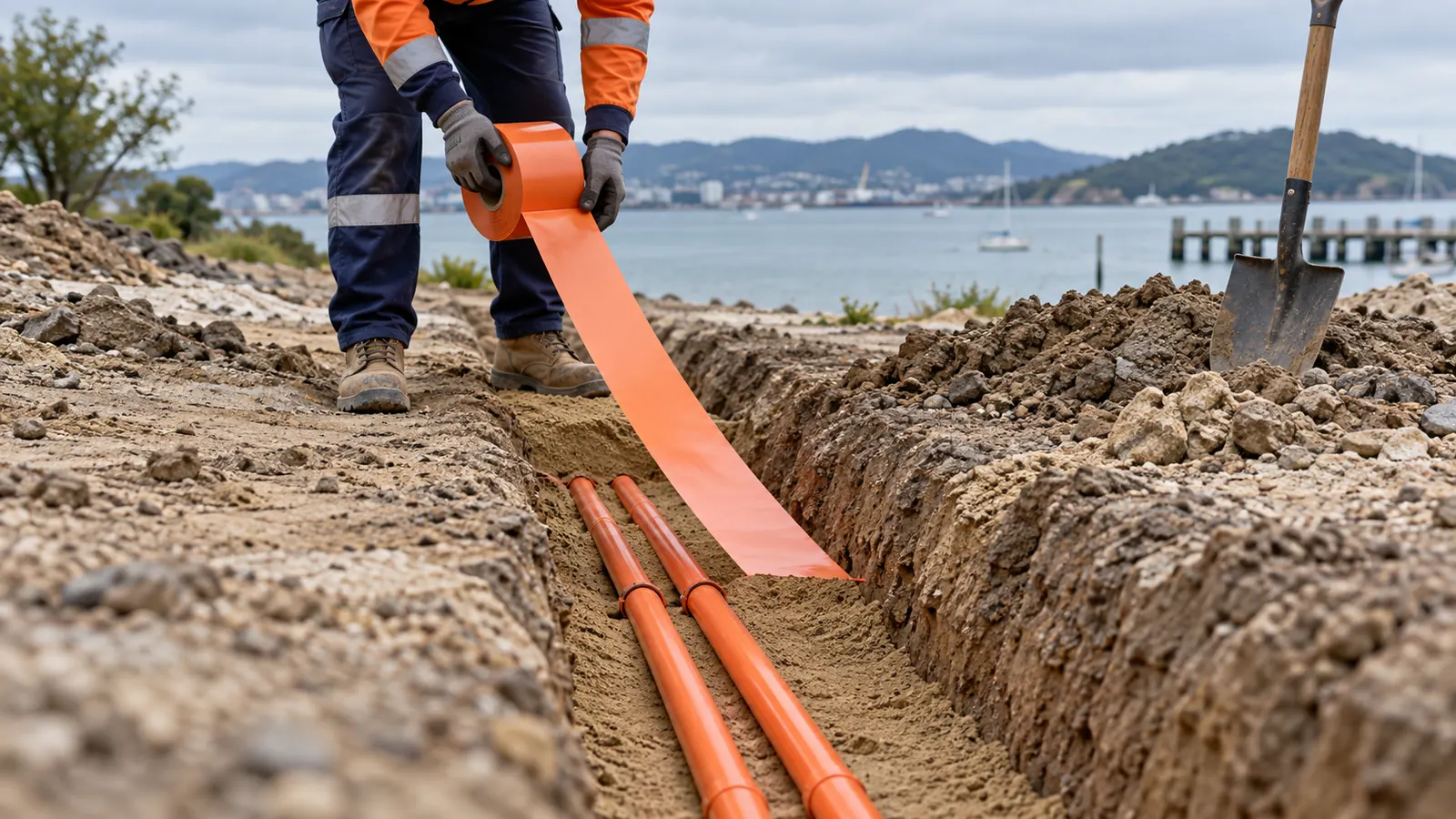
- 4 min basahinUnderground cables and civil interfacesBurial categories, depth of cover, bedding and separation for underground cables, with a worked 100 A submain that changes size when the trench changes.
Mga calculator na ginagamit ng mga guide na ito
- Cable size calculatorHanapin ang pinakamaliit na cable size na pumapasa sa bawat check.
- DC cable size calculatorI-size ang d.c. cable hanggang 1500 V para sa current at voltage drop.
- Battery arc flash and classBattery DVC, hazard class, arc flash energy at PPE level.
- Solar battery calculatorI-size ang home battery para sa solar evening load.
- Arc flash calculatorI-estimate ang enerhiya ng arc flash at ang PPE category nito.
- Cable tray at ladder fillLapad ng tray o ladder, mga tier, kg/m at ang grouping factor.
- Correction factor calculatorBasahin ang bawat correction factor at ang rating na kailangan ng cable.
- Pagsusuri ng umiiral na circuitTingnan ang naka-install na circuit: cable, device, drop at Zs.
- Earth fault loop impedance calculatorTingnan ang earth fault loop impedance laban sa maximum Zs.
- Comms cable selectorPumili ng comms cable at tingnan ang haba ng run.
- Loop power budget para sa 4–20 mA loopsTingnan ang voltage na naiiwan ng 4–20 mA loop sa transmitter.
- Construction site supply calculatorMga rule ng supply, RCD at test para sa construction site.
- Site cord length calculatorAng pinakamahabang run ng cord o cable na puwede sa construction site.
- Test and tag intervalsMga retest interval at pass limit para sa portable gear.
- Hand-held appliance supplyBasahin ang listahan ng supply arrangement sa regs 88 hanggang 89A.
- Show and carnival wiring checkerMga RCD check sa show wiring, kasama ang lalim at taas ng site wiring.
- Voltage drop calculatorKalkulahin ang voltage drop sa cable run at tingnan ang limit.
- Battery bank calculatorKalkulahin ang capacity at autonomy ng battery bank para sa isang load.
- Full load current calculatorKalkulahin ang full load current mula sa power, voltage at phase.
- Cable screen earthing selectorHanapin kung saan i-earth ang screen, drain wire o armour.
- Wet area zones checkerHanapin ang Section 6 zone, IP at RCD malapit sa tubig.
- RCD Selection calculatorTingnan kung kailangan ng RCD at subukan ang trip time.
- Outbuilding earthingI-earth ang shed: earth kasama ang submain, o sarili nitong MEN.
- Earthing and bonding calculatorI-size ang earthing, main earth at bonding conductors.
- Generator sizing mula sa load listI-size ang generator mula sa load list kasama ang motor starting.
- Generator current calculatorFull load at fault current ng generator mula sa kVA nito.
- Motor calculatorHanapin ang motor full load current, starting current at torque.
- Cable fault rating calculatorTingnan kung kayang tiisin ng conductor ang fault current.
- Maximum demand calculatorI-estimate ang maximum demand para sa domestic o non‑domestic loads.
- Lighting lumen method calculatorBilang at grid ng luminaire para sa room ayon sa lumen method.
- Three phase power calculatorI-convert sa pagitan ng power, current, voltage at power factor.
- Motor circuit calculatorCable, breaker, contactor at overload para sa isang motor.
- Paghahambing ng motor starting methodIkumpara ang DOL, star-delta, soft start at drive starts.
- Obtrusive light checkerTingnan ang outdoor light sa boundary window ayon sa AS/NZS 4282.
- Power factor correction calculatorHanapin ang capacitor kvar para itaas ang power factor.
- Voltage Rise calculatorKalkulahin ang voltage rise para sa embedded generation o PV.
- PV isolator and earthing calculatorI-rate ang PV array cable, d.c. isolator at earthing.
- PV string calculatorModules per string, string current at isolator para sa PV.
- RCD standing leakage budgetGaano karaming standing leakage ang kayang dalhin ng isang RCD.
- RCD arrangement checkTingnan ang mga circuit kada RCD at ang lighting split.
- Transformer calculatorKalkulahin ang transformer full load current at impedance.
- Test results checkerTingnan ang nasukat na test results laban sa Section 8 limits.
- Underground cable depth calculatorDepth of cover at separation para sa buried cable.
- Conduit fill calculatorTingnan kung kasya ang cable bundle sa conduit.