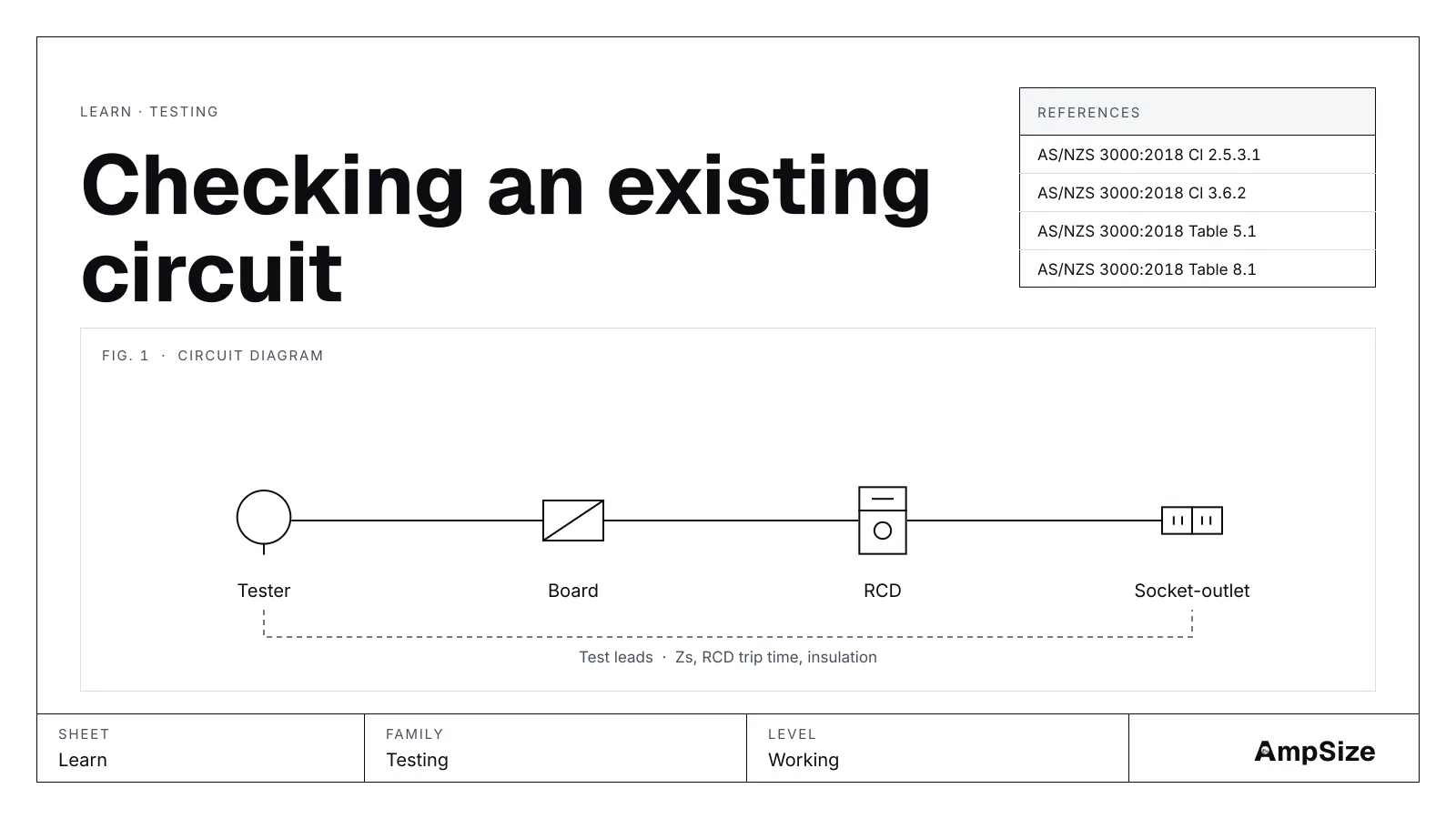
A new circuit starts from the load and ends with a cable and a breaker. An existing circuit starts the other way round. The cable and the breaker are already in the wall. The question is whether they still suit the load and the route.
That question comes up when a load changes, a breaker is swapped or insulation covers a cable. The circuit check tool answers it from the installed size. The worked guide What size breaker for 4 mm² cable runs one circuit over several routes.
The five checks
The tool runs the five checks of the cable size calculator at the installed size. It uses the same code, so the two tools agree. The figures below assume a C curve breaker, 30 °C and one circuit. Ze is 0.35 Ω, on the New Zealand tables.
1. Current capacity. The tool reads the tabulated rating for the installed size and method. For multicore cable in New Zealand, that is Table 13 or 14 of AS/NZS 3008.1.2:2017. The tool multiplies the rating by the correction factors for the route to get Iz. Iz must be at or above the design current Ib. For 4 mm² copper PVC enclosed in air, Iz is 29 A.
2. Voltage drop. The tool works out the drop over the run at the load current. It compares the drop with your limit, 5 % by default (AS/NZS 3000:2018 Cl 3.6.2). A 25 A load over 20 m of 4 mm² drops 2.21 %. Voltage drop basics sets out the method.
3. Breaker rating. The breaker rating In must sit between the load and the cable: Ib ≤ In ≤ Iz (Cl 2.5.3.1). The tool shows both margins. IB ≤ IN ≤ IZ explains the rule and why the order matters. On an existing circuit, a bigger breaker fails this check. 4 mm² on a 32 A breaker fails it, because Iz is 29 A.
4. Loop impedance. The tool sizes the earth conductor from Table 5.1 of AS/NZS 3000. It adds the active and earth resistance over the run to Ze to get Zs. Zs must stay under the maximum in Table 8.1 for the breaker curve and rating. A long run often fails here. 4 mm² over 80 m has a Zs of 1.52 Ω. On a 25 A C curve breaker the maximum is 1.23 Ω, so it fails. See Loop impedance and disconnection time.
5. Fault withstand. This check runs only when you enter a prospective fault current. The conductor must survive it for the clearing time, which comes from the breaker maker's data.
What the result tells you
The circuit passes only when every check it runs passes. The tool then gives two figures that point to a fix. The smallest size that passes is the cable the breaker needs. The largest breaker of the same curve is the most the installed cable allows.
For 4 mm² on a 32 A C curve breaker, those are 6 mm² and 25 A. A smaller breaker is often the cheaper fix, but only if it still carries the load. The tool does not try another curve. On the 80 m run, a B curve passes with a maximum Zs of 2.3 Ω.
Calculated against measured
The tool works from your inputs. Its Ze default of 0.35 Ω is an assumed figure. The real Ze depends on the supply, so measure it at the main switchboard and enter the reading.
A higher Ze lowers the margin on every circuit. Take a measured Ze of 0.8 Ω. The 25 A circuit on 4 mm² over 20 m then has a Zs of 1.09 Ω. It still passes against 1.23 Ω, with 0.14 Ω to spare.
Then measure Zs at the far end of the circuit. Compare the reading with the maximum the tool gives. A reading well above the calculated Zs points to a fault, such as a loose termination. The run may also be longer than you thought. Testing to Section 8 explains how to read the gap between the two numbers. A test reading on site rules over a calculation.
What the tool does not check
- RCD rules. Whether the circuit needs RCD protection, and of which type. See RCD types and where they are required.
- Discrimination. Whether this breaker opens before the one upstream of it.
- The cable's condition. Damage, heat marks, insulation resistance and the state of the terminations. Only an inspection and the Section 8 tests find these.
- Changes along the route. The tool takes one method and one ambient temperature. Check the worst part of the run, such as the stretch through ceiling insulation.
New Zealand and Australia
In New Zealand the tool reads AS/NZS 3008.1.2:2017. In Australia it reads AS/NZS 3008.1.1, and the Edition select picks 2025 or the superseded 2017 edition. The 2025 edition numbers its tables by section, so the tool cites Table 3.18 in place of Table 13 for this cable. Take 4 mm² enclosed in air at 30 °C. Iz is 29 A on the New Zealand tables. It is 28.25 A on the Australian 2025 tables.
The breaker rule, the earth conductor size and the maximum Zs come from AS/NZS 3000, the same in both countries. Who may change a breaker or a circuit differs. For New Zealand, see Who may do electrical work in NZ.
See also: What size breaker for 4 mm² cable, IB ≤ IN ≤ IZ and Testing to Section 8.