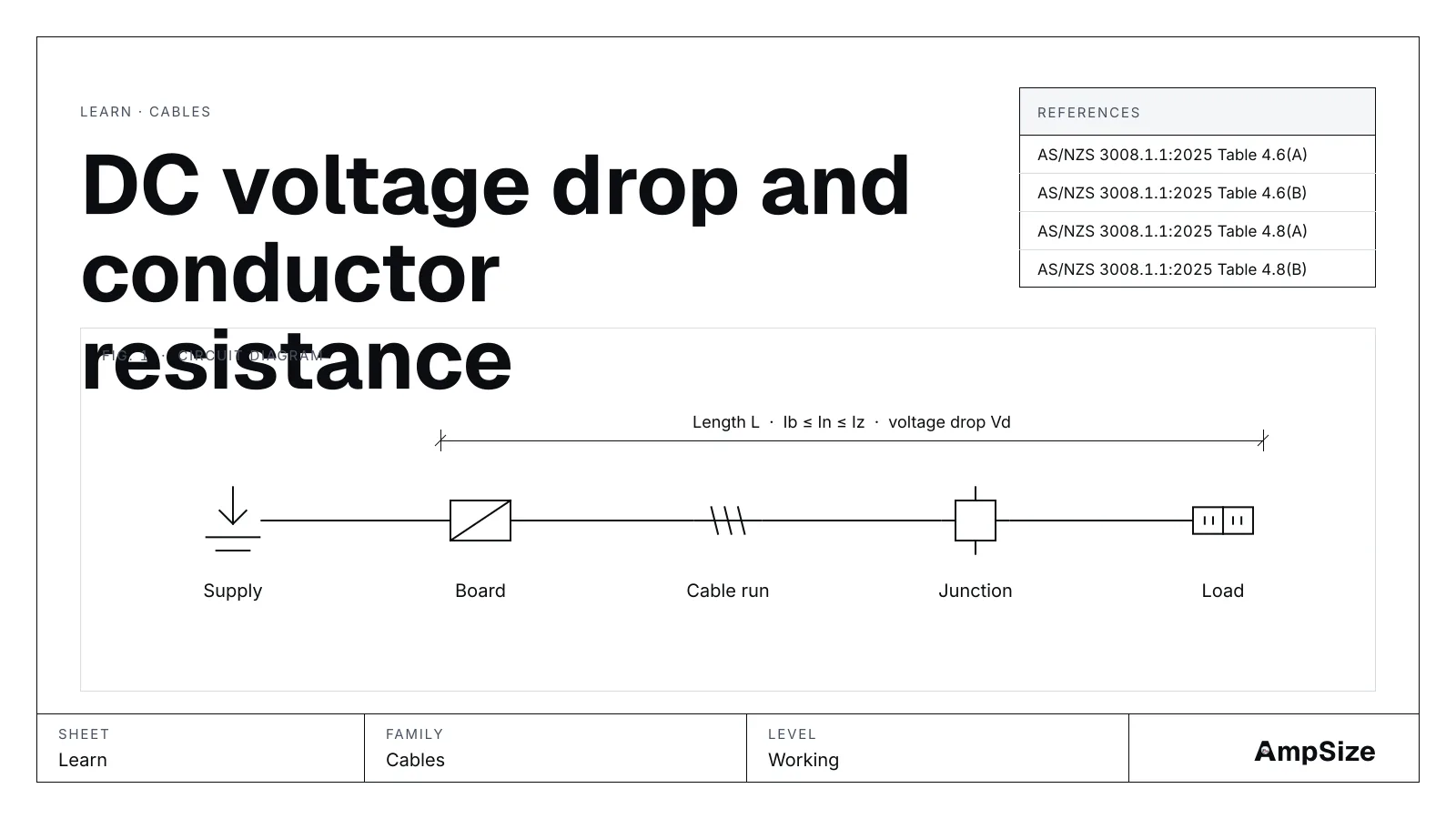
A d.c. circuit loses volts along its cable in the same way as an a.c. circuit. The arithmetic is simpler, because only resistance counts. This page explains what the voltage drop calculator does in d.c. mode. Read Voltage drop basics first for the drop, the percent limit and the maximum length.
Why the drop is 2 × I × R × L
Current leaves the source on one wire and returns on the other. Both wires carry the full current, and both are as long as the route. The drop is therefore:
drop = 2 × I × R × L
I is the current in amps, R the resistance of one conductor in Ω/km, and L the route length in kilometres. The tool works in metres, so it takes 2 × R in mV/A·m and divides by 1000.
Take 30 A at 12 V over 6 m on 10 mm² copper twin. R is 2.23 Ω/km, so 2 × R is 4.46 mV/A·m. The drop is 4.46 × 30 × 6 ÷ 1000 = 0.8 V, or 6.69 %. Open this case.
Enter the route length, not the total wire length. The factor 2 already counts the return wire.
No reactance, no power factor, no phases
Reactance comes from a current that changes direction. A steady d.c. current does not, so the cable has no reactance to add. With no reactance, the voltage and current stay in step. The power factor has no meaning, and the tool hides the field.
A d.c. circuit also has no phases. It is always two wires, so the tool hides the Phases field too. The a.c. mV/A·m combines resistance and reactance at the power factor. The d.c. figure is resistance alone.
Resistance at the maximum conductor temperature
Copper and aluminium resist current more when they are hot. AS/NZS 3008.1.1:2025 prints the d.c. resistance at several conductor temperatures. The tool reads the value at the maximum conductor temperature for the insulation: 75 °C for PVC and 90 °C for XLPE.
| 10 mm² copper | Resistance | 12 V, 30 A, 6 m | Percent |
|---|---|---|---|
| PVC, 75 °C | 2.23 Ω/km | 0.8 V | 6.69 % |
| XLPE, 90 °C | 2.33 Ω/km | 0.84 V | 6.99 % |
The hot value gives the drop of a cable at its full rating. A lightly loaded cable runs cooler, so its real drop is a little lower. The tool does not adjust for that, so its answer errs on the safe side.
Single-core and multicore tables
Single-core cable reads Table 4.6(A) for copper and 4.6(B) for aluminium. Multicore cable reads Table 4.8(A) and 4.8(B). Set Cores to match the cable. Twin and flat twin cable is multicore.
For copper the two tables agree up to 400 mm². At 500 mm² copper at 75 °C reads 0.0445 Ω/km single-core and 0.0454 Ω/km multicore. The multicore tables stop at 500 mm². The aluminium rows start at 16 mm². Where a table prints no row, the tool says so and gives no result.
The limit: ELV or LV
The System field sets the limit.
- Extra-low voltage. The limit is 10 % (AS/NZS 3000 Cl 7.5.7). This covers 12 V, 24 V and 48 V battery circuits.
- Low voltage. You set the limit (AS/NZS 3000 Cl 3.6.2). A PV array string above extra-low voltage takes this path.
The limit sets the maximum length. A 48 V, 100 A run on 35 mm² single-core reaches 10 % at 37.68 m. Open the ELV case. At a 5 % limit the same run reaches it at 18.84 m. Open the 5 % case.
A PV array cable at 600 V and 15 A over 40 m on 4 mm² XLPE drops 7.06 V. That is 1.18 % against a 3 % limit. Open the PV case.
Cables in parallel
Two cables in parallel share the current, so the tool divides the resistance by two. Two 16 mm² single-core cables per pole give 0.7 Ω/km. On the 48 V run that drops 0.7 V, or 1.46 %. Open the parallel case. One 35 mm² cable drops 0.64 V on the same run.
The tool assumes the cables share the current equally. Keep parallel cables the same size, material, length and route.
New Zealand reads the 2025 AU part
AS/NZS 3008.1.2:2017 is the NZ part, and it prints no d.c. tables. The 2017 AU part prints none either. So the tool reads AS/NZS 3008.1.1:2025 in both countries, and the Standard field hides in d.c. mode. The result carries a note that says where the resistance came from. The same inputs give the same drop in New Zealand and in Australia.
This tool and the DC cable size tool
The DC cable size calculator reads the printed d.c. mV/A.m of Tables 4.16 to 4.23. That figure is twice the resistance, rounded as printed. This tool takes 2 × R from the resistance tables. The two drops can differ in the last digit.
The DC cable size tool also checks the current rating. Use it to choose a size. Use the voltage drop tool to check a cable you already have. DC cable size: 48 V battery and 600 V PV array works both checks.
See also: 12 V caravan cable: d.c. voltage drop, Voltage drop basics and 24 V DC voltage drop on an instrument loop.
This page is a design aid. Verify every value against the current edition of the standard.