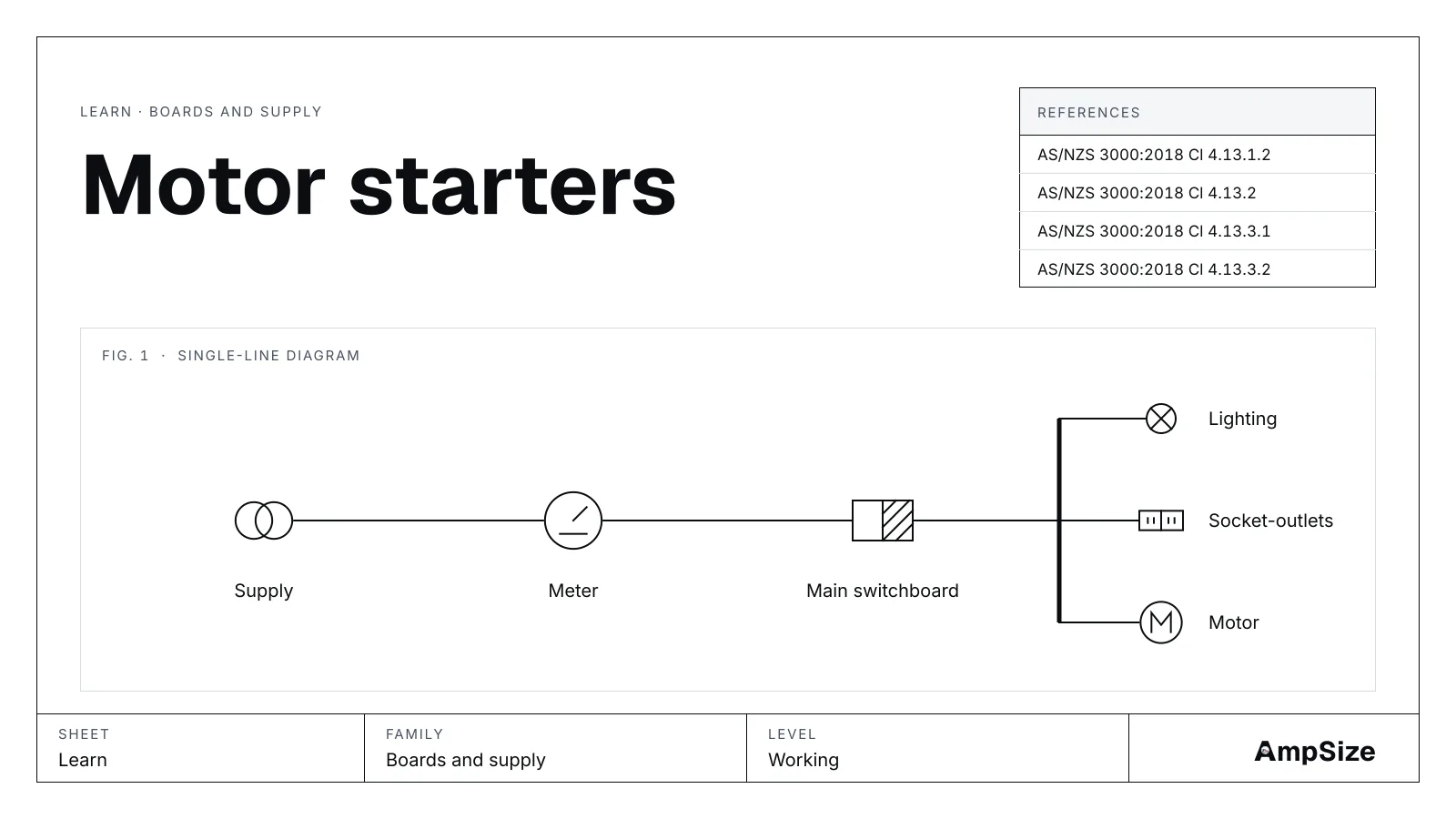
A motor starter switches the motor and watches its current. It has a contactor to make and break the supply, and a relay to trip on overload. This page covers how to size them. For the cable and the breaker, read Motor circuits and starting first. The motor circuit calculator works all the parts at once.
Full load current from the nameplate
Full load current (FLC) is the running current at the shaft power on the nameplate. Use the nameplate figure when you have it. If not, the motor calculator finds it from the power, the supply, the power factor and the efficiency. The starter parts follow this figure.
Locked-rotor current and code letters
At standstill the motor draws a large current. The maker gives it as a multiple of FLC. A code letter on the nameplate gives it as kVA per horsepower, which you convert. Many motors sit between 6 and 8 times FLC. With no figure, AS/NZS 3000:2018 Cl 4.13.1.2(i) lets you take 8 times FLC. The tool does the same. The current falls as the motor speeds up.
Why a direct on line start trips a type C breaker
A breaker trips at once above its instantaneous band. The generic low end is 3 times the rating for type B, 5 for type C and 10 for type D. A start of 8 times FLC can sit inside a type C band. The breaker then trips on every start. You can move to type D or to a larger rating. The cable must then cover the new rating.
Star-delta
The motor starts with its windings in star, then changes to delta. The line current in star is a third of the direct on line start. In delta, each winding carries FLC ÷ √3. So the main contactor, the delta contactor and the relay are sized at FLC ÷ √3. The star contactor only carries the start, so it is sized at FLC ÷ 3. The motor needs six cables.
Soft starters and drives
A soft starter ramps the voltage. The start is the current limit you set, such as 3.5 times FLC. A bypass contactor then carries the run current. A drive ramps the frequency, and the start is low, about 1.5 times FLC in the tool. Size the supply from the drive's input current. These figures are generic. Take the real ones from the maker.
AC-3 and AC-23
A motor contactor works to the AC-3 duty. It makes the start current and breaks the run current. Pick a frame at or above the current from the starter type. An isolating switch has a different job. It might open on a stalled motor, so it must break the locked-rotor current. That is the AC-23 duty. A switch at or above FLC at AC-23 does this (Cl 4.13.1.2).
The overload relay
Set the relay to the nameplate FLC. In star-delta, set it to FLC ÷ √3, the current in the relay. Choose a range that holds the setting, ideally near the middle. A relay trips on a sustained overload. Many also trip on a lost phase.
Overload and overtemperature protection
Overload protection is needed above 370 W (Cl 4.13.2). Overtemperature protection is needed above 2250 W (Cl 4.13.3.1). An unattended motor needs it above 240 VA. A thermistor or a thermostat in the winding gives it. It catches a blocked fan or a hot room, which a current relay cannot see.
The fire-service exception
A motor on a fire-protection service, such as a sprinkler pump, has no overload or overtemperature protection (Cl 4.13.3.2). The pump must run for as long as it can. The short-circuit protection stays.
Check the maker
Contactor frames, relay ranges and breaker bands vary between makers. The tool's lists are generic. They are not from a standard. Check the maker's catalogue and coordination tables. A coordination table shows which starter, relay and breaker work together through a short circuit. For a worked pump, see Motor circuit for a 15 kW pump: DOL or star-delta.