A home battery stores the solar you make at midday for the evening, when the panels stop. Too small and the home still buys power every night. Too big and part of it never fills. This guide sizes one battery with the solar battery calculator. The terms are explained in Home batteries and AS/NZS 5139.
The home
- A family home that uses 25 kWh a day, from the last power bill.
- About 65 % of it is used after sunset and before sunrise: cooking, heating, hot water and screens.
- An 8 kW solar array, with a yearly average yield of 3.5 kWh per kW a day.
- The largest evening load at once is about 6 kW: an oven, a heat pump and the kettle together.
- The battery will hang on an outside wall of the garage.
Step 1. Find the evening energy
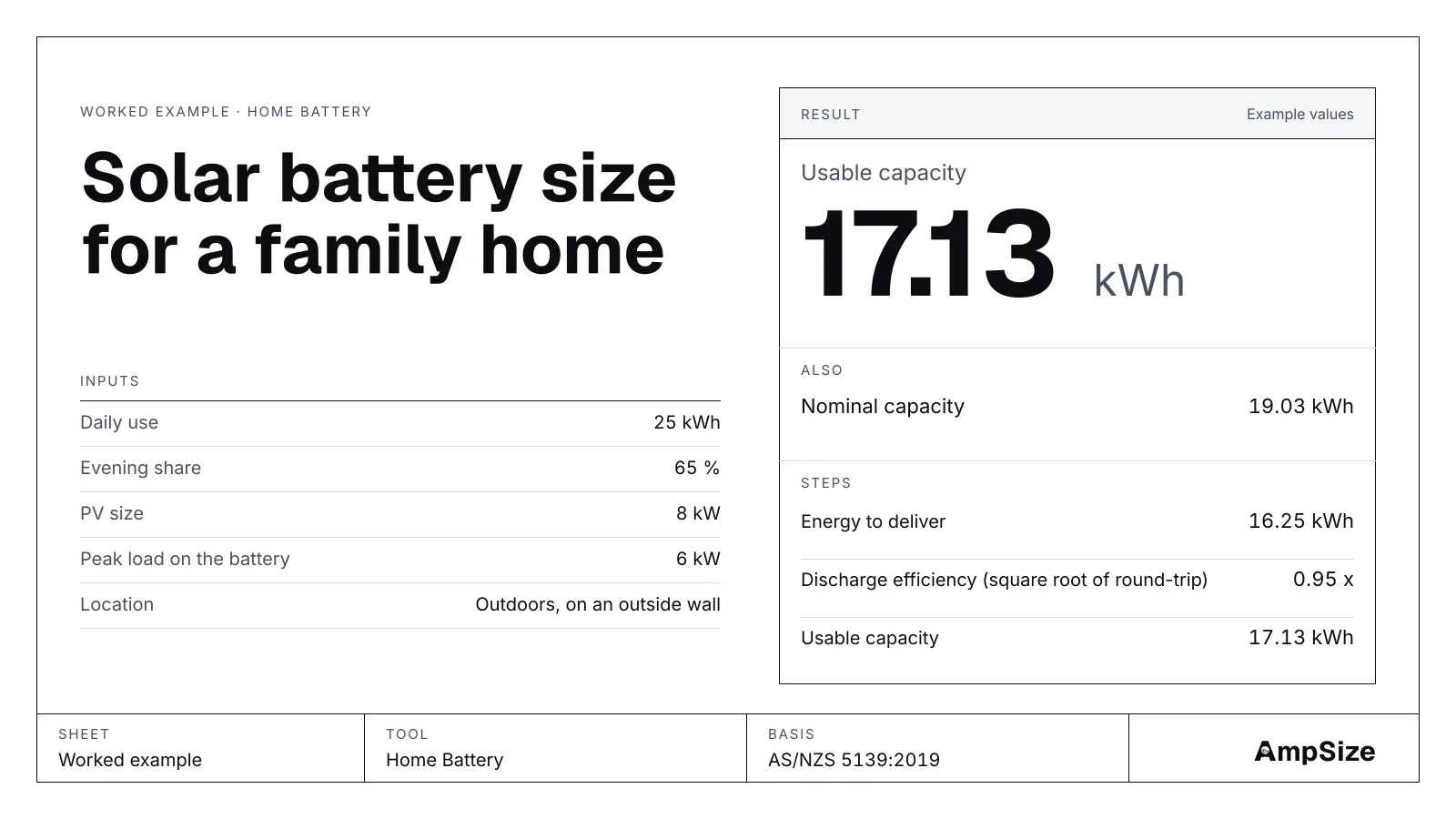
65 % of 25 kWh is 16.25 kWh. That is what the battery must deliver each night.
Step 2. Add the losses and the depth of discharge
A battery loses some energy as it charges and some as it discharges. A round-trip efficiency of 90 % loses about 5 % each way, so the battery must hold 16.25 ÷ 0.949 = 17.13 kWh usable.
The battery does not let you use all of its cells. At a 90 % usable depth of discharge, the nominal size on the data sheet is 17.13 ÷ 0.9 = 19.03 kWh.
Step 3. Pick the bank and the inverter
In 5 kWh modules, that is four modules, a 20 kWh bank. The inverter must carry the largest evening load at once, 6 kW, so the tool suggests a 6 kW inverter. A motor or compressor that starts under load also needs the inverter's surge rating.
Step 4. Check the solar can fill it
The array makes 8 × 3.5 = 28 kWh on an average day. The home uses 8.75 kWh in daylight, which leaves 19.25 kWh spare. Filling 16.25 kWh through the losses takes 18.06 kWh, so an average day fills the battery.
A winter day is different. At 2 kWh per kW, the array makes 16 kWh and leaves only 7.25 kWh spare. The tool warns that the surplus cannot fill the evening share. Plan to top up from the grid at night-rate times, or add panels.
| Case | Spare solar | Needed to fill | Fills? |
|---|---|---|---|
| Yearly average, 3.5 kWh/kW | 19.25 kWh | 18.06 kWh | Yes |
| Winter, 2 kWh/kW | 7.25 kWh | 18.06 kWh | No |
Step 5. Check the location
AS/NZS 5139:2019 Cl 4.2.2.2 keeps an all-in-one battery out of habitable rooms, ceiling spaces, wall cavities, the space under stairs and escape routes. An outside garage wall is a common place. The tool still lists the rules that apply there:
- Keep 600 mm from an exit, a window or vent of a habitable room, and from a hot water unit or air conditioner. Keep 900 mm below them (Cl 4.2.2.2).
- Outdoors, the battery needs IP23 at least (Cl 4.2.3.2).
- Keep 600 mm clear on the working side, 900 mm where 230 V connections are reached (Cl 4.2.5).
If the wall backs onto a bedroom, the wall must be non-combustible past the battery: 600 mm each side and 900 mm above (Cl 4.2.4.2). Brick, concrete, cement sheet and tiles count.
The result
| Item | Value |
|---|---|
| Evening energy | 16.25 kWh |
| Usable capacity | 17.13 kWh |
| Nominal capacity | 19.03 kWh |
| Bank | 4 × 5 kWh |
| Inverter | 6 kW continuous |
The battery cable carries d.c. at the battery voltage. Size it with the DC cable size tool. For an off-grid or backup bank in Ah, use the battery bank calculator instead.
AmpSize does not hold AS/NZS 5139 Amendment 1 (2025). Public notices say it adds a battery short-circuit calculation, so check the amendment before you design the protection.