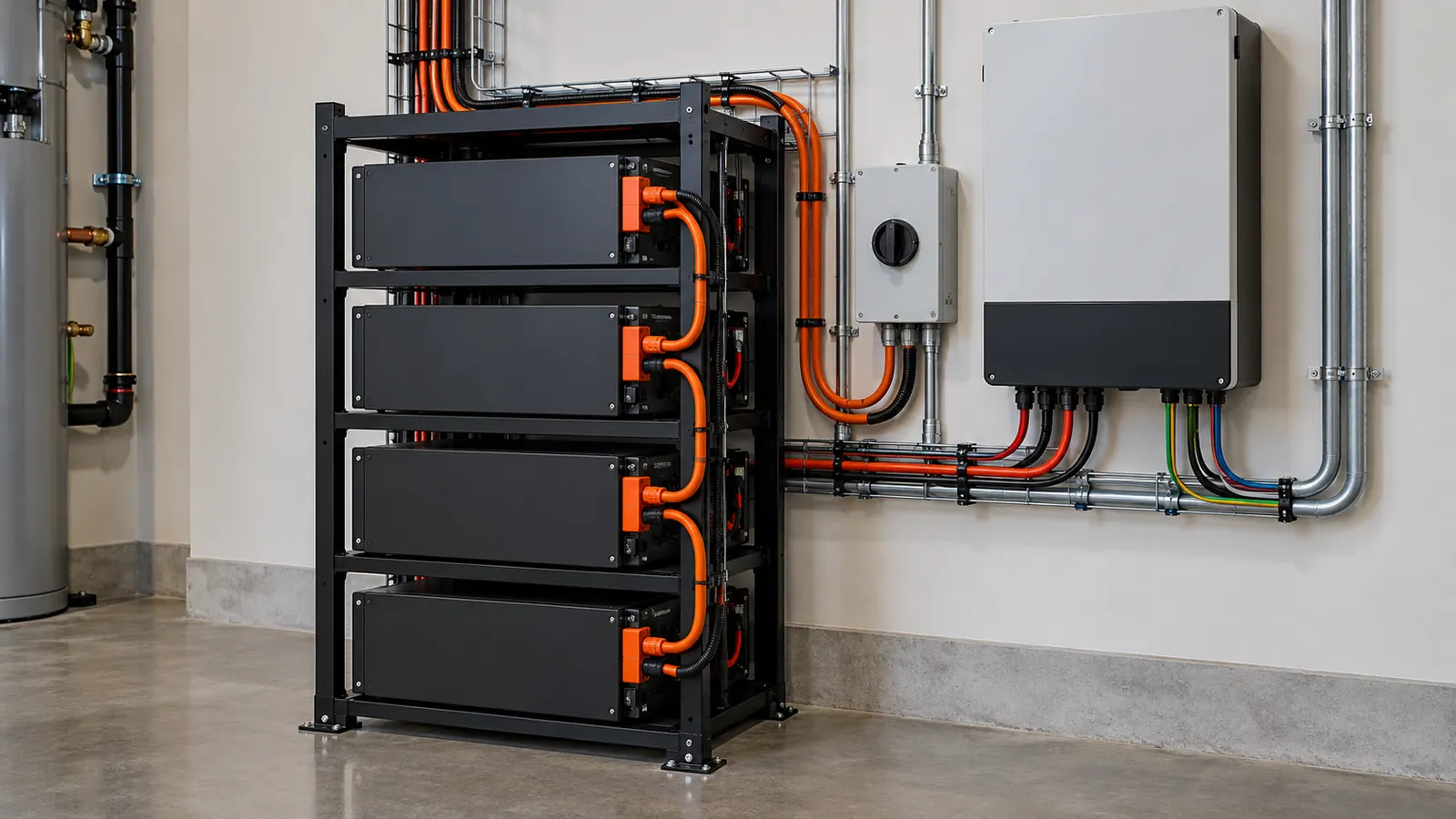
Off-grid battery sizing starts with a load list, not a battery catalogue. Write down what runs and for how long. Everything after that is arithmetic the tool does in three steps.
The question
A bach on a 48 V off-grid system runs a kitchen and tool group of 800 W for 5 hours a day. A fridge and standby group draws 150 W for the full 24 hours. The owner wants two days of cover without sun. The design needs the bank capacity in ampere hours.
The inputs
- Load 1: 800 W for 5 h
- Load 2: 150 W for 24 h
- System voltage: 48 V
- Depth of discharge: 0.5
- Inverter efficiency: 0.9
- Days of autonomy: 2
The load list is the part worth arguing about. Every other input is a decision, not a measurement.
The clause
Cl 7.3 of AS/NZS 3000:2018 covers a stand-alone power system within an installation. The DC run from the bank to the inverter sizes on AS/NZS 3008.1.2:2017 Tables 30 to 35 for impedance. Cite both by number on the design.
The steps
The tool multiplies watts by hours for each load and adds them. 800 W for 5 h gives 4000 Wh. 150 W for 24 h gives 3600 Wh. The total energy per day is 7600 Wh.
That energy passes through the inverter, so the DC side has to supply more than the AC side delivers. The tool divides by the 0.9 efficiency, then divides by the 48 V system voltage. The charge drawn per day is 175.93 Ah.
Two days of autonomy doubles that. The 0.5 depth of discharge doubles it again, because only half the nameplate capacity is usable. The required capacity is 703.7 Ah.
The result
The bank needs 703.7 Ah at 48 V. Round up to the next real battery configuration, not down.
Four factors set that number and each one is a lever. The load list scales it directly. Autonomy days scale it directly. Depth of discharge divides it. Inverter efficiency divides it.
Depth of discharge is the biggest single lever here. 0.5 suits a lead acid bank that has to last years of daily cycling. A lithium iron phosphate bank runs at 0.8 and cuts the same duty to a smaller nameplate. The tool takes whichever figure the battery datasheet supports.
The 150 W standby group contributes 3600 Wh, which is nearly half the daily total. Standing load always costs more than it looks, because it runs for 24 hours. A fridge, a router and a few standby supplies are the usual culprits on a bach.
What the number does not cover
The capacity figure says nothing about charging. A bank that discharges over two days needs a PV array and a controller able to refill it. That refill has to happen before the next cloudy spell. Size the array against the 7600 Wh daily figure and the site irradiance, not against the bank.
Cold also matters. A bank at 5 °C delivers less than its rated capacity. The tool has a temperature factor input for that case, left at 1 here. Set it above 1 when the batteries sit in an unheated space over winter.
Then size the DC cable. The 175.93 Ah per day figure is an average, not a peak. Take the largest instantaneous DC current the inverter can draw at 48 V into the cable size tool. Low voltage DC runs fail on voltage drop long before they fail on capacity. A 48 V system has little headroom to lose. The guide to d.c. cable size for a 48 V battery and a PV array works a 105 A battery run.
This page is a design aid. Verify every value against the current edition of the standard.