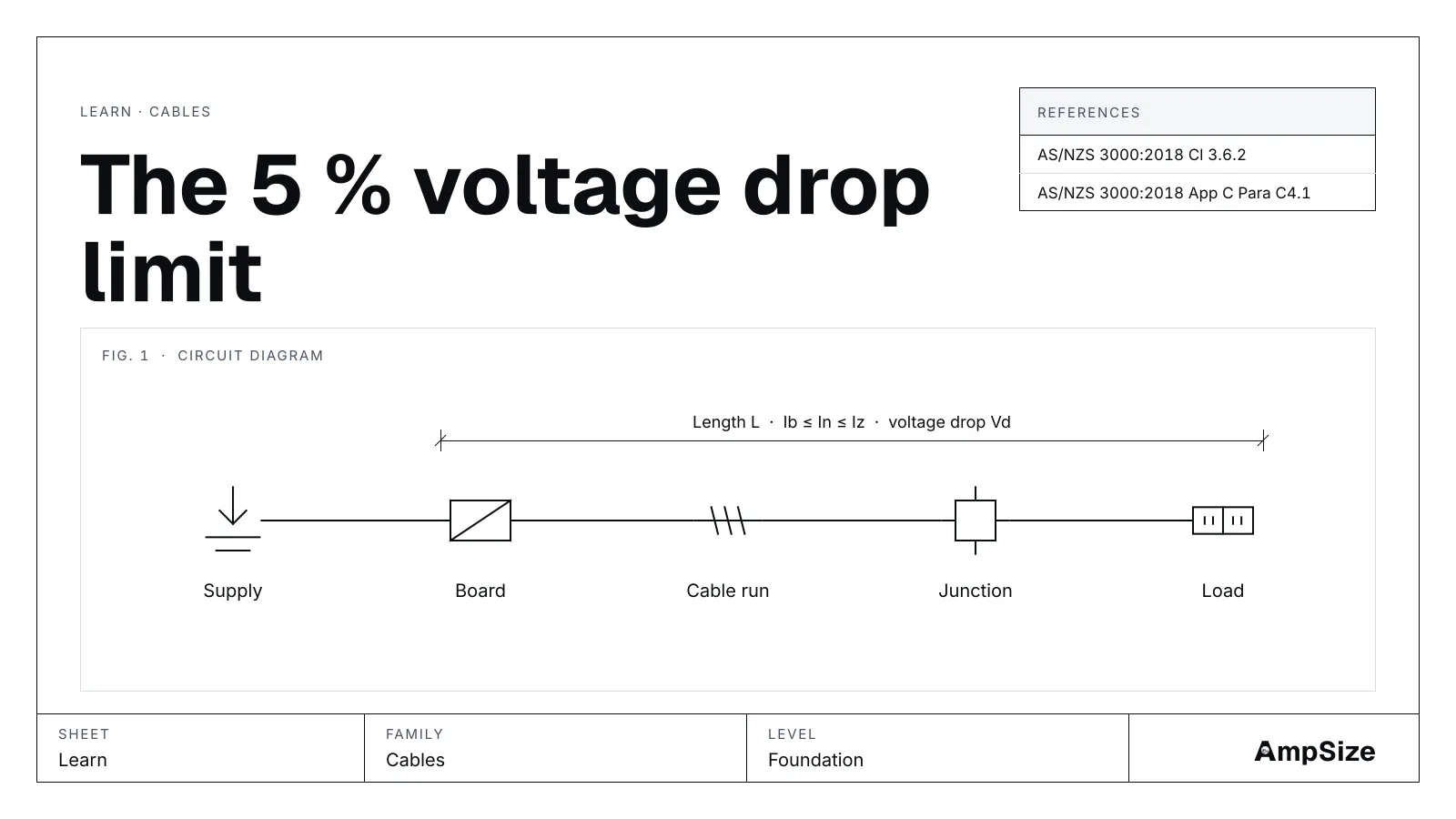
Every cable drops some voltage along its length. AS/NZS 3000 limits how much the voltage may fall between the point of supply and the equipment. This page explains what the limit covers, how the parts of an installation add, and where the limit changes.
What the limit covers
Cl 3.6.2 limits the voltage drop from the point of supply to any point in the installation. The limit is 5 % of the nominal voltage at the point of supply.
- The point of supply is where the network hands over to the installation. In most houses it is the start of the consumer mains.
- Any point is the far end of every final subcircuit: the last socket-outlet, light or fixed appliance.
So the limit is not per circuit. The consumer mains, every submain on the way and the final subcircuit share one 5 %.
How the parts add
Each part of the run has its own drop. A part's drop in volts is its current, times its route length, times the cable's mV/A·m, divided by 1000. AS/NZS 3008.1 lists the mV/A·m of each cable.
Volts do not add well across a single-phase and a three-phase part. Percents do. App C Para C4.1 of AS/NZS 3000 takes each drop as a percent of its own circuit voltage, 230 V single phase or 400 V three phase. Then the percents add directly.
| Part | Percent |
|---|---|
| Consumer mains | 0.9 % |
| Submain to a shed | 2.23 % |
| Final subcircuit in the shed | 1.7 % |
| Total | 4.83 % |
Open this run in the total voltage drop calculator.
Which current to use
The current for each part need not be more than one of these:
- the total connected load on it,
- its maximum demand, or
- the rating of its protective device.
A final subcircuit whose load is spread along it, such as socket-outlets or lights, may use half its device rating (Exception 1). Short drops when a motor starts are not part of the limit.
Where the limit changes
- Extra-low and high voltage circuits are outside Cl 3.6.2 (Exception 2). Extra-low voltage has its own limit in Cl 7.5.
- A substation on the premises. Where the point of supply is the low voltage terminals of a substation on the same premises, which supplies only this installation, the limit is 7 % (Exception 3).
- A stand-alone system may go past 5 %, if the voltage at the equipment never falls more than 11 % below the nominal supply voltage, source included (Exception 4).
The split is your choice
Cl 3.6.2 gives no split between the mains, the submains and the final subcircuits. A designer often keeps the mains and submains to about 2 % so the final subcircuits have room later. That is a plan, not a rule. A run with 4 % in the mains and 1 % in the final subcircuit complies. But it leaves no room for a longer circuit later.
Work out the parts with the total voltage drop calculator. It shows what the upstream parts take and what is left for a final subcircuit. To size one run on its own, use the voltage drop calculator. For a worked house with a shed, read Total voltage drop: mains, submain and final.