When the network goes down at milking time, the cows still need milking. A standby set has to run the shed, and it has to start the motors without the voltage falling so far that contactors drop out. This guide sizes one set with the generator sizing calculator. The ideas behind it are explained in Generator sizing for motor starting.
The shed
- A 7.5 kW vacuum pump, direct on line.
- A 5.5 kW milk vat chiller, direct on line.
- A 1.5 kW milk pump, direct on line.
- 6 kW of hot water and 3 kW of lights and sockets.
- A three‑phase 400 V supply. Each motor at a power factor of 0.85.
The set's figures are your inputs, not rules. This guide keeps the tool's defaults: a largest dip of 15 %, a subtransient reactance of 15 % and a rated power factor of 0.8. Take the reactance and the derating from the alternator's data sheet, and set the dip to what your loads can ride through. AmpSize holds no generator standard, so it does not check these against one.
Step 1. The running load
The tool adds the real power and the reactive power of every load, then takes the kVA from both.
| Load | Running kVA | Starting kVA, direct on line |
|---|---|---|
| Vacuum pump, 7.5 kW | 9.8 | 58.82 |
| Milk vat chiller, 5.5 kW | 7.19 | 43.15 |
| Milk pump, 1.5 kW | 1.96 | 11.76 |
| Hot water, 6 kW | 6 | 6 |
| Lights and sockets, 3 kW | 3 | 3 |
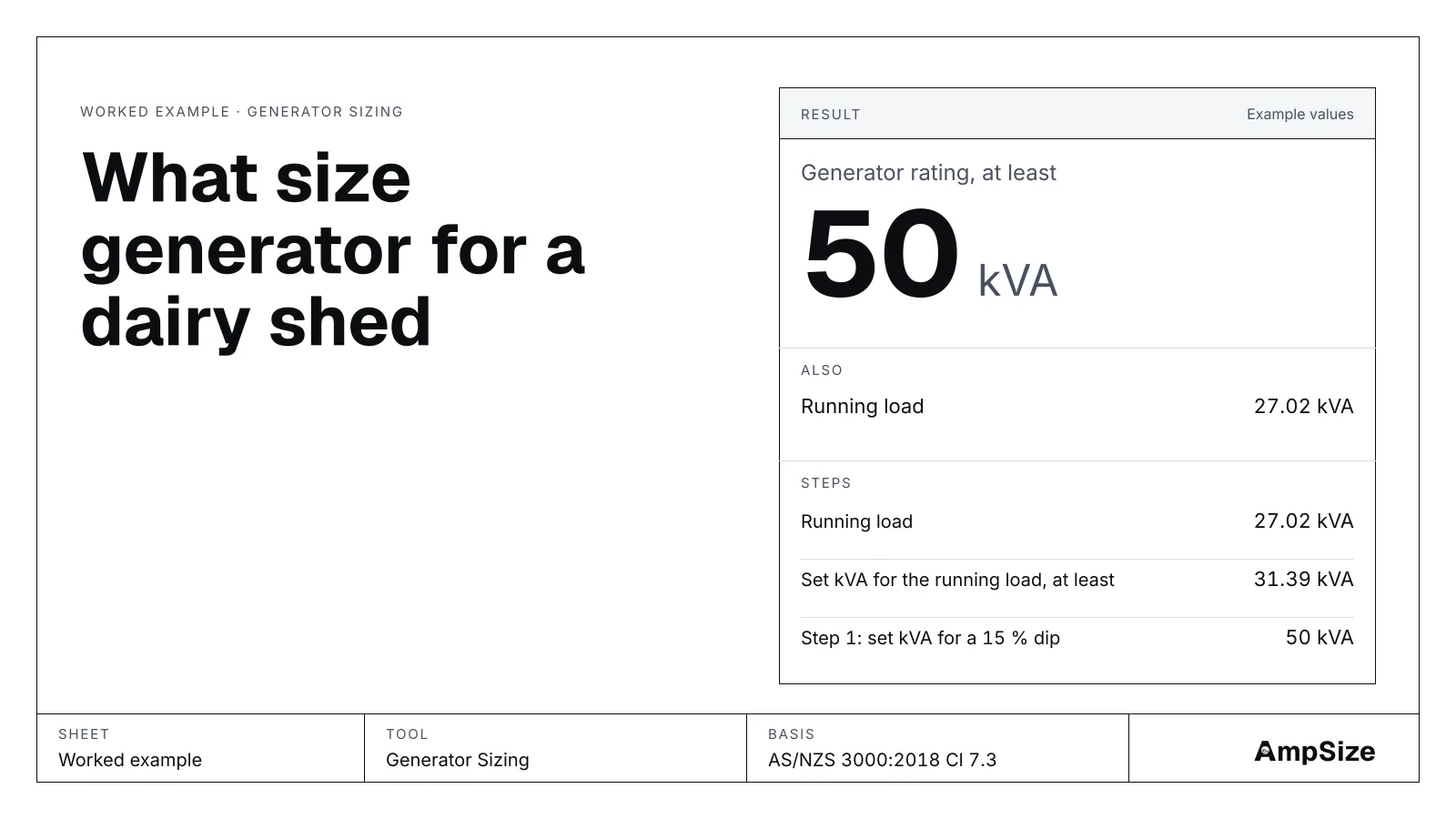
The shed draws 25.11 kW and 9.99 kvar running, so the running load is 27.02 kVA. The set must also give the 25.11 kW at its rated power factor of 0.8. That takes a set of at least 31.39 kVA, which is more than 27.02 kVA. On running load alone, the shed needs 31.39 kVA.
A motor's running kVA comes from the motor tool's full load current. The tool takes a direct-on-line start as 6 times that current. It is an assumption, stated on every result.
Step 2. Everything starts at once
After an outage, everything on the board may come back together. Put every load in step 1 and the three motors start at once. The set needs 104.32 kVA to hold that start to a 15 % dip, more than three times the running load. The tool warns that starting the motors in turn can make the set smaller. Open the shed with every load in one step.
Step 3. Start the loads in turn
Bring the loads on in steps after the changeover: the vacuum pump first, then the chiller, then the milk pump with the hot water and lights. A timer on each starter can do it.
Now the vacuum pump starts on its own. It is the largest start, so it sets the size: 50 kVA, as Starting step 1. The chiller's step needs 36.68 kVA and the last step 17.65 kVA. At 50 kVA the full load current is 72.16 A and the fault current at the terminals is 481.1 A. Open the shed with the loads in steps.
Step 4. Soften the vacuum pump's start
The vacuum pump's start still asks for a set far bigger than the running load. Change how it starts. The tool takes star-delta as a third of the direct-on-line current, a soft starter at the multiple you enter (3 by default), and a variable speed drive at its running current.
| Vacuum pump start | Step 1 needs | Set size | Set by |
|---|---|---|---|
| Direct on line | 50 kVA | 50 kVA | Starting step 1 |
| Star-delta | 16.67 kVA | 36.68 kVA | Starting step 2 |
| Soft starter, 3 × FLC | 25 kVA | 36.68 kVA | Starting step 2 |
| Variable speed drive | 8.33 kVA | 36.68 kVA | Starting step 2 |
Any of the three takes the vacuum pump out of the running. The chiller's direct-on-line start now sets the size at 36.68 kVA. Open the shed with the pump on star-delta, on a soft starter or on a drive.
Some sheds already run the vacuum pump on a drive to hold the vacuum steady. If yours does, enter it as a variable speed drive.
Step 5. Soften the chiller too
Put the chiller on a soft starter as well, with the vacuum pump on its drive. The chiller's step now needs 18.34 kVA, and no start needs more than the running load. The running load sets the size at 31.39 kVA. At that size the largest dip is 9.3 %, the full load current is 45.31 A and the fault current is 302.05 A. Open the shed with both motors softened.
Past this point a smaller set needs a smaller running load, not a gentler start.
A hot engine room
A set gives less than its rating in heat and at altitude. Take the reduction from the maker's derating data. With 10 % off, the shed in Step 5 needs a set rated 34.88 kVA, and its full load current at that rating is 50.34 A. Open the shed derated 10 %.
The result
| Shed | Set size | Set by |
|---|---|---|
| Everything in one step | 104.32 kVA | Starting step 1 |
| Loads in steps, all direct on line | 50 kVA | The vacuum pump's start |
| Vacuum pump softened | 36.68 kVA | The chiller's start |
| Both motors softened | 31.39 kVA | The running load |
Use the size as a first pick. The tool works the dip from the reactance alone. It leaves out the voltage regulator's recovery, the engine's speed dip and the loads already running, which the maker's sizing program models. Check the pick on the maker's data before you order the set.
Installing the set is covered by AS/NZS 3000 Cl 7.3, not by this tool. For the current and fault level of a set you have already chosen, use the generator calculator. For the shed's demand on the network supply, use the maximum demand calculator.