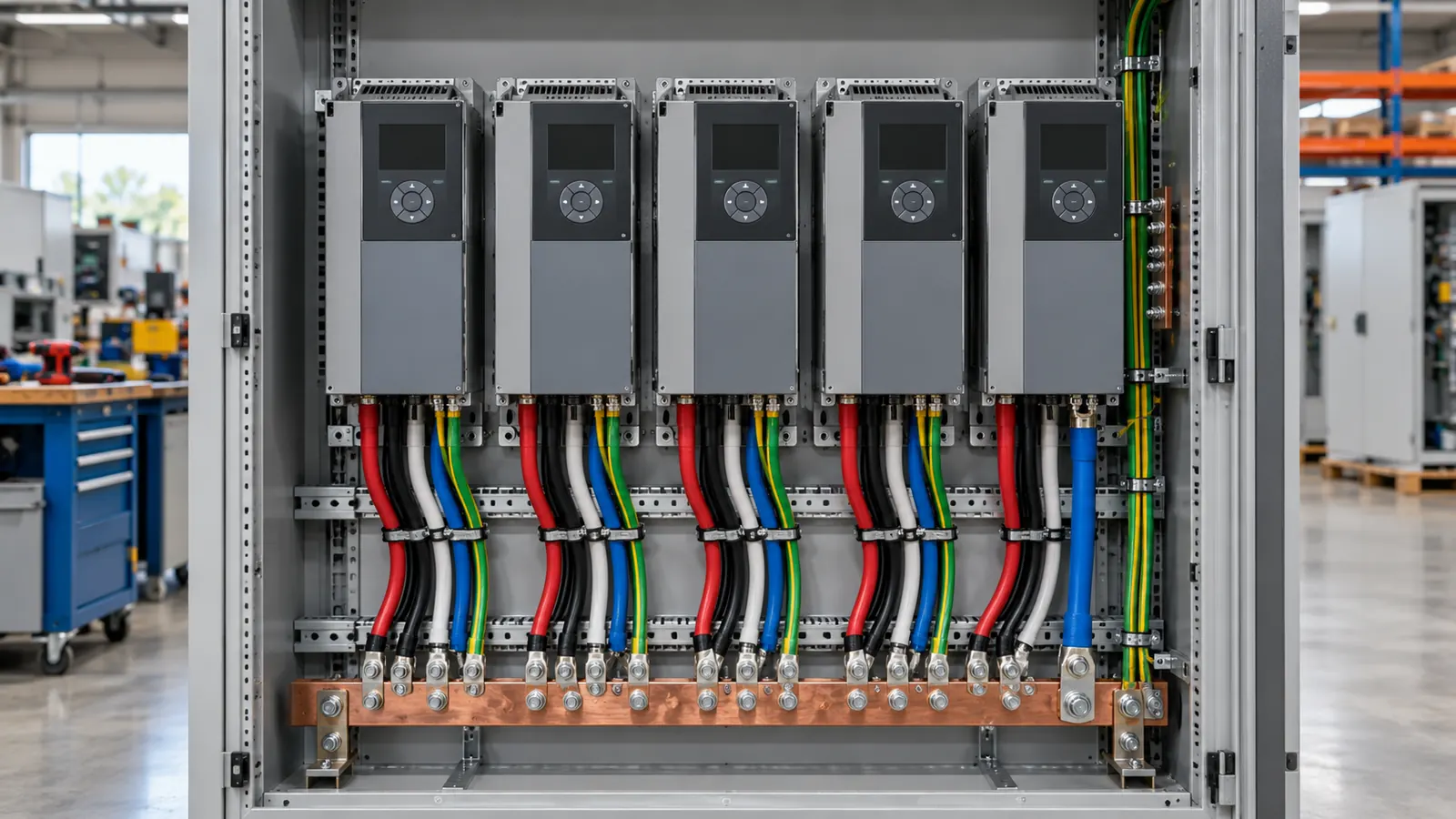
A balanced three-phase circuit with linear loads carries almost nothing in the neutral. The three phase currents are 120 degrees apart and they cancel. That cancellation is the reason a neutral is often the same size as a phase, and sometimes smaller.
Non-linear loads break it.
Why the third harmonic adds
A switch-mode power supply draws current in pulses rather than in a sine wave. An LED driver and a six-pulse drive do the same. The pulse contains a fundamental at 50 Hz plus harmonics at multiples of it.
The odd multiples of three are the problem. The third harmonic sits at 150 Hz. It arrives in each phase in step, not 120 degrees apart. Third harmonic currents therefore add in the neutral instead of cancelling.
At high third harmonic content the neutral carries more current than any phase. A four-core cable sized on phase current then has a neutral that runs hotter than its phases.
What the standard does about it
AS/NZS 3008.1.2:2017 Cl 3.5.9 covers harmonic currents in four-core and five-core cables. Table 2 and App C carry the supporting data. AS/NZS 3000:2018 Cl 3.5.2 covers the neutral conductor itself.
The treatment works in bands of third harmonic content. Up to 15 %, nothing changes. Above 15 % and up to 33 %, a reduction factor of 0.86 applies to the tabulated rating. The phase current still sets the size. Above 33 % and up to 45 %, the neutral current sets the size, and the 0.86 factor still applies. Above 45 %, the neutral current sets the size with no reduction factor.
The 0.86 factor shrinks the capacity of the cable. An ambient or grouping factor does the same thing. The factor itself does not change the design current or the device. Above 33 %, the neutral current becomes the design current.
How the tool applies this factor
The cable size tool applies ambient temperature, grouping, soil resistivity and burial depth. On a three-phase circuit it also asks for the third harmonic content. At 0 %, the default, it applies no harmonic factor. Enter the measured content, and the tool applies the factor for its band.
The circuit below is worked twice: first at 0 %, then with the harmonic content entered. The arithmetic in between shows what the tool does.
A worked circuit
Take a three-phase 400 V submain. The inputs are:
- Design current: 80 A
- Route length: 30 m
- Cable: four-core copper, XLPE insulation
- Installation method: unenclosed and touching, on a tray
- Ambient temperature: 35 °C
- Circuits grouped: 2
- Device: 80 A curve C
- External loop impedance: 0.2 Ω
- Third harmonic content: 0 %
The tool selects 25 mm². The steps behind that selection are:
- Tabulated rating of the 25 mm² conductor: 122 A
- Ambient factor at 35 °C: 0.95
- Grouping factor for two circuits: 0.8
- Total derating factor: 0.76
- Derated capacity: 92.72 A
- Voltage drop: 0.9 %
92.72 A covers the 80 A device, so the circuit passes as the tool reports it.
Open the cable size calculator with these inputs.
Applying the factor
Now suppose the board feeds lighting and IT loads, and a logger shows 25 % third harmonic content. At that level the phase current still sets the size, and the 0.86 factor applies. Multiply the derated capacity by 0.86.
92.72 A multiplied by 0.86 is 79.74 A. The device is rated at 80 A, so 25 mm² no longer covers it. It is 0.26 A short.
The next size up gives room. Its tabulated rating is 151 A, and on the same route it derates to 114.76 A. Multiplying by 0.86 gives 98.69 A, which leaves 18.69 A of margin over the device.
Enter 25 % as the third harmonic content and the tool does this arithmetic itself. It selects 35 mm² and reports a derated capacity of 98.69 A.
Open the cable size calculator with 25 % third harmonic content.
Three points that follow
Harmonic content is a measurement, not an assumption. A power quality logger at the board gives the third harmonic share. A guess decides the conductor size on no evidence.
The neutral is a conductor with a rating. Cl 3.5.2 of AS/NZS 3000:2018 governs its size. A reduced neutral belongs on a circuit with linear loads, not on a board feeding drives and power supplies.
Protection sees phase current. An overcurrent device in the phases does not measure the neutral. A neutral overloaded by harmonics can run hot for a long time with no device responding.
This page is a design aid. Verify every value against the current edition of the standard.