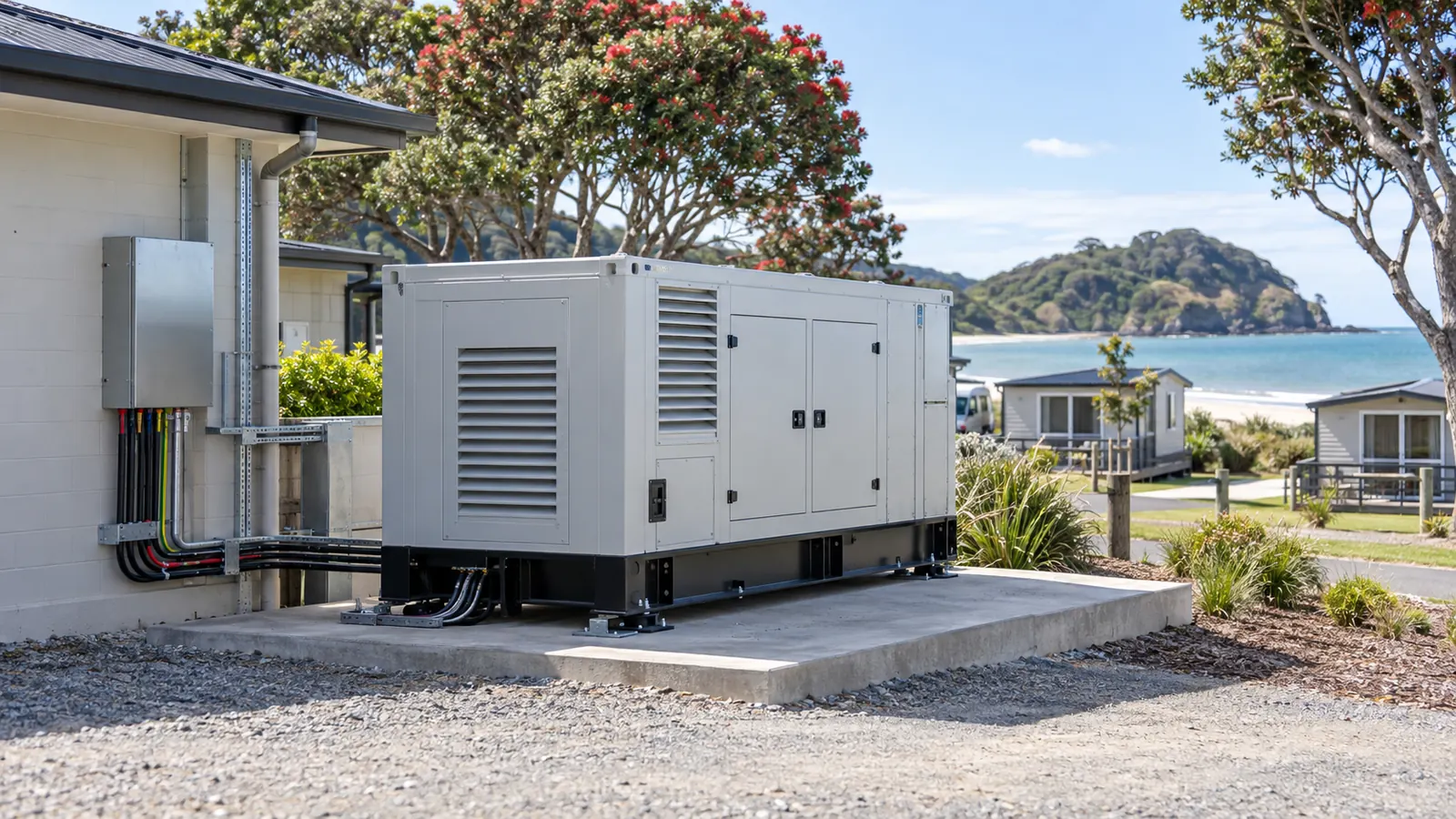
A holiday park fills up over the Christmas break. The network drops out and the standby set takes the load. Nobody at the switchboard works in kVA. The changeover switch, the incoming cable and the protective device all need a current.
The question
A 150 kVA three-phase set runs a park at 400 V. Three numbers decide the switchgear around it. The design needs the current the set delivers at full output. It needs the real power that current represents at the rated power factor. It also needs the fault current at the set terminals.
The inputs
- Rating: 150 kVA
- Phases: 3
- Line voltage: 400 V
- Power factor: 0.8
- Subtransient reactance: 15 %
The power factor and the reactance both come from the machine test sheet. The tool defaults the reactance to 15 %, which suits a typical four-pole brushless alternator.
The clause
Cl 7.3 of AS/NZS 3000:2018 covers a generating set within an installation. It sets the requirements for the changeover arrangement, the earthing and the switching. Reg 75 of the Electricity (Safety) Regulations 2010 applies to the connection of a generating set. Read both by number before the design goes out.
The steps
The full load current follows from the apparent power and the line voltage. For three phases, the tool divides 150 kVA by the square root of three and by 400 V. That gives 216.51 A.
Real power is the apparent power at the rated power factor. 150 kVA multiplied by 0.8 gives 120 kW. That is the figure to compare against the park load in kilowatts, not the kVA rating.
Fault current comes from the per unit reactance. The tool divides the full load current by 0.15 and returns 1443.38 A.
The result
The set delivers 216.51 A. Size the changeover switch, the alternator cable and the set protection above 216.51 A, not around 150 kVA.
The 120 kW figure sets what the park can actually run. A site that draws 130 kW of real load will overload the set long before the alternator reaches 150 kVA. Cabin heating and hot water on a cold January night are the loads that move that number.
The fault current is the point most people miss. 1443.38 A is a small multiple of the full load current. The network supply to the same park will offer several kiloamps. Protection graded against the network fault level may not operate at all on the set. Check the trip times of every device at 1443.38 A as well as at the network figure.
That fault current is also the initial value. The tool reports it from the subtransient reactance and says so with the result. The current decays to the transient and then the synchronous value within a few cycles. Excitation limits cut it further. Use the machine test sheet figure when the supplier provides one.
Reading it against the season
Peak season is when a park proves its backup. The set that covered the load three summers ago may not cover it now. Add up the cabins, the kitchen, the laundry and the pool plant as real power in kilowatts. Compare that total against 120 kW, then work back to the current for the switchgear.
For the incoming cable from the set, take 216.51 A into the cable size tool as the design current. For the board fault rating, take 1443.38 A into the fault rating tool as the generator source case.
This page is a design aid. Verify every value against the current edition of the standard.
See also: Commercial maximum demand with Table C2, Motor full load current: 11 kW 400 V DOL and Maximum demand and diversity.