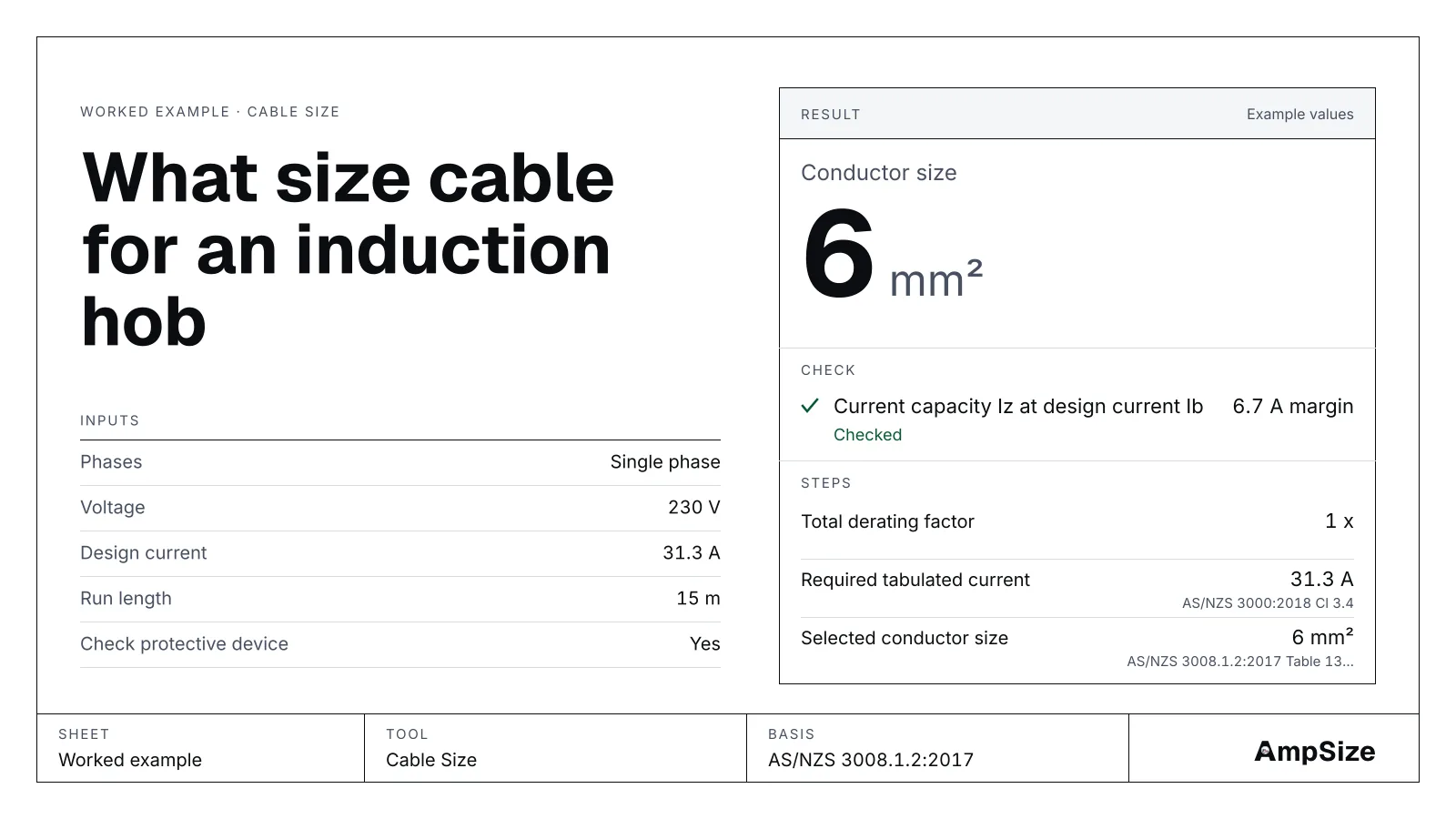
A 7.2 kW induction hob on a 230 V single‑phase supply takes 6 mm² cable on a 32 A breaker, over a 15 m run in a New Zealand house. This guide gets there in the cable size tool and then changes the route to show where 6 mm² stops being enough.
How much current does a 7.2 kW hob draw?
Divide the rating by the voltage: 7.2 kW at 230 V is 31.3 A. That is the design current, Ib. Use the nameplate rating, not the number of zones. A four-zone hob rarely runs every zone at full power, but the cable is sized for the rating unless the demand assessment says otherwise. The maximum demand guide shows how the cooking group is assessed for the whole house.
What size cable for a 7.2 kW hob over 15 m?
Run the case. The cable is multicore copper, enclosed in air at 30 °C, one circuit, on a 32 A C curve breaker. Table 13 of AS/NZS 3008.1.2:2017 gives the rating for each size, and Cl 3.4 of AS/NZS 3000:2018 sets the current check.
| Size | Derated capacity | Voltage drop | Passes |
|---|---|---|---|
| 4 mm² | 29 A | 2.08 % | No |
| 6 mm² | 38 A | 1.4 % | Yes |
| 10 mm² | 50 A | 0.84 % | Yes |
4 mm² fails twice. Its 29 A is below the 31.3 A load, and below the 32 A breaker, which Cl 2.5.3.1 does not allow. 6 mm² clears both. The tool sizes the earth conductor at 2.5 mm² from Table 5.1. The loop impedance is 0.54 Ω against a Table 8.1 maximum of 0.96 Ω for a 32 A C curve breaker.
What if the hob circuit shares a route?
The cable changes when its route does. Run the same hob grouped with one other circuit. The grouping factor is 0.8, so 6 mm² drops to 30.4 A and fails. 10 mm² gives 40 A and passes.
Run it again buried in ceiling insulation, fully surrounded with no wiring enclosure. The tool returns 16 mm², with 39 A. Most hob circuits run in a wall or under the floor, so this case is rare, but it shows how far the method moves the answer.
What if the hob is 45 m from the board?
Run 45 m on 6 mm². The voltage drop is 4.19 %, close to the 5 % limit in Cl 3.6.2. The loop impedance reads 0.92 Ω against 0.96 Ω. 6 mm² passes both with little margin. At 4 mm² the drop is 6.24 % and the loop impedance is 1.01 Ω, so it fails both. The tool assumes an Ze of 0.35 Ω. Measure Ze on site and enter the reading before you accept a pass this close.
What if the hob is three‑phase?
Some hobs connect across three phases. Take the same 7.2 kW at 400 V: 10.4 A per phase. Run it on a 16 A breaker over 15 m. The tool returns 1.5 mm², with 16 A capacity and a 1.01 % drop. The tool sizes for current, drop and the device. The hob maker's instructions can set a larger minimum, so read them before you cut cable.
What this guide does not cover
The tool does not choose the breaker for you. It checks the one you enter. It does not read the demand rules for the house or the hob maker's instructions. It does not test the circuit. For the test step, see checking an existing circuit.
The result
| Case | Size that passes |
|---|---|
| 7.2 kW, 15 m, one circuit, 32 A breaker | 6 mm² |
| Grouped with one other circuit | 10 mm² |
| Fully in insulation, no enclosure | 16 mm² |
| 45 m run | 6 mm², drop 4.19 %, Zs 0.92 Ω |
| Three‑phase, 10.4 A per phase, 16 A breaker | 1.5 mm² |
For a house in Australia, set the Standard to AS/NZS 3008.1.1 in the tool. The Australian 32 A circuit guide shows that route.
See also: AS/NZS 3008 Table 13 multicore current ratings, Domestic maximum demand with Table C1 and Cable size for 32 A single‑phase over 25 m.