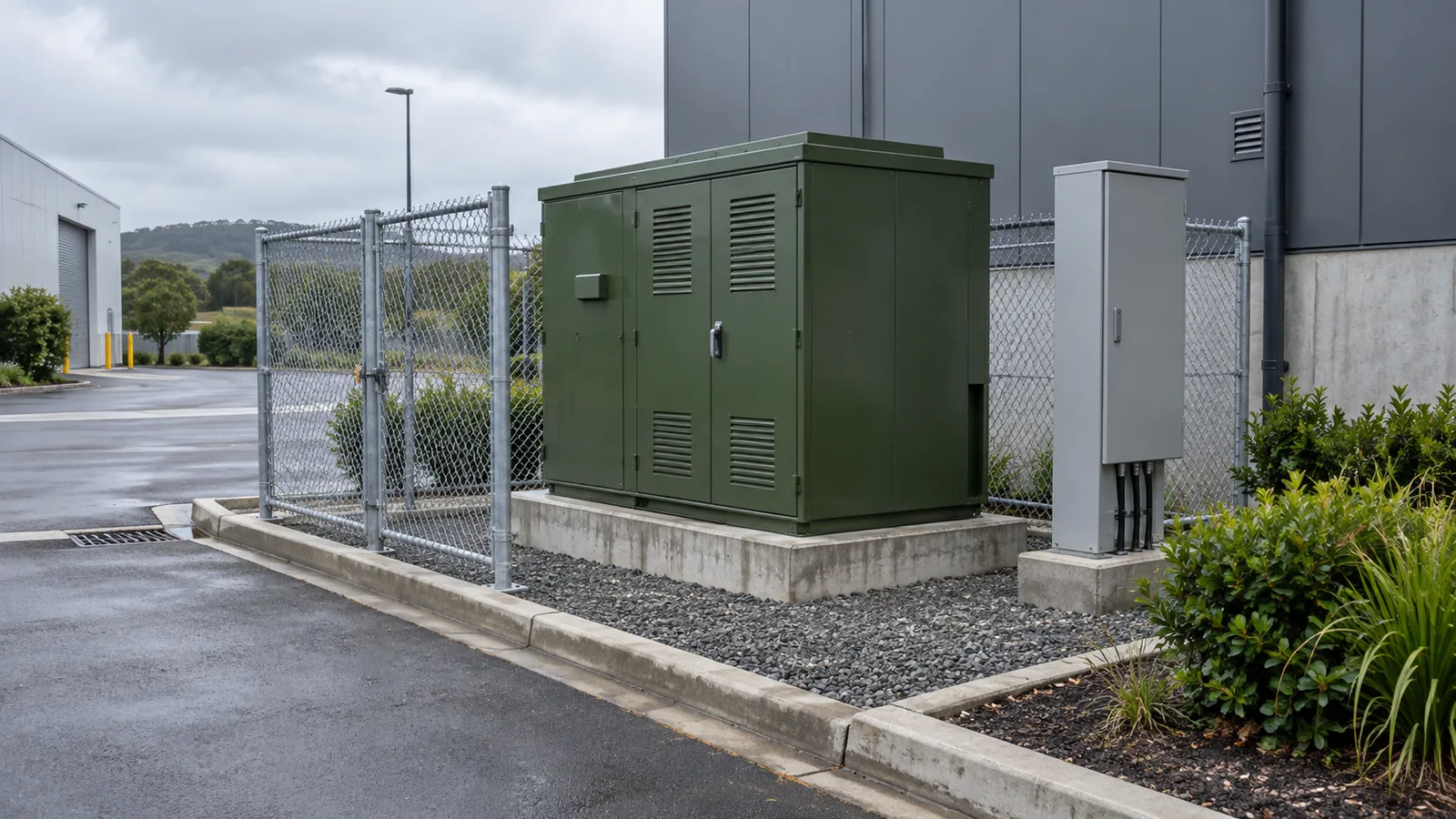
A kiosk transformer sets the fault level for everything downstream of it. The switchboard rating, the cable withstand check and the arc flash study all start from one number. That number is the fault current at the transformer secondary terminals. Three nameplate figures produce it.
The question
A 500 kVA transformer feeds a plant board. The primary is 11 kV, the secondary is 400 V, and the nameplate impedance is 6 %. The check gives the current in a bolted three‑phase fault at the secondary terminals. It also gives the full load current on each side.
The inputs
- Rating: 500 kVA
- Phases: 3
- Primary voltage: 11000 V
- Secondary voltage: 400 V
- Impedance: 6 %
Every figure comes off the nameplate. No cable data is entered, because the tool works at the terminals.
The clause
Cl 2.5.4.1 of AS/NZS 3000:2018 requires the prospective fault current at each point of the installation. The transformer terminals are the first such point in a customer substation. The result feeds the fault rating tool for the cable withstand check. It also feeds the arc flash tool for the incident energy at the board.
The steps
The tool takes three steps.
First it divides the rating by the primary voltage and the square root of three. That gives the primary full load current: 26.24 A.
Second it repeats the division at the secondary voltage. That gives the secondary full load current: 721.69 A.
Third it divides the secondary full load current by the per unit impedance. At 6 % the per unit impedance is 0.06. The fault current is the full load current divided by 0.06. The result is 12,028.13 A, or 12.03 kA.
The third step shows why the impedance percent matters more than the rating on its own. The same unit at 4 % gives half again the fault current it gives at 6 %. A larger transformer of the same impedance raises the fault current in proportion to the rating.
The result
- Secondary full load current: 721.69 A
- Primary full load current: 26.24 A
- Secondary fault current: 12,028.13 A
The tool returns one note with the result: the fault current assumes an infinite upstream source. The 11 kV network has its own impedance, and that impedance lowers the fault current at the secondary terminals. The figure above is therefore the worst case. Use the network operator's declared fault level at the primary when a tighter figure is needed for equipment selection.
Cable impedance is not included either. The fault current at a board 30 m from the transformer is lower than the terminal figure. The run adds resistance and reactance. Take the terminal figure as the design value for the main switchboard and the incoming cable. Work downstream from there.
Where the number goes next
The 12.03 kA figure sets two selections. The main switch and the main board need a short circuit rating at or above it. The incoming cable needs an adiabatic withstand check at that current and clearing time. The fault rating tool takes both figures and reports the minimum conductor size.
The 721.69 A secondary full load current sets the rest. It is the design current for the incoming cable and the floor for the main switch rating.
This page is a design aid. Verify every value against the current edition of the standard.
See also: Prospective fault current at a main switchboard, Arc flash incident energy at a 400 V switchboard and Short-circuit withstand and the k factor.