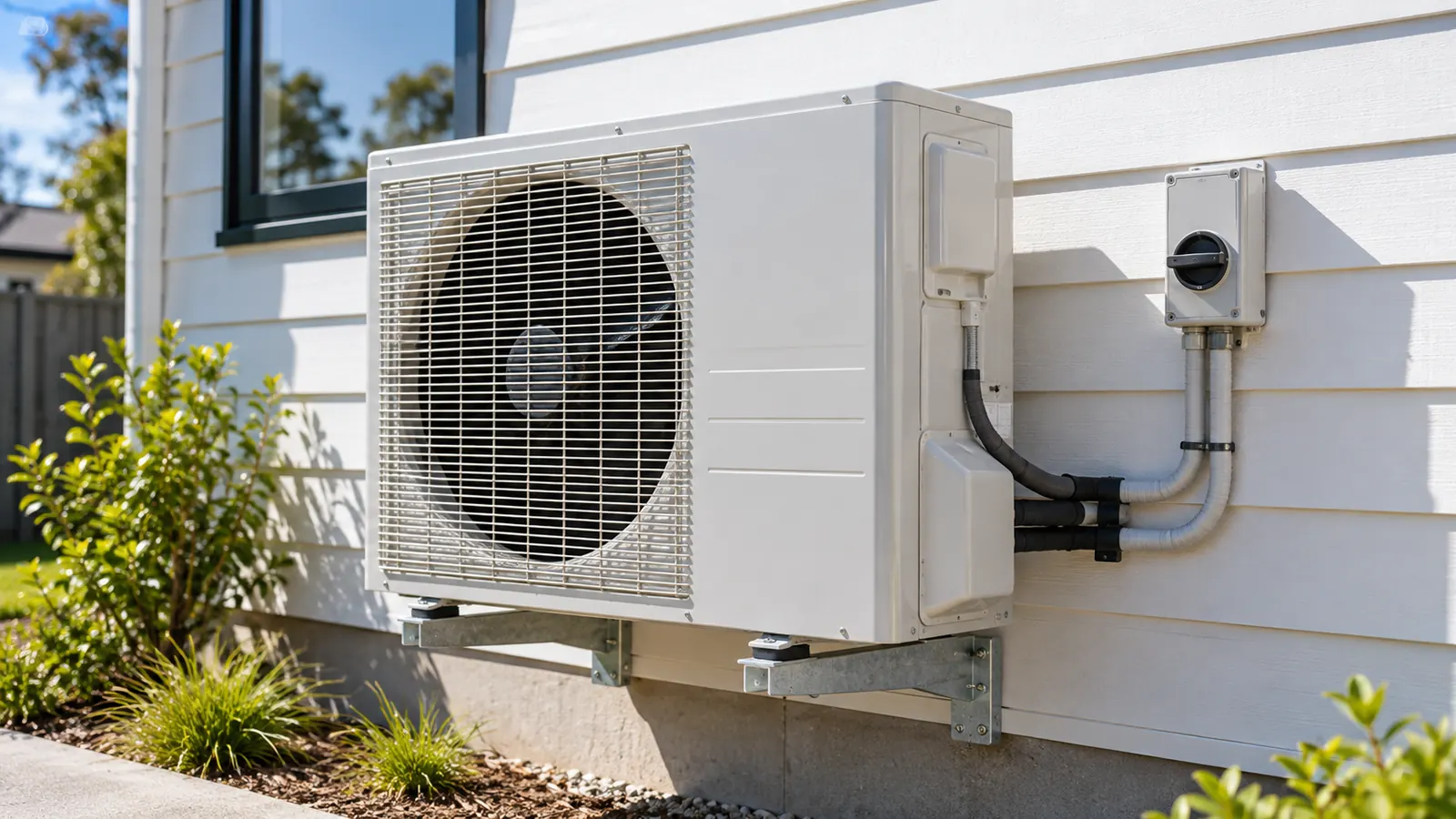
A heat pump circuit looks like a 20 A job on paper. The route is what changes the answer. The cable crosses a roof space in February, part buried in ceiling insulation. The tabulated rating drops before the run even starts.
The question
A ducted heat pump draws 20 A at 230 V. The cable runs 18 m from the board, through a roof space that reaches 40 °C in summer. The cable sits partly surrounded by thermal insulation. A 20 A curve C breaker protects it. The design needs the smallest conductor that passes every check.
The inputs
- Phases: 1
- Voltage: 230 V
- Design current: 20 A
- Route length: 18 m
- Installation method: partially surrounded by thermal insulation
- Wiring enclosure: none
- Ambient temperature: 40 °C
- Protective device: 20 A, curve C
40 °C is not a pessimistic figure for a Northland or Hawke's Bay roof space on a still afternoon. The 30 °C default in most tables belongs to a wall cavity, not a ceiling.
The clause
Cl 3.4 of AS/NZS 3000:2018 sets the current-carrying capacity requirement. Cl 3.6.2 sets the voltage drop limit. A fixed heating or cooling appliance falls under Table C1 group D for maximum demand. Ratings come from AS/NZS 3008.1.2:2017 Tables 4 to 21, and the ambient factor from Tables 27(1) and 27(2).
The steps
The ambient factor comes first. At 40 °C the tool applies 0.88. No other circuit shares the route, so the grouping factor is 1. Soil and depth do not apply to this method. The total derating factor is 0.88.
Dividing the 20 A design current by 0.88 gives a required tabulated current of 22.73 A. The tool then walks the standard sizes until one clears that figure.
2.5 mm² carries a tabulated 19 A on this method. After the 0.88 factor that is 16.72 A, below the 20 A the circuit draws. It fails on capacity.
4 mm² carries a tabulated 26 A. After derating that is 22.88 A, which clears both the 22.73 A requirement and the 20 A device rating.
The result
The answer is 4 mm², with a 2.5 mm² earth conductor.
- Derated capacity: 22.88 A
- Voltage drop: 1.59 %
- Earth fault loop impedance: 0.61 Ω
The capacity check sets this size, not the voltage drop. At 18 m the drop on 4 mm² is 1.59 %, well inside the limit. Even 2.5 mm² would have passed on drop at 2.55 %. The method is the story: partly in insulation, 2.5 mm² starts at 19 A, under the 20 A load.
What moves the answer
Drop the ambient to 30 °C and the factor returns to 1. The required tabulated current falls back to 20 A. 2.5 mm² still fails: its tabulated 19 A sits under 20 A with no derating at all. The summer figure costs margin on 4 mm², not a size, and it is the figure the cable actually sees.
Move the cable fully into the insulation rather than partly, and the tabulated rating falls again. The tool has a separate method for that case. Choose the method that matches the worst section of the route, not the average.
The 20 A device rating also holds the answer where it is. A 4 mm² conductor at 22.88 A takes a device of 20 A or less on this route. Cl 3.4 requires the device rating to stay within what the cable can carry after derating.
For the maximum demand side of the same job, the appliance lands in Table C1 group D. Adding a ducted heat pump to an existing house can move the consumer mains. Run the demand check before the circuit goes in.
This page is a design aid. Verify every value against the current edition of the standard.
See also: Cable size for a 32 A single-phase 25 m run, AS/NZS 3008 Table 27 (now 3.44, 3.45): temperature and Current-carrying capacity and derating.