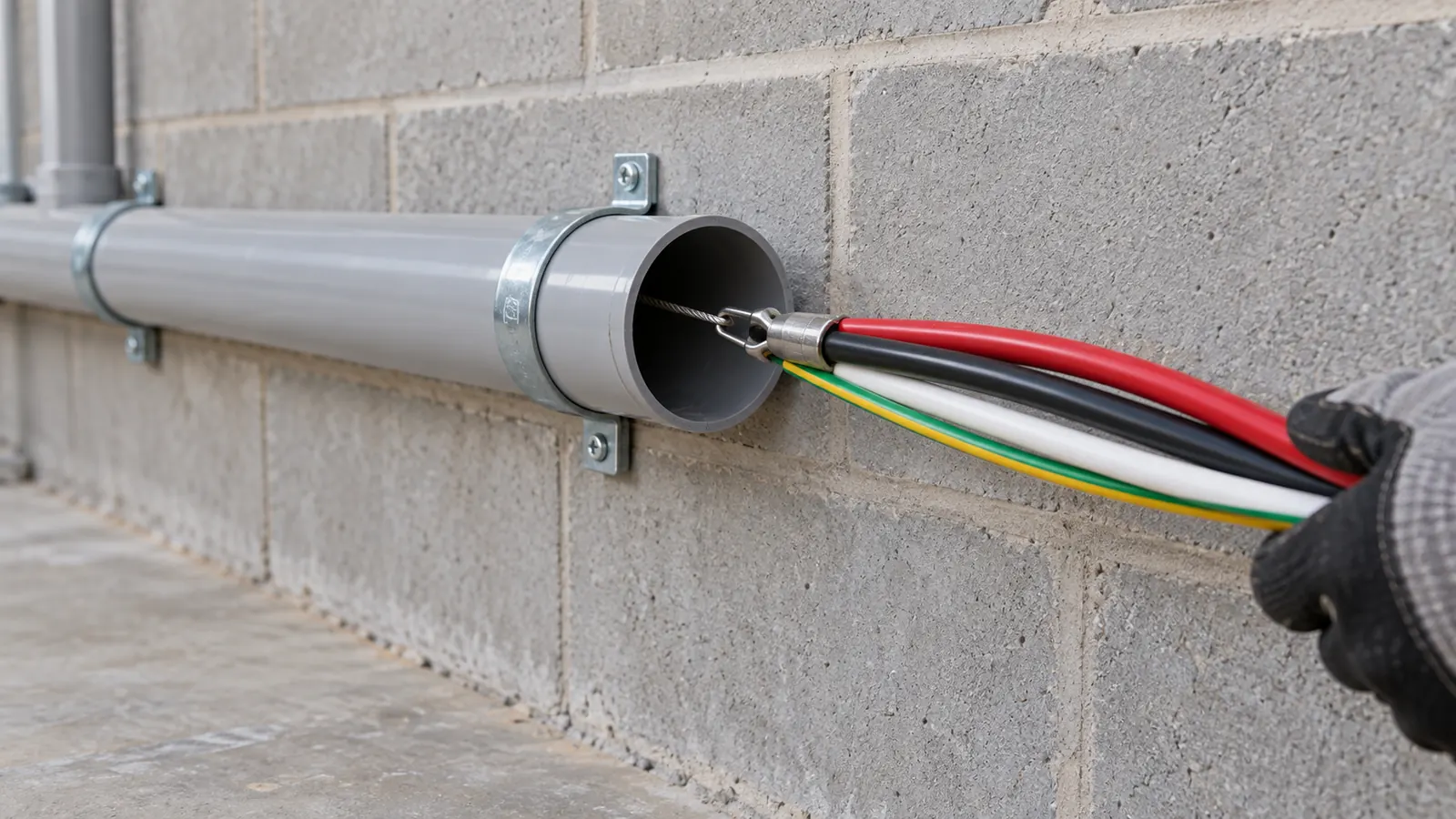
Four singles in a 25 mm conduit is a common run. The question is whether the bundle fits, and whether a smaller conduit would have done. Appendix C of AS/NZS 3000:2018 answers both, by two different methods.
The inputs
- Conduit: 25 mm nominal
- Cables: four single-core 6 mm² conductors
Single core and multicore cables of the same conductor size have different overall diameters. The core choice therefore changes the result, and it has to match what goes in the conduit.
The paragraph and the tables
Para C6.2 of AS/NZS 3000:2018 Appendix C sets the space factors. The tool applies 50 % for one cable, 33 % for two cables and 40 % for three or more. Four cables take the 40 % factor.
Tables C10 to C12 of the same Appendix give a maximum cable count for a conduit size instead. That is a different method with the same purpose. The tool reports the fill percentage method, and says so with every result.
The two methods do not always agree. A count table is built around a nominal cable diameter. A fill calculation uses the diameter of the cable actually installed.
The steps
The tool converts the nominal conduit size into an internal area. A 25 mm conduit gives 359.68 mm² of internal area.
It then adds the overall cross-sectional area of every cable in the bundle. Four 6 mm² singles come to 81.71 mm².
Dividing one by the other gives the fill.
The result
- Conduit fill: 22.72 %
- Permitted fill: 40 %
- Conduit internal area: 359.68 mm²
- Cable area: 81.71 mm²
- Recommended conduit: 20 mm
22.72 % against a 40 % space factor is a pass with room to spare. The tool also reports the smallest nominal conduit that takes the same bundle. That figure is 20 mm, not 25 mm.
So the run fits, and a size down would also fit on the fill test. Whether to drop a size is a separate judgement. A 25 mm conduit pulls more readily and leaves room for a later addition. It costs little more in a short run. A 20 mm conduit on a long run with several bends can be hard to draw into. The arithmetic still passes.
What the fill percent leaves out
The calculation is a cross-section test. It says nothing about bends, draw-in force, or the length of the pull. A straight 3 m run and a 30 m run with four bends have the same fill. The installation differs.
Cable diameters vary by manufacturer. The tool derives them from manufacturer data, so a particular brand can sit above or below the figure used here. On a bundle close to the limit, measure the cables that will be installed.
The fill test also does not derate the cables. Several circuits sharing one conduit take a grouping factor, which belongs to the cable size tool and its derating tables. A bundle that passes on space can still fail on current rating.
This page is a design aid. Verify every value against the current edition of the standard.