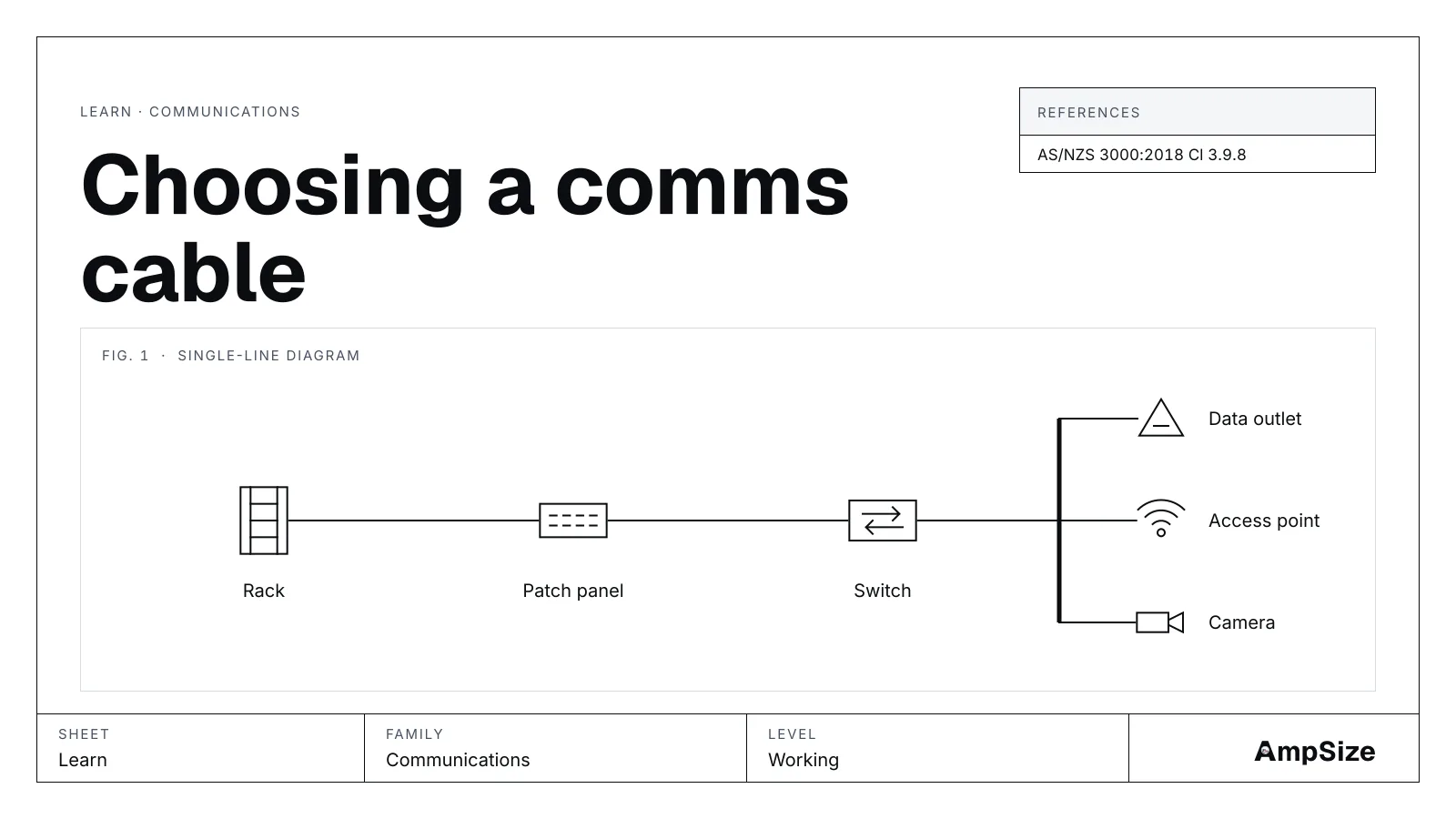
A plant has many wires that carry data, not power. Each one has a length limit. Each one also has a rule for the screen. This page shows how to check both before you buy the cable.
Where the limits come from
Power cables have clear rules. Comms cables do not. No printed communications standard is held by AmpSize. The limits come from cable maker data and training courses. The tool says so on every result.
Treat each limit as a starting point. Confirm it against the data sheet of the device you install. The device maker has the final word.
AS/NZS 3000:2018 Cl 3.9.8 still applies to the route. Keep data cables apart from power cables as that clause requires.
The three checks
The tool checks three things.
Length. The run must not exceed the limit for the interface and the speed.
Screen. Some interfaces need a screen. Some only recommend one. The tool reports which.
Environment. A moving run, an outdoor run and a run in an EMC area each need a different sheath.
Run 1: RS-485 at 1000 kbps
A bus runs 600 m. It carries RS-485 at 1000 kbps on a fixed route. The tool reports 200 m as the limit and the run fails.
The held table lists printed speeds. 1000 kbps lies between two printed rows. The tool uses the 1500 kbps row, which is the next speed up. That row gives the shorter run.
The tool also gives the construction. Use one pair or more, with a screen, and a conductor larger than 0.34 mm². Terminate each end with 120 Ω. A line allows 32 unit loads.
A lower speed gives a longer run. A repeater splits the bus into segments. The tool notes that a repeater is needed past the segment length.
Open the comms cable tool with this run.
Run 2: Ethernet on Cat 6
An Ethernet link runs 120 m on Cat 6. The tool reports a limit of 100 m. The run fails by 20 m.
The category check passes. Cat 6 is good enough for the link. The length is the problem. Cable quality does not buy extra distance.
A switch placed within 100 m solves it. So does a fibre link. Both change the design, so check the cost before you commit.
Open the comms cable tool with this run.
Run 3: a 4–20 mA loop
A 4–20 mA pair runs 400 m. The tool reports no published limit. The screen is required and the check passes.
The length of a current loop does not come from the cable type. It comes from the voltage budget. The supply voltage, the transmitter minimum voltage and the input resistance set it.
That calculation is a different tool. The loop power tool takes the supply, the lift-off voltage, the loop current and the resistances. It then gives a margin in volts and a maximum cable length. Use it for every 4–20 mA run.
Open the comms cable tool with this run.
The screen
Earth a screen at one end only. The panel end is the usual choice. A second earth at the field end can close a loop and carry current. For bus and network cables, follow the device maker installation guide.
Where it goes wrong
The longest figure on a data sheet is used. Maker limits assume a given speed and cable family. A faster speed shortens the run.
A flexible run uses a fixed cable. A drag chain needs a flexible conductor and a suitable sheath. A fixed cable fails early.
An outdoor run uses plain PVC. Sunlight breaks down a sheath that is not marked UV-resistant.
Termination is skipped. An RS-485 line needs a resistor at each end. A short line may not, but the tool states the 120 Ω value for a normal bus.
The bus count is mixed up. A count of 32 unit loads is not always a count of 32 devices.
This page is a design aid. Verify every value against the device maker data.
See also: 24 V DC voltage drop on an instrument loop, Control panels and PLC wiring and PLC panel 24 V DC battery backup.