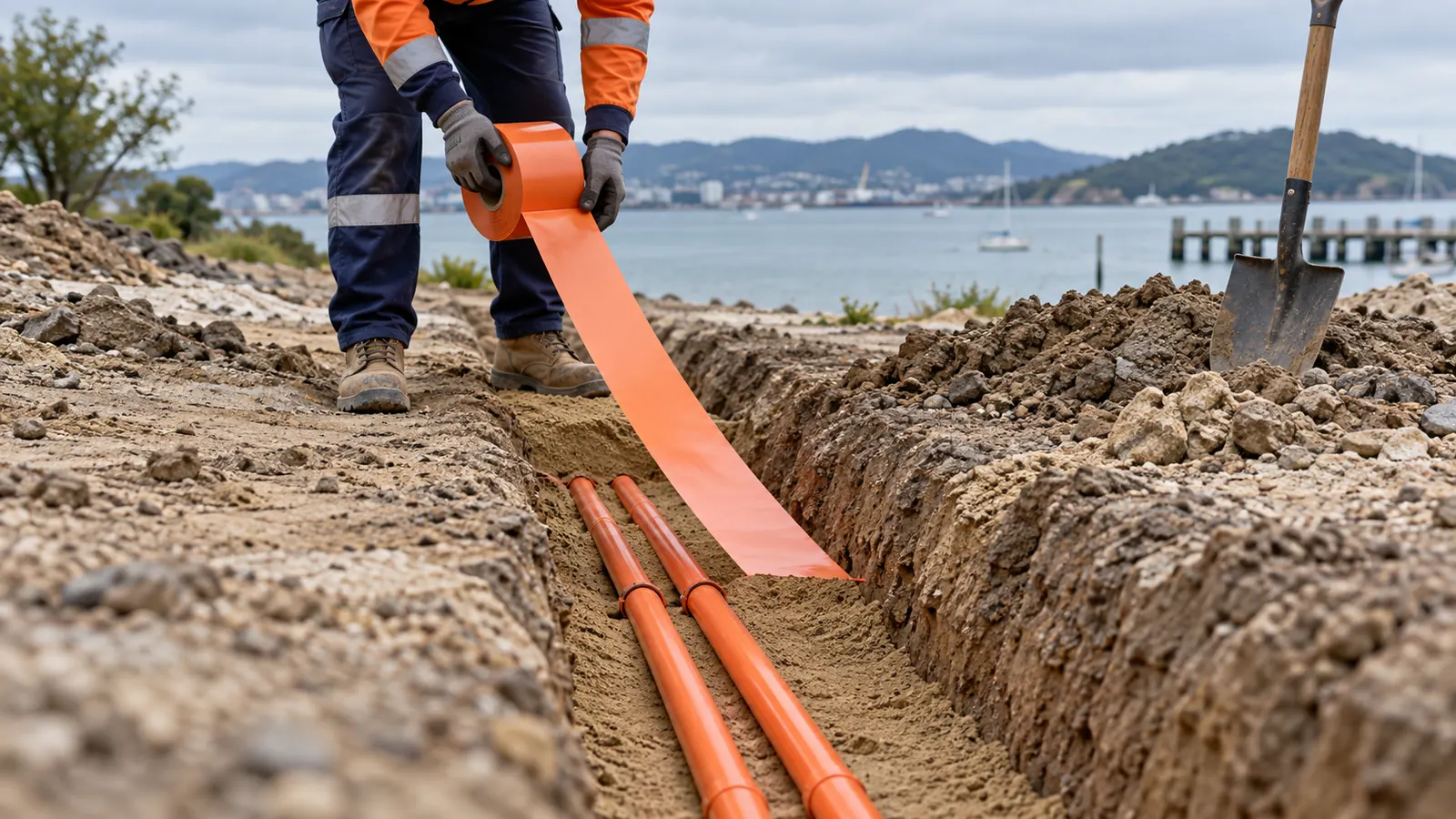
An underground cable is two problems at once. The civil problem is the trench: depth, bedding, marking and separation. The electrical problem is heat: buried soil carries heat away more slowly than moving air. Both problems change the conductor size.
The civil side, by clause
AS/NZS 3000:2018 sets out the wiring system underground in Cl 3.11.4.2 to Cl 3.11.4.5. The tables carry the numbers.
Category. Table 3.5 gives the cable categories, A, B and C. The category depends on the cable construction and on the mechanical protection around it. A cable in a heavy-duty enclosure sits in a different category from the same cable laid bare.
Depth of cover. Table 3.6 gives the cover required for each category and each location. A cable under a driveway takes more cover than the same cable under a garden. Measure cover to the top of the cable, not to the trench floor.
Separation. Table 3.7 gives the separation from other services. Water, gas and telecom runs each have a figure. Table 3.7 treats a crossing and a parallel run differently.
Bedding and marking. The cable sits on clean fill, free of stones that concentrate load on the sheath. Marker tape goes above the cable so the next excavation finds it before a machine does.
Get the civil work right and the cable lives. Get it wrong and the failure appears years later, under a slab.
The thermal side, by table
AS/NZS 3008.1.2:2017 gives a buried cable its own tabulated rating and its own derating factors. Three factors apply underground that do not apply in air.
Ambient. Soil temperature, not air temperature. Tables 27(1) and 27(2) carry the factors. Soil is cooler than a roof space and steadier through the day.
Soil thermal resistivity. Table 29 carries the factor. Dry sand holds heat around the cable. Wet clay carries it away. The difference between a good soil and a poor one is large.
Burial depth. Tables 28(1) and 28(2) carry the factor. Deeper is cooler in air terms and worse in thermal terms. The heat has further to travel to the surface.
Grouping still applies, from Tables 22 and 25. Two circuits in one trench heat each other.
The same load, two trenches
Take a 100 A three‑phase submain at 400 V, power factor 0.9, over 60 m. Copper conductors with XLPE insulation, buried direct. The load never changes. Only the trench does.
The good trench. One circuit, 25 °C soil, resistivity 1.2 K·m/W, cover 0.6 m.
Ambient gives 0.93, grouping gives 1, soil gives 1 and depth gives 0.99. The total factor is 0.9207. The tool needs a tabulated rating of 108.61 A. It selects 16 mm², tabulated at 118 A and derated to 108.64 A. Voltage drop is 3.53 %. The earth conductor is 6 mm².
Open the cable size calculator with the good trench.
The hard trench. Three circuits, resistivity 2.5 K·m/W, cover 1.0 m. Everything else is identical.
Ambient still gives 0.93. Grouping gives 0.70 and soil gives 0.74. At 1.0 m, depth gives 0.94 for a conductor above 50 mm². The total factor falls to 0.4528. The tool now needs a tabulated rating of 220.83 A and selects 70 mm², derated to 121.81 A. Voltage drop falls to 0.88 %. The earth conductor rises to 25 mm².
Open the cable size calculator with the hard trench.
Four conductor sizes separate the two trenches, on the same load over the same distance. The soil and the trench sharing did that, not the load.
Where conduit changes the answer
A cable in an underground enclosure is a different install method from a cable buried direct. It takes a different tabulated rating. The conduit also has to hold the bundle, which is the conduit fill question.
Two habits help. Size the conduit for the draw-in force, not only for the fill percent. A long duct with bends takes more pull than the fill figure suggests. Leave a spare duct in every trench, because the second excavation costs far more than the first duct.
A habit worth keeping
Ask for the trench detail before you price the cable. The depth, the duct count and the soil decide the conductor size. An estimate from the load alone can run three sizes light.
This page is a design aid. Verify every value against the current edition of the standard.