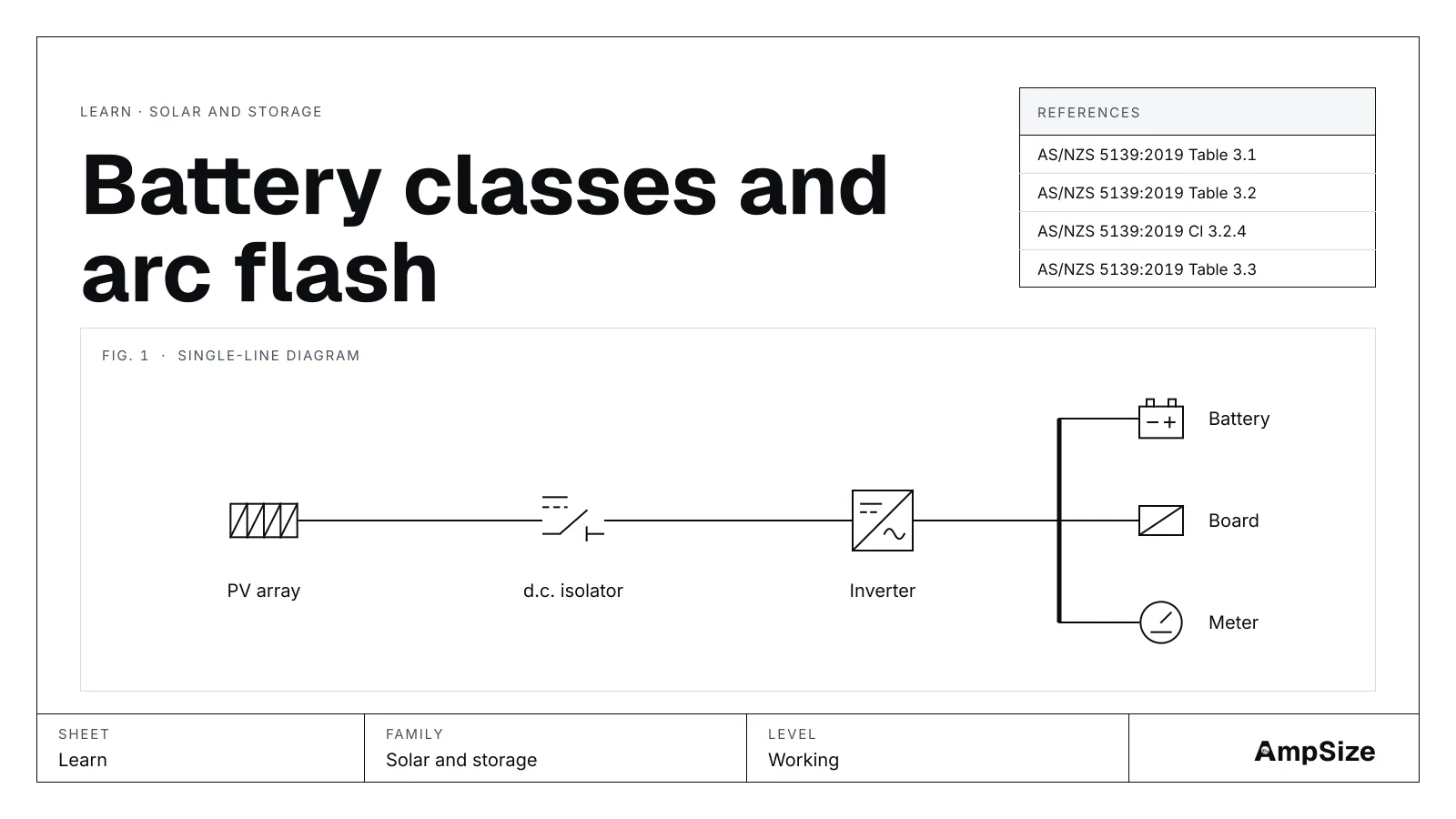
Before a battery system goes in, AS/NZS 5139 asks what it is. Section 3 classes it by its hazards, its voltage and the energy an arc at its terminals would release. Section 6 then uses that energy for the risk assessment and for where the system may go. This page walks through each step.
The hazards and the fire hazard level
Table 3.1 lists, for each chemistry, which hazards it carries: electrical, energy, mechanical, fire, explosive gas, chemical and toxic fume. The fire column is given as a level.
| Chemistry | Fire hazard level |
|---|---|
| Lead acid | 2 |
| Nickel alkaline | 2 |
| Lithium ion | 1 |
| Flow | Not applicable |
| Hybrid ion | Not applicable |
Two notes to the table lift the level. Note 1 covers pre-assembled lithium ion equipment that meets the industry Best Practice Guide. Note 2 covers lead acid and nickel alkaline batteries in cases rated V0. Either then takes no fire hazard level. A note also says that not applicable is a classification only. It does not mean the hazard is absent.
The decisive voltage class
Table 3.2 sorts the system by its highest voltage into a decisive voltage class (DVC). For a battery, the d.c. limit is the one that counts.
| Class | D.c. voltage |
|---|---|
| DVC-A | 60 V or less |
| DVC-B | Above 60 V, up to 120 V |
| DVC-C | Above 120 V |
A 48 V battery is DVC-A. A stacked home battery at a few hundred volts is DVC-C. Note 2 to the table makes a DVC-B or DVC-C battery system a low voltage installation under AS/NZS 3000.
The arc flash energy
Cl 3.2.4 gives one equation for the incident energy, Equation 3.2.4(1). It multiplies:
- 0.01, the coefficient;
- the battery voltage, V;
- the arcing current, which Equation 3.2.4(2) takes as half the bolted fault current;
- the arcing time divided by the square of the working distance;
- a multiplying factor for where the arc is.
The result is in cal/cm². The inputs have rules of their own:
| Input | Rule | Clause |
|---|---|---|
| Working distance | 45 cm at most | Cl 3.2.4.2.2 |
| Arcing time | 2 s where the device time is not known, or the work is on its battery side | Cl 3.2.4.2.3 |
| Multiplying factor, enclosure or cabinet | 3 at least | Cl 3.2.4.3 |
| Multiplying factor, battery room | 1.5 at least | Cl 3.2.4.3 |
A 48 V lithium battery with 6 kA at its terminals, at 2 s, gives 4.27 cal/cm². Open the 48 V battery.
The energy is in proportion to the time. Inter-string fuses that clear the arc in 0.1 s bring the same battery to 0.21 cal/cm². Open the 48 V battery at 0.1 s.
Appendix F prints tables of this equation at 45 cm and a factor of 3, at 2 s without inter-string protection and 0.1 s with it. The tool reproduces every printed row.
The arc flash boundary
The boundary is the distance at which the energy falls to 1.2 cal/cm² (Equation F.4). It does not depend on the working distance. For the 48 V battery at 2 s it is 849 mm.
The PPE level
Table 3.3 turns the energy into a PPE level, from 0 to 4. Each level names a set of arc-rated clothing and protection; read the table for what each one includes.
| Energy, cal/cm² | PPE level |
|---|---|
| 0 | 0 |
| Above 0, up to 4 | 1 |
| Above 4, up to 8 | 2 |
| Above 8, up to 25 | 3 |
| Above 25, up to 40 | 4 |
| Above 40 | None |
Above 40 cal/cm² no level applies. The system has to be arranged, with inter-string protection or smaller blocks, so that no one works at that energy. A 350 V system with 15 kA gives 77.78 cal/cm², and the tool fails it. Open the 350 V system.
The consequence level
The risk assessment of Section 6 grades the consequence of an arc by its energy, in Table 6.1. The likelihood comes from your own assessment of the work.
| Energy, cal/cm² | Consequence |
|---|---|
| Below 1.2 | Insignificant |
| 1.2 to below 4 | Minor |
| 4 to below 8 | Moderate |
| 8 to below 40 | Major |
| 40 or more | Catastrophic |
The limits in and outside a home
Cl 6.3.2.3 limits the energy by where the system goes.
| Where | Energy | What the tool flags |
|---|---|---|
| In or at a home | Above 4 cal/cm² | A dedicated room or enclosure, or fire hazard level 1; not inside or against a building with habitable rooms |
| In or at a home | 40 cal/cm² or more | A fail: it must be below 40 cal/cm² |
| Outside, not connected to a building with habitable rooms | 8 cal/cm² or more | It should be below; otherwise isolate into blocks of 4 cal/cm² at most |
A 24 V lead acid bank in a battery room away from the house takes the room factor of 1.5. With 12 kA at 2 s it gives 2.13 cal/cm², PPE Level 1, inside every limit. Open the lead acid bank.
A 48 V lithium cabinet with 12 kA outside the house gives 8.53 cal/cm², and the tool warns. Open the outdoor cabinet.
The edition
This page and the tool read AS/NZS 5139:2019 as published. Amendment 1 (2025) is not checked here, so confirm any change it makes before you rely on a figure.
Class a battery with the battery arc flash and class tool. A worked job is in Arc flash at a 48 V home battery. To size the battery, use the home battery tool. Arc flash on an a.c. switchboard uses the IEEE 1584 model instead: see Arc flash basics.