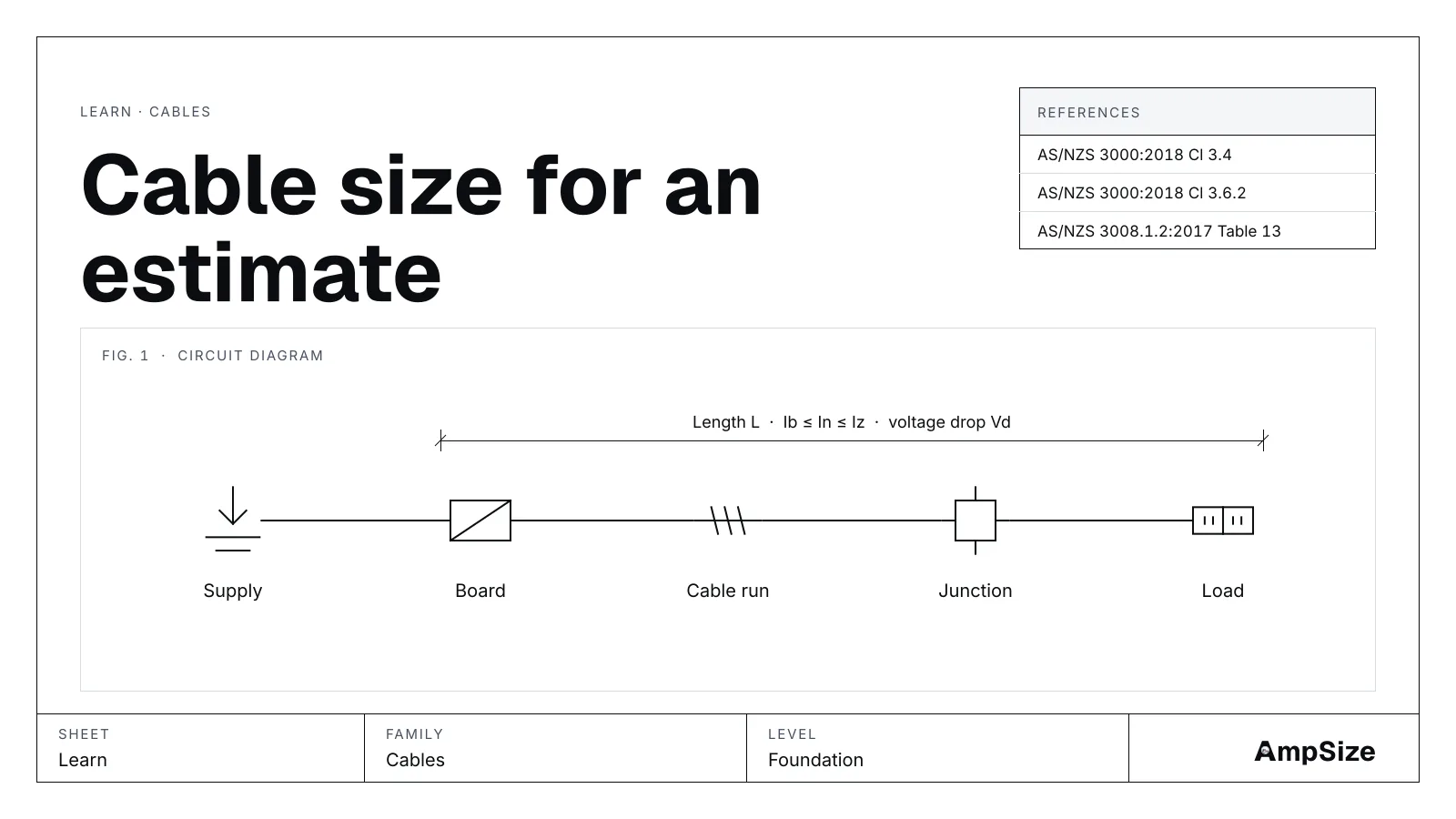
An estimator prices cable by size and by metre. The size depends on the length. A longer run can need a larger conductor, even at the same current. This page shows where the steps fall.
Two checks set the size
The tool tests every standard size in turn. It reports the smallest size that passes each check.
Current capacity. The derated rating of the cable must carry the design current. This check does not depend on length.
Voltage drop. The drop over the run must stay within the limit. The tool defaults to 5 %. This check grows with length.
Short runs are decided by capacity. Long runs are decided by drop. Somewhere between the two the size steps up.
One load, four lengths
Take a three‑phase supply at 400 V. The design current is 50 A. The power factor is 0.9. The cable is multicore copper with PVC insulation in enclosed air. The ambient temperature is 30 °C. One circuit, no grouping.
| Run length | Size | Voltage drop | Earth conductor |
|---|---|---|---|
| 30 m | 10 mm² | 1.33 % | 4 mm² |
| 60 m | 10 mm² | 2.66 % | 4 mm² |
| 120 m | 16 mm² | 3.37 % | 6 mm² |
| 200 m | 25 mm² | 3.61 % | 6 mm² |
The 10 mm² cable carries 50 A with no margin to spare. Capacity decides the size at 30 m and 60 m. The drop is well inside the limit.
At 110 m the same 10 mm² cable still passes, with a drop of 4.87 %. At 120 m the same cable would exceed the 5 % limit. The tool moves to 16 mm². That cable has a derated capacity of 66 A.
At 200 m the size steps again, to 25 mm². The derated capacity is 87 A.
Open the cable size tool at 60 m.
Open the cable size tool at 120 m.
Why the price steps
Cost follows size, and size follows the governing check. A job priced at 10 mm² for 60 m can need 16 mm². That happens when the site plan gives 120 m. The cable price per metre rises. The total rises faster, because the length also grew.
A line in an estimate should record the length it assumes. When the length changes, re-run the size.
What to record
Write down the inputs next to the size.
- The design current and how it was found
- The route length, not the straight-line distance
- The installation method
- The ambient temperature and any grouping
- The voltage drop limit used
An estimate with these notes can be re-checked in a minute. An estimate without them cannot.
Other checks that can raise the size
This page covers capacity and drop. Other checks can raise the size further.
- A protective device check
- An earth fault loop impedance check
- A fault withstand check
The tool runs them when you turn them on. A high fault current can control the size even on a short run. Ask the designer for the fault level before you finalise a price.
Where it goes wrong
The length is taken from a plan. A plan shows the straight line. The cable follows walls, risers and trays.
The design current is the breaker rating. Use the load. If the breaker is the basis, say so.
Ambient and grouping are left at 30 °C and one circuit. A hot roof space or a bunched tray lowers the capacity. A larger size can follow.
The drop limit is spent on one leg. A submain that uses the full 5 % leaves nothing for the final circuits.
Prices are applied to the wrong size. Re-read the size after every change of length or current.
This page is a design aid. Verify every value against the current edition of the standard.
See also: Submain voltage drop estimate for a tender, 160 A, Voltage drop basics and Current-carrying capacity and derating.