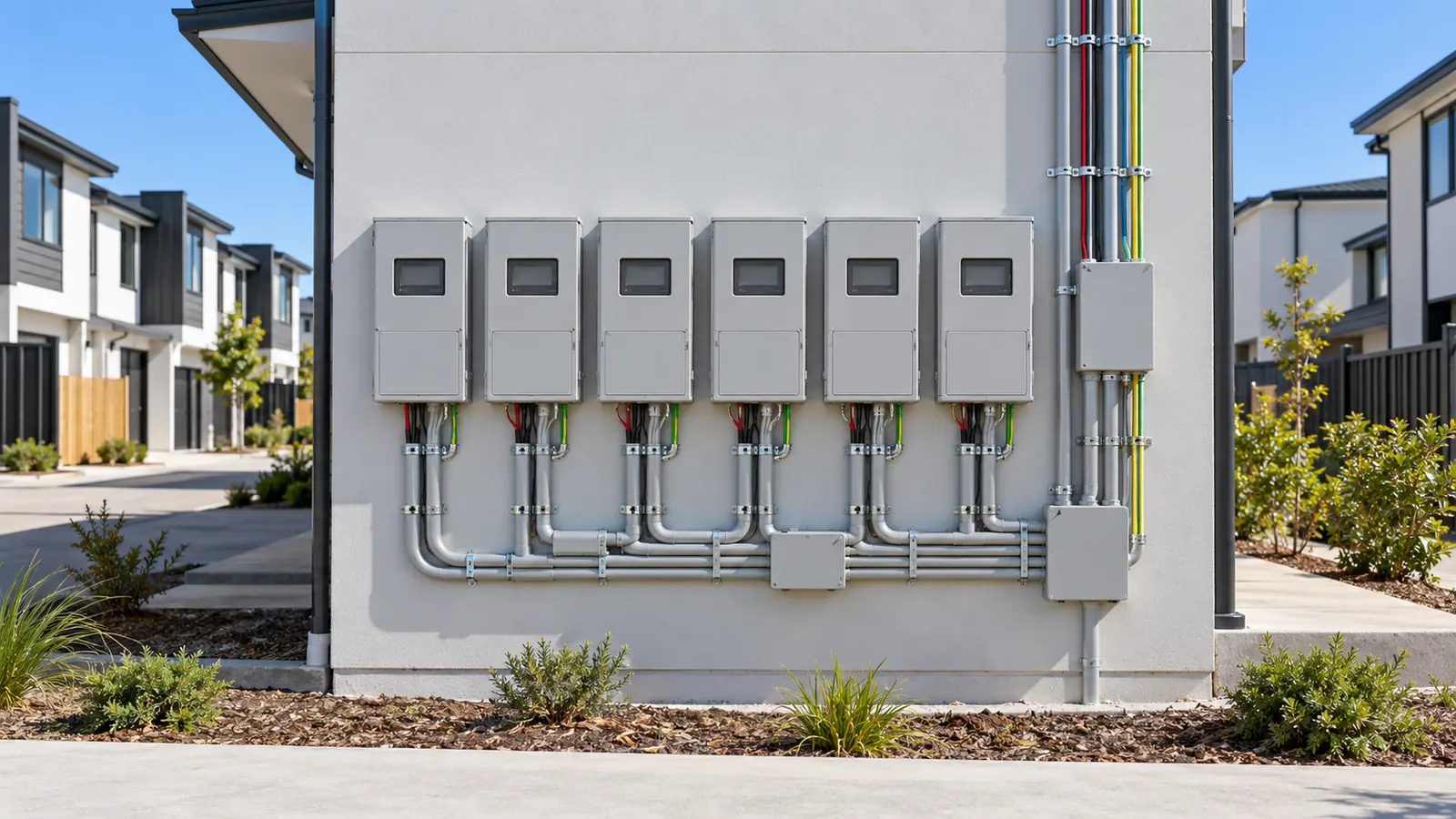
A townhouse block of eighteen units goes to tender. The network application needs a demand figure per phase. Table C1 has a separate rule for blocks of living units. It is not the single dwelling rule repeated eighteen times.
The inputs
- Table: C1
- Mode: blocks of living units
- Living units, all phases: 18
- Phases: 3
- Phase voltage: 230 V, line to neutral, not the 400 V between lines
The load rows name which groups are present. In the living units mode the unit count drives the demand for a unit group. The quantity on those rows does not change the result.
- A(i) lighting
- B(i) socket‑outlets and equipment up to 10 A
- C ranges, cooking and laundry
- F storage water heaters
- H communal lighting: 2 kW
Group H is a communal load in kilowatts, so it does take a quantity.
The clause and the table
AS/NZS 3000:2018 Cl 2.2.2 requires a maximum demand assessment for the consumer mains. Table C1 gives the rules for a single domestic installation and for a block of living units.
The living units columns already give a demand per phase. The unit count divides across the three phases first. Table C1 carries that instruction in its notes.
The steps
The tool divides 18 units by 3 phases and works from 6 living units per phase. It then applies the Table C1 column for each group at that unit count.
- A(i) lighting: 6.5 A
- B(i) socket‑outlets and permanently connected equipment up to 10 A: 37.5 A
- C ranges, cooking appliances and laundry equipment: 16.8 A
- F storage water heaters: 36 A
- H communal lighting: 8.7 A
Each line is a demand, not a connected load. The socket‑outlet figure of 37.5 A covers every socket in six units. The tool shows the table and the column that produced each line.
The result
- Maximum demand per phase: 105.5 A
- Maximum demand, all phases: 316.5 A
The tender prices consumer mains for 105.5 A per phase. The mains cable, the main switch and the metering all follow that figure, not the 316.5 A total.
The tool adds a note against the Electricity (Safety) Regulations 2010 reg 59. The demand is above the reg 59(1) threshold of 50 A per phase. Reg 59(2) then allows either a Part 2 installation or a certified Part 1 design. State which route the tender assumes.
Storage water heating at 36 A per phase is the largest single line. Swapping cylinders for instantaneous units changes the group F rule. So does moving them to a controlled supply. Both move the result. Run the change through the tool before you price it.
The consumer mains still need the current rating, voltage drop and loop impedance checks at 105.5 A. A long driveway run to a rear block usually fails on voltage drop before it fails on current rating.
Group H is the communal load. Stair lighting, a lift lobby and a carpark feed sit outside the unit count. Enter the communal load in kilowatts, and the tool converts it at the 230 V phase voltage.
The result follows the unit count per phase, not the total. Nineteen units still give six per phase on two phases and seven on the third. A network application takes the highest phase. Check the split before you submit it.
This page is a design aid. Verify every value against the current edition of the standard.
See also: Domestic maximum demand with Table C1, AS/NZS 3000 Tables C1 and C2: demand groups and Maximum demand and diversity.