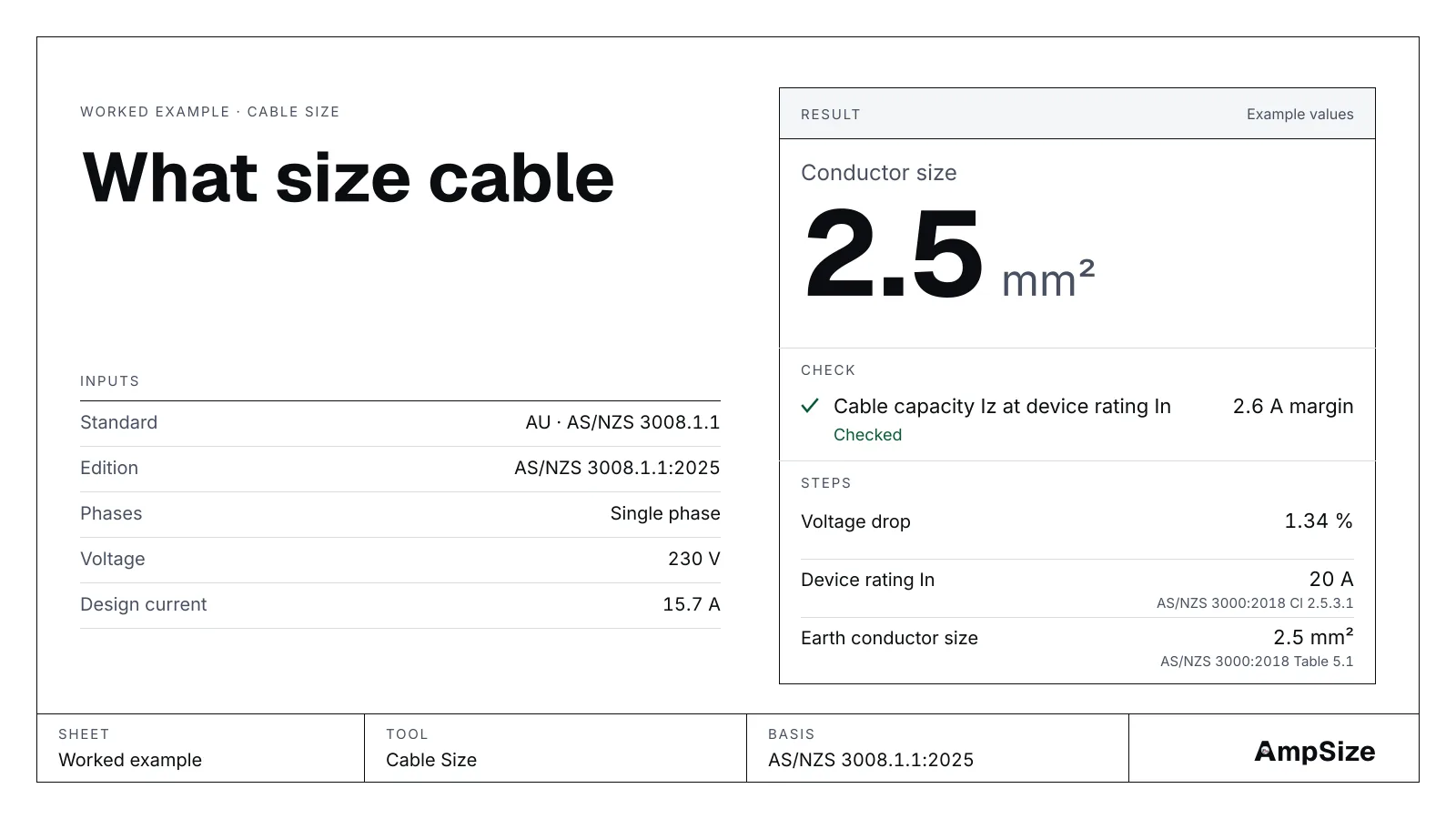
A 3.6 kW wall oven on 230 V takes 2.5 mm² cable on a 20 A breaker, over a 12 m run in Australia. The size comes from the 2025 edition of AS/NZS 3008.1.1, which the cable size tool reads when you set the Standard to Australia. This guide runs the case, then changes the route.
How many amps does a 3.6 kW oven draw?
3.6 kW divided by 230 V is 15.7 A. That is the design current, Ib. A double oven or an oven with a hob on the same circuit is a bigger load, and the last case below covers it.
What size cable for a 15.7 A oven on a 20 A breaker?
Run the oven. The cable is multicore copper in an enclosed route at 30 °C, one circuit. The tool reads Table 3.18 of the 2025 edition and applies an ambient factor of 1.13 at 30 °C (Tables 3.44 and 3.45).
Check the current first. Without the breaker, 1.5 mm² passes with 15.82 A of derated capacity. It clears 15.7 A by 0.12 A. Add the 20 A breaker and 1.5 mm² fails, because the breaker rating may not exceed the cable's capacity (Cl 2.5.3.1). The next size, 2.5 mm², gives 22.6 A and passes.
| Check | 2.5 mm² result | Limit |
|---|---|---|
| Derated capacity | 22.6 A | 15.7 A load, 20 A breaker |
| Voltage drop | 1.34 % | 5 % |
| Loop impedance | 0.57 Ω | 1.53 Ω |
The 1.53 Ω limit is the Table 8.1 figure for a 20 A C curve breaker. The tool sizes the earth conductor at 2.5 mm².
What if the oven is in a hot roof space?
Set a 45 °C ambient and group one other circuit with it. Run that route. The total derating factor is 0.74. The cable must now carry 21.1 A of tabulated current, and 4 mm² is the smallest size that does it, with 18.6 A derated. 2.5 mm² gives 14.88 A and fails. Most oven circuits run in a wall. If yours crosses a roof space, run the real route.
What if the oven is 40 m from the board?
Run 40 m on a 20 A breaker. 2.5 mm² still passes. The drop is 4.45 %, close to the 5 % limit, and the loop impedance is 1.07 Ω against 1.53 Ω. 1.5 mm² fails the breaker check, the drop at 8.14 % and the loop impedance at 1.67 Ω. The tool assumes an Ze of 0.35 Ω, so measure the real one before you rely on the margin.
What if the oven shares a circuit with a hob?
A 7.2 kW hob and the oven on one 32 A circuit is a bigger load. Take 31.3 A. Run it at 12 m. The tool returns 6 mm², with 37.29 A and a 1.12 % drop. 4 mm² gives 28.25 A and fails. The Table 8.1 loop impedance limit for a 32 A C curve breaker is 0.96 Ω, and 6 mm² reads 0.5 Ω.
The result
| Route | Size that passes |
|---|---|
| 3.6 kW, 12 m, 20 A breaker, 30 °C | 2.5 mm² |
| Same, current check only | 1.5 mm² |
| Hot roof space at 45 °C, one other circuit | 4 mm² |
| 40 m run | 2.5 mm² |
| Oven and hob, 31.3 A, 32 A breaker | 6 mm² |
What this guide does not cover
The tool checks the breaker you enter. It does not choose the breaker, and it does not read the oven maker's instructions. Check the nameplate for the supply the oven needs. It does not test the finished circuit, and Cl 3.6.2 voltage drop is a design check, not a measurement.
New Zealand readers use the 2017 tables. The induction hob guide runs a 7.2 kW case on them.
See also: AS/NZS 3008.1.1:2025 tables against 2017, What size breaker for 4 mm² cable and Correction factors in 2017 and 2025.