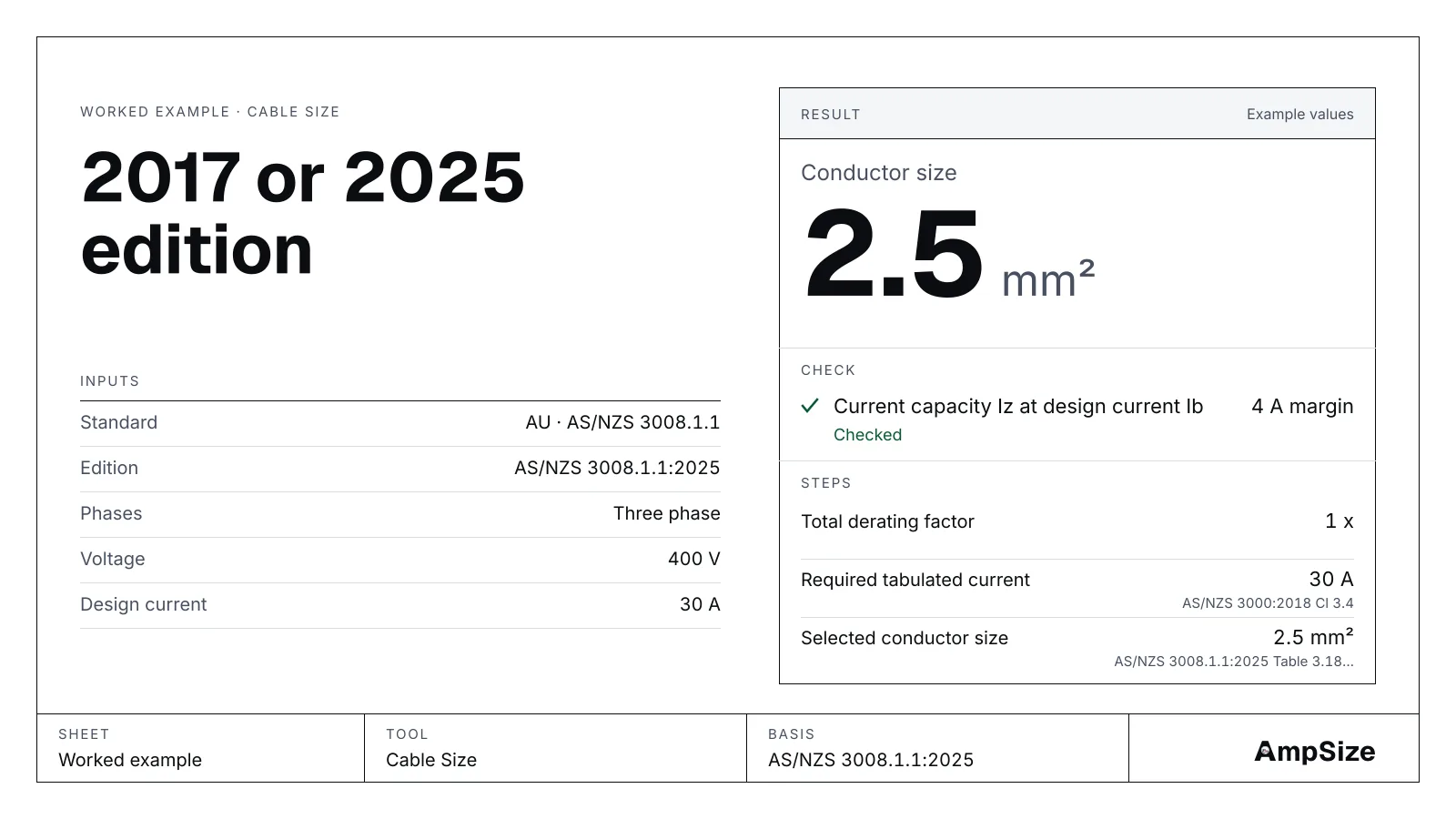
A job was calculated last year. The cable schedule says 4 mm² for a buried 30 A circuit. A new calculation on the 2025 edition says otherwise. This guide reads the two editions side by side. It also shows what the tool does when a link names no edition.
The inputs
- Australia, three phase, 400 V, power factor 0.9.
- Design current 30 A, run length 30 m.
- Copper, PVC insulated, multicore, buried direct.
- Ground at 25 °C, one circuit.
The 2025 result
Open the 2025 run. The tool picks 2.5 mm² from Table 3.18. The derated capacity is 34 A, a margin of 4 A. The voltage drop is 3.18 %.
The tool adds a note. The 2025 edition calculates buried-direct ratings up to 10 mm². Check that the protective device lets the cable reach the rating.
The 2017 result
Open the 2017 run. The tool reads Table 13 and Tables 27(1) and 27(2). It picks 4 mm². The derated capacity is 33 A, a margin of 3 A. The voltage drop is 1.98 %.
The old schedule is right for its edition. The two editions disagree about small buried cables. The 2025 rating for 2.5 mm² buried direct is higher than the 2017 rating.
The legacy rule
A link with no edition reads 2017. This is the legacy rule. It keeps every old link and every saved result on the numbers it first showed. An old link, which reads the 2017 edition shows 4 mm², the 2017 answer, with a derated capacity of 33 A.
A new calculation starts on 2025. A link written by hand does not. When you build a link, add the edition to it. A link that reads 2017 is not wrong. It is old.
When the edition makes no difference
Many circuits give the same size on both. A 32 A single‑phase run at 40 °C picks 6 mm² on 2025. The 2017 edition gives the same size. The edition matters most for buried cables, for hot air and for large conductors in enclosed methods.
A working rule for the job
- Keep a finished design on its edition. Open its saved link and the result does not move.
- Run a new design on 2025.
- On a design near its limit, run both editions and record the difference.
- Write the edition beside the size in the cable schedule.
Which edition a job must follow is a question for the designer, the client and the regulator. The tool does not decide it. It shows both.
What to tell the client
Two numbers for one circuit can confuse a client. Say which edition each number uses. Say that the 2017 figure belongs to the finished design, and the 2025 figure belongs to a new calculation.
If a design is near its limit on one edition, ask which one the job follows. Do not pick the edition that gives the smaller cable and leave it there. Record the choice, the date and who made it.
Saved results and old links
Old links appear in emails, in cable schedules and in saved projects. They all read 2017 unless the link names an edition. That is deliberate. The result a client saw last year does not change when the tool is updated.
To move a job to 2025, open the saved link, set the edition to 2025, and compare. Save the new link as a new revision. Keep the old link beside it.
The result
| Edition | Size | Derated capacity | Voltage drop |
|---|---|---|---|
| 2025 | 2.5 mm² | 34 A | 3.18 % |
| 2017 | 4 mm² | 33 A | 1.98 % |
| No edition in the link | 4 mm² | 33 A | 1.98 % |
The buried 30 A circuit sizes at 2.5 mm² on 2025 and 4 mm² on 2017. Record the edition with the size. Try it with these inputs.
This page is a design aid. Verify every value against the current edition of the standard.
See also: AS/NZS 3008.1.1:2025: what changed from 2017, AS/NZS 3008.1.1 table numbers: 2017 to 2025 and Correction factors in the 2017 and 2025 editions.