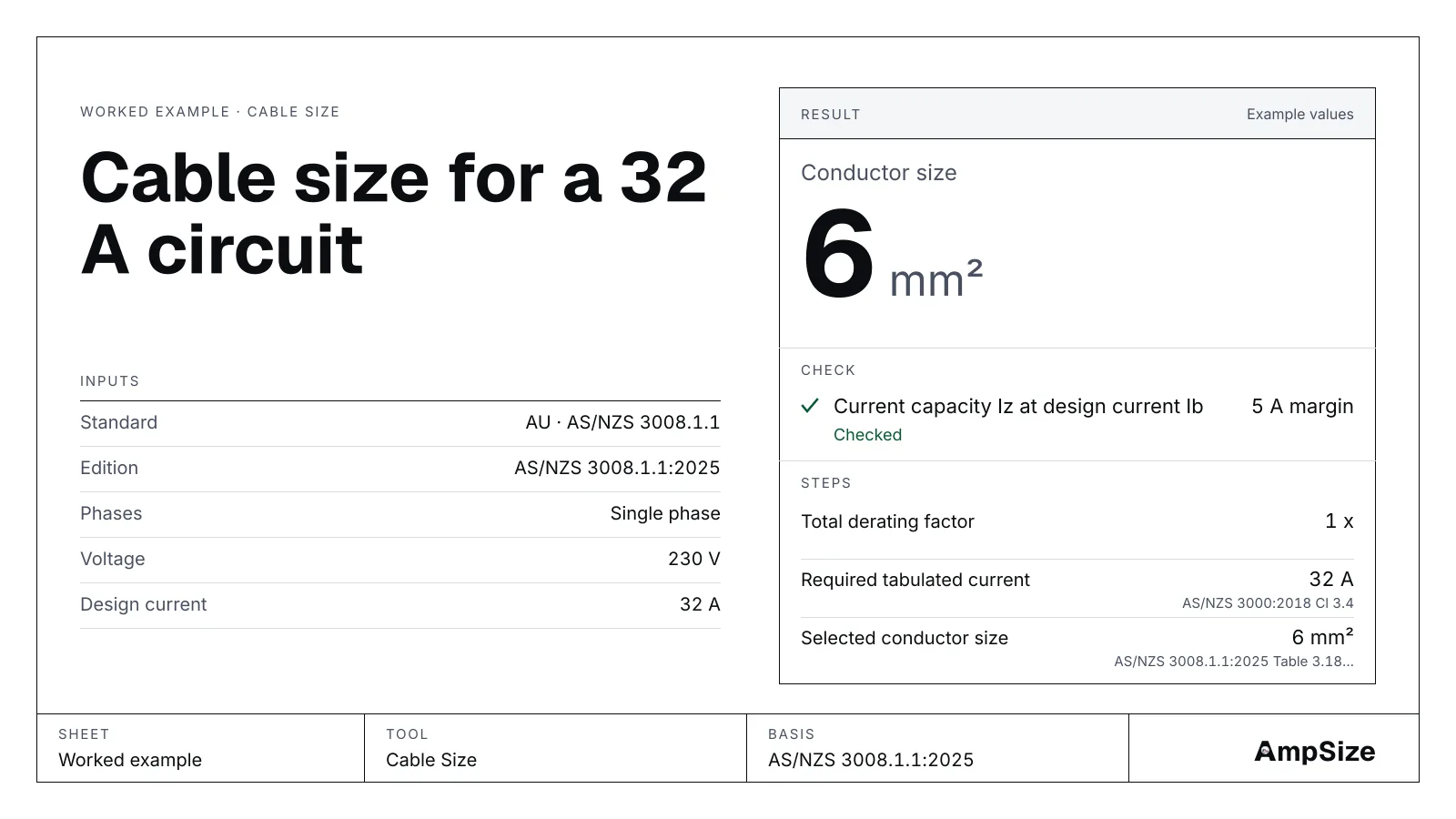
A 32 A circuit is a common size for a range, a workshop supply or an EV charger. This guide sizes one in Australia on AS/NZS 3008.1.1:2025. It then runs the same inputs on the 2017 edition. The aim is to see whether the new edition changes the cable.
The inputs
- Jurisdiction: Australia. Edition: 2025.
- Single phase, 230 V, power factor 1.
- Design current 32 A, run length 25 m.
- Copper, PVC insulated, multicore, unenclosed and touching a surface.
- Air at 40 °C, one circuit.
- A 32 A protective device.
AS/NZS 3000:2018 Cl 3.4 sets the rule. The cable must carry the design current after correction. It must also carry the device rating.
The table and the factors
The 2025 edition rates cables for 40 °C air. At 40 °C the ambient factor from Tables 3.44 and 3.45 is 1. One circuit gives a grouping factor of 1. The total derating factor is 1, so the cable needs a tabulated 32 A.
Table 3.18 against Table 13
Open the 2025 run. The tool reads Table 3.18 and picks 6 mm². The tabulated rating is 37 A. That is 5 A above the design current.
4 mm² rates 29 A and fails. 10 mm² rates 51 A and passes.
The same inputs on 2017 read Table 13 and Tables 27(1) and 27(2). The answer is the same: 6 mm² and 37 A. For this method, the renumbering did not move the value.
Voltage drop
AS/NZS 3000:2018 Cl 3.6.2 gives the 5 % limit. The tool gives 2.61 % for 6 mm² over 25 m. The margin is 2.39 %.
Run length changes that. At 45 m, the drop on 6 mm² is 4.7 %. The tool warns that the run is close to the limit. At 45 m the next size is the safer choice.
When the editions do differ
Heat is where they part. At 50 °C in 2025, the ambient factor is 0.85. The tool needs 37.65 A tabulated and picks 10 mm², which carries 43.35 A.
At 50 °C in 2017, the factor is 0.82. The tool needs 39.02 A tabulated, and 10 mm² carries 41.82 A. Both editions pick 10 mm².
The other checks
The cable passes on current and drop. The tool also reads the protective device and the earth fault loop. The 6 mm² cable carries 37 A against the 32 A device. The margin is 5 A. The earth conductor comes from AS/NZS 3000:2018 Table 5.1 and is 2.5 mm². With the form's default Ze of 0.35 Ω, the loop impedance is 0.67 Ω. The tool checks it against Table 8.1.
Each check can govern. The smallest size that passes all of them is the answer. Here current and drop both pass at 6 mm², and the next size down fails on current.
Write the edition and the size in the cable schedule together. A size without an edition does not show which table it came from.
Choosing the next size up
The tool lists every size with its rating and drop. The next size above 6 mm² is 10 mm². It carries 51 A with a drop of 1.55 % at 25 m. A larger cable costs more. It also leaves room for a future load, a longer run or a hotter day. Decide on the job, not on the table.
The result
| Case | Size | Derated capacity | Voltage drop |
|---|---|---|---|
| 2025, 40 °C, 25 m | 6 mm² | 37 A | 2.61 % |
| 2017, 40 °C, 25 m | 6 mm² | 37 A | 2.61 % |
| 2025, 40 °C, 45 m | 6 mm² | 37 A | 4.7 % |
| 2025, 50 °C, 25 m | 10 mm² | 43.35 A | 1.55 % |
| 2017, 50 °C, 25 m | 10 mm² | 41.82 A | 1.55 % |
A 32 A circuit at 40 °C needs 6 mm² on both editions. Heat or length moves the size, not the edition label. Try it with these inputs.
This page is a design aid. Verify every value against the current edition of the standard.
See also: AS/NZS 3008.1.1:2025: what changed from 2017, AS/NZS 3008.1.1 table numbers: 2017 to 2025 and Voltage drop for AS3000 on a 2025-edition run.