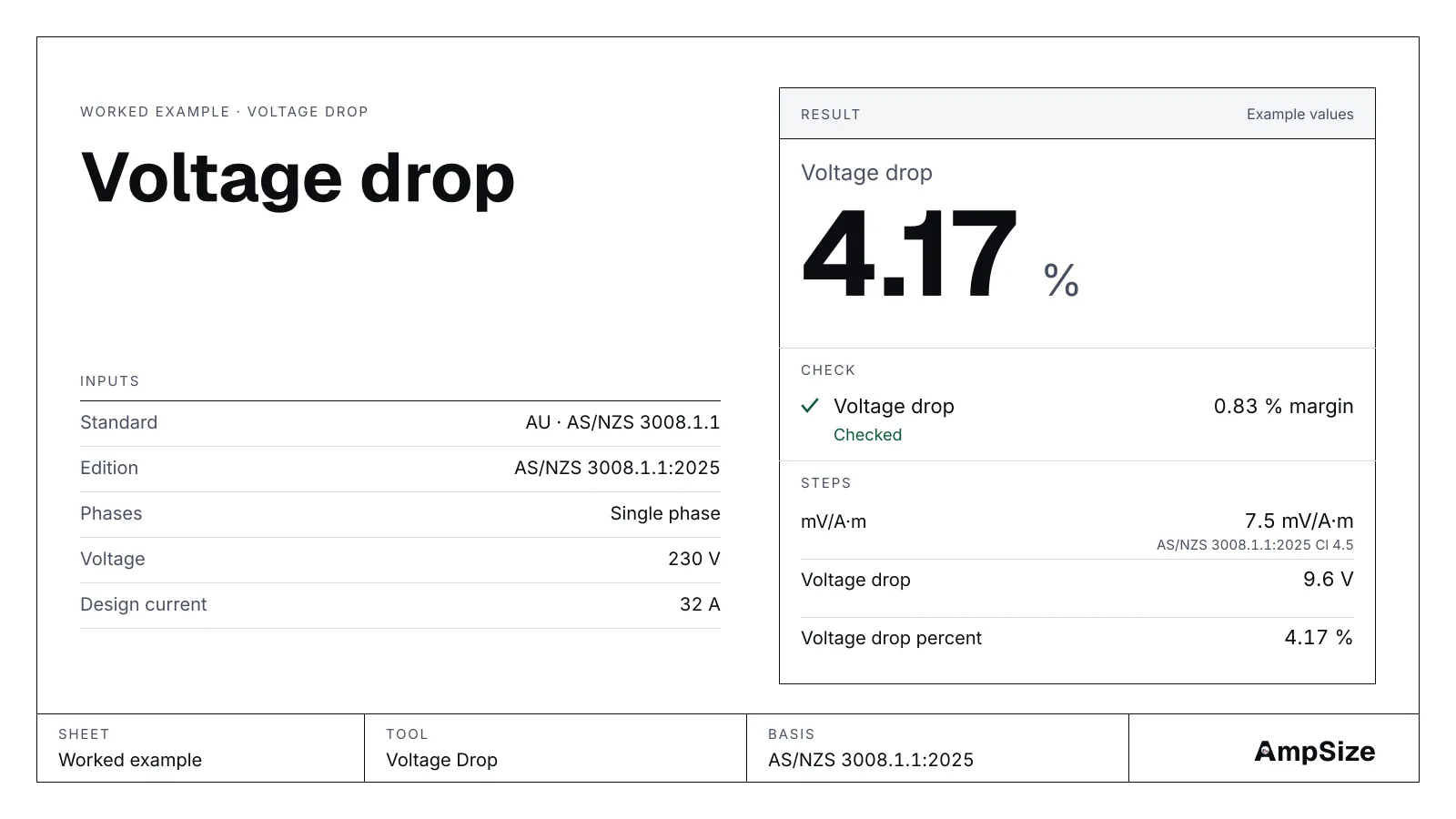
A 32 A circuit runs 40 m to a detached garage. The cable carries the current, but the voltage at the far end may sag too far. This guide checks the drop with the mV/A·m method on the 2025 edition of AS/NZS 3008.1.1.
The inputs
- Australia, edition 2025. Single phase, 230 V, power factor 1.
- Current 32 A, run length 40 m.
- 6 mm² copper, PVC insulated, multicore.
- Drop limit 5 %.
AS/NZS 3000:2018 Cl 3.6.2 sets the 5 % limit from the point of supply to the load. This guide checks the one circuit against that limit.
The method
The tool takes the resistance and reactance of the cable from the 2025 tables. Tables 4.1(A) and 4.1(B) give the reactance. Tables 4.5(A) and 4.5(B) give the resistance. It combines them into one value in mV/A·m. Cl 4.5 then gives the drop. The drop is the mV/A·m value times the current times the length.
Open the run. The 6 mm² cable has a resistance of 3.75 Ω/km and a reactance of 0.097 Ω/km. That gives 7.5 mV/A·m. The drop is 9.6 V, which is 4.17 %. The check passes with a 0.83 % margin, and the tool warns that the drop is close to the limit.
The maximum length at the limit is 47.92 m. A 45 m run would still pass. A 50 m run would not.
The same run on 2017
On the 2017 edition the tables carry other numbers. Table 30 gives the reactance. Tables 34 and 35 give the resistance. The values are the same. The drop is 4.17 % again. A design that quotes a table number should name the edition with it.
Other sizes
10 mm² gives 4.46 mV/A·m and a drop of 5.71 V, or 2.48 %. The maximum length is 80.58 m. 4 mm² gives 11.22 mV/A·m and a drop of 6.24 %. It fails, and its maximum length is only 32.03 m.
Aluminium on a three‑phase run
Now take a three‑phase feeder: 50 A at 400 V, 80 m, power factor 0.9. 16 mm² copper drops 2.25 %. 25 mm² aluminium has a resistance of 1.47 Ω/km and a reactance of 0.085 Ω/km. It gives 2.356 mV/A·m and a drop of 2.36 %.
So 25 mm² aluminium matches 16 mm² copper on drop. Check the current rating separately. The voltage drop tool does not do that.
Using the margin
The 5 % limit covers the whole run from supply to load. The 6 mm² cable uses 4.17 % of it. That leaves 0.83 % for the consumer mains or submain upstream. Check the upstream drop before you accept this cable.
A drop above the limit is not always a reason to change the cable. Shorten the run, raise the voltage or move the load. A larger conductor lowers the mV/A·m value. The size table above shows how fast the drop falls.
Reading the chart
The tool draws the drop against length for the chosen cable. The line is straight, because the drop rises in step with the length. Read across from the limit to find the longest run. That is the maximum length the tool prints.
The result
| Case | mV/A·m | Voltage drop | Result |
|---|---|---|---|
| 6 mm² Cu, 40 m, 32 A | 7.5 | 4.17 % | Passes |
| 10 mm² Cu, 40 m, 32 A | 4.46 | 2.48 % | Passes |
| 4 mm² Cu, 40 m, 32 A | 11.22 | 6.24 % | Fails |
| 16 mm² Cu, 80 m, 50 A, three phase | 2.25 | 2.25 % | Passes |
| 25 mm² Al, 80 m, 50 A, three phase | 2.356 | 2.36 % | Passes |
6 mm² copper passes at 40 m with 0.83 % to spare. Use the cable size calculator to check the current and the drop together. Try it with these inputs.
This page is a design aid. Verify every value against the current edition of the standard.
See also: Voltage drop with the mV/A·m method, AS/NZS 3000 Cl 3.6.2: the voltage drop limit and Cable size for a 32 A circuit, Australia 2025.