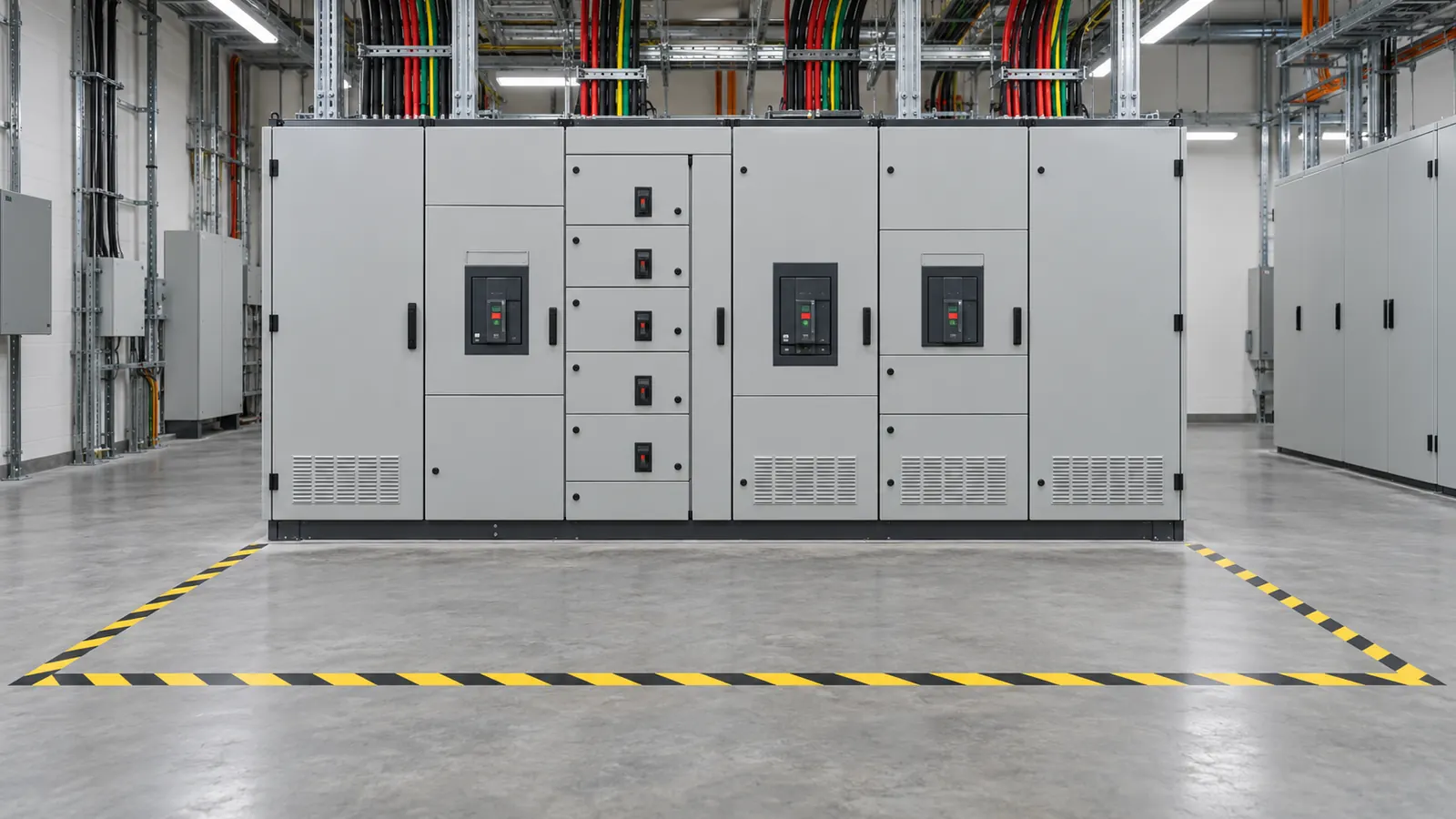
A bolted fault is a solid connection between conductors. An arc fault is not. The current crosses air, and the air becomes a plasma at several thousand degrees. The damage is thermal, and it reaches a person standing in front of the equipment.
Four quantities
Arcing current. The current that actually flows in the arc. It is lower than the bolted fault current, because the arc itself has impedance. IEEE 1584-2002 Cl 5.2 gives the model.
Incident energy. The heat that lands on one square centimetre at a stated distance. It covers the whole duration of the arc. The unit is cal/cm². Cl 5.3 gives the model.
Arc flash boundary. The distance at which the incident energy falls to the onset of a second degree burn. Cl 5.5 gives it.
Working distance. How far the face and chest of a worker sit from the arc. Energy falls steeply with distance, so this input carries real weight. The tool uses 455 mm by default, which suits low voltage switchgear work.
AS/NZS 3000:2018 Cl 2.5.5 covers the arcing fault requirement for an installation. The energy numbers themselves come from IEEE 1584-2002.
A worked switchboard
Take a 400 V switchboard. The bolted fault current is 20 kA. The upstream device clears in 0.2 s. The equipment is enclosed switchgear, earthed, at a working distance of 455 mm.
The tool takes an electrode gap of 32 mm for this equipment type. It works the arcing current down to 9.64 kA, which is under half the bolted figure. It then applies a calculation factor of 1.5 and a distance exponent of 1.473.
The incident energy is 6.23 cal/cm². The arc flash boundary is 1,395.97 mm. At that energy the tool reports PPE category 2.
Note the boundary. It is nearly 1.4 m from the arc. A person standing clear of the open door is still inside it.
Open the arc flash calculator with these inputs.
Which input to attack
The energy depends on two things a designer can change: how much current flows, and for how long. Run the same board twice and the answer is plain.
Halve the fault current. Drop the bolted fault to 10 kA and keep 0.2 s. The incident energy falls to 3.45 cal/cm².
Halve the clearing time. Keep 20 kA and drop the clearing time to 0.1 s. The incident energy falls to 3.12 cal/cm², the boundary shrinks to 871.99 mm, and the tool reports PPE category 1.
Faster clearing wins. It wins twice over. Halving the fault current means weakening the supply, and that costs voltage regulation and starting performance across the site. Halving the clearing time costs a protection setting.
How to make the clearing faster
Grade the relays for speed, not only for selectivity. A long time multiplier on an incoming relay buys margin and pays for it in energy. The IDMT tool reports the trip time of each relay at a stated fault current, and the margin between them.
Use a maintenance setting. Switch in a lower instantaneous setting while someone works on the board. That cuts the clearing time for the task.
Know the real fault level. The transformer tool gives the fault current a transformer can deliver. The fault rating tool checks what the cable withstands. Both feed the arc flash study.
Stand further back. Remote racking and remote operation move the working distance out. The distance exponent of 1.473 means a modest increase in distance gives a large drop in energy.
What the tool does not do
The tool opens on the IEEE 1584-2018 model, with the 2002 model as a choice. The runs on this page use 2002, and their links keep it. The two models give different answers for the same board, and a formal study states which model it used. The 2018 model adds the electrode configuration, the enclosure size and a second run at a reduced arcing current.
The PPE category comes from the tool's own energy bands, not from a standard clause. Treat it as an indication of severity, not as a garment specification.
A single calculation is not an arc flash study. A study covers every point in the network and every protection setting. It covers every operating configuration, including the ones that raise the clearing time.
A habit worth keeping
Read the clearing time before you read the fault current. The fault current sets the equipment rating. The clearing time sets what happens to the person in front of it.
This page is a design aid. Verify every value against the current edition of the standard.