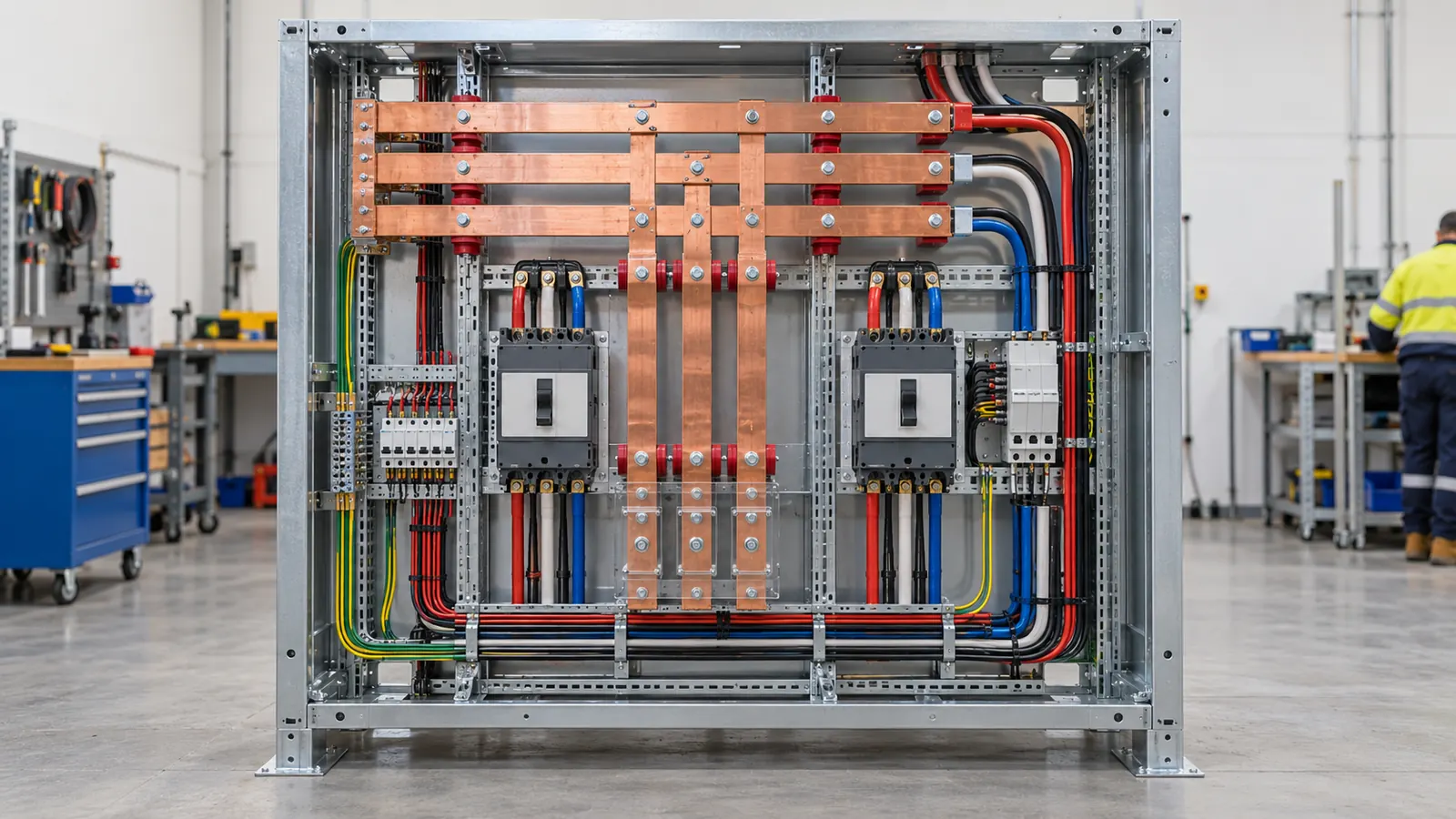
A switchboard build carries a fault rating on its label. That rating is a property of the assembly, and the conductors inside the assembly have to match it. The conductor side is an adiabatic check. A 1 s withstand is the hardest version of it.
The question
A board is specified for 25 kA. The incoming connection is 185 mm² copper with XLPE insulation. The upstream protection may take up to 1 s to clear a fault at the board. The check tests the conductor over that second.
The inputs
- Prospective fault current: 25 kA
- Clearing time: 1 s
- Conductor size: 185 mm²
- Material: copper
- Insulation: XLPE
One second is not an arbitrary figure. An assembly rating states a short time current and a duration. 1 s is the common duration on the label. Matching the conductor check to that duration keeps the two ratings on the same basis.
The clause and the table
Cl 5.3 of AS/NZS 3008.1.2:2017 gives the adiabatic equation I²t = k²S². Table 52 of the same standard gives the k factor by material and insulation. Cl 2.5.4.1 of AS/NZS 3000:2018 requires the short circuit check. App K of the same standard covers switchboard construction.
Assembly ratings themselves belong to the AS/NZS 61439 series, and AS/NZS 61439.2 covers power switchgear and controlgear assemblies. That standard is not held here, so no rating, table or figure from it appears on this page. Read the current edition for the assembly requirements.
The steps
The tool takes three steps.
First it reads the k factor for copper with XLPE insulation from Table 52. The value is 143. XLPE allows a higher final conductor temperature than PVC does. Its k factor is higher, so the same conductor holds more energy.
Second it rearranges the equation for the minimum size. 25 kA held for 1 s against a k of 143 gives a minimum conductor size of 174.83 mm².
Third it works the equation the other way for the installed size. 185 mm² of copper with a k of 143 withstands 26.46 kA for 1 s.
The result
The check passes. The minimum size is 174.83 mm² and the installed size is 185 mm².
The margin is thin. The withstand of 26.46 kA sits just above the 25 kA specification. Two ordinary changes remove it. A network upgrade to 27 kA raises the minimum size to 188.81 mm², so the check fails. A move from XLPE to PVC drops the k factor to 111. The minimum size rises to 225.23 mm² and the withstand falls to 20.54 kA.
185 mm² copper XLPE is the smallest conductor that passes at 25 kA for 1 s. The next size up restores the headroom.
Where the clearing time comes from
The 1 s figure is a design choice, and it is the conservative one. A faster upstream device makes the check far less demanding. The minimum size falls with the square root of the time. At 0.25 s the minimum size is 87.41 mm² and the withstand rises to 52.91 kA.
The risk runs the other way on a graded system. An incomer set with a long time delay for discrimination can hold a fault for longer than 1 s. Take the clearing time from the grading study. Use the device that clears the fault, not the nearest one.
What the check leaves out
The adiabatic method covers the thermal effect only. It assumes no heat leaves the conductor during the fault. It does not cover the electromagnetic forces on busbars and supports. It does not cover the enclosure arcing performance or the normal current rating. Those sit with the assembly standard and with the cable size tool.
This page is a design aid. Verify every value against the current edition of the standard.
See also: Consumer mains fault withstand for 16 mm² copper, AS/NZS 3008.1.2 Table 52: the k factor and Short-circuit withstand and the k factor.