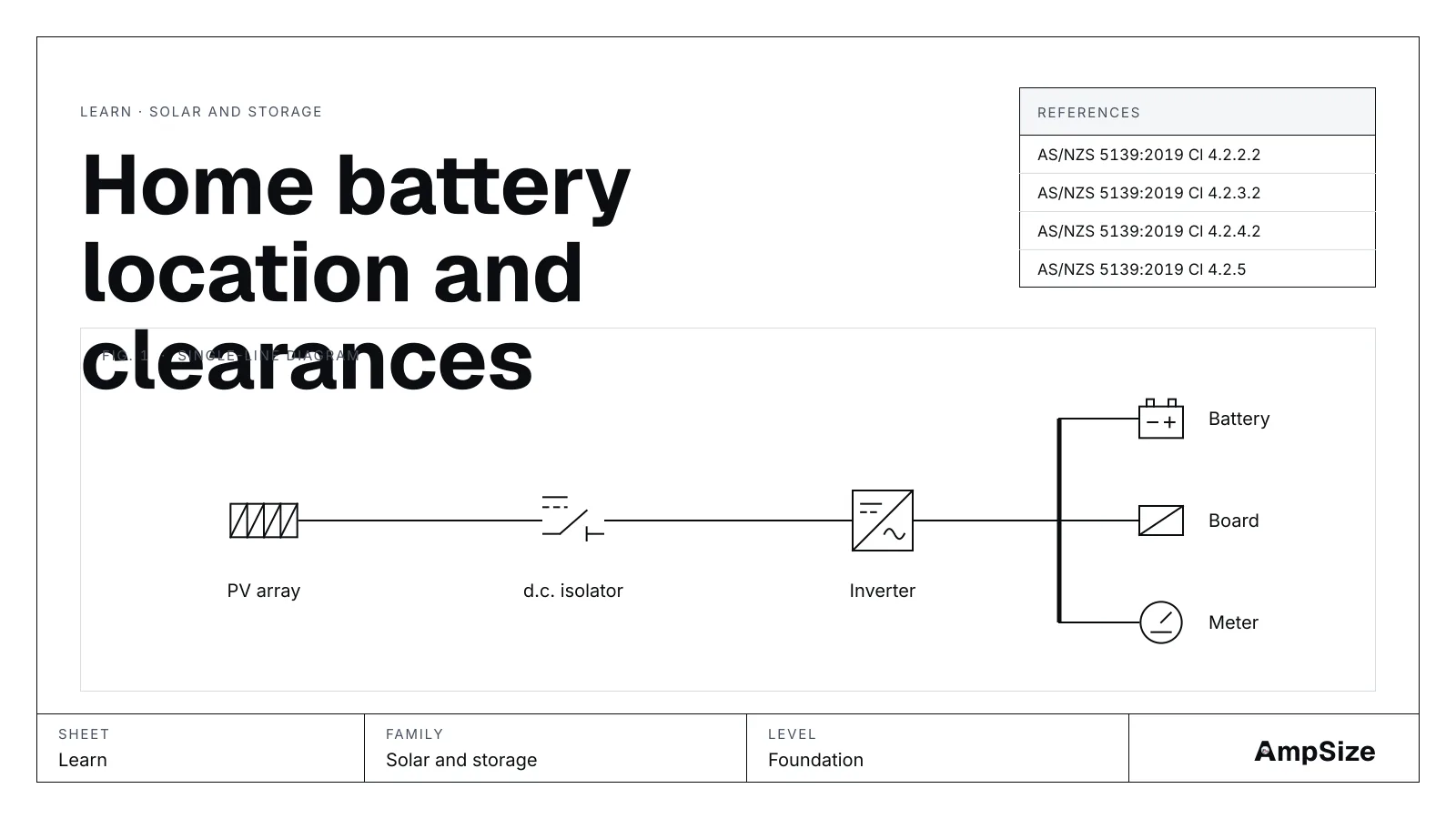
A home battery holds a lot of energy in a small box. A fault can start a fire. The battery is then both fuel and a source of ignition. The location rules in AS/NZS 5139:2019 Section 4 keep that fire away from people, exits and the rest of the building. They cover a pre-assembled integrated battery energy storage system, the all-in-one home battery. The battery location checker tests a site against them.
Restricted places
Cl 4.2.2.2 lists places where you must not put the battery. These are:
- places where a switchboard may not go;
- ceiling spaces and wall cavities;
- roofs, unless the roof is deemed suitable;
- under a stairway or an access walkway;
- an escape route;
- a habitable room of a home, such as a bedroom, lounge or kitchen;
- a hazardous area, such as near a gas cylinder or a relief vent.
In a corridor, keep 1 m clear for egress (Cl 4.2.2.1). Garages, storage rooms, verandas and outside walls are the usual places that pass.
Zones around exits, windows and appliances
Keep the battery 600 mm to the side of:
- an exit;
- a window or vent of a habitable room;
- another appliance, such as a hot water unit or an air conditioner.
Keep 900 mm below any of those items. If one is above the battery, the gap up to it must be at least 900 mm. The reason is simple. Smoke and flame must not cut off a way out, and must not reach an opening into the home.
The habitable room barrier
A battery can be on a wall with a habitable room on the other side. The rule also applies if it stands on the floor within 300 mm of that wall (Cl 4.2.4.2). The wall must then be non‑combustible, or it needs a barrier. The barrier reaches:
- 600 mm past each side of the battery;
- 900 mm above it;
- down to the bottom of the battery.
Brick, masonry, concrete, cement sheet and tiles count as non‑combustible. Timber framing and plasterboard on their own do not.
The ceiling
If the ceiling is within 900 mm of the top of the battery, make it non‑combustible. It must reach 600 mm past the battery on every side. A higher ceiling needs no treatment.
IP codes
The IP code says how well the case keeps out solids and water. The first digit is for solids. The second is for water.
- Indoors, the battery needs IP2X at least (Cl 4.2.3.2). X means no water rating is asked for.
- Outdoors, it needs IP23 at least. The 3 is for spray.
A battery with a higher code, such as IP55, passes both. Wet areas, a hose or a tap nearby can call for more than the least.
Working space
Someone must be able to work on the battery. Keep 600 mm clear on the working side (Cl 4.2.5). Where panels reach the 230 V a.c. connections, keep 900 mm. If the maker asks for more, use the maker's figure.
Smoke alarm and ventilation
Two notes are not hard rules. Fit a smoke alarm in the same room as the battery. If the building has a fire indication panel, fit a detector linked to it (Cl 4.3.4). Follow the maker's instructions on ventilation (Cl 4.3.5). Also keep the battery inside the maker's temperature range, out of direct sun and away from heat.
What the tool does not cover
The tool assesses an all-in-one battery under Section 4. Section 5 covers pre-assembled battery systems. Section 6 covers other battery systems. AmpSize holds neither, so the tool does not assess them. AmpSize also does not hold Amendment 1 (2025). Check the amendment for changes before you design.
A distance you leave blank is not assessed. The tool tests the numbers you give it. It does not see your site. Measure from the battery to the nearest item.
Next, see a worked case in Where can a home battery go? Garage wall clearances. To size the battery, use the home battery tool. For the basics, read Home batteries and AS/NZS 5139.