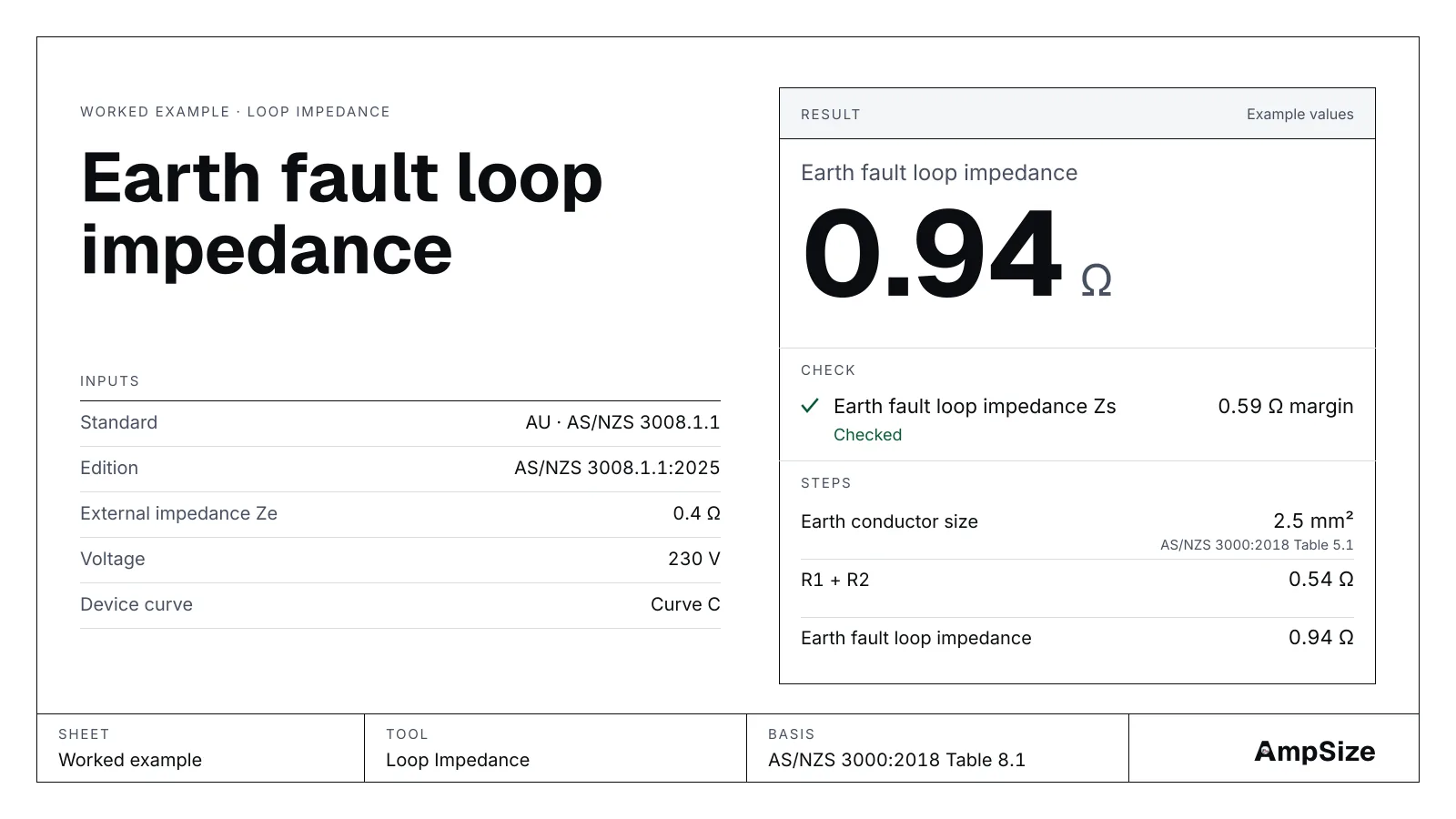
An earth fault must trip the breaker fast. That needs enough fault current. Enough fault current needs a loop of low enough impedance. This guide checks a 20 A C curve breaker on a 30 m circuit. It uses the 2025 impedance tables.
The inputs
- Australia, edition 2025. Phase voltage 230 V.
- External impedance Ze: 0.4 Ω. This is an assumed value. Use the measured Ze on the job.
- C curve breaker, 20 A.
- Active conductor 2.5 mm² copper, PVC insulated. Run length 30 m.
- Earth conductor chosen from Table 5.1.
The loop
The loop has two parts. Ze is the supply side, up to the origin. R1 + R2 is the circuit side: the active conductor out and the earth conductor back. The total is Zs.
AS/NZS 3000:2018 Table 5.1 sets the earth conductor. For a 2.5 mm² active, it gives a 2.5 mm² earth. The tool takes the resistance of both from the 2025 tables: Tables 4.1(A), 4.1(B), 4.5(A) and 4.5(B).
The steps
Open the run. The tool uses 18.02 Ω/km at the conductor operating temperature for the pair. Over 30 m that gives an R1 + R2 of 0.54 Ω. Add Ze of 0.4 Ω and Zs is 0.94 Ω.
Table 8.1 gives a maximum Zs of 1.53 Ω for a 20 A C curve breaker. The margin is 0.59 Ω. The prospective earth fault current is 244.52 A.
The tool also gives the longest run that stays within the limit. For this circuit, it is 62.89 m.
Longer runs
Zs climbs with length. At 45 m, Zs is 1.21 Ω with a margin of 0.32 Ω. At 60 m, Zs is 1.48 Ω and the margin is down to 0.05 Ω. Past 62.89 m the circuit fails.
A B curve instead
A B curve trips at a lower multiple of its rating, so the allowed Zs is higher. With a 20 A B curve the maximum is 2.88 Ω and the longest run is 137.35 m. Zs stays at 0.94 Ω. Swapping the curve is one way to recover a long run. Check that the curve suits the load.
The 2017 edition
On 2017 the tool reads Table 30 and Tables 34 and 35 instead. The resistance is the same 18.02 Ω/km. Zs is 0.94 Ω again. For this conductor the edition does not move the result.
When Zs fails
A failing result has four fixes. Shorten the run. Use a larger conductor, which lowers R1 + R2. Lower Ze, if the supply allows it. Or change the curve, as the B curve case shows. Each fix has a cost. The tool shows the maximum length, so the choice is clear.
Measure Zs at the far end of the circuit once the work is complete. The measured value includes the real connections and the real temperature. It is the figure that proves the design.
Ze and the supply
Ze is a property of the supply, not the circuit. The network and the service cable set it. A rural supply has a higher Ze than a city one. The 0.4 Ω used here is an assumption. Ask the network operator for a value, or measure it at the origin.
A change in Ze moves every circuit on the board. A circuit near the limit at one Ze can fail at the next.
The result
| Case | Zs | Maximum Zs | Margin |
|---|---|---|---|
| C20, 30 m | 0.94 Ω | 1.53 Ω | 0.59 Ω |
| C20, 45 m | 1.21 Ω | 1.53 Ω | 0.32 Ω |
| C20, 60 m | 1.48 Ω | 1.53 Ω | 0.05 Ω |
| B20, 30 m | 0.94 Ω | 2.88 Ω | 1.94 Ω |
The 30 m circuit passes with 0.59 Ω to spare. A measured Zs on site replaces the calculated one. Test it against the same Table 8.1 limit. Try it with these inputs.
This page is a design aid. Verify every value against the current edition of the standard.
See also: Earth fault loop impedance and maximum Zs, Earth fault loop impedance and disconnection time and 2017 or 2025 edition on an existing AU job.