A builder's pole is the first piece of electrical work on a new house. It is up before the slab, and it supplies every saw, compressor and light until the house has its own switchboard. This guide works one pole for a single-storey house build to AS/NZS 3012:2019. It covers the supply, the RCDs, the cord lengths and the test intervals.
The site
The house is a single-storey build on a New Zealand section. The pole takes a single phase supply from the network. It carries four 10 A socket‑outlets and one 15 A socket‑outlet for the floor sander and a small welder. The builder runs a 45 m extension lead to the far corner of the slab, with a portable socket‑outlet assembly (a PSOA) on the end. The PSOA has its own 2 m lead.
The fixed wiring from the network to the pole socket‑outlets already uses 1.5 % voltage drop.
Step 1: the supply
Cl 2.1.1 of AS/NZS 3012:2019 lists four supplies for construction wiring: the network distributor's main, an existing switchboard on the premises, a generating set installed to AS/NZS 3010, and an inverter to AS/NZS 4763. A builder's pole on a network supply is the first of these.
The construction site supply tool reports the supply clause, Cl 2.1.1(a), for this case. It also reports the RCD and the test intervals, which steps 2 and 4 use.
Step 2: the RCDs and the socket‑outlets
Every final sub‑circuit on the pole needs an RCD at the pole. The RCD has a rated residual current of 30 mA at most, and it opens the active and the neutral (Cl 2.4.6.1). Where the pole has two or more RCDs and two or more lighting circuits, spread the lighting circuits across the RCDs. One trip then does not put the whole site in the dark.
Each socket‑outlet on the pole is 10 A or more (Cl 2.3.4). A note to the clause asks for at least one 15 A or 16 A single phase socket‑outlet where the site needs one. A floor sander or a welder is the usual reason.
The construction site supply tool reads these rules:
- Additional protection required: Yes
- Maximum rated residual current: 30 mA
- Socket‑outlets on a switchboard: 10 A minimum
In New Zealand, Cl 2.4.6.1 has a fourth exception: a 110 V centre-tapped transformer with plugs and socket‑outlets that fit no other supply. The tool offers it for New Zealand only.
Step 3: the cord lengths
The extension lead is the part of the job that most often breaks the rules. Cl 2.6.7 sends every flexible cord on site to Table 1. Table 1 sets a maximum length for each rated current and conductor size, for single phase and three phase, and for two kinds of use. General use is ordinary power tools, sized to a 5 % drop. Specific use is gear where a motor that fails to start puts someone at risk, sized to a 3 % drop.
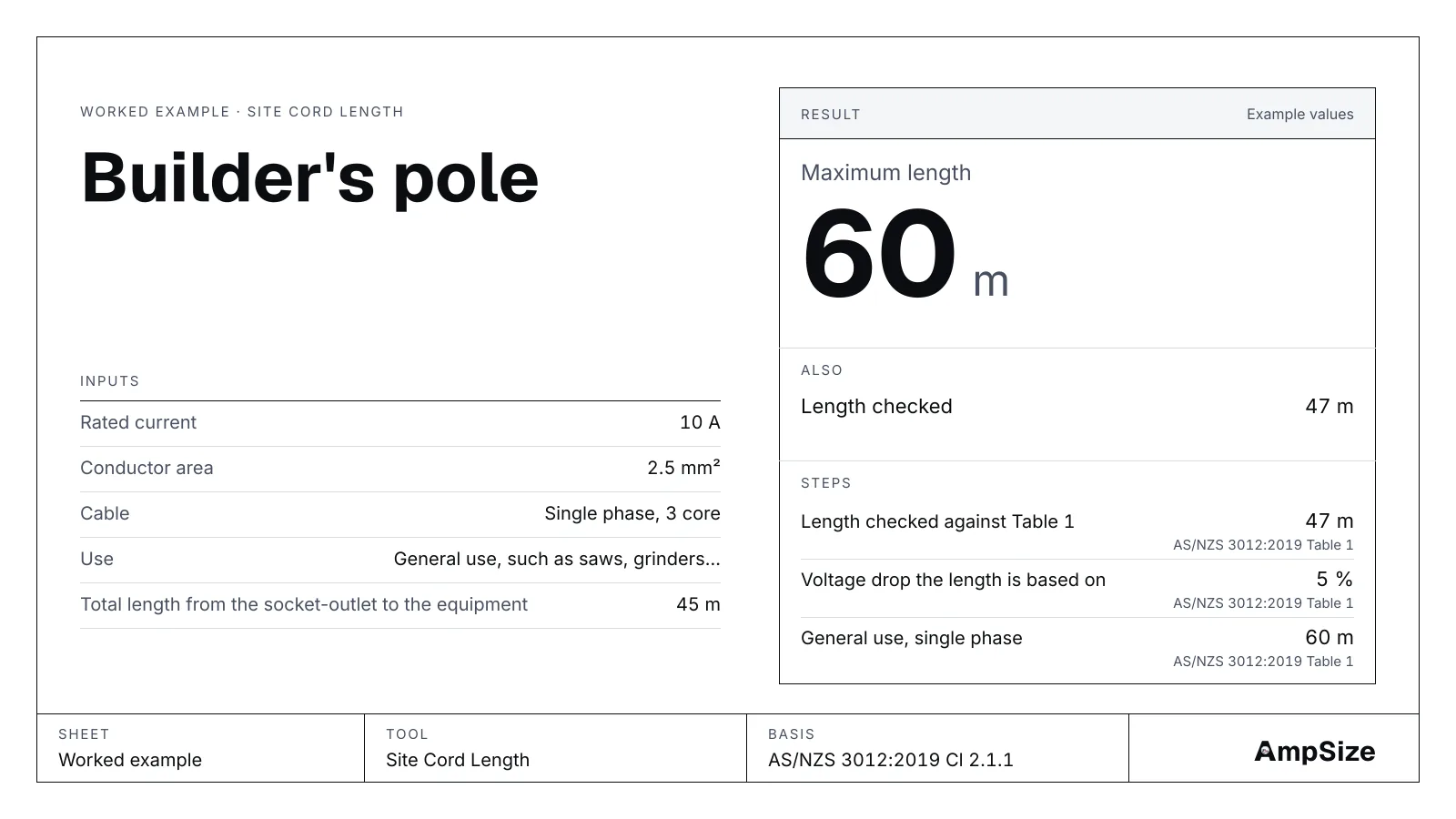
The lead here is 10 A, 2.5 mm², single phase, general use. The site cord length tool gives these figures:
- Length entered: 45 m
- PSOA supply lead: 2 m
- Length checked against Table 1: 47 m
- Maximum length: 60 m
- Inside the limit: Yes
- Voltage drop the length is based on: 5 %
- Total voltage drop at the equipment: 6.5 %
The 2 m PSOA lead is the most Cl 2.6.10(b) allows. The tool adds it to the run. The 2019 edition no longer prints the 2010 note that counted it, and AmpSize still counts it, so the run it clears is never longer than the table allows.
The total drop is the point of Note 4 to Table 1. The 5 % of the cord adds to the 1.5 % the fixed wiring already used. The table length assumes the installation stays inside its own 5 % to the socket‑outlet.
The 15 A socket‑outlet is a different story. A 2.5 mm² lead on it stops at 40 m. A 50 m lead on that socket‑outlet fails, and so do two 25 m sets joined together: Cl 2.6.8(b) holds joined sets to the same single maximum. Use a 4.0 mm² lead, which reaches 65 m at 15 A, or move the work closer to the pole.
Step 4: the test intervals
Table 6 of AS/NZS 3012:2019 sets the intervals for a construction or demolition site. The construction site supply tool reads them by the equipment and the kind of RCD:
| What | Interval |
|---|---|
| The pole, its wiring and any fixed equipment | 6 months |
| Portable tools, leads, PSOAs and generators | 3 months |
| A portable RCD, push-button | Before use, every day |
| A fixed RCD on the pole, push-button | 1 month |
| A portable RCD, trip time | 3 months |
| A fixed RCD on the pole, trip time | 12 months |
Hire gear follows Cl 3.2(c): inspect it before each hire and test it at least monthly. The test and tag tool gives the AS/NZS 3760 test limits the inspection uses. On a construction site, the Table 6 intervals replace the AS/NZS 3760 intervals.
Where the other site tools fit
A hand-held tool on a New Zealand site also sits under the Electricity (Safety) Regulations 2010. The hand-held supply tool lists the supply arrangements regs 88 to 89A name.
A temporary supply for a show, a market or a fair is not a construction site. AS/NZS 3002 covers it, and the show and carnival tool works to it.
Drawing the pole
On a plan, the builder's pole is a device on the residential preset. Select a cable run from the pole, and the Run menu offers the site cord length check on the run's own length. In the Site builder, a temporary board draws as the builder's pole on the overview.
This page is a design aid. Verify every value against the current edition of the standard.
See also: Construction site supplies, RCD types and where they are required and Homeowner shed supply voltage drop over 60 m.