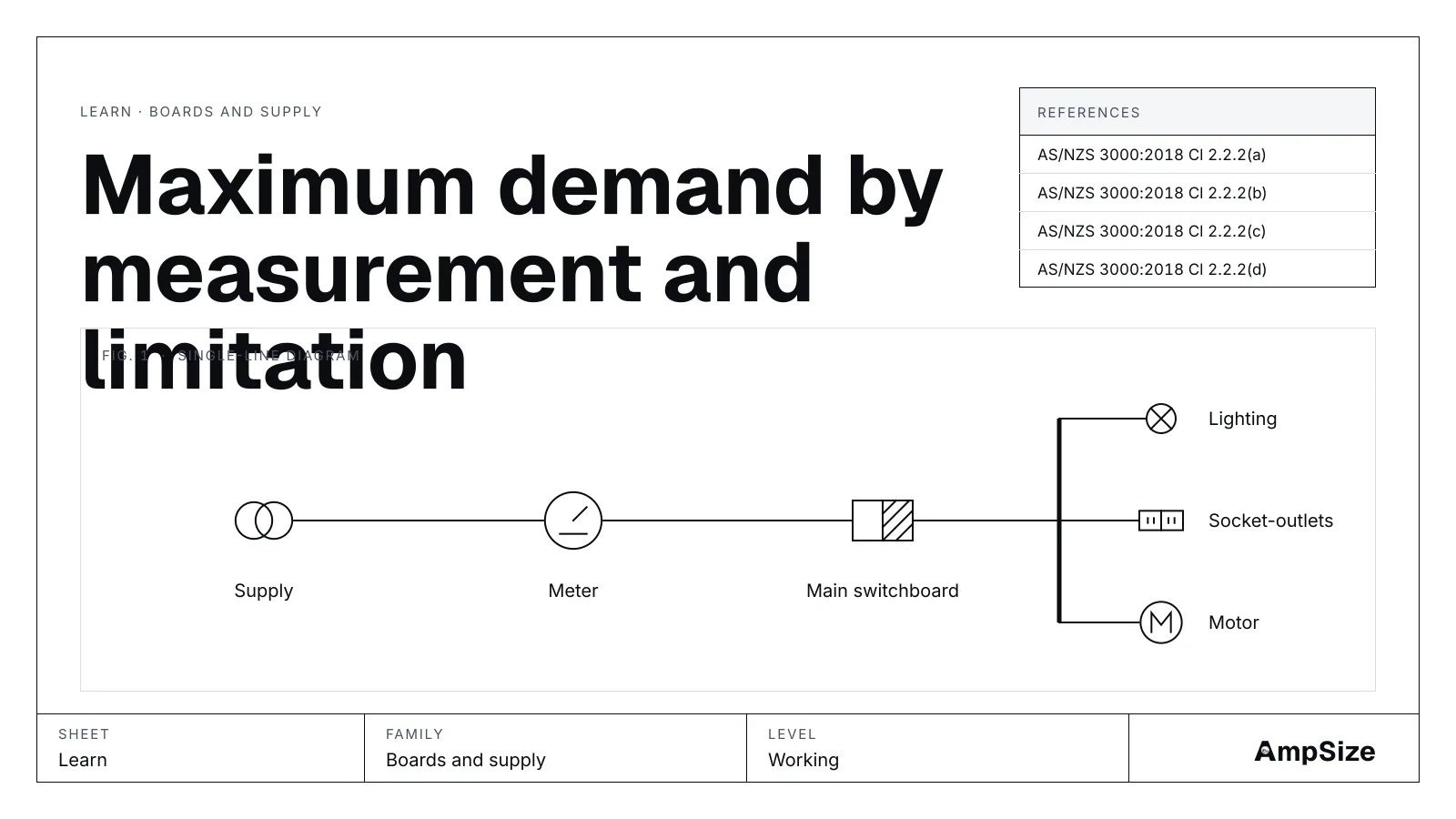
Every supply has a maximum demand. It is the highest load the supply must carry. For a new installation, you calculate it. For an existing supply, you have more choices. This page explains them and shows how the spare capacity calculator uses them.
The four methods
AS/NZS 3000:2018 Cl 2.2.2 lists four ways to find the maximum demand:
- Calculation (a). You add up the connected loads and apply diversity. The maximum demand calculator does this.
- Assessment (b). You estimate the demand from the load type and how it runs.
- Measurement (c). You record the demand on the real supply.
- Limitation (d). A device limits the demand, so its setting becomes the figure.
Calculation suits a new design. Measurement and limitation suit a supply that already runs.
Measurement
The measured figure is the highest demand over 30 minutes. Take one reading per phase.
- Fit a logger or a maximum demand indicator on the mains. Clamp each phase.
- Record when the demand peaks. For a house, that is a cold evening with the cooking on.
- Take the highest 30-minute average from the record.
Smart-meter interval data can also work. Many meters store the demand in 30-minute blocks. Ask the retailer or the network for the data. Read the highest block and convert it to amps per phase.
A short spike is not the figure. A 30-minute average is. A motor start lasts seconds and does not count on its own.
The measured-above-calculated rule
You may have both a calculated and a measured demand. When the measured figure is above the calculated one, the measured one is the maximum demand. Your calculation was too low. Use the larger figure. The tool does this when you enter both.
Limitation
Limitation uses a protective device to cap the demand.
- One breaker. A fixed or adjustable circuit-breaker limits the demand. Its setting is the maximum demand on every phase it covers.
- A sum of breakers. For consumer mains and submains, add the settings of the breakers they feed. Do it per phase. A three‑pole breaker counts on each of the three phases.
The sum takes no diversity. It assumes every breaker carries its full rating at once. So the sum is high, and it can exceed the main switch. A measurement is usually lower and is better evidence. Use the sum when you cannot record.
Spare capacity per phase
Spare capacity is the main switch rating minus the maximum demand. Work it on each phase.
On a three‑phase supply, the phases are rarely equal. Say L1 records 30 A, L2 records 45 A and L3 records 22 A, on a 63 A main switch. The spare capacity is 33 A on L1, 18 A on L2 and 41 A on L3. The phase with the least spare capacity limits a three‑phase load. For more on per-phase demand, see Maximum demand per phase on a three‑phase supply.
Placing a new load
A three‑phase load splits equally. A 3 kW load at unity power factor and 230 V draws 4.35 A on each phase. On the example board, that leaves 28.65 A on L1, 13.65 A on L2 and 36.65 A on L3.
A single‑phase load sits on one phase. Put it on the phase with the most spare capacity. Take a 16 A load. On L3, 25 A is left. On L2, only 2 A is left.
A kW load becomes amps with kW ÷ (phase voltage × power factor). A load with a low power factor draws more current for the same kW.
The main switch is not the whole limit
The tool measures against the main switch. The real limit can be lower:
- The supply fuse. The network fuse at the boundary can be smaller than the main switch.
- The network agreement. The connection can set a limit in amps or kVA.
- The service cable. An old service cable can limit the supply, even with a large main switch.
Check each one before you promise a client a new load. If the load does not fit, three options remain: load management, a move to another phase, or a larger supply.
Related
The EV charger calculator applies this check to one load. See EV charging load and spare capacity for that case. For a worked heat pump example, see Will a heat pump fit a 63 A supply?.