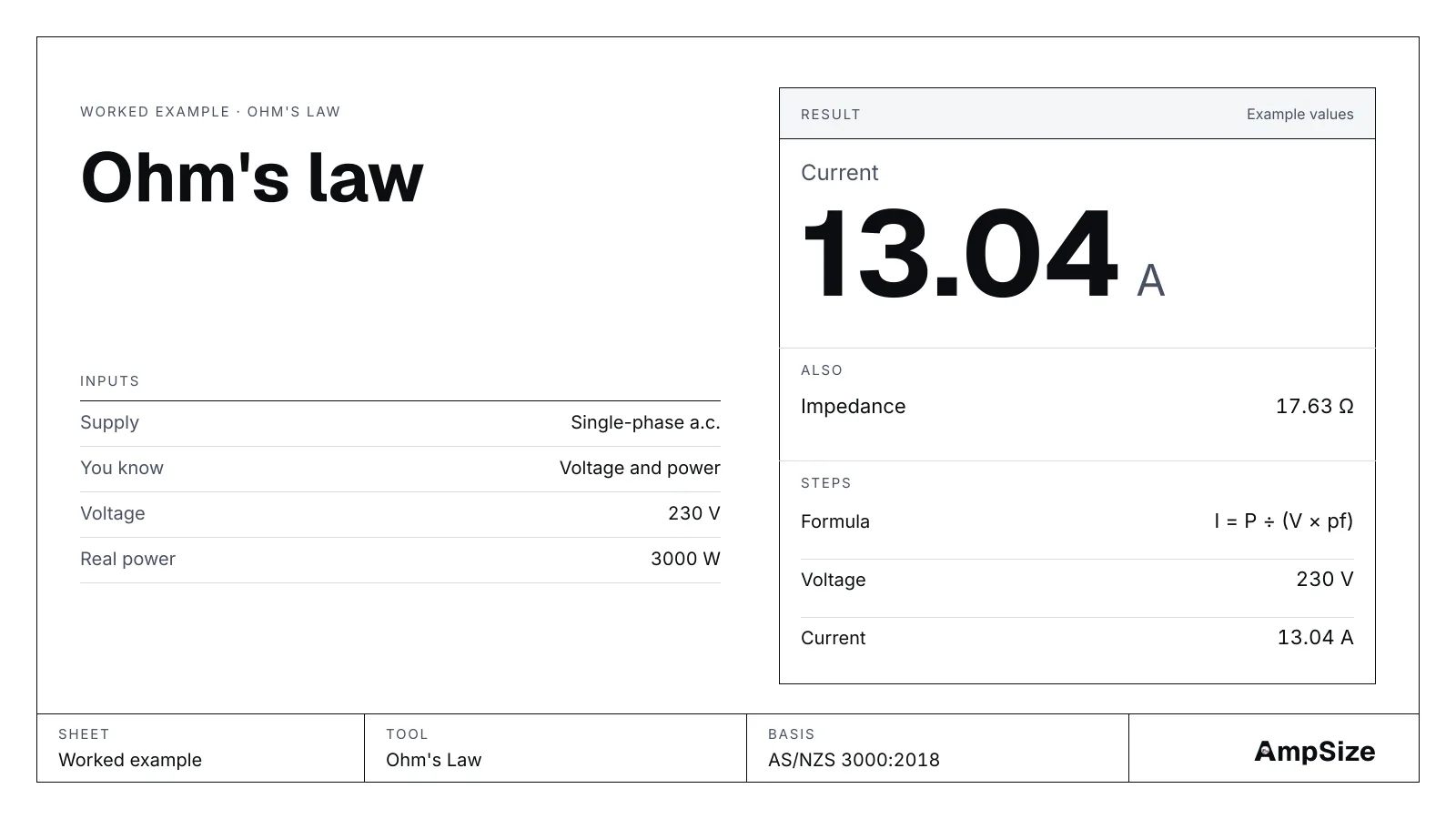
A hot water cylinder element is a plain resistance. Its rating plate gives two figures, the power and the voltage. Ohm's law and the power formula turn those two into the current it draws and the resistance it works at. This guide works one element, then a three‑phase heater bank, with the Ohm's law calculator. The formulas are explained in Ohm's law and power on d.c. and a.c..
The element
- A hot water cylinder element rated 3 kW at 230 V.
- Single‑phase a.c.
- Power factor 1. A heating element has no motor and no coil, so the current is in step with the voltage.
The current and the working resistance
You know the voltage and the power. The current is the power over the voltage.
| Quantity | Formula | Value |
|---|---|---|
| Current | I = P ÷ V | 13.04 A |
| Working resistance | R = V ÷ I | 17.63 Ω |
Open the 3 kW element at 230 V.
On a.c. the tool labels the second figure impedance. At a power factor of 1 the impedance and the resistance are the same thing, so the element works at 17.63 Ω.
The current is what the circuit has to carry. For the cable and the breaker on this circuit, read Hot water cylinder cable size for a 3 kW element.
Check it with a clamp meter
With the element heating, clamp the active and read the current. Say the meter shows 13 A at 230 V. Enter the voltage and the current.
The tool gives 17.69 Ω and 2,990 W. That is within a few watts of the rating plate, so the element is doing its job.
Why the cold reading is lower
Turn the power off, isolate the element and put a multimeter across its terminals. The reading will be a little lower than 17.63 Ω.
The wire in an element is a metal whose resistance rises as it heats. The rating plate figures are for the element at working heat. The meter reads it cold, so it sees less resistance. A cold reading a little under the working value is what a good element gives.
What to look for on the meter:
- Close to the working value, a little under. The wire is intact.
- Open circuit. The element wire is broken. Replace it.
- Close to zero. Two turns or the two ends are touching. Replace it.
A good reading across the terminals does not show a leak from the wire to the sheath, the common fault in a cylinder element. Test the insulation resistance from each terminal to the sheath as well. Testing to Section 8 covers the tests.
The tool takes resistance as fixed. It does not model the change with heat, so use it for the working figures and treat the meter reading as a check.
An element rated at 240 V
Older elements are often rated at 240 V. A 3 kW, 240 V element works at 19.2 Ω. Open the element at its rated 240 V.
On a 230 V supply the resistance stays about the same, so the power falls. Enter the voltage and the resistance. Open the 19.2 Ω element on 230 V.
It draws 11.98 A and gives 2,755.21 W. The power goes with the square of the voltage, so a small drop in voltage takes a bigger share off the power. The water takes longer to heat. Nothing is wrong with the element.
A three‑phase heater bank
A workshop has a 9 kW heater bank on a 400 V three‑phase supply: three elements of 3 kW each. Set the supply to three‑phase a.c. and enter the line voltage and the total power.
| Quantity | Value |
|---|---|
| Line current | 12.99 A |
| Impedance per phase, star | 17.78 Ω |
On three phase the power is √3 times the line voltage times the line current times the power factor. The tool gives the impedance of one phase of a balanced star load. In star each element sits between a phase and the star point, so it sees the line voltage over √3. Each element is then 17.78 Ω.
The same bank in delta
In delta each element sits across two phases, at the full 400 V. Work one element on its own as a single‑phase load: 3 kW at 400 V.
Open one 3 kW element across 400 V.
Each element carries 7.5 A and works at 53.33 Ω, three times the star value. The line current is √3 times the element current, so it is the same 12.99 A as the star bank. Same power, same line current, different elements. Read the rating plate before you swap an element: a 230 V element in a delta bank gets 400 V across it.
The result
| Load | Current | Working resistance |
|---|---|---|
| 3 kW element on 230 V | 13.04 A | 17.63 Ω |
| 3 kW, 240 V element on 230 V | 11.98 A | 19.2 Ω |
| 9 kW bank on 400 V, star | 12.99 A per line | 17.78 Ω per element |
| 9 kW bank on 400 V, delta | 12.99 A per line, 7.5 A per element | 53.33 Ω per element |
For the full load current of a motor or other load from its kW rating, use the full load current calculator. For kVA, kW and kvar on a three‑phase board, use the three phase power calculator. Loads with a power factor below 1 are covered in Power factor and reactive power.