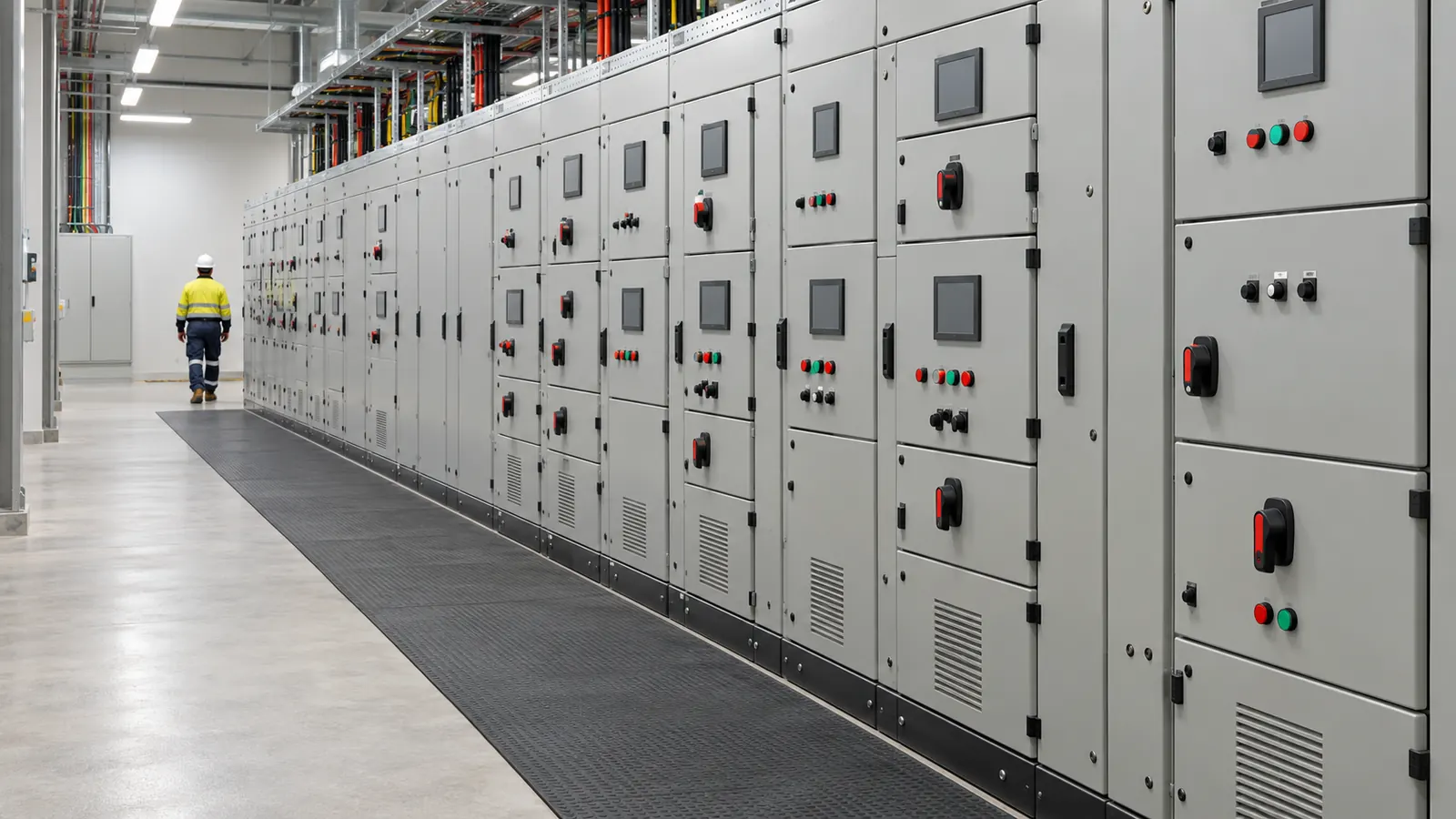
The arc flash boundary is the distance at which the incident energy falls to the onset of a second degree burn. It is the number that sets where a barrier goes and where an approach stops. This page works one 400 V motor control centre through to that distance.
The inputs
- System voltage: 0.4 kV
- Bolted fault current: 25 kA
- Clearing time: 0.1 s
- Equipment type: motor control centre
- Enclosed: yes
- Grounded: yes
- Working distance: 455 mm
An MCC sits close to the transformer in most plants, so 25 kA is common. The 0.1 s clearing time assumes a device that sees this fault and clears it in its magnetic region. Working distance is the distance from the arc to the face and chest of the worker.
The model and the clauses
The tool uses the empirical model of IEEE 1584-2002. IEEE 1584-2002 Cl 5.4 gives the arcing current from the bolted fault current, the voltage and the enclosure state. IEEE 1584-2002 Cl 5.5 gives the incident energy and the boundary. AS/NZS 3000:2018 Cl 2.5.5 covers the arcing fault duty of the installation. The tool now opens on the 2018 model. The example here keeps the 2002 model, so the figures below still match.
The steps
The equipment type is the input that changes the model, not just the answer.
- Electrode gap: 25 mm
- Arcing current: 12.2 kA
- Normalised incident energy: 3.419
- Calculation factor: 1.5
- Distance exponent: 1.641
The 25 mm gap and the 1.641 distance exponent both come from the motor control centre row of the model. Switchgear carries a wider gap and a lower exponent. A lower exponent makes energy fall off more slowly with distance. A switchboard case and an MCC case with the same fault current therefore do not scale the same way.
The result
- Arcing current: 12.2 kA
- Incident energy at 455 mm: 4.15 cal/cm²
- Arc flash boundary: 971.46 mm
- PPE category: 2
The arcing current of 12.2 kA is less than half the bolted fault current of 25 kA. That gap is the part of an arc flash study that surprises people. A device that clears 25 kA fast may sit on a slower part of its curve at 12.2 kA. Read the clearing time off the curve at the arcing current, not at the bolted value.
4.15 cal/cm² sits just above the category 2 band edge of 4. A small change in clearing time moves this case across that edge. The label should carry the energy, not only the category.
Reading the boundary
971.46 mm is close to one metre. A switchroom aisle in front of an MCC is often narrower than twice that distance. A second worker across the aisle then stands inside the boundary of the first. Plan the barrier position and the second person's station from 971.46 mm, not from the cubicle depth.
Clearing time drives the boundary hard. Energy is the product of arc power and time. Hold every other input and set the clearing time to 0.2 s: the energy becomes 8.3 cal/cm², the boundary becomes 1,482.06 mm and the PPE category becomes 3. Take the clearing time from the upstream device that actually sees this fault. At an MCC that is usually the incomer, not the starter.
This page is a design aid. Verify every value against the current edition of the standard.
See also: Arc flash incident energy at a 400 V switchboard, IDMT curve grading for a 100 A feeder and Arc flash basics.