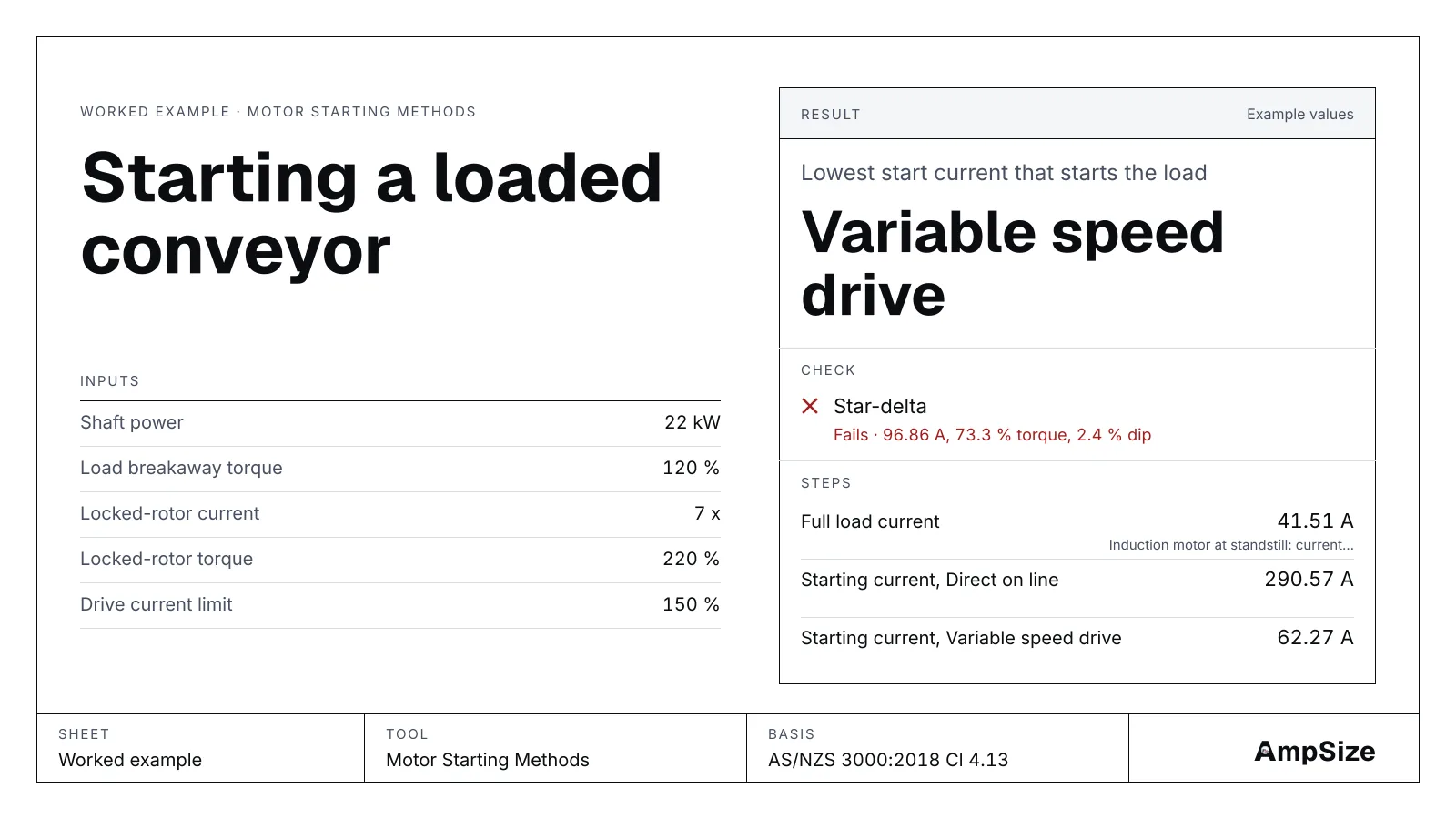
A starter is chosen to cut the starting current. But every way of cutting the current also cuts the torque, and a loaded belt needs torque to move. This guide works a 22 kW conveyor through the motor starting comparison. The physics is in Motor starting methods: current and torque.
The motor and the load
| Item | Value |
|---|---|
| Motor | 22 kW, 400 V, power factor 0.85, efficiency 0.9 |
| Full load current | 41.51 A |
| Locked-rotor current | 7 times full load current, from the motor data |
| Locked-rotor torque | 220 % of full load torque |
| Load breakaway torque | 120 % of full load torque, a loaded belt |
| Fault level at the motor | 4 kA |
Step 1. Direct on line
The motor draws its full locked-rotor current, 290.57 A, and gives its full 220 % torque. That starts the belt easily. The cost is the current: about a 7.3 % dip at the motor with 4 kA of fault level.
Step 2. Star-delta
In star each winding sees the line voltage divided by the square root of 3. The line current falls to a third, 96.86 A, but so does the torque: 73.3 %. That is below the belt's 120 %, so star-delta cannot break it away. The motor sits stalled in star until the timer changes it to delta, and then it draws a direct on line start anyway.
Step 3. Soft starter and primary resistance
A soft starter at 3.5 times full load current draws 145.29 A, but its torque falls with the square of that limit over the locked-rotor current: 55 %. Primary resistance leaving 70 % of the voltage gives 107.8 %. Neither starts the belt.
Step 4. What does start it
- A variable speed drive. At a 150 % current limit it gives about 150 % torque from standstill, at 62.27 A and about a 1.6 % dip. It is the lowest current that starts the belt.
- An autotransformer at the 80 % tap. The torque is the tap squared times 220 %: 140.8 %. The line current is 185.96 A. Open the 80 % tap.
- Direct on line, where the supply takes the dip.
With a drive limited to 110 %, the drive no longer starts the belt either, and the lowest start that does is direct on line at 290.57 A. Open the 110 % drive.
The result
| Method | Line current | Starting torque | Starts the belt |
|---|---|---|---|
| Direct on line | 290.57 A | 220 % | Yes |
| Star-delta | 96.86 A | 73.3 % | No |
| Autotransformer, 65 % tap | 122.77 A | 93 % | No |
| Soft starter, 3.5 times | 145.29 A | 55 % | No |
| Variable speed drive, 150 % | 62.27 A | 150 % | Yes |
The comparison is at standstill. A method that only just breaks the load away can still stall during the run-up. Size the circuit-breaker so its magnetic trip clears the starting current of the method you choose. The motor tool gives the full load current and speed, and the fault level tool the fault current at the motor's board.