The question
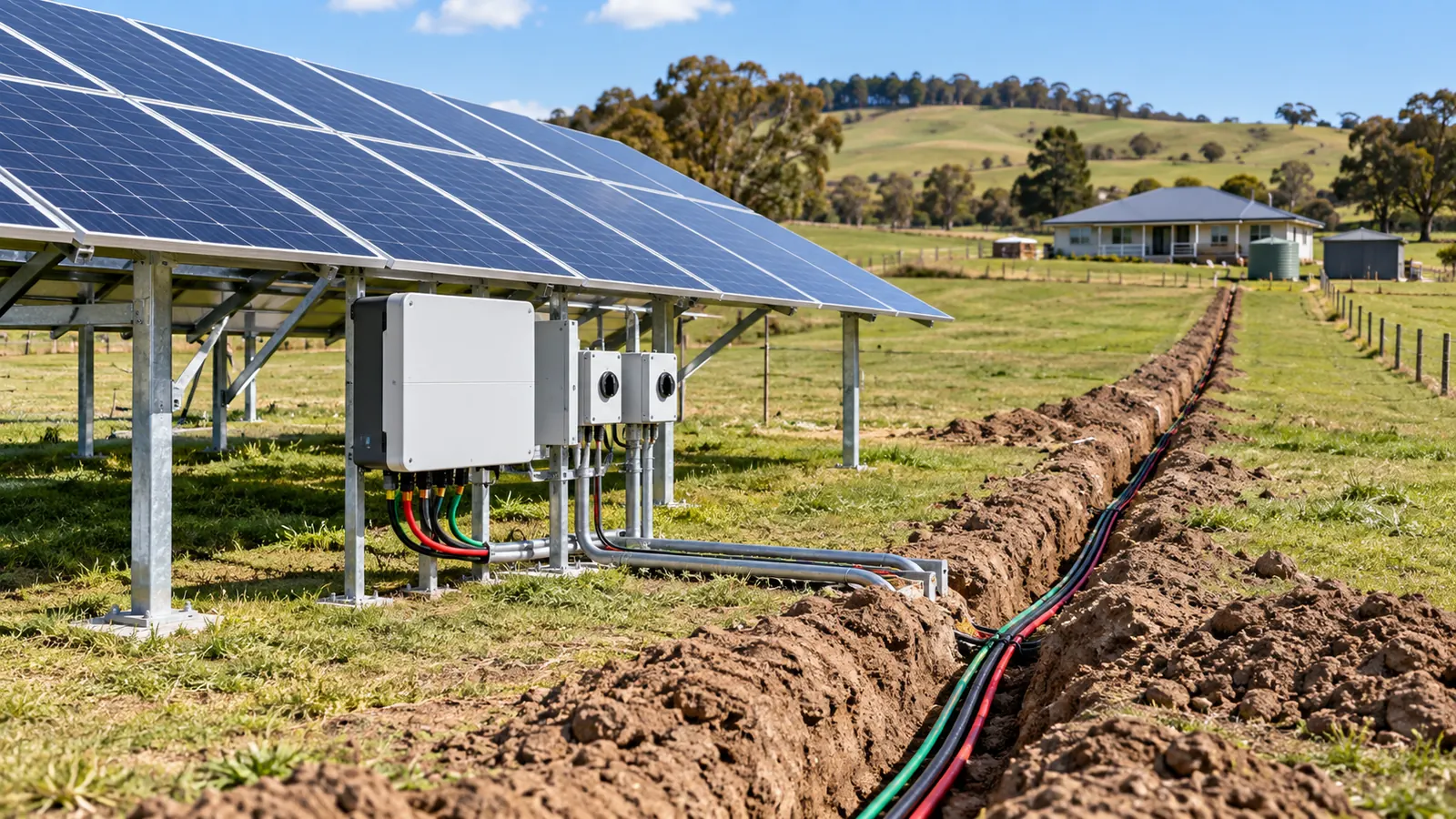
A farm puts a 5 kW single‑phase array on an implement shed. The house switchboard is 80 m away across the yard. On a short suburban run the cable size follows the inverter current. On a run this long the voltage rise decides the size instead, and it decides it by a wide margin.
The inputs
- Phases: 1
- Voltage: 230 V
- Inverter rating: 5 kW
- Power factor: 1
- Route length: 80 m
- Cable size: 25 mm²
- Limit: 2 %
The route length is the length of cable, not the distance across the yard. A trench that follows a fence line adds metres, and every metre adds rise.
The clause
AS/NZS 3000:2018 Cl 3.6.2 Note 3 refers voltage rise to AS/NZS 4777.1. AmpSize does not hold AS/NZS 4777.1, so the 2 % limit above is an input to the tool. Check the current edition of that Standard for the limit and the clause that apply. The tool states the same caution beside its result.
Conductor resistance and reactance come from AS/NZS 3008.1.2:2017 Tables 30 to 35. Cl 4.5 of the same Standard sets how the tool combines them at the power factor.
The steps
The tool takes the inverter rating to a current first.
- Inverter output current: 21.74 A
- Resistance of 25 mm² copper: 0.884 Ω/km
- Combined figure at a power factor of 1: 1.768 mV/A·m
It multiplies that figure by the current and by the route length.
- Voltage rise: 3.07 V
- Voltage rise as a percentage: 1.34 %
- Maximum length at the limit: 119.68 m
The result
25 mm² gives a rise of 1.34 % over 80 m, inside the 2 % design limit. The same cable reaches the limit at 119.68 m.
That maximum length figure is the useful one on a rural site. Yard layouts change during the job. A pole gets moved, a trench dodges a soak hole, and the run grows. 119.68 m says how much the route can grow before the cable size has to change.
Why the cable is so large
A 25 mm² cable for 21.74 A looks oversized against current capacity alone. Current capacity is not what sets it. Rise grows with length. An 80 m run needs a conductor far larger than a 10 m run at the same current.
A smaller cable on this route fails on rise while it still passes on current. It also costs the farm output. Every volt of rise pushes the inverter closer to its over-voltage trip. An inverter that trips on a sunny afternoon makes nothing.
Two rural extras
Direct burial and conduit change the current rating of the cable. The tool takes the rise from the conductor resistance and the route length. Check capacity and rise as two separate steps.
A long DC run from the array to the inverter has its own loss. This tool does not cover that loss. Keep the inverter near the array where the site allows it, and put the long run on the AC side.
This page is a design aid. Verify every value against the current edition of the standard.
See also: Voltage rise for a 10 kW three‑phase inverter, Voltage rise for a 5 kW solar inverter cable and PV and inverter basics.