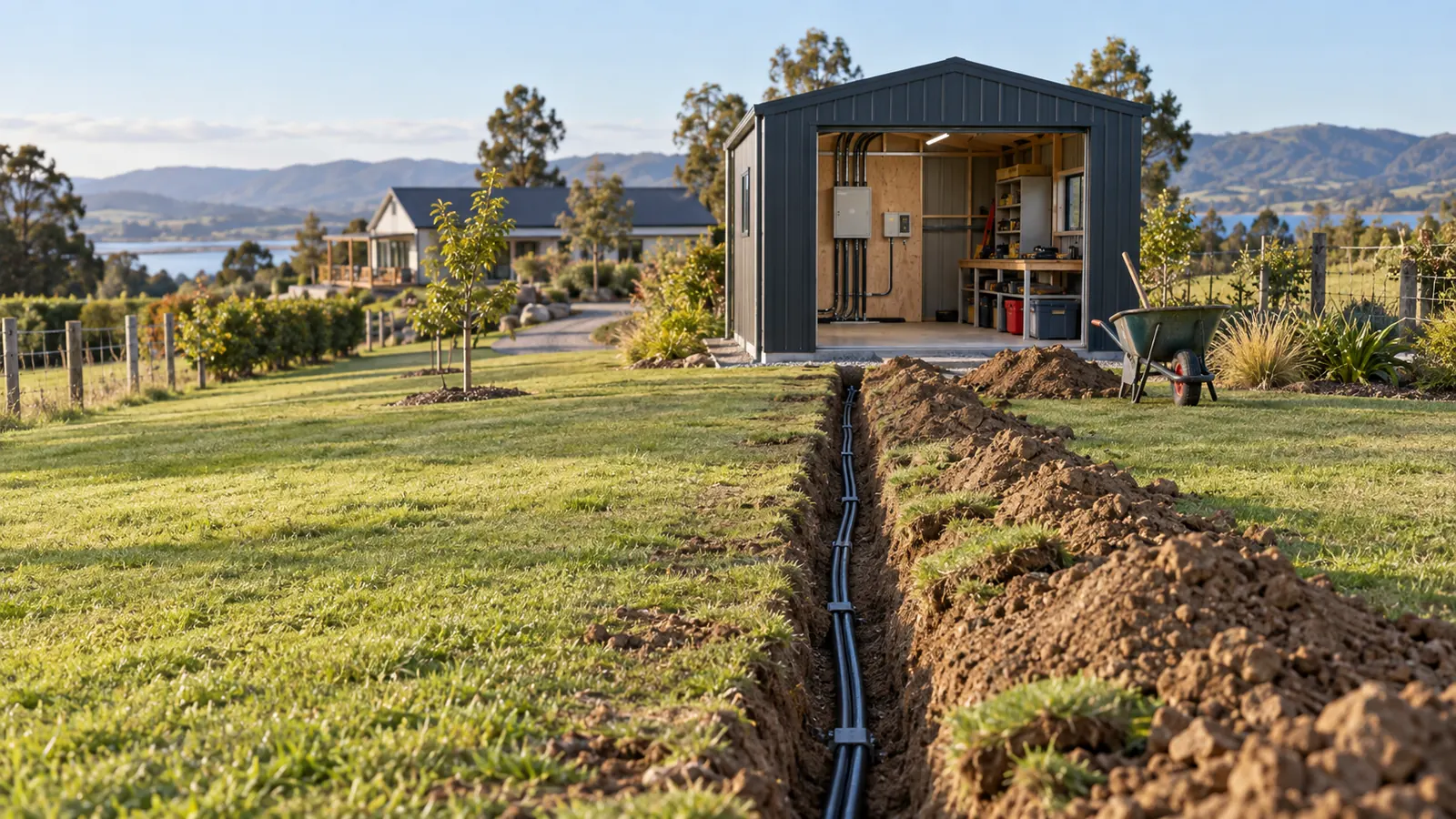
A shed at the back of a section sits a long way from the house switchboard. Distance decides the cable size on a run like this, not the load. This page works one 60 m run. It shows where each number comes from.
The inputs
The run is a 230 V single‑phase supply from the house switchboard to the shed. The design current is 20 A. The route length is 60 m. The power factor is 0.9. The cable is 6 mm² copper with PVC insulation. One cable, no parallel runs. The example sets the limit to 5 %.
Route length is the length of the cable, not the distance across the lawn. Every rise up a wall counts. So does every bend around an obstacle and every metre of slack in the trench.
The clause and the regulations
Cl 3.6.2 of AS/NZS 3000:2018 sets the voltage drop allowed across the installation. It runs from the point of supply to any point in that installation. Tables 30 to 35 of AS/NZS 3008.1.2:2017 hold the conductor resistance and reactance the calculation uses.
Two regulations sit around a run like this one. They are the Electricity (Safety) Regulations 2010 reg 57 and reg 63. This page states their numbers and nothing further. Questions about who may carry out the work go to WorkSafe New Zealand. They also cover what has to happen before a new circuit carries supply.
The steps
The engine reads the conductor data first. It combines resistance and reactance at the stated power factor. It then multiplies by the current and by the length.
- Resistance: 3.75 Ω/km
- Reactance: 0.097 Ω/km
- Drop per amp metre: 6.834 mV/A·m
- Voltage drop: 8.2 V
- Voltage drop percent: 3.57 %
- Maximum length at the limit: 84.13 m
The result
The 60 m run drops 8.2 V. That is 3.57 % of 230 V, and it passes against the 5 % limit.
The more useful figure is the maximum length. The same cable at the same current reaches 84.13 m before the drop hits 5 %. A shed at 60 m has room. A shed at 90 m does not. The cable then has to go up a size, or the current has to come down.
Two things narrow that headroom. The first is the load. The 20 A figure covers lights, a few sockets and one modest machine. A welder, a kiln or a car charger changes it. The drop rises in step with the current.
The second is the budget split. The 5 % limit covers the whole path from the point of supply. A house main that has already used part of it leaves less for the shed run. Set the limit for this leg lower than 5 % in that case.
The route carries a second question the drop figure does not answer. A buried cable derates for soil and depth. A cable in a wall derates for insulation. Voltage drop and current carrying capacity are separate checks, and a long run usually fails on drop first.
Change the length and read the percentage again. Change the cable size and read the maximum length again. The two figures move in opposite directions. The answer sits where both stay inside the limit.
This page is a design aid. Verify every value against the current edition of the standard.
See also: Voltage drop single phase vs three phase, Submain voltage drop estimate for a 160 A tender and Voltage drop basics.