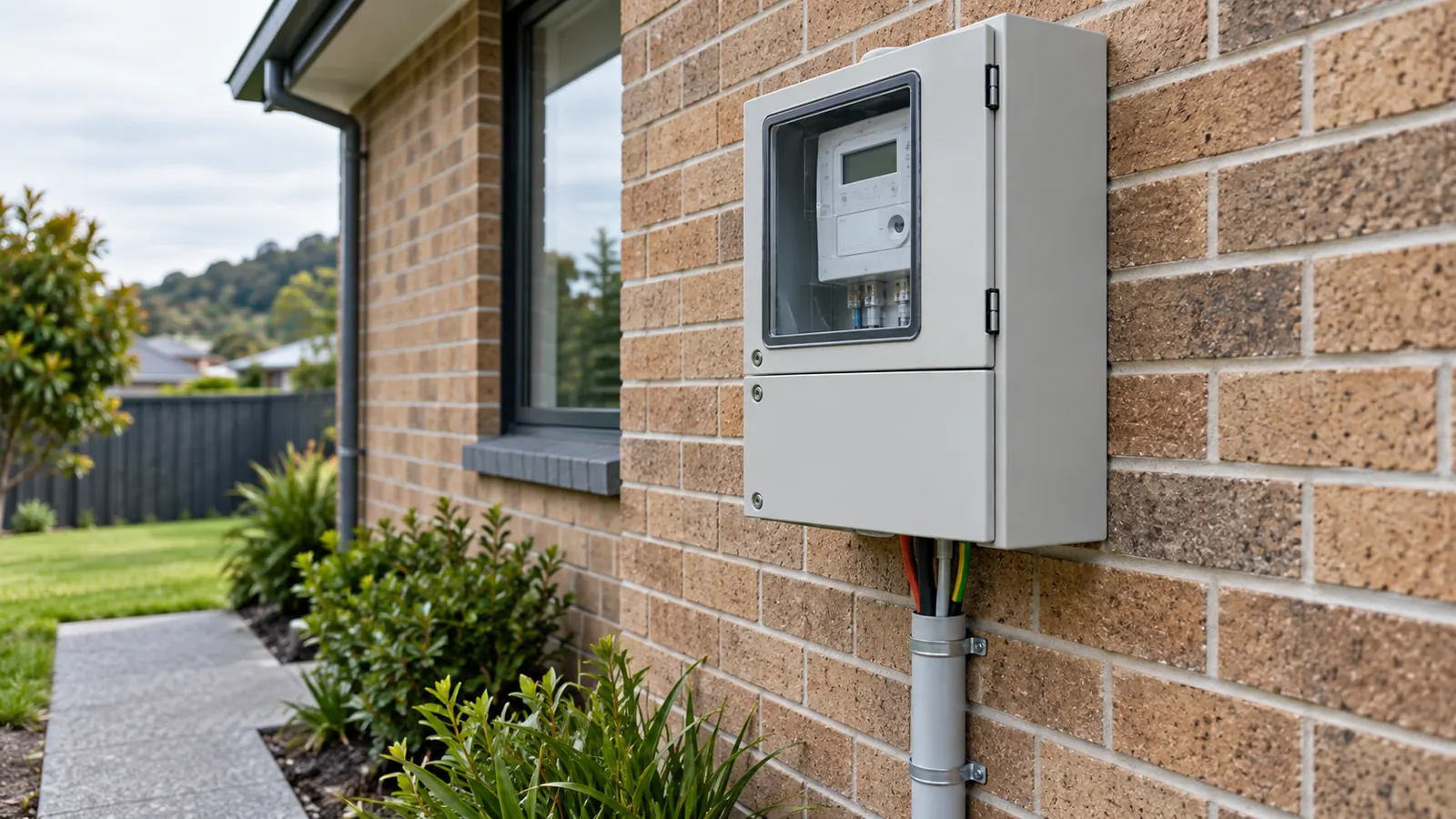
A house switchboard sits at the end of the consumer mains. The mains carry the load current all day. They also survive a fault at the main switch for as long as it lasts. Those are two separate checks, and the second one turns on the clearing time more than on the size.
The question
A domestic supply has a prospective fault current of 6 kA at the main switchboard. The consumer mains are 16 mm² copper with PVC insulation. The main fuse clears a fault in 10 ms. The check tests the cable against that fault.
The inputs
- Prospective fault current: 6 kA
- Clearing time: 0.01 s
- Conductor size: 16 mm²
- Material: copper
- Insulation: PVC
The clearing time must belong to the device that clears the fault, not to a downstream breaker. On consumer mains that device is the service fuse or the network fuse. 10 ms is a common figure for a fuse in its current limiting range.
The clause and the table
Cl 5.3 of AS/NZS 3008.1.2:2017 gives the adiabatic equation, written as I²t = k²S². The energy let through by the device, I²t, must not exceed what the conductor absorbs. Table 52 of the same standard gives the k factor for each combination of conductor material and insulation.
Cl 2.5.4.1 of AS/NZS 3000:2018 is the clause that requires the check. It sets the short circuit performance that protection and conductors must meet together.
The steps
The tool takes three steps.
First it reads the k factor for copper with PVC insulation from Table 52. The value is 111.
Second it rearranges the adiabatic equation for the minimum size. It multiplies the fault current by the square root of the clearing time, then divides by k. 6 kA for 0.01 s against a k of 111 gives a minimum conductor size of 5.41 mm².
Third it works the equation the other way for the installed size. 16 mm² of copper with a k of 111 withstands 17.76 kA for 10 ms.
The result
The check passes. The minimum size is 5.41 mm² and the installed size is 16 mm². The mains carry the fault with a wide margin. The same cable holds 17.76 kA at that clearing time. That is almost three times the fault current at this board.
Why clearing time dominates
The square root in the equation is what makes the clearing time the strongest input. Hold the fault current at 6 kA and change only the time.
- At 0.01 s the minimum size is 5.41 mm².
- At 0.1 s the minimum size is 17.09 mm², and the 16 mm² cable fails the check. The withstand current of the same cable drops to 5.62 kA.
The size, by contrast, scales directly with the current it can hold. Doubling the conductor size doubles the withstand current at the same time. Raising the clearing time by a factor of four also doubles the size required.
A current limiting device on the consumer mains changes the answer more than a size increase does. A device that cuts the fault in milliseconds lets through far less energy. A slower device lets through more.
Where the 6 kA figure comes from
The prospective fault current at a house switchboard is a network value. It depends on the distribution transformer, its impedance and the length of the service main. The network operator declares a figure for the area. 6 kA is a common declared value on a suburban low voltage supply.
A house at the transformer sees more than a house at the end of a long street. Ask for the declared figure for the address rather than carrying one number across every job. Where a larger transformer lands nearby, the figure rises and the mains check has to run again.
This page is a design aid. Verify every value against the current edition of the standard.
See also: AS/NZS 3008.1.2 Table 52: the k factor, Prospective fault current at a main switchboard and Short-circuit withstand and the k factor.