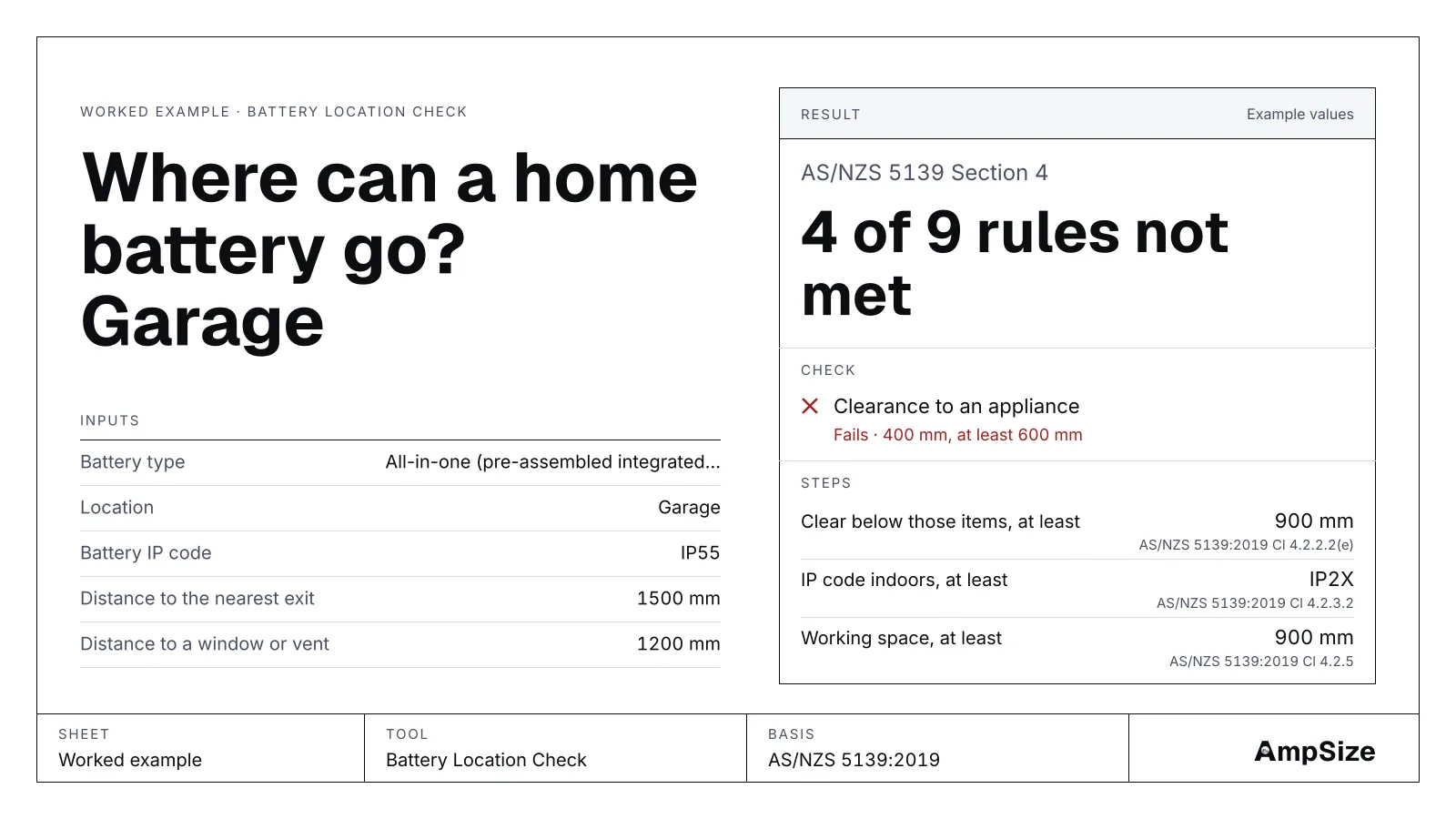
A garage wall is a common place for a home battery. It is out of the living space and near the switchboard. But a garage can back onto a bedroom, and a hot water cylinder often sits close by. This guide checks one such wall with the battery location checker. The rules are explained in Home battery location and clearances.
The site
- An all-in-one battery on a garage wall.
- The other side of the wall is a bedroom. The wall is timber framed.
- The door is 1500 mm away. The nearest window or vent is 1200 mm away.
- The hot water cylinder is 400 mm from the battery.
- The ceiling is 700 mm over the top of the battery. It is plasterboard.
- The battery is IP55. Its panels reach the 230 V a.c. connections. 700 mm is clear in front.
- A non‑combustible sheet is already on the wall: 300 mm past each side and 500 mm above.
Step 1. Check the site as it is
The tool gives 4 of 9 rules not met. The garage is not a restricted place. The exit, the window, the IP code and the clear space below all pass. Four checks fail:
- Appliance. 400 mm, at least 600 mm.
- Barrier. 300 mm each side and 500 mm above, at least 600 and 900 mm.
- Ceiling. Within 900 mm: make it non‑combustible for 600 mm past the battery.
- Working space. 700 mm, at least 900 mm.
Step 2. Fix the appliance clearance
Move the battery 300 mm away from the hot water unit. At 700 mm it keeps clear of the 600 mm rule. You can also move the cylinder. The rule covers an air conditioner too.
Step 3. Extend the barrier
The bedroom side of the wall is combustible, so the sheet must reach further. Take it to 600 mm past each side and 900 mm above, down to the bottom of the battery. Cement sheet counts as non‑combustible. So do brick, masonry, concrete and tiles. A wall that is already masonry needs no sheet.
Step 4. Treat the ceiling
The ceiling is within 900 mm of the top. Line it with non‑combustible sheet for 600 mm past the battery. Or hang the battery lower, so the gap is 900 mm or more.
Step 5. Clear the working space
Panels reach the 230 V a.c. connections, so the clear space is 900 mm. Keep 1000 mm free in front. If the maker's manual asks for more, use the maker's figure.
The result
Open the tool with the fixed site. The tool now gives 9 of 9 rules met.
| Check | Before | After |
|---|---|---|
| Location | Met | Met |
| Exit | Met | Met |
| Window or vent | Met | Met |
| Appliance | Not met | Met |
| Clear below | Met | Met |
| IP rating | Met | Met |
| Barrier | Not met | Met |
| Ceiling | Not met | Met |
| Working space | Not met | Met |
The tool also gives notes. Fit a smoke alarm in the same room as the battery (Cl 4.3.4). Follow the maker's instructions on ventilation (Cl 4.3.5).
What this does not cover
The tool checks Section 4 of AS/NZS 5139:2019 for an all-in-one battery. It does not assess other battery types. AmpSize does not hold Amendment 1 (2025), so check it for changes. To size the battery first, use the home battery tool and read Solar battery size for a family home. For the terms, see Home batteries and AS/NZS 5139.